
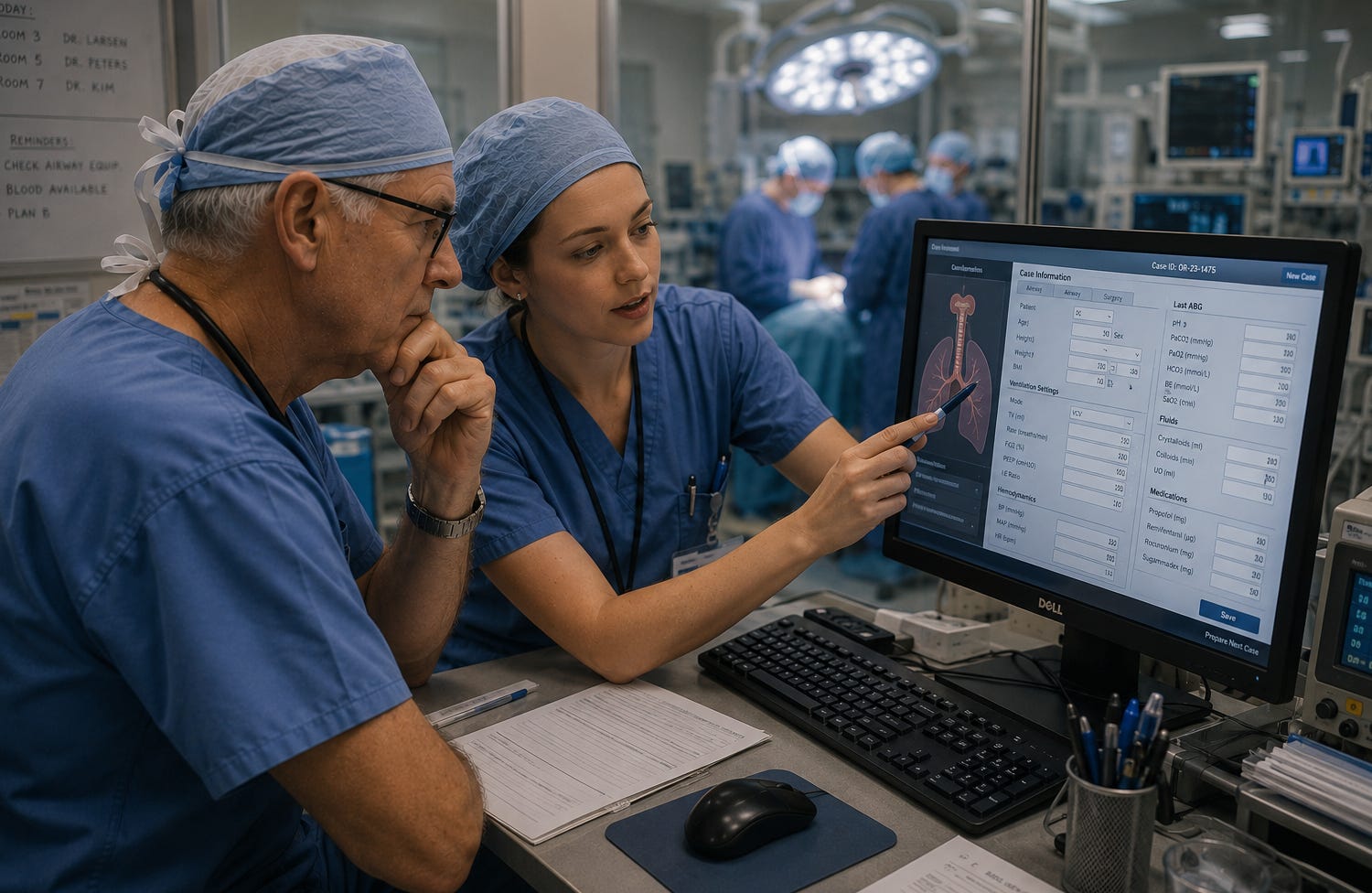
This is a work of fiction. Any resemblance to real colleagues, patients, or events is coincidental.
_
I usually walk the same route along the shore, then turn in by the cemetery and up onto the hill above the airport. I have the little Apple buds in my ears; I don’t remember what they’re called anymore.
Now I’m standing fully dressed, looking out the window, trying to gather the courage to go out. This isn’t pleasant weather for a walk. A sharp north wind whipping the sea in the ice-cold bay. I put in the earbuds, start the audiobook, and set off.
When I turn in by the cemetery, the story suddenly stops. It’s probably been a while since I charged the thing. Damn it, I was really pulled into that story. Now there is nothing to hear but the whine of the north wind.
I think about the dinner waiting at home. My wife was going to make something good; I don't remember what at the moment. I'm worried. About her. About both of us.
She’s started repeating herself. It’s not very noticeable yet, but I notice it clearly. Maybe it’s normal. She’s sixty-three; people forget things. Everyone forgets things. She tells me the same things over and over, sometimes on the same day.
The moment I come in from my walk, she reminds me we’re going to dinner at Anna and Pétur’s on Friday.
“I know,” I say.
She’s standing by the stove, looking at me with that new expression, the one that pretends not to be an expression at all.
“What?” I ask.
“Nothing.”
“Why are you looking at me like that?”
“I wasn’t. Not at all.”
The same expression again, the same look. Some mixture of accusation and grief.
“Friday at seven,” she says.
“Yes.”
“At Anna’s.”
“I know.”
She smiles, but there’s something in the smile I don’t like and don’t want to mention. So I don’t.
Thirty-eight years of marriage teaches a person that it’s usually best to just carry on and act like nothing’s wrong. Besides, I have no idea what I’d say anyway.
I’m an anesthesiologist. Have been for thirty-two years. I’ve always loved the work. It’s a small world that demands watchful eyes, full attention, concentration. Those are my strengths.
The patient, the airway, the heartbeat, the blood pressure, the drugs. These things are my life, along with the people around me. The surgeon who wants to start the operation, if we’re not still waiting for him to show up. The anesthesia nurse asking whether I want another line. The monitors that keep beeping like old friends. Usually there’s no visible strain, but underneath there’s a tension that brings a quiet satisfaction, the feeling of having everything under control.
“Don’t you ever get stressed?” people often ask.
Of course I do, but experience has taught me to stay calm under difficult circumstances. Fear is useless when oxygen saturation drops or blood pressure falls.
These days the young doctors have checklists for everything. Endless protocols and apps. Evidence-based practice is what matters above all. Sometimes I think they wouldn’t cross the street without a randomized trial confirming which direction to look first.
Maybe I’m just getting old, set in my ways, even out of date.
Today I’m working with a resident whose name I can’t remember. I know her perfectly well, though—tall, dark-haired, a northern accent, her father’s a surgeon. She has a freshness and lightness about her when she walks into the break room in the early morning.
“Good morning,” I say.
“Good morning.”
“How’s it going?”
“Fine.”
Problem solved. Her name comes back to me ten minutes later. Sandra. Or Sara. No—Sandra.
I sometimes think about how badly designed names are. No logic, no obvious meaning, nothing to hang them on. Ask me for a potassium level from a patient I anesthetized three weeks ago and I’ll probably remember it. If you asked me the name of an actor I've known for forty years, I might have to spend half an evening groping around in my brain like a man looking for his car keys in the dark. I blame it on age, since this seems to be a common experience among people I know. Dementia is different. I should know that.
A few days later I’m scrolling through my phone when my wife asks whether I’ve booked the car in for servicing.
“Me? Is it time for that?”
She looks at me. “You were just talking about it yourself.”
“Right. Maybe I did book it. I’ll check.”
“You said you were going to call them.”
“When?”
“Yesterday.”
I don’t remember any of this. “Are you sure?”
“Yes.”
“Maybe it was you who said you’d call them.”
“No.”
There’s that look again. I put the phone down.
“You’ve been doing this a lot lately.”
“Doing what?”
“Claiming you already told me things.”
Her expression changes. Slightly, but unmistakably. “I’m not claiming anything.”
“Yes, you are.”
“Fine. Forget it.”
This gets under my skin more than it should. “I’ll call them tomorrow.”
“You don’t have to.”
“I said I’d call them.”
She nodded. I pick the phone back up and keep scrolling.
After a moment, I realize I’ve read the same paragraph three times. I understand every word but can’t grasp the meaning at all.
A small wave of anxiety comes now, and for one moment I’m nearly afraid. It passes quickly.
The hospital is rolling out a new electronic medication system soon. We’ve been trialing it. It’s, without question, the worst piece of software ever built. I simply hate it. It also throws off other systems I’ve used for years and know well.
The younger doctors seem fine with it. They grew up with computers and pick things up instantly. When I was their age, everything was on paper, written by hand or dictated.
One Tuesday I can’t find a patient’s earlier anesthesia record. I click through three menus. Nothing.
Sandra comes over. “Want me to find it?”
“No, I’ve got it.”
I don’t have it. She clicks twice. The record appears.
“This is ridiculous,” I say.
“They moved it, put it somewhere else.”
“When?”
“Last month.”
“Why?”
She shrugs. Then she asks whether I gave the antibiotic.
“Of course.”
“It’s not signed off.”
“I’ll do it in a minute.”
“Okay. Fine.”
I go into the system right away and sign it.
I keep thinking about it later in the car, driving home. I can see the syringe, the IV line, the patient’s arm. I remember asking about allergies.
What I don’t remember is injecting the drug. I must have done it. I always do.
At the next traffic light I try again. Syringe. Line. Arm. Nothing more.
My hands get sweaty on the wheel. Ridiculous. What am I even worried about? Thirty-two years of anesthesia experience. Thousands of injections I don’t remember. No one remembers every single detail of every ordinary day.
On Sunday our son comes to visit with his daughter. She heads straight upstairs to get something she left behind last week.
We watch football. We’ve done that together since he was a boy. Ninety minutes where neither of us needs to talk about anything that matters.
At halftime we talk about Saturday’s matches. “Our team got lucky yesterday,” I say.
“They were terrible.”
“Won anyway.”
“Two–one.”
“That second goal was absurd.”
He laughs. “The keeper won’t want to see that one again.”
A few minutes later my wife comes in with coffee.
“We were seriously lucky yesterday,” I say. “Did you see that second goal?”
My son looks at me. “Yeah.”
“Awful goalkeeping.”
“Yeah.”
He smiles. “You already told me that, Dad.”
I laugh. “Did I?”
“Five minutes ago.”
“Well, it was still awful goalkeeping five minutes later.”
He laughs too. That should be the end of it.
But my wife still stands in the doorway with two cups. She isn’t laughing.
Our eyes meet. She looks away, then it’s as if she catches herself.
“Exciting match?”
“No, pretty dull,” I say, and feel that familiar cold settle into my stomach.
For the rest of the match I think through every sentence before I say it. I also talk less.
He notices. “You okay, Dad?”
“Yeah, all good.”
I smile.
That evening I ask my wife whether she said something to him. “To whom?”
“Our son.”
“About what?”
“You know what.”
She sits down slowly. “No.”
“Good.”
“He noticed on his own.”
There are sentences that shift the air around us in an instant. That was one of them.
“What do you mean? Noticed what?”
She doesn’t answer. “Noticed what?”
“That you repeat yourself sometimes.”
“Everyone repeats themselves.”
“I know.”
“Then why are we talking about it?”
She suddenly looks older. “I don’t know.”
“Yes, you do.”
She looks down at her hands. “I worry about you.”
I stand up. It feels better to stand now. “I understand. Stop it. There’s no reason for it.”
“It’s hard to make a conscious decision not to worry when you’re constantly reminded that something’s not the way it should be, that something is changing.”
“There’s nothing wrong with me.”
“I hope you’re right.”
That stings. Not the words. The way she says them.
I go upstairs and stare out the window at the sea and the houses on the other side of the bay.
We doctors often fear certain diseases more than other people do, because we know too much. Cancer kills. Heart attacks kill. A stroke can take half your body in a single afternoon.
But there’s another one. I stop there. Ridiculous. I’ve repeated a comment about football. That’s all it is. Isn’t this making a mountain out of a molehill?
I decide to start writing things down. Not necessarily because I’m worried. It’s simply sensible.
A small black notebook. Inside jacket pocket.
Car in for service – Tuesday 10:00.
Dentist – the 14th, 15:30.
Dinner at Anna and Pétur’s – Friday 19:00.
Talk to Magnús about summer leave requests and the shift schedule.
I decide not to explain this to my wife. This is entirely my own decision. I just do it. She can ask about it if she wants. There’s nothing strange about carrying a notebook. Plenty of people do.
The notebook works well. Sometimes she mentions something and I find I’ve already written it down.
Reassuring. Less reassuring, though, that I don’t always remember writing it.
One time I find an entry:
Elín – Thursday.
I stare at it. I know who Elín is. She handles my pension matters. But which Thursday is this, what’s supposed to happen, and at what time?
I flip the page. Nothing.
For half a minute I feel genuine fear. Then it comes back to me: we’re meeting on Thursday.
Of course. The relief is so great I laugh.
I rewrite it properly.
Meeting with Elín, Thursday, 16:30.
That’s the whole point of the notebook. If I remembered everything, I wouldn’t need it.
I decide to become more organized at work, or rather more systematic.
Start earlier in the mornings. Go over everything twice. Write down doses I know by heart. Open the charts before anyone else arrives.
This gives me a sense of security.
One day, just before noon, when I go to the computer to check some blood values, Sandra says, “You already checked that this morning.”
“What?”
“The potassium.”
“I know.”
She waits. “I wanted to see the trend.”
“Oh.”
That’s nonsense. There’s obviously no trend. I’m ashamed of the lie. Not because it matters, but because of how easily it came.
My wife asks one evening whether everything’s all right at work. “Of course.”
“You’ve started leaving earlier in the mornings.”
“Traffic.”
“Is there less traffic earlier?”
She almost smiles. I don’t.
“Has someone said something?”
Strange question. “About what?”
“Nothing.”
“Why do you keep asking questions and then saying nothing?”
“I’m just asking.”
“Well, stop it.”
She looks down. I regret it immediately.
“Sorry.”
“It’s fine.”
“I’m tired.”
“I know.”
I reach for her hand. She holds mine tighter than usual.
Then I ask whether our daughter called. She looks at me.
“What?”
“Did Anna call?”
“Anna?”
I realize instantly I’ve used the wrong name. “Our daughter.”
“Karen.”
“Of course.”
She doesn’t say anything. “I was thinking of Anna.”
“Of course.”
The careful tone in her voice frightens me. She stands up and starts clearing the table even though we haven’t finished eating.
Her shoulders tremble slightly. I pretend not to notice, but I know she’s badly shaken. I know that right now she feels as if she can’t trust me anymore.
I’ve sensed this at work too. A colleague who hesitates. A nurse who double-checks something I’ve already checked. Tiny things, but I notice them all the same.
That’s why I notice that Sandra watches me. Not often. Often enough that I’m sure of it, though.
I also notice she’s started writing more things down when we work together. Maybe she’s just becoming more conscientious. I’ve trained her well.
The first time I get lost, I have a good excuse. Because I’m not really getting lost. That distinction matters.
Roadworks force me to take a different route than usual. At the junction by the old petrol station, I stop. The light is green now. The car behind me honks. It sounds more aggressive than usual.
I know where I am. I know the town is to the left and the highway to the right.
Still, I don’t remember which direction I meant to turn. For three seconds I don’t know where I’m going. Four.
Then I remember. Right. Of course. I raise a hand to the driver behind me and turn.
My heart is pounding. I drive another hundred meters and pull over. I sit with both hands cold and sweaty on the wheel. This time I don’t laugh.
What was that? I think I was just off in my own world, thinking about something else. Perfectly normal. Happens to plenty of people. Every day. I was probably just deep in my own thoughts.
I close my eyes. For the first time I let the thought take its full shape.
What if something is wrong with me? I open my eyes.
No. Can’t be. Fatigue. Distraction. Age. Stress. Any doctor could list ten harmless explanations. By the time I get home I’ve found eleven. I don’t tell my wife about this.
A week later, at work, I overhear them talking.
I’ve left my glasses in the break room. The door is half open. Sandra’s inside with Magnús.
I hear my name. I assume that means I shouldn’t be listening. I listen anyway.
“...not the first time,” Sandra says.
Magnús says something I can’t hear.
“No. I’ve noticed it too.”
Silence.
“Has anyone talked to him?”
“Not that I know of.”
Then Magnús says, “But this can’t go on like this.”
I’m standing outside the door. My mouth is dry. I could walk away.
Instead I push the door open. They both look at me.
“Don’t let me interrupt.”
Sandra looks at Magnús. Magnús looks at me.
“We were just—”
“My glasses.”
They’re on the table. I pick them up.
“Carry on.”
I walk out. Fear comes first. Part of me wants to run and hide.
Anger arrives in the elevator and I’m grateful for it because it helps. It gives me direction. I can at least point it at someone other than myself.
I’ve been working on this ward for thirty-two years. Thousands of patients put under. Nights when Magnús was still a medical student and I ran between two operating rooms.
I think I know what it means.
The shift schedule. Night work. Then retirement.
That’s what they mean. It has to be.
I drive home so angry I miss the turn into our street. I take the next one instead. No real harm done.
I don’t tell my wife right away. “They want to get rid of me,” I say to her that night as we’re getting ready for bed.
She sets her book down. “Who?”
“The department.”
I tell her about it. Not all of it. Just what I think she needs to know to understand.
“And then Magnús said this couldn’t go on.”
“He said that?”
“More or less.”
“What exactly did he say?”
I try to remember. “Does it matter?”
She looks away. Something in her face stops me.
Not surprise. She’s not surprised at all. Just curious, I think.
“What’s wrong?”
“Nothing.”
“Don’t say nothing.”
Her eyes are wet. “Maybe you should talk to Magnús.”
“Why?”
“Because maybe you need to hear what he was actually talking about.”
“Isn’t it his job to call me in if he has something to say?”
She doesn’t answer. Now I’m suddenly afraid of what she might say.
“I’ll talk to him.”
I meet Magnús alone two days later. “What were you and Sandra talking about?”
At first he acts as if he doesn’t know what I mean. Then he says, “We were talking about you.”
“If you’ve got a problem with my work, say it to my face.”
“We’ve been worried about you.”
“Why?”
“About how you’ve been lately. We think there’s been a change.”
I laugh. “What kind of change? How I’ve been?”
“There have been a few incidents. This is so unlike you. You’ve always been the one everyone trusts, the one everyone comes to for advice.”
“What incidents?”
He hesitates. “If this is about the shift schedule—”
“It’s not about that.”
“Then what?”
“I’m sorry to say it, but we—your colleagues, your friends—we’re seeing a cognitive change. You need to get it looked at, and we need to do something about it.”
“How do you want us to do that?”
He doesn’t answer. Suddenly things come back to me. Sandra. The antibiotic. You already told me that, Dad. The junction. My wife crying. The notebook. Could all of this be part of the same thing.
“You think I have dementia.”
Magnús looks down at his coffee. “I think you should talk to someone.”
“I’m sixty-five years old.”
“I know.”
“I forget names.”
“It’s more than names.”
“What else?”
He names a patient. I don’t recognize the name.
He explains. Then I remember. Of course.
The bowel surgery. The difficult airway. I remember it perfectly.
He makes it sound worse than it was. “I remember the case.”
“Okay.” And now that particular look, the one I’ve seen on so many other faces.
“I know what cognitive decline looks like,” I say. “I’ve known plenty of—
He cuts in: “I know.”
“I’ve been a doctor for forty years.”
“I know. More than that. A good doctor. One of the best this department has had.”
“If something were wrong with me, I’d know.”
Magnús doesn’t answer. I want him to. I want him to laugh and tell me this is all some mistake that can be fixed, and that we can start over again tomorrow.
He doesn’t. I leave.
My wife is waiting when I get home. “Magnús called you.”
She doesn’t deny it. “He had no right to do that.”
“He was worried.”
“So now everyone’s worried.”
She walks toward me. “Sweetheart—”
“No. I’m not doing this.”
“Doing what?”
“Standing here while everyone decides I’m not fit.”
“No one said unfit.”
“Then what are you saying?”
Her eyes fill with tears. “I’m scared.”
She’s never said that before. Not worried. Scared.
The anger leaves me. “Scared of what?”
She shakes her head. “No. Say it.”
“I’m scared something is happening to you.”
“Nothing is happening to me.”
“You always say that. You refuse to face it. Everyone who knows you sees it. Everyone wants to help, but no one wants to hurt you.”
My eyes well up. I fight the tears. She sees it, wipes her own face.
“Do you remember when we went to Anna and Pétur’s last Friday?”
“Of course.”
“Do you remember what Anna told us about Elísabet?”
I look at her. “What about her?”
“That’s what I’m asking.”
There was wine. Pétur opened a second bottle. Anna said something about their daughter.
I can see Anna leaning forward over the table, one hand around her glass. I can see her face. But the words are gone.
“What does that prove?”
“Nothing.”
“Then why are you asking?”
“Try to understand me. I’m not trying to catch you out.”
“That’s exactly what you’re doing.”
“No.”
“Then stop looking at me like that.”
“Like what?”
“Like I’m disappearing.”
She puts a hand over her mouth. I wish I hadn’t said it.
I stand up. “I won’t be interrogated in my own home.”
“I’m not interrogating you.”
“Yes, that’s exactly what you’re doing.”
I go upstairs. I stop halfway up. I’m forgetting why. I stand there with my hand on the railing.
Then I remember. My notebook. It’s downstairs.
Relief comes first. Then fear.
I go back down. “What are you looking for?” she asks.
“My notebook.”
She points at the table. I pick it up.
“I thought it was in my jacket pocket.”
“You took it out when you got home.”
“I know.”
I open it. There’s an entry.
Thursday, 11:30 – Aron Kristjánsson.
I stare at it. “Who is Aron Kristjánsson?”
She doesn’t answer.
“Who is he?”
“You booked the appointment yourself yesterday.”
“What appointment?”
She wipes her face. “At the memory clinic.”
I look at the handwriting closely. No, there’s no doubt. This is my writing.
Thursday, 11:30.
I try to remember, but nothing comes. I don’t remember writing this. It’s absurd; I’ve trusted my mind my whole life. You don’t test the floor before you put your foot down. Now I have to do it all the time.
My wife moves closer to me. I close the notebook.
“Well,” I say, “this is easily solved.”
I’m relieved to hear my voice sound normal.
“What do you mean?”
“I’ll cancel the appointment.”
She looks at me. That warm look I know so well.
I put the notebook in my pocket. She reaches for my hand.
This time I don’t pull away.
I think about all the times I’ve done that. Pretended not to see her looking, not to hear what was underneath her questions.
Not tonight.
I hold on tight. She’s still crying. I let her.
Thanks for reading! This post is public so feel free to share it.
No posts
Comments
Nothing yet. Say the first thing.
Sign in to join the conversation.