
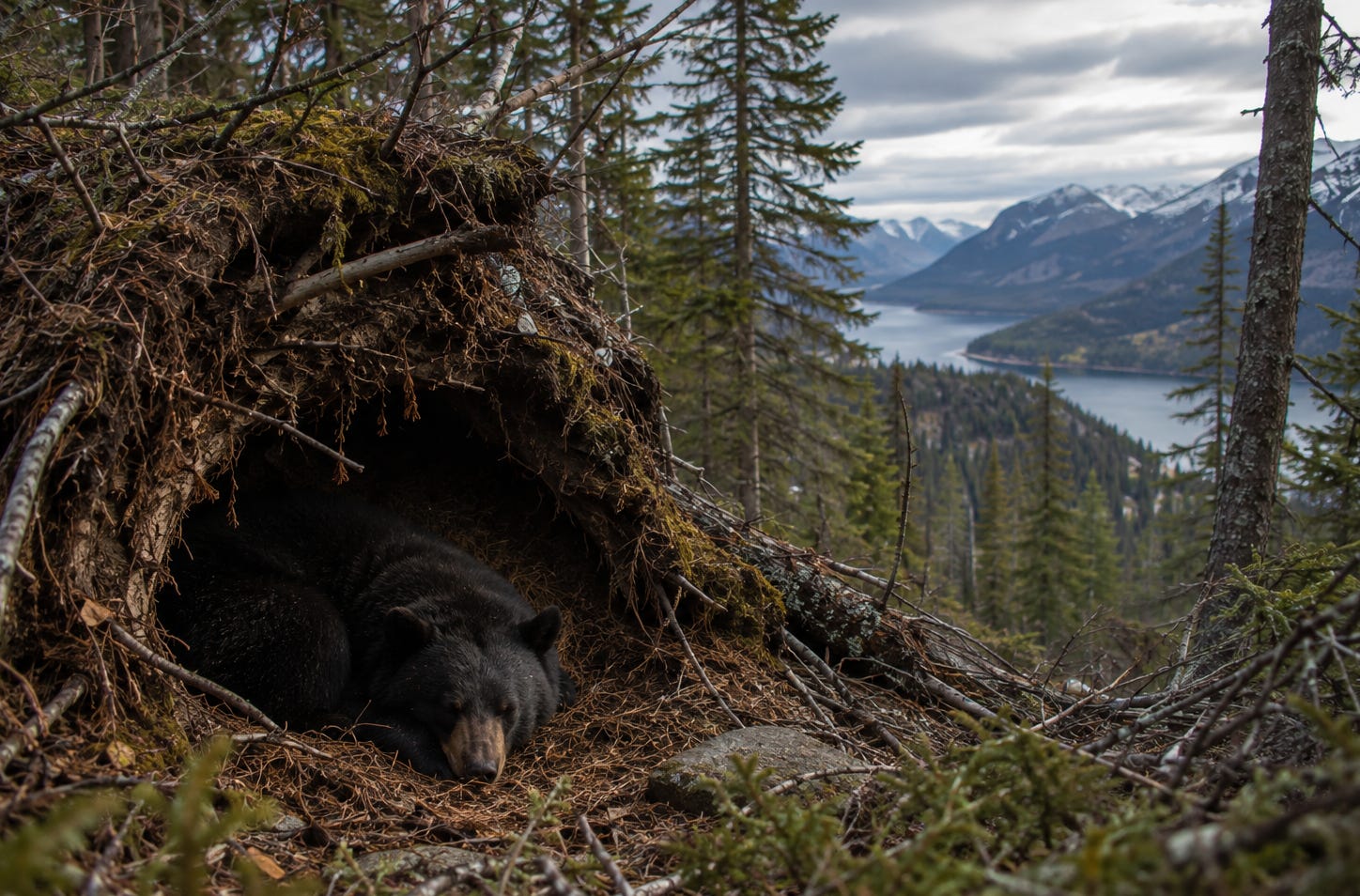
Autumn is the time of year you might catch sight of a black bear walking in slow, unhurried steps toward its den. Calm lies ahead in its life, and it won’t eat again until next spring. Its body has received an internal signal that now is the time to slow down and focus above all on staying alive. It will consume neither food nor water for the next five months. It’s genuinely remarkable that it survives this. Humans, like most mammals, would starve to death long before they were halfway through a fast this long. Another thing we would find very difficult is the long stretch of inactivity that comes with hibernation. A person confined to bed for five months would be good for little, and could expect a long rehabilitation process to regain their former strength.
The bear, somehow, treats all of this as routine. It walks out in spring looking like itself. Its heart slowed drastically during hibernation but never stopped. Its brain stayed sharp enough to wake and fend off an intruder mid-winter. Its muscles are mostly intact too, despite five months without a single deliberate movement. They’ve shrunk some, but nowhere close to what a person would lose over the same stretch.
The bear's priorities here are unmistakable. It burns fat steadily, losing somewhere between fifteen and thirty percent of its body weight over the winter. That's the cost of protecting everything else.
The bear seemed like the perfect example to put what I’ve been writing about in recent chapters into better context, before we dive deeper into the processes behind it. Reserve, it turns out, isn't a pot that gets rationed out equally to everyone. Some systems simply matter more than others, and the body spends accordingly. The body’s goal, first and foremost, is to keep itself alive, whatever that actually costs.
If we move further down our own ranking, we come to the reproductive system, which the body is relatively quick to shut down almost entirely. Female athletes and dancers who train hard without eating enough can lose their periods for months, sometimes years. It's one sign of a broader condition now called RED-S: relative energy deficiency in sport. It’s a series of signals through the brain’s hypothalamus telling the reproductive system, in effect, that this is a bad year for pregnancy, and that its resources are unfortunately needed elsewhere. There’s no weakness or malfunction here. On the contrary, this is the bear’s logic: we spend first from whatever system we can afford to lose, at least for the winter.
It should be clear to us by now that there are control systems deciding, again and again, what continues to get funded and what doesn’t. It’s time we tried to understand these systems. While the ranking itself isn’t complicated, the same can’t be said for the control systems and processes behind it.
Compared to the black bear, our own human ranking is neither as fast nor as dramatic. If we stop eating, the body turns to its glycogen stores and burns through them in a day or two. It also turns to muscle, using the amino acids to keep blood sugar up. This matters enormously for the brain, which is quite dependent on glucose as fuel. This can't continue indefinitely, though, since our muscle mass would burn away quickly, and then real trouble sets in.
Within two to three weeks, the brain, which normally runs almost entirely on glucose, is getting much of its energy from ketone bodies made from fat instead.
The brain has to make this change, for its own sake and for the sake of other organs, because it can’t use free fatty acids directly the way muscle and most other tissue can. If muscle protein had to keep supplying the brain with glucose, there would soon be little muscle mass left. Once the brain has shifted to living more or less on ketone bodies, though it still always needs some baseline glucose, muscle breakdown slows considerably.
Up to now, we’ve been looking at these processes at the organ level: heart, brain, muscle, reproduction. Now it’s time to go one layer deeper, because it’s important to understand the physiology behind this. That physiology will also play an important role later, when we get to aging.
Like so much else in nature, these processes are fairly complex. There’s no one sitting at a control panel making these decisions. There’s no single foreman. The ranking rests on at least three systems, each running on its own clock.
Endocrine glands and hormones play an important role. These control systems work relatively slowly compared to most others. Insulin and IGF-1 generally signal that things are good and supplies are sufficient. Cortisol, on the other hand, sends the message that conditions are bad and that it’s time to focus on whatever’s necessary to survive. If needed, muscle can be broken down, and priority goes to making sure the brain gets enough glucose, regardless of the damage that causes elsewhere.
Inside individual cells, two sensors watch the same conditions and pull in opposite directions, too. mTOR picks up on abundance, even excess, and pushes cells to build. AMPK picks up on scarcity and pulls the other way, toward conserving, breaking down, and recycling whatever's already there.
A faster, far more precise system takes over during illness. Infection and inflammation prompt the production of cytokines, among them interleukin-6 and TNF-alpha, which suppress muscle building and redirect resources toward fever and immune defense instead. This is part of why we lose muscle when we’re sick, even if we’re eating reasonably well. It may also explain how we tend to feel when sick: the fatigue, the loss of appetite, the urge to just lie there and do nothing. None of this is a sign that we’re giving up. It’s our nervous system doing the math and cutting the budget.
The fastest system works very quickly, taking only a few seconds to switch on and off. Under sudden physical threat, the sympathetic nervous system is activated, and blood flow and fuel get redistributed toward muscle and brain; digestion waits. This is a short-term solution designed for emergencies, and it doesn’t last long.
Many systems, at different levels, working at different speeds. When resources become scarce, the body doesn’t try to keep everything running at full strength. It chooses. Then it keeps choosing, again and again, as conditions change.
Spring has arrived. The black bear stumbles out, thin and stiff, after five months in which it essentially did nothing but stay alive. Heart, brain, and muscle all come through more or less as they went in. What's actually gone is the fat, spent exactly as intended, and it will take the whole next year to build back, the same slow way it was built the autumn before.
This capacity of the bear’s evolved over a very long time, under conditions where food was scarce over the winter. Abundance was rare, and the bear learned to make use of it while supplies lasted. Our own capacity as humans has also evolved over a long time, and it too rests largely on tolerating temporary scarcity, though ours is considerably more random than the black bear’s. Most people reading this now live in a different kind of world, one where food, safety, and rest are available more or less constantly. What a priority system built for scarcity does when scarcity is almost never present is the question we try to answer in the next chapter.
If you found this piece useful or enjoyable, you can support my work here.
Cahill GF Jr. Fuel metabolism in starvation. Annu Rev Nutr. 2006;26:1-22.
Miyazaki M, Shimozuru M, Tsubota T. Regulation of protein and oxidative energy metabolism are down-regulated in the skeletal muscles of Asiatic black bears during hibernation. Sci Rep. 2022;12:19723.
Mountjoy M, Ackerman KE, Bailey DM, et al. 2023 International Olympic Committee’s (IOC) consensus statement on Relative Energy Deficiency in Sport (REDs). Br J Sports Med. 2023;57(17):1073-97.
Dantzer R, Kelley KW. Twenty years of research on cytokine-induced sickness behavior. Brain Behav Immun. 2007;21(2):153-60.
Hardie DG. AMPK—sensing energy while talking to other signaling pathways. Cell Metab. 2014;20(6):939-52.
Herzig S, Shaw RJ. AMPK at the interface of nutrient sensing, metabolic flux and energy homeostasis. Nat Metab. 2026.
The Spark • Engines of Life • The Currency of Energy
Insulin — The Governor of Abundance • The Architecture of Storage • The Lipid Pathways • The Lipoprotein Network • The Glucose Pathway • The Timing Problem
Liver, Muscle, Adipose: Where the System Yields • Insulin Resistance — Compensation Before Hyperglycemia • The Ketone Detour • When the Detour Becomes Intentional • When the System Finally Rests • When the Engines Struggle • The Inflammatory Whisper • The Loss of Flexibility • Restoring Flexibility
Who Controls the Switch • Insulin and the State of the Body • The Glucagon Signal • Before the Signal • The Hunger Signal
The Vigilance Signal • When the Clock Drifts • The Reward Loop • The Movement Signal
The Fuel Choice • The Protein Question • The Metabolic Economy • Investment • Maintenance • Reserve • Accumulating Capacity
No posts
Comments
Nothing yet. Say the first thing.
Sign in to join the conversation.