
I am considering sending flowers to the Auditor General for publishing TWO reports on personnel less than two weeks after my birthday – truly a gift.
Now that I have expunged my main character energy (an exorcism has never hurt anyone), let’s turn our attention from recruitment to military housing.
The Auditor General’s conclusions are far from being fantastic, and they bring up some big questions about management and administration within the Department.
If you want to understand how military housing functions and what the last OAG report concluded in 2015, I suggest you go and read my last stackie on the matter in which I tried to make sense of how it works (emphasis on “tried”).
So here we are, 18 months after my piece and a decade since the last audit into military housing. What has the OAG found?
This is seems to be the common thread of these two defence audits, which brings a lot of questions about the ability of the Department of National Defence and the military to function as organizations.
This assessment is not simply quantitative, it is also quantitative.
“National Defence has not defined its operational need for quarters.”
A central theme of last audit was the lack of definition of the operational need for housing. The Department did indeed implemented the OAG’s recommendation, but did not define the operational need for quarters.
For a little digression, there is an important distinction between residential housing (mostly unfurnished, multi-bedroom units) and quarters (furnished units, mostly bed spaces, for single members). Quarters include the following:
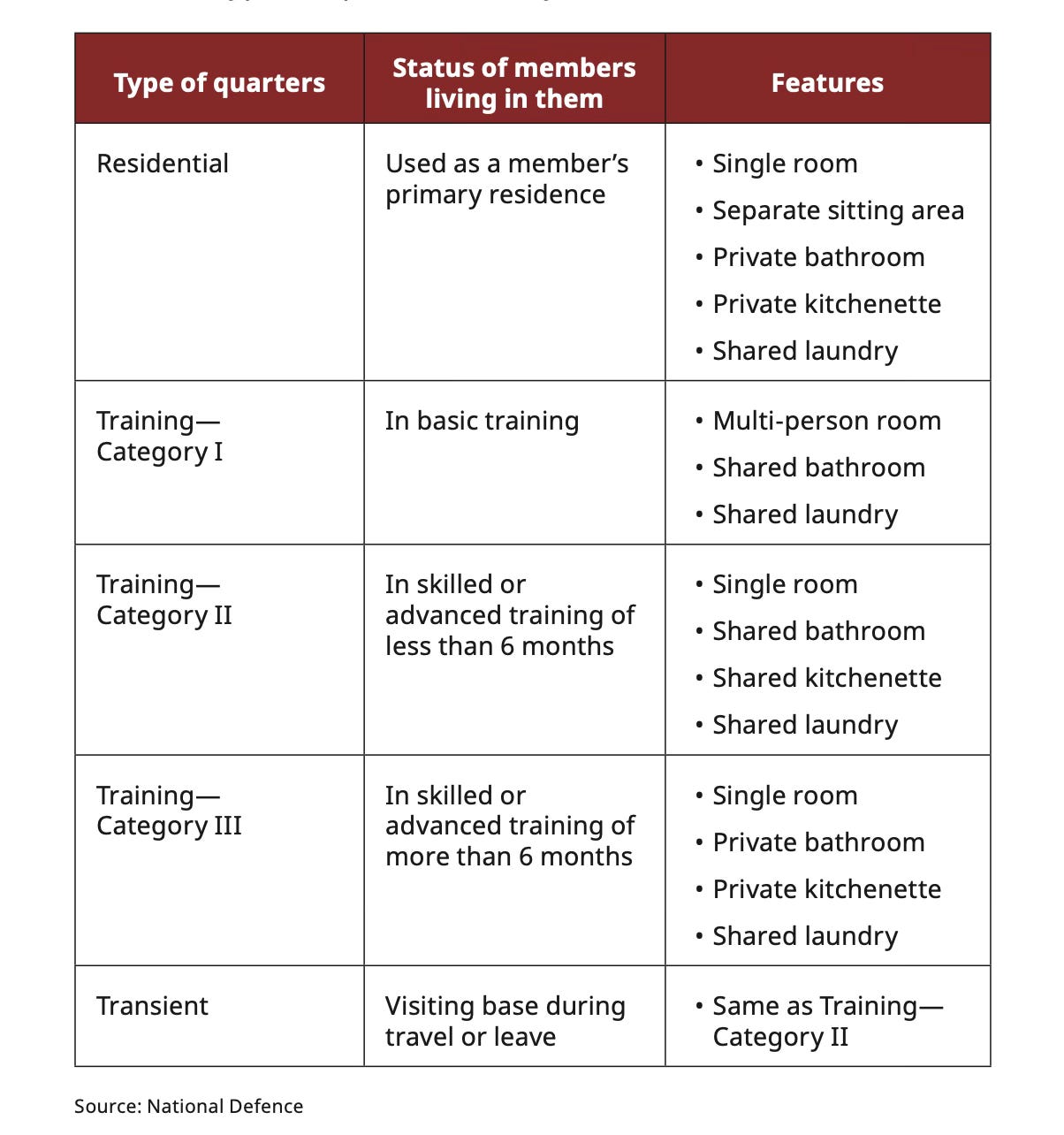
Quarters are jointly managed by DND’s real property operations groups and bases and wings.
Another challenge is the lack of data on the use of quarters, which is compounded by the disparate use of different systems in silos that prevented the centralized collection of accurate data.
While DND did establish minimum standards for the living spaces based on how long and for what purpose a member was using them, it did not always offer a bed space that met these standards. Some of the issues identified were:
“insufficient living space per person, which could result in overcrowding
communal showers where standards required individual shower stalls
a lack of modern amenities, such as Wi-Fi access.”
Further, DND placed some people on longer-term, residential stay in training quarters/ short-term stays due to shortages in residential quarters.
“Many National Defence quarters were in need of significant repair.”
Another management issue the OAG found was that DND does not track spending for housing and living accommodations separated from other types of infrastructure. Additionally, the report found that DND fell short of its spending targets in maintenance and preventative maintenance.
The audit also noted that about 19% of quarters building eligible for an inspection were not inspected. Given that inspection reports guide maintenance and repair assessment, it is a major blind spot for the organization.
To help with their audit, the OAG examined quarters in Gagetown, Esquimalt, and Trenton, and observed that: “32 of the 35 quarters buildings with a current inspection needed at least 1 high-priority repair. Across all of the 32 buildings, a total of 227 high-priority repairs were identified.” of 40 high-priority repaired they selected for a closer examination, they found that only 5% had been completed.
It is important to note that this past fiscal year (2024/25), the CAF did conduct an initial collection of data to capture its quarters portfolio. It found that “25% of quarters needed major repairs or did not meet the operational needs of National Defence or the needs of the Canadian Armed Forces members staying in them,” and considers them “candidates for disposal.”
“The Canadian Forces Housing Agency did not have enough residential housing units for single members.”
As mentioned earlier, following a recommendation from the 2015 OAG report on military housing, the CAF did define the operational requirement for residential housing in 2017. However, it did not put in place policies for its implementation until 1 December 2024.
The definition changed how got priority access to residential housing, giving highest priorities to new recruits, training needs, and frequent relocations and isolated postings.
The issue of a lack of units remained: on March 31, 2025, over 3,700 members had an outstanding application for housing for 205 available units.
Additionally, the portfolio does not align with the need of service members: while 66% of applicants for housing were single members, only 22% of the portfolio could accommodate them.
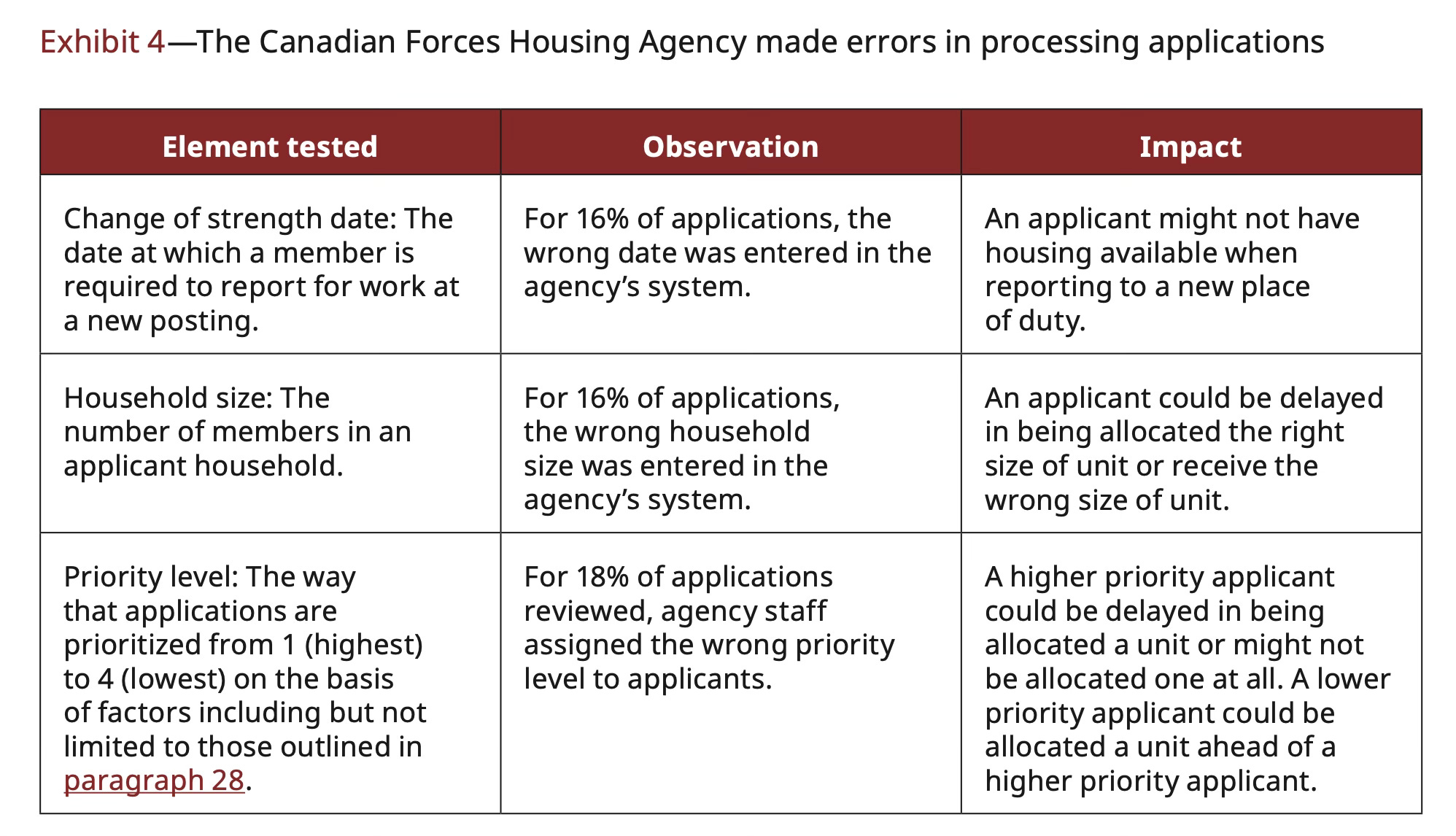
“The Canadian Forces Housing Agency made errors in prioritizing member applications for housing.”
In a close examination of a representative sample of housing applications received between December 1, 2024 and March 31, 2025, the OAG found many errors in the processing of applications, including misalignment with the priorities set out on December 1, 2024 (for which the CFHA provided additional training):
“The agency did not complete required monitoring of the condition of residential housing units, which is needed to plan renovations, plan new construction, and report on results.”
Echoing the findings on the quarters, there is an issue of monitoring the state of units. The OAG found that 26% of units did not have an up-to-date assessment of their condition. This issue encounters regional variability, with 52% of units in the Maritimes that remain to be assessed.
This issue is not only a problem in terms of “domain awareness,” but also in terms of truthfulness in reporting. While in 2023/24 the CFHA reported having met its target of no more than 1,635 units being in below that average conditions, there remained 3,025 units that had not had an up-to-date assessment.
Finally, 18 of the CFHA’s 24 strategic site plans were older than 5 years old, despite the requirement to be updated every half decade. This lack of accurate information led to misguided decision-making on retrofitting and building of units.
“National Defence’s plan to increase the housing supply does not fully meet the needs of the Canadian Armed Forces for housing.”
Back to the common theme of this report: a discrepancy between the needs of the organization and how DND manages files. CFHA plans for its residential housing based on the following requirements: (1) trained effective strength at each base, (2) the existing portfolio, (3) the availability of housing on the local market. The issue is that the CFHA defined those requirements in 2019, when it had 57 more units than it has now, and the analysis of the housing market conducted then relied in part on data from the 2011 National Household Survey. Moreover, the introduction of the housing differential in 2023 and military pay in 2025 will impact service members’ ability to access housing on the local market. CFHA is working on updating its needs assessment to inform new requirements, but it relies on the size of the total Regular Force as of May 2024, not on the planned personnel growth.
As a result, DND’s plans to invest $2.2 billion over 19 years in capital funding for the CFHA to build 1,400 residential units and renovate 2,500 already show significant gaps. Work is underway to improve integration between the CFHA and the CAF.
“National Defence has considered affordability in planning for living accommodations.”
To align how much it charges with the National Housing Strategy’s definition of affordability, the CFHA asks that service members pay 25% of their “gross household income, excluding utilities” for residential units, and between $120-$500 a month for quarters.
The report also found that the Housing Differential, while meant to keep housing costs at no more than 25% of a members’ gross income, might not be too effective in some cases, as it is based on the rental costs for a 2-bedroom apartment.
“National Defence has considered gender-based analysis plus in planning for living accommodations, but gaps remain.”
Here, the OAG underlines the work DND has done to include gender-based considerations to plan its living accommodation plan, and paints a positive picture. Plans understand which demographic would most benefit their services, and the portfolio includes accessible residential housing. It identified some gaps, including regarding shelter for victims of gender based violence, and awareness of whether it has enough accessible units to meet the needs of members.
“National Defence did not consider the impact of reduced priority for residential housing units on long-serving members.”
DND did not do a thorough impact assessment of the December 1, 2024 policy change on priority access for housing. The new prioritization of members in their first five years of posting meant deprioritizing members with longer service. Given that housing is a known irritant for service members, this raised concerns in terms of well-being for the latter group.
While this report deals with military housing specifically, its findings are applicable to other aspects of (1) personnel policy and management and (2) organizational management within the CAF. What really strikes me in this year’s reports on housing and recruitment is the disconnect. What these audits tell us – and to many of us, it is not a surprise – is that the way the military functions is disconnected from its needs. Neither recruitment nor housing are completely aligned with the CAF’s operational and personnel needs. We see that in the way that the procurement process functions (although this goes beyond National Defence).
What is the cause? Is it “just government”? Is it an issue of resources and an under appreciation of the time and labour good administration and management takes? Is it an issue of unnecessarily burdensome bureaucracy? I think the answer is “yes” to all of these. I do not think there is a single factor involved, just like there is a single solution. For example, automation of processes and the use of AI could help move things forward – but it can only happen with a good information management system, which requires well-trained humans to actively participate. Good information management takes time and still requires labour in order to ensure proper stewardship. When your workload is heavy, it is harder to implement.
I am well aware that this stackie is adding to the negative story around the Canadian Armed Forces. Many – including service members – view these stories as taking away from the good work the military is doing. In my view, the two are not mutually exclusive. The CAF could do a much better job in highlighting the work for their service members, while people like me celebrate the wins and criticize the shortcomings.
Reactions to the audits are not criticism for its own sake; it is about ringing the alarm bells for serious issues DND/CAF ought to tackle sooner rather than later.
If we want our military to be successful in its missions, we need to pay attention to the negative stories, to the profound systemic, structural, and cultural issues within the organization. This is accountability.
No posts
Comments
Nothing yet. Say the first thing.
Sign in to join the conversation.