
I chatted live on Substack with Michael Frey, who along with his wife, Nicole Dooling, makes DIRT Wine at her family’s Mariah Vineyards, high on a ridgetop in Mendocino County. What follows is an edited Q&A from our live conversation, covering regenerative viticulture, the radical transparency behind the DIRT label, and what it all means for consumers standing in front of a wine shelf.
Dave McIntyre: Give readers a little background — how did you end up farming at Mariah Vineyards?
Michael Frey: I was born and raised in Switzerland, close to nature, and grew up passionate about the environment. I trained in hospitality and worked in the food industry — including for the world’s largest chocolate producer — before deciding at 35 to travel the world. That trip took me from Alaska down through Central America to Peru, where I met my wife, Nicole. Her parents own Mariah Vineyards, and I started volunteering there. One day we had lunch with Paul Dolan, former president of Fetzer Vineyards and a major figure in biodynamic farming, and that’s when I first heard about regenerative agriculture — the idea of restoring ecosystems and biodiversity while still growing an expressive crop. That conversation changed everything, and we went back up to the vineyard and started implementing it.
DM: For context — Mariah Vineyards was planted from scratch by Nicole’s parents, Dan and Vicky Dooling, starting in 1979, at about 2,400 feet in the coastal mountains of Mendocino. How many acres are planted now?
MF: Thirty acres. Mariah is still family-owned and operated — completely off the grid, on solar power and our own spring water. We farm without chemicals and without irrigation, and we were the first vineyard verified by the Savory Institute’s Land to Market program.
DM: What sets “regenerative” apart from terms like sustainable, organic, or biodynamic?
MF: The goal is to restore an ecosystem through farming, not just sustain or minimize damage to it — rebuilding soil organic matter, biodiversity, water infiltration and storage. It’s fascinating to watch biodiversity return to a vineyard, and the benefits go beyond the environment: It builds climate resilience, so the vineyard can handle heat waves, heavy rain, and drought.
DM: So it’s not just about reducing your footprint — it’s actively rebuilding the health of the land.
MF: Exactly. Paul Dolan used to say it’s “farming in favor of life.” We’ve even measured carbon sequestration on our site with a startup, and we’re actively storing carbon, not just reducing harm.
DM: Your label, DIRT, is actually an acronym. What does it stand for?
MF: Directly Impacting Regenerative Transformation. It’s a mouthful, but in an industry that talks about terroir and a movement that talks about soil, it’s a name that starts conversations.
DM: You also talk about “radical transparency.” What does that mean to you?
MF: I think transparency is the missing ingredient in wine — the missing piece for engaging a younger generation and for creating broad regenerative impact. Younger consumers read labels and want their purchases to align with their values, yet our industry allows roughly 76 additives and processing aids during winemaking without requiring most of them on the label. You can spray glyphosate and still hold a sustainability certification. You can put “America” on a bottle when a quarter of the juice didn’t come from the U.S. After eight years of measuring soil health, plant sap, and chemical residues in our wine, I’ve seen how hard it is for consumers to tell genuine outcomes from greener marketing. I think the path forward is giving people the information to make conscious purchasing decisions.
DM: Practically speaking, what should a consumer look for on the shelf?
MF: It’s genuinely difficult to navigate the wine aisle. You can trust a knowledgeable source, look for credible certifications like Regenerative Organic Certification, or — best of all — get to know your farmer, the same way people do with food. On our website we have a transparency page where we publish everything: an annual ecological outcome verification with the Savory Institute (measuring water infiltration, biodiversity, and soil health), sap analysis to check for nutrient deficiencies in the vines, and testing for 576 chemical residues in the finished wine — including glyphosate, which can turn up even if you never spray it, just from drift or rain. Measuring something only matters if you also publish it.
Tasting Dirt
·
Jan 29
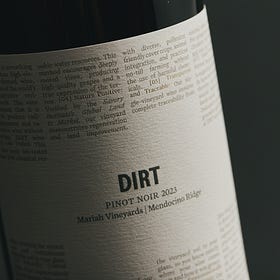
Some wines grab your attention at first sip and refuse to let go. That happened to me last year as I was tasting a few pinot noir samples from Anderson Valley in California, trying to suss out a regional signature. They featured dark fruit flavors, rather like Russian River Valley but not as hefty; a middleweight, perhaps, compared to the lithesome, red…
DM: Is this kind of intensive, data-driven regenerative farming scalable beyond a 30-acre vineyard?
MF: Absolutely — though I’ll admit I’m biased. Vineyards that aren’t working on climate resilience right now are going to fall behind; it’s not a question of if but how quickly we adapt. Regenerative farming is highly site-specific, so I’d encourage growers to start small: trial a block or even a few rows — try cover crops, stop tilling — measure the results, and scale up what works. That’s the idea behind the One Block Challenge we’re involved with here in Mendocino. We did the same thing ourselves: we tested eliminating cultivation on a few rows, measured the impact through plant sap analysis, and once we saw it worked, rolled it out across the whole property. We didn’t do this only to save the planet — it was also about building climate resilience and differentiating our fruit. We’ll never compete on quantity, so we compete on quality.
DM: Readers on the East Coast often hear that organic or biodynamic farming is much harder in a humid climate. Do you think regenerative practices translate to tougher regions?
MF: It’s completely site-specific — and that circles back to transparency. “Regenerative” isn’t a legally defined term, so anyone can claim it. On one end you have producers who are organic, with social and animal welfare built in, genuinely pushing things forward. On the other end, you could spray glyphosate, bring in a couple of sheep once a year, and still call yourself regenerative. What works at Mariah, with our 90 inches of rain and up to 12% soil organic matter, won’t look like what works in Paso Robles. But every farmer can start with a baseline: measure your soil, count your biodiversity, and find your own path from there.
DM: How much weight should consumers put on certifications like Regenerative Organic Certification or Savory Institute’s Land to Market?
MF: Certifications are essentially a substitute for trust — if we had true transparency industry-wide, we wouldn’t need them as much. I was drawn to the Land to Market verification because it’s outcome-based rather than process-based; many certifications reward optimizing a process year over year rather than proving an actual result. I believe in hard measurements. That said, Regenerative Organic Certification does great work, including social and animal welfare components, though it takes real resources for a small producer to participate. Biodynamic certification is also meaningful. Personally, I buy organic wine too — there’s a whole spectrum here, but I believe strongly in a chemical-free approach.
DM: Is “regenerative” at risk of becoming a buzzword — greenwashing, essentially?
MF: Yes, honestly, I think so — at least within regenerative viticulture. It would be wonderful if claims were based on documented outcomes rather than marketing. There are so many growers doing genuinely great work, and it bothers me that it’s so hard for a consumer to tell them apart from the greenwashers.
DM: Should some of this transparency be required rather than voluntary?
MF: It would be nice. I don’t think there’s anything wrong with winemaking techniques or processing aids in general — there’s room for low-intervention wine and room for wine made to taste consistent every vintage. But labeling what’s actually used, and tracing where the fruit comes from, would serve consumers well — even if it’s not necessarily in every brand’s interest.
DM: After eight years, do you feel Mariah has “arrived” at a regenerative state, or is the work ongoing?
MF: That would be a nice problem to have — there’s always room for improvement. Right now we’re working on biodiversity, breaking up our monocrop with hedgerows, pollinator habitat, and trials of low-growing flowers beneath the vines on eleven rows, based on research showing beneficial insects can move up to 20 meters into a vineyard. If that works, we’ll roll it out across the property. And the work never really stops — the site keeps changing. We’ve had our coldest year and, the following July, a heat wave. That constant adjustment is part of the beauty of farming a vintage-driven wine: it never tastes exactly the same twice.
DM: Have you noticed the regenerative shift show up in the taste of the wine itself?
MF: The biggest change came from stopping irrigation and dry-farming the whole site — it produces more compact clusters and, I think, better quality. If I had unlimited resources, I’d love to run nutrient-density testing on the fruit through fermentation, the way it’s done in meat and dairy, to actually track quality alongside farming practices — but without a broader benchmark to compare against, and given the cost, that’s not realistic yet. What we do have is outside validation: our first DIRT vintage received strong ratings, and the second is getting great reviews too, which gives us some proof we’re on the right path.
DM: DIRT currently makes a Pinot Noir, a Sauvignon Blanc, and just released a Chardonnay from Italian clones — Trentino and VCR10. What led to that choice?
MF: We’re mainly grape growers, so plantings have followed the market — mostly Pinot Noir and Chardonnay now, with some Sauvignon Blanc and Primitivo. The Italian clones were my mother-in-law’s idea — she has Italian roots. We also have French clones 76 and 96 on the property, and some clients have fermented both separately and blended them with great results.
DM: Where can readers find your wines?
MF: At dirt-wine.com — we ship direct to consumers and are currently looking to expand distribution. The site also has our blog and our transparency page with all our test results, plus a way to reach me directly.
DM: Last question, one I ask everyone: what does Michael Frey drink when nobody’s watching?
MF: I’m biased toward European wines — a good white Burgundy, and I’m a big Nebbiolo fan right now. Lately I’ve been leaning more toward whites than reds. A good Riesling from Germany or Austria really excites me too. And from California, the Tablas Creek Grenache Blanc.
DM: Any chance of Nebbiolo going into the ground at Mariah?
MF: Not right now — farming 30 acres regeneratively is already plenty of work, and we’re focused on optimizing what we have. Let’s talk again in three years.
Read more from Michael and Nicole, including their own detailed account of Mariah’s regenerative journey and links to their full data, at dirt-wine.com. My next live conversation is scheduled for July 23rd with Sonoma County winemaker Jamie Kutch — stay tuned.
Available for iOS and Android
Comments
Nothing yet. Say the first thing.
Sign in to join the conversation.