
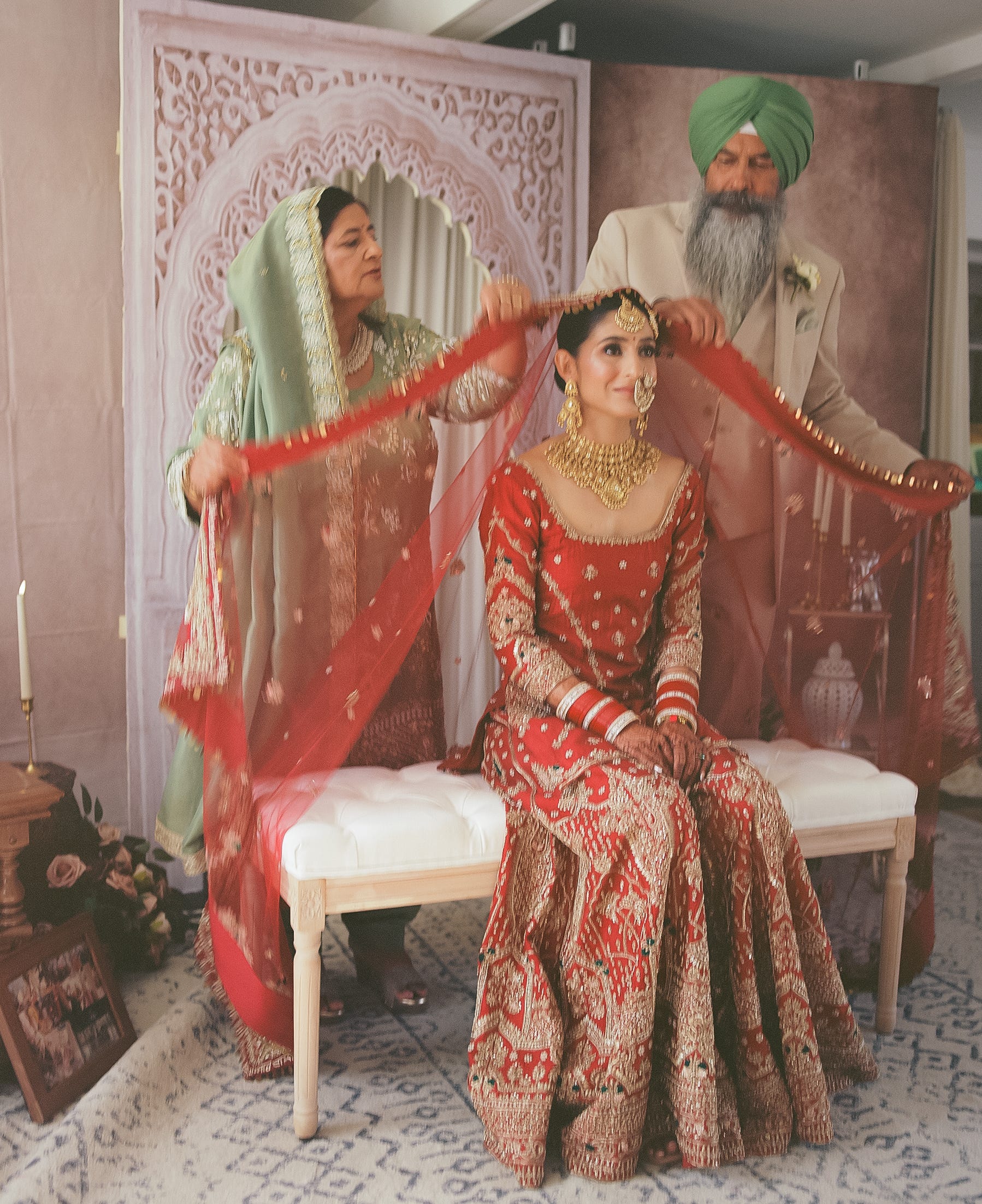
Hi dear loved ones! It’s been a while. Life has been full of transitions and quiet transformations, and I’ve been letting it all arrive at its own pace. This essay is part catch-up, part prayer, part documentation because some things feel too sacred to reduce to a photo or a caption.
To start off, I got married last week — which, if you know me, is a big statement to say. Marriage is not something I always dreamed of, especially as a young girl who felt like she had witnessed many marriages in which freedom felt limited for South Asian women. And the older I got, it felt like marriage was either a business transaction or a cultural pageant, an excuse for South Asians to show off wealth, compete, and curate. I wasn’t interested in being anyone’s display. I grew up watching many brown girls be groomed to marry before they were ever taught how to want. Many were taught how to serve, how to compromise, how to carry shame that wasn’t ours. We watched our mothers and aunties hand over pieces of themselves in the name of duty and respect. Marriage for many years scared me — not because I didn’t believe in love, but because I believed in myself too much to lose her. And even in all the noise around me, I am very grateful my parents never added pressure. They didn’t rush me into marriage or make it a “finish line” to reach. Instead, they encouraged me to learn myself first, to figure out what I wanted, who I was becoming, and the kind of partner who would honor that journey. They gave me time, trust, and space to grow into my own voice.
And because of that, love arrived. But it didn’t arrive in isolation. It came at a time when I had already been held so well by my people, by the women who showed me what it means to stand grounded. My siblings, cousins, aunts and uncles made everything feel like celebration. My bridesmaids held it down without question, without hesitation. My family showed up in the way that only family can, with food, with prayers, with complexities, and with care. And in that, I was reminded of what makes Punjabi weddings what they are, not just the colors and noise, but the presence of everyone, all at once. I hadn’t seen this much family in years because we had never had the privilege to travel and see each other all the time growing up. The way loved ones fill the room with memory and movement. The way ancestral tradition sits beside the newest joy. There is such an honor in participating in what our people have done for generations and also in reshaping it with intention. That gathering of community was not background to the wedding, it was the wedding. And slowly, I understand marriage not as erasure, but as emergence. Not as tradition, but as transformation.
When I got married last week, I stood in my Anand Karaj ceremony holding all the contradictions I had inherited and reworked. I did not arrive untouched by patriarchy, caste, colonialism, or the long history of women being turned into vessels of sacrifice. But I arrived with clarity, with community, and with choice: a privilege not everyone has. To be a brown woman and choose your partner freely, to marry in safety, to be visible and veilless in your joy, I recognize these are not small things. They are not accidents. They are the result of so many others being denied what I was allowed to hold.
At one point during my Anand Karaj morning, one of our photographers asked gently, “Do you want a photo where your dupatta is a veil?” and while this look is very popular in photographs, I responded: “No, Guru Gobind Singh Ji reminds us we don’t need the veil”. I didn’t say it to be political in that moment, I said it because I meant it with every breath. The veil has never been just an accessory. Not for the women I come from. It has been a border between the self and the world. It has been silence disguised as grace. It has been the tool of disappearance dressed up as tradition. And I didn’t want to disappear. Not on that day. Not ever again.
At the beginning of July, my partner and I took taken a three-hour Anand Karaj class at the San Jose Gurdwara before the ceremony — something I highly recommend for anyone getting married in the Sikh tradition. You can contact the gurdwara directly to ask about future sessions; they walk you through the history, meaning, and structure of the Anand Karaj in a way that’s clear, grounding, and deeply aligned with Gurmat.
I didn’t want to do something sacred without understanding it for myself. I wanted to know what I was walking toward. The laavan, I learned, are not about hierarchy. They are about remembrance. Each step is an offering. A dissolving of ego. A coming closer to Ik Onkar. The class also reminded me that my partner and I didn’t need to follow tradition blindly to be aligned with Sikhi. Our faith was never meant to be stagnant, and rather it is a living practice, one that was born in resistance to unjust systems. Guru Nanak Dev Ji refused the thread ceremony. Mata Khivi redefined leadership through langar. Guru Hargobind Singh Ji wore two swords to show that spiritual and political power must walk together. We come from a lineage of people who reshaped the world by reshaping their practices.
So we created our own traditions. We wove poetry into the program. We built a memory table for the ancestors. We made space for remembering. We didn’t do things just because others had done them. We asked, Does this honor our values? Does this feel whole? And if the answer was no, we left it behind because tradition, when unexamined, can become a cage. But tradition, when rooted in intention, can become a home.
And in the midst of remembering myself, in planning, in preparing for a new chapter, I also remembered the quote I have carried with me for years. Leila Khaled once said:
“I have learned that a woman can be a fighter, a freedom fighter, a political activist, and that she can fall in love and be loved. She can be married, have children, be a mother. Revolution must mean life also; every aspect of life.”
That quote changed me when I was in college (S/o to GUPS at SFSU). It reminded me that love does not dilute resistance. That softness does not weaken fire. That we do not need to choose between tenderness and militancy, between joy and politics, between devotion and freedom. I remembered that I could be a partner and still belong to myself. That I could say yes to this sacred union and still remain whole. That revolution must mean life also: weddings, families, sweetness, grief, rebirth, rage, and rest. Every aspect of life.
Still, even in that moment, I carried the weight of what allowed me to be there. A passport. Financial mobility. A family that let me choose. A partner who sees me. Clean carpet beneath my feet, a dome above me, safety surrounding me. And I knew, deeply, that this was not a right granted equally.
While I stood encircled by sangat, others are marrying on rubble, through checkpoints, in exile. In Gaza, couples hold each other under tarps. They hold joy before airstrikes. They say “I do” in tents while mourning the martyrs. Their weddings are not delayed for grief, they happen inside it. In India, Dalit and inter-caste couples marry in defiance of violence and surveillance. Across borders, queer couples marry in silence or celebration, depending on who is watching. Their ceremonies are shaped by resistance. Their love is sacred. Their weddings are sacred. And they do not need to look like mine to be worthy of the word anand.
So this is my ardaas:
May the ones who marry under siege be protected. May the veils they wear be lifted only for peace, never for war. May their vows be witnessed by the divine, even when the world turns away. May their love outlive the walls trying to contain them. May we never mistake our safety for superiority. And may every joy we hold include their names.
And while I honor this marriage I chose, I also know marriage is not the only home love can live in. I hold in my heart the love that dares to exist outside societal norms—queer love, caste-defying love, love that is quiet, uncelebrated, unseen. I know that many people resist the institution because it was built to exclude them, because it has punished those who dared to love beyond borders, binaries, or brahminical expectation. I want to say clearly: you don’t need a wedding to be worthy of celebration. You don’t need a ceremony to be a keeper of love. I know that not marrying is also a path of wholeness. I know that many people resist the institution because it was built without them in mind, because it has harmed more than it has healed.
And love is abundant. Love showed up in my life long before a partner did. It came in the hands of women who raised me, aunties who fed me, friends who let me fall apart and stayed anyway. It came in mentors, in ancestors, in chosen family. They taught me how to show up with care. How to keep loving in conflict. How to apologize. How to stay. And it’s because of them that I was able to recognize love when it arrived. Because marriage is not sustained by two people alone. It is held by community. It is not proven in one day. It is practiced in the days after. In the call-back. In the care. In the critique. In the apology. In the protest. In the poem. In the prayer.
And maybe the question underneath all of this, the veil, the vows, the sangat, the prayers is this: What is the work of all of us? Of those still living? Of those who had the privilege to gather, to feast, to circle the Guru without fear?
What does it mean to become good ancestors in real time?
At our wedding, we had an In Loving Memory table, a quiet corner for those who could not be with us in body, but remain present in name, in memory, in spirit. We placed their photos there not just to grieve them, but to remember what it means to be remembered. To ask ourselves: How do we live in a way that lets others feel safer, softer, more seen?
This, to me, is the work of love. To build homes that don’t vanish when we leave the room. To choose truth even when it’s uncomfortable. To organize joy as a communal resource, not a private escape. To walk forward while reaching backward, to lift what must be carried, and to lay down what never belonged to us. To become ancestors not just by biology, but by intention.
No posts
Comments
Nothing yet. Say the first thing.
Sign in to join the conversation.