
I’ve been thinking about the emotional vocabulary we attach to age: not just respect or disregard, but fear. What happens when that disappears?
In politics and public life, fear functions as a kind of deterrent. If you believe that the generations before you remain consequential, that they still carry power, you might think twice before rewriting policies in ways that harm them. Though that hesitation didn’t necessarily spring from empathy, it acted as a brake on neglect and public expressions of hostility.
Without that brake, ageism can operate unchecked. It shows up in budget negotiations where “entitlements” become abstractions rather than food, rent, and medical care. It undergirds the quiet dismantling of supports that older adults don’t even know they’re losing until a notice arrives in the mail or the aide doesn’t show up. It reduces our lives to numbers on a spreadsheet, with no sense that there is a line not to be crossed.
Thanks for reading The Long Game: Reporting for Grown-Ups! This post is public so feel free to share it.
For those of us now in our sixties, seventies, eighties and beyond, this is no longer theoretical. We’ve lived through administrations that treat older people as expendable, and through legislative sessions where the safety nets we counted on face “reform” that looks a lot like unraveling. We see how quickly policy choices can turn aging from a stage of life into a risk category.
In the essay that follows, Margaret Morganroth Gullette, the noted cultural critic and expert on aging, asks us to consider what happens when fear of elders disappears—and what, if anything, should replace it. She looks back to cultures where elders and ancestors inspired awe, even terror, and then turns her gaze on the United States today, where the absence of that fear leaves older people vulnerable to neglect, indifference, and worse.
It’s an unsettling piece, drawing on a dramatically different vision of aging than we know.
-Diana Jean Schemo
By Margaret Morganroth Gullette
In an era of rampant government-sponsored ageism, it is uncanny to be reminded that for millennia, elders—only males—and male ancestors were held in the utmost awe in cultures around the world. Alive, the fathers and grandfathers demanded obedience. Dead, they demanded appeasement—recognition of their potentially unforgiving spiritual power.
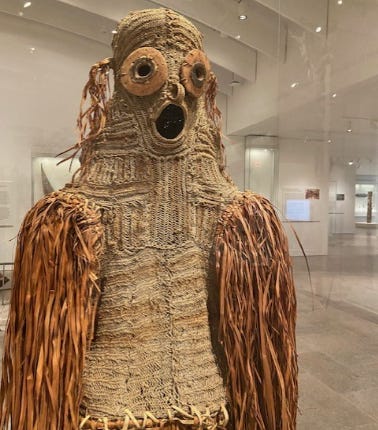
This amazing contrast initially overwhelmed me when I visited the new Oceania exhibit in New York’s Metropolitan Museum. As a cultural critic who studies gerontocracy, I was transfixed by the terrifying Asmat sculptures.
Where Elders Were Feared
Celebrating the opening of a new men’s ceremonial house, any West Papua New Guinea boy wearing a basketweave mask displayed eyes wide open in shock and a mouth stretched in a permanent shriek. The full-body coat looks like Edvard Munch’s “The Scream,” meticulously worked in mulberry fiber, rattan, and Sago palm leaves. It renders existential dread.
Stretched out nearby is a long, eerily bottomless, canoe—part of an intense, frightening pubertal initiation ceremony for boys being turned into subordinated men. The wooden figures bent over, face down, each penis exposed, their four limbs tortuously bent as if they were lizards or grasshoppers, tied with ropes in their relentless position, were painted over in white. Whiteness meant scary deadness, as if a shroud had soaked into their skin. At the prow of the boat, the ancestor is embodied as an upturned face on a severed head.
Initiates had to crawl across the spirit canoe on their stomachs. While they were engulfed in the unfamiliar dark of the night, their tender skin physically had to scrape the hard, rough wooden convergence of the living and the ancestral worlds.

One doesn’t expect museum exhibits to have visceral effects, but my own stomach heaved envisioning the silent scream of child underlings undergoing entrance into the traditional order. Empathy explains my first, spontaneous revulsion.
But after that, what needs explaining is my equally horrified, unwilling, ambivalent admiration for that ferocious culture. The relevant fact is that I am eighty-four, an older woman living in the United States of America who felt compelled to write a book, American Eldercide, about Trump’s unabashedly cruel, ageist administration.
How Western Gerontocracy Withered
Our Western forms of gerontocracy were long supported by punishing restrictions, religion and myths, habits of submission. The sacrifice of Isaac—set as a test by the first monotheistic deity—the hierarchical “Great Chain of Being,” the divine rights of kings, the autocratic authority of fathers over families: such traditions deeply embedded feelings of fear and respect in children, younger men, and women of all ages.
Then, the era of revolutions and declarations of equality provided proofs that traditions that had seemed eternal and inflexible could be altered. It took political ideas of liberty and secular, scientific, feminist, economic, and individualist tendencies to reduce some of the powers of the male Geronts. “Equality” became an aspiration.
The process has taken hundreds of years, and unstinting efforts by the underlings.
The imaginary of all-powerful male elders was struck, and struck again, with hatred and through reasoning, and with success: in the Enlightenment, in the revolutions (American, French, Haitian, Russian), in the collapse of monarchies, in theorists like Hegel and Marx, in the sons’ rejection of primogeniture and political limits on the franchise, in the uprisings of the daughters and the demands of feminism, the end of slavery, and through the establishment of countervailing rights, civil and political. This was a noble history of accelerating freedoms that eventually weakened the patriarchal family and the misogynistic state. Women marry without their fathers’ permission, finally vote, keep their own money. The fight for equality brought formerly excluded women into the highest reaches of some governments (Indira Gandhi, Golda Meir), although not quite yet in the United States.
But in the long run, as historian Thomas R. Cole in The Journey of Life reports, societies also lost some valuable feelings and practices. Where reverence thoroughly vanishes, even respect dwindles. Ageist indifference and contempt emerge. The Old, as a group in the U.S., are by now shrunk: leaderless, powerless, lacking prestige and self-organization. Polarized, they are divided into millionaires at one end and indigent nursing home residents on the other. High percentages do vote, but they seem unable to vote as a bloc for their own advantage. They can’t even get Congress to stabilize Social Security, which almost all depend on. Their own internalized ageism is surely another important part of their political disunity.
Midlife and older adults now suffer from the disparate impact of laws, hostile behavior, and prejudicial discourses that undermine our ability to obtain or retain available work at decent wages as we grow older in the workforce.
We pay into Medicare and Social Security. The safety nets meant to protect us from the most dire existential conditions, from dying in poorhouses or under bridges, or being left without adequate medical care—are mainly a legacy of big-D Democrats (Franklin Delano Roosevelt, Lyndon Johnson, Barack Obama’s inclusion of people 55 to 64 in The Affordable Care Act). Now these nets are being eliminated or slyly mutilated by a Republican Congress.
Looking With an Asmat Eye
And here’s the danger, viewed with an Asmat eye. No fear of retribution remains to stay the cruelty. Republicans, with no support from Democrats, have made massive cuts to federal health aid to the states, through OB3 (aka One BIG Ugly Bill) signed July 2025. Governors in turn feel forced to cut programs that include Adult Family Home Care, Adult Day Care, and Personal Care Attendants for people with disabilities. Medicaid’s program for indigent old age allows elders, mostly older women, to live in government-sponsored nursing facilities that are supposed to confer on the residents dignity, autonomy, and necessary physical care as long as they live.
Instead, owners have been allowed to understaff the “homes” because the states inadequately regulate and inspect and sanction them. In early December, the Trump Administration quietly scuttled President Joe Biden’s national minimum staffing requirement for nursing homes, which had been a historic first. In American Eldercide, I estimate that the segregated residents died of COVID in 2020—prematurely and unnecessarily—26 times as often as people living in their own communities.
“During the pandemic, private-equity-owned nursing homes had a 40 percent higher Covid mortality rate than other nursing homes,” Senator Elizabeth Warren said at a hearing in 2024. “I’ll say it bluntly: turning private equity loose in our health care system kills people.” By permitting for-profit companies, often backed by private equity, to take over facilities, legislators put into question these older adults’ basic right, to
Republican-led government downsizing has shuttered Social Security offices and curtailed the human phone responders, making it difficult for hundreds of thousands to get information, correct wrongs, and receive the money we paid into the system over a lifetime of work, to save our old age from humiliation and ignominy, hunger, cold and heat, and destitution. Trump’s Medicaid cuts and regulations harm people with disabilities who are unable to work.
Public forums, failing to resist ageism and ableism, treat us as burdens and misrepresent aging as a useless decline. So far down has our culture come, that pro-aging forces—“the Justice League,” as Anne Basting, a MacArthur Fellow in age studies, calls us—are put on the defensive. Many older adults are still in the dark about the legislative and administrative acts that deprive them of needed supports. It is incumbent upon the media to do more to reveal the harmful effects.
Lacking gerontocracy, no spiritual force threatens the malefactors, even those who say they have faith in God. No bottomless canoe awaits them for their devious, opportunistic, mean-spirited betrayals. Except, perhaps, elections.
Meanwhile, as politics fail, only prayers echo the best values of the more-respectful past. “May the blessings of the elders be apportioned to the deserving, and be heard and valued; and may their reproofs also serve as guidance to the generations.”
About the author: Margaret Morganroth Gullette is the author of American Eldercide: How It Happened, How to Prevent It (2024, University of Chicago Press); Ending Ageism, or How Not to Shoot Old People (2017, Rutgers University Press), and other prize-winning books. She is a Scholar at the Women’s Studies Research Center at Brandeis University. Gullette is the inaugural winner of the W. Andrew Achenbaum Award from the Gerontological Society of America, for her work in “the gerontological humanities.”
Comments
Nothing yet. Say the first thing.
Sign in to join the conversation.