

There are plenty of reasons this market could be going down.
It just isn’t.
The war with Iran continues. Shipping through the Strait of Hormuz remains severely disrupted. Oil prices remain elevated. Inflation is still a concern. And sector leadership continues to change almost faster than investors can develop a narrative to explain it.
Yet the S&P 500 just completed its third consecutive winning week and remains near record highs.
Sometimes the most important thing the market tells us is also the simplest:
Watch what it does, not what you think it should do.
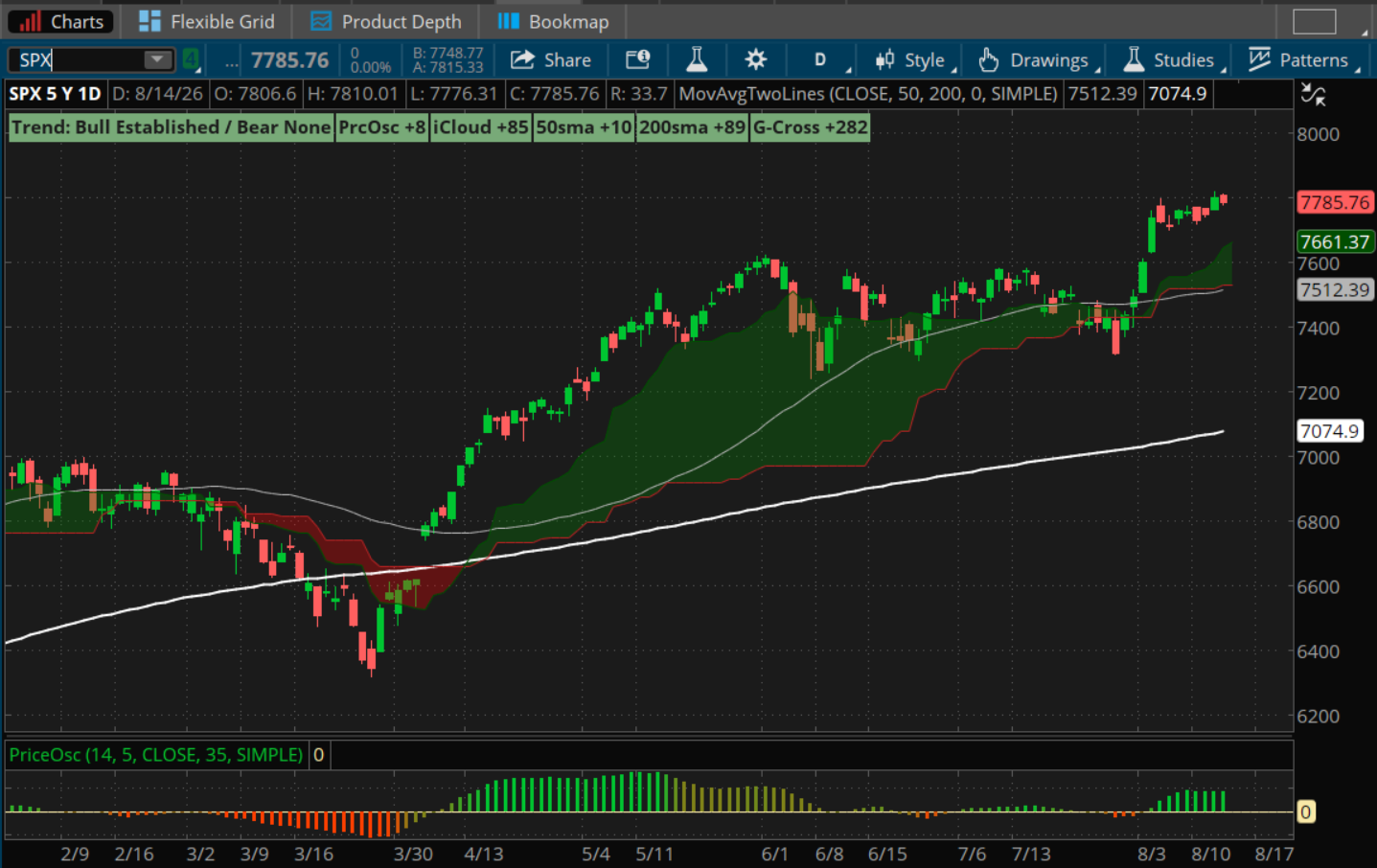
Take a look at the S&P 500.
The index finished the week near 7,786.
More importantly, the technical structure remains decisively bullish.
SPX is above its 50-day moving average, well above its 200-day moving average, and above our trend cloud. Our proprietary trend indicators currently show:
Bull Established / Bear None.
That doesn’t mean stocks can’t pull back.
It doesn’t mean geopolitical risk has disappeared.
And it certainly doesn’t mean we should become complacent.
It simply means that, based on the evidence we have today, the primary market trend remains bullish.
That’s the starting point.
Everything else has to be considered in that context.
Last week I described the market’s reaction to Iran as something of a Groundhog Day effect.
Iran headline.
Hormuz headline.
Negotiations are progressing.
Negotiations aren’t progressing.
Oil moves.
Stocks react.
Repeat.
This week, however, the underlying situation deserves continued attention.
Shipping through the Strait of Hormuz has slowed dramatically. Reuters reported that only five commodity vessels passed through the strait Saturday and none Sunday, compared with 31 the previous weekend. Negotiations between the United States and Iran also remain stalled.
That is not insignificant.
The Strait of Hormuz has historically carried roughly one-fifth of the world’s oil and LNG shipments. A prolonged disruption has obvious implications for energy prices, transportation costs and potentially inflation.
And yet, despite all of that, the stock market remains near its highs.
That’s what makes the current environment so interesting.
The question isn’t whether Iran matters.
Of course it matters.
The better question for investors is:
So far, the answer is: absorbing it remarkably well.
That can change.
If it does, we’ll see the evidence.
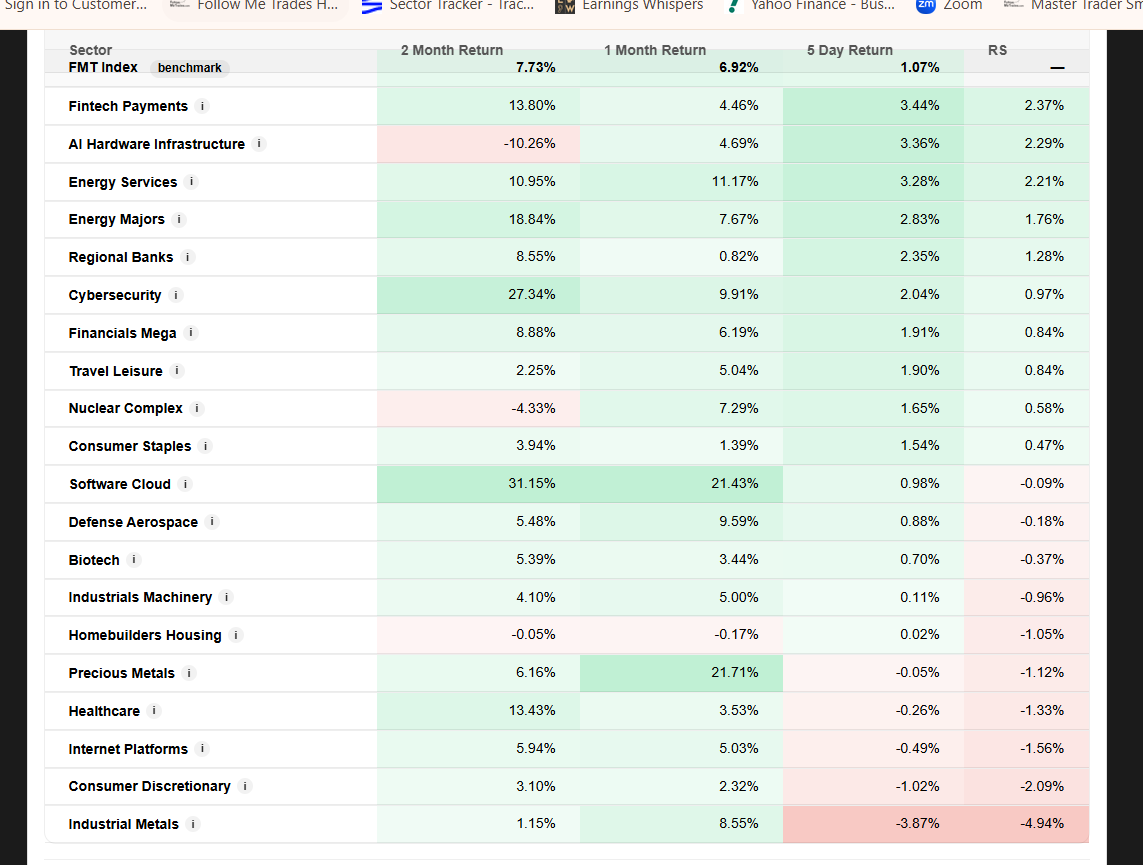
If the broad market trend looks straightforward, what’s happening underneath the surface is anything but.
Our Relative Strength Dashboard continues to show rapid rotation.
Look at AI Hardware Infrastructure.
It’s still down more than 10% over two months, but it’s up 4.7% over the past month and 3.4% in just the past five trading days.
Fintech Payments, which had recently fallen out of favor, is suddenly at the top of our short-term rankings.
Energy Services and Energy Majors have moved back toward the top, not particularly surprising given what’s happening with oil.
Meanwhile, some of the recent leaders are cooling.
Software Cloud is up more than 31% over two months and 21% over one month — but gained less than 1% over the past five days.
Precious Metals, which was one of our strongest short-term groups last week, was essentially flat.
And Industrial Metals dropped nearly 4%.
That’s quite a bit of movement in a very short period.
If you’re trying to predict which sector will lead next week based upon a compelling macroeconomic story, good luck.
Fortunately, we don’t have to predict it.
The whole purpose of relative-strength analysis is to let the market show us where money is moving.
When leadership changes, we change with it.
Compared with last week’s inflation reports, this week’s scheduled economic calendar is fairly light.
We’ll get housing starts and building permits Tuesday, along with industrial production and capacity utilization.
Thursday brings weekly unemployment claims and the Philadelphia Fed Manufacturing Index.
And Friday brings the flash Manufacturing and Services PMI reports.
But the event likely to attract the most attention comes Wednesday:
The minutes from the latest Federal Reserve meeting.
As always, Wall Street will parse every sentence looking for clues about where monetary policy goes next.
There’s one important caveat.
Minutes tell us what Fed officials were thinking at the time of the meeting.
Markets have received additional inflation, employment, energy and geopolitical information since then.
So the minutes matter.
But perhaps not as much as Thursday afternoon’s headline will inevitably suggest.
The giant technology earnings reports may largely be behind us.
But earnings season isn’t finished.
This week we get something arguably just as interesting:
Home Depot reports Tuesday.
Target and Lowe’s report Wednesday.
Walmart reports Thursday.
Reuters identifies U.S. retail earnings as one of the major market themes for the coming week, particularly as consumers deal with higher fuel costs and continued geopolitical uncertainty.
These companies give us several different windows into consumer behavior.
Walmart can tell us about everyday spending and whether consumers continue trading down looking for value.
Target provides a somewhat different look at discretionary spending.
And Home Depot and Lowe’s give us insight into housing-related spending, remodeling and larger discretionary purchases.
One earnings report doesn’t tell us much about the economy.
Taken together, however, these companies can provide an interesting snapshot of how consumers are behaving.
I’ll be watching what management teams say about the next few months at least as closely as the earnings numbers themselves.
That’s really where we enter the new week.
Iran remains a legitimate geopolitical and economic risk.
Oil remains elevated.
The Fed remains data dependent.
Sector leadership remains frustratingly unpredictable.
And we’re about to hear directly from some of America’s largest retailers about the condition of the consumer.
There are plenty of things that could derail this market.
But that’s different from saying they have derailed it.
Right now:
The broad market trend remains bullish.
SPX remains near record highs.
Sector rotation remains rapid and unpredictable.
Iran and Hormuz remain the biggest unscheduled catalysts.
And this week’s retail earnings should give us a useful look at the consumer.
If those facts change, we’ll change with them.
Until then, I’m not particularly interested in constructing a bearish forecast simply because I can make a convincing argument for one.
Price is evidence.
And right now, the evidence continues to favor the bulls.
Which brings us back to the principle behind everything we do at Follow Me Trades:
If you’d like to see how we identify changing sector leadership and individual stocks showing evidence of institutional accumulation, I’d love to have you join us inside FMT Framework Stock & Option Picks.
You’ll receive our current portfolio, trade ideas, live market sessions, and the same Relative Strength tools and proprietary scans we use every day to follow institutional money.
Try it for just $37 for your first 30 days, backed by our 30-Day Money-Back Guarantee. After that, it’s $97 per month, and you can cancel anytime.
Comments
Nothing yet. Say the first thing.
Sign in to join the conversation.