
Over the past few months, Claude Code has become the most important tool in my workflow — not just for writing code, but for thinking, exploring, and connecting ideas across domains I wouldn’t have previously linked together. As I’ve leaned into it, I’ve found myself pulled into a web of communities, conversations, and projects that all seem to be circling the same realization: agentic coding is the most important innovation since the smart phone.
Here’s what that’s looked like lately.
Building a Community Around Agentic AI
Last month I started a Discord called AI Excellence — a space for developers and curious minds to collaborate and push each other forward. We’re currently working through Agentic Design Patterns in weekly online meetups, exploring how autonomous AI agents can be composed into systems that actually get things done.
What I didn’t expect was for Antonio Gullí — the book’s author and a Distinguished Engineer at Google — to show up and join the community. That kind of thing doesn’t happen by accident. It’s a signal that the people doing the most serious work in this space are hungry for genuine dialogue, not just broadcast. If you’re building with agentic AI or want to understand where things are headed, come join us.
Retired Entrepreneurs Talking Claude
Brad Feld started an online community for retired entrepreneurs exploring AI-assisted work. I was fortunate to get an invitation, and the quality of discussion there is high. These are people who’ve built and sold companies, who understand leverage and compounding, and they’re applying that same lens to AI. The post that introduced the community is worth a read if you want a feel for the spirit of it.
There’s something particularly interesting about watching experienced operators engage with these tools. They skip past the novelty and go straight to: what does this change, and how do I use it?
Every App Needs a CLI
Andrej Karpathy posted a tweet recently arguing that every app should have a command-line interface. I read it and immediately started building one for Blockchain Rangers. It’s the kind of nudge that’s obvious in retrospect — a CLI makes an app scriptable, composable, and agent-friendly. Any app that does not implement this is now “legacy” and at a disadvantage.
(Relatedly, every website should have an llms.txt file. Here is the the llms.txt for Blockchain Rangers.)
Coding Is For Liberal Arts Majors Now
Last week I taught an InterIntellect salon called Write, Run, Realize: Claude Code for the Humanities. The room was full of writers, artists, and thinkers who had heard something big is happening, but weren’t sure how to start. The course was simple. I simply asked someone in the room what they want to build, then shared my screen as I used Claude. At the start I told Claude to treat me like I have no knowledge of coding and explain everything like I’m five. In 45 minutes we built and deployed a working app. Since Claude did most of the work, I simply narrated what it was doing and took questions from the audience.
There’s something I find genuinely exciting about introducing Claude Code to people who aren’t developers. The barrier isn’t the tool. It’s the belief that the tool is for “someone technical who understands this stuff.” It’s for everyone. Everyone.
I’m doing another session in March and will post a link to the RSVP when it’s live.
Claude Code as My Personal Operating System
For years I bounced between Notion, various task managers, and whatever productivity system I was convinced would finally stick. Some were more useful than others, but I always found them lacking in some fashion. Or even if had what I needed, I didn’t feel motivated to watch a bunch of how-to videos.
I’ve landed on Obsidian as my personal working artifact vault, and pairing it with Claude Code has simplified things considerably. Instead of conforming to a system, I build it as I go.
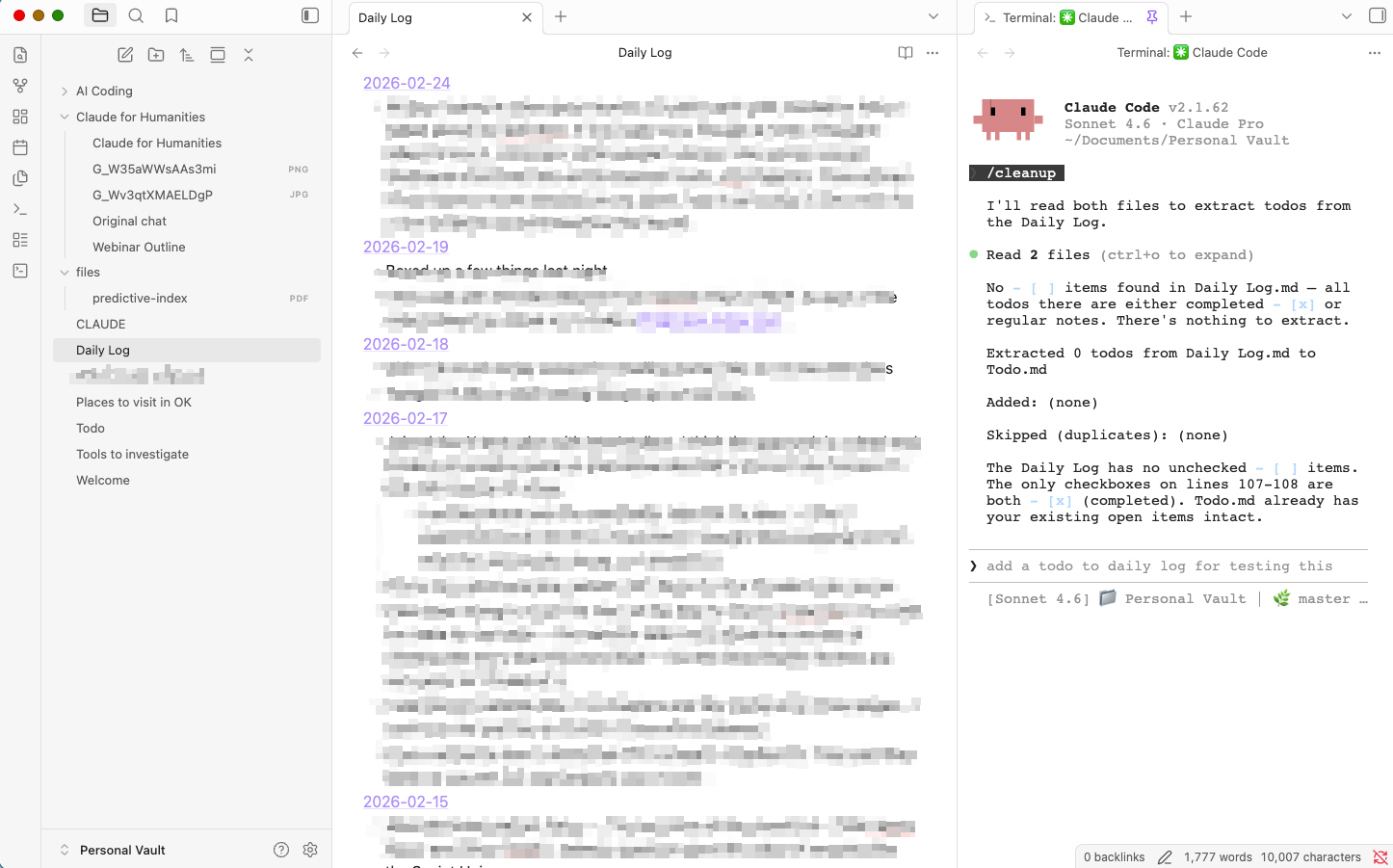
The screenshot above shows Claude Code running a custom /cleanup command against my Daily Log — scanning for unchecked todos in my Daily Log and moving them to a dedicated Todo file. It’s the kind of small automation that would have taken me an afternoon to cobble together before. Now it’s a conversation.
Claude Code treats your file system as a first-class interface. Markdown files, plain text, local directories — it works with all of it natively. Obsidian’s plain-text philosophy and Claude Code’s ability to read, write, and reason about files are a natural fit.
To do this yourself, open Obsidian settings, click Community Plugins on the left side, then browse and search for “terminal.” Once installed, open the terminal and start Claude in the same directory as your vault. Run /init to create the CLAUDE.md file
A Fresh Start in Oklahoma City
All of this online community building has been especially meaningful because, until recently, my in-person community has been thin. I spent the last three years in Fayetteville, Arkansas — a perfectly fine place that I never quite connected with. I stayed busy, but I never put down roots.
I just moved to Oklahoma City, and it already feels different. My closest friend from college lives nearby and has a network I can step into. It’s a cheat-code for belonging that you don’t fully appreciate until you’ve gone without it. I’m actively looking for meetups and interest groups — tech, entrepreneurship, whatever has smart, curious people in the room. If you’re in OKC and know of something worth showing up to, please let me know
The through line in all of this, even if I didn’t plan it, is community. The most interesting things happening with AI right now are taking place in group chats, online forums and salons — and, I hope, in meetup spaces in a new city. I’m grateful to be in the middle of it.
No posts
Comments
Nothing yet. Say the first thing.
Sign in to join the conversation.