
In 2004, David Byrne discovered a new medium: Microsoft PowerPoint.
Despite his initial disdain for the program, Byrne became intrigued by its artistic potential. He began turning PowerPoint’s bars and lines, stock images and clichéd phrases into his creative playground.
The main idea, Byrne says, was to take the rational forms and structures of this business tool and use them in an irrational way.
“Artists are notoriously snooty and suspicious of anything coming from the business community,” Byrne says. “So I have all kind of built in prejudices and suspicions that are working against me, that would naturally steer me away from anything like this. That’s why I have to turn the steering wheel and go right into it.”
This is the pattern: a new medium arrives as a corporate tool, artists treat it irrationally, and a new kind of beauty follows.
Music has long been comfortable with technology. The very first piece of purely electronic music was Karlheinz Stockhausen’s Studie I, released in 1953. (I recommend only listening to it while high.) Robert Moog invented the synthesizer in 1964. It soon produced music that sometimes sounded like the future but more often sounded like corporate training videos.
In 1981, Kraftwerk's Computer World changed the way we think about electronic music because it treats the computer as both instrument and subject. Every track explores computational culture: data networks, pocket calculators, home computers. The precision, repetition, and algorithmic patterns are the sonic embodiment of how computers think. Kraftwerk made us hear machines as artists, not just tools for artists.
Consider “Numbers,” the album’s third track. The track is literally just counting: "1, 2, 3, 4, 5, 6, 7, 8" vocoded in multiple languages over a pulsing electronic rhythm. On the surface, it seems almost absurdly minimal, but that's precisely the point. Kraftwerk found music in the most fundamental operation of computing: enumeration. When you strip away human expression and leave only pure enumeration, you get something that still grooves, still hypnotizes, still works as music.
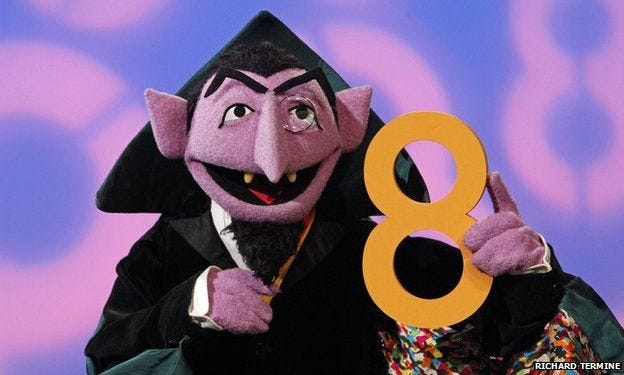
And yet, it’s still irreducibly human. Consider the lyrics to “Computer Love,” then ask yourself whether you’ve ever felt this way while doomscrolling.
Another lonely night
Stare at the TV screen
I don’t know what to do
I need a rendezvousI need a rendezvous
I call this number
For a data date
I don’t know what to do
I need a rendezvous
The mistake people make about AI art is thinking artists are supposed to create, rather than choose.
The important thing about technology-enabled artists is what they choose to keep.
When Stockhausen spliced magnetic tape and Kraftwerk programmed sequencers - they were operating the technology. The artist’s hand remained visible in every decision. Even PowerPoint, for all its corporate banality, did exactly what Byrne told it to do. The constraint was aesthetic, not autonomous.
AI feels different because it appears to make choices. The model isn’t conscious, but it behaves like a collaborator because it produces coherent surprises. Ask it to write a song, and it interprets your prompt. Feels weird. It generates options you didn’t specifically request. Interesting as a party trick, but is it art? This autonomy is what makes artists suspicious: if the machine is making creative decisions, what’s left for the artist to do?1
This question reveals a misunderstanding about the creative process. The artist’s role isn’t pure creation; it’s discernment. Knowing what to keep, what to discard, what to juxtapose.
Byrne didn’t create PowerPoint’s clip art library or its slide templates. He selected, arranged, and re-contextualized them. Kraftwerk didn’t invent binary counting or vocoder technology. They decided that counting could be music. The artistic act wasn’t just creation per se. It was curation, framing, and contextualization.
This is where AI becomes useful rather than threatening, by massively expanding what you can curate from.
Here’s the thing: the same logic applies when you’re not making art at all.
Right now, thousands of people are “vibe coding” - describing an app they want and letting AI generate the code. They’re building productivity tools, workout trackers, budgeting apps, and data visualizations without writing a single function themselves. They’re even graphing cultural abstractions using vibes-based categorization. 2
In other words, they are doing exactly what Byrne did with PowerPoint: operating through selection and arrangement rather than direct manipulation. The difference is speed and scale. What would have taken months of learning to code now takes an afternoon of steering.
The app builders have figured something out: you don’t need to understand the technology to direct it. You just need to know what you want and be able to recognize it when you see it.
Which raises an obvious question: if vibe coding works for making a to-do app, why wouldn’t it work for making art?
Not Sora videos of dogs doing backflips, not knockoff Marvel movie screenplays, and definitely not the creepy AI porn that dominates the discourse and makes everyone anxious.
I’m talking about something that makes you feel something new. Something that uses AI’s weird capabilities—its ability to interpolate between concepts, to generate infinite variations, to find patterns humans miss—in ways that actually matter aesthetically.
Somewhere, right now, an artist is learning to vibe code.
They’re not a programmer. They don’t care about code and never will. But they’re spending hours steering AI through thousands of iterations, developing an intuition for what prompts unlock interesting spaces, learning to recognize when the machine stumbles onto something genuinely strange and worth pursuing.
They’re doing what Kraftwerk did: turning the logic of the medium itself into the art. Not fighting against what AI does naturally, but listening to it. Finding music in the enumeration. And when it arrives—when someone makes the Computer World of AI art—we’ll realize we were asking the wrong question all along..
We keep asking, can AI make art?
The better question is: what becomes possible when artists treat AI as their PowerPoint?
The best “AI music” I’ve encountered so far is Nick Harrison on TikTok. He takes 90’s and 2000’s era rock music and re-interprets it as classic soul, providing surprisingly affecting examples of how taste informs genuinely good cover songs. Covers are a longstanding tradition in music. See also Brahms’ Variations on a Theme by Haydn — one classical giant paying tribute to another.
I particularly like the vibe behind Bill french’s bespoke AI ideation workflow:
Ideas are feral. They don’t respect your sprint cycle. They strike when you’re standing in line at the DMV, navigating a roundabout in a Tesla while cursing at a confusing stop sign, or in that fugue state between waking up and checking your email.
I liked it so much that I copied his post into a markdown file and pointed Google Antigravity at it. It’s building it as I write this.
No posts
Comments
Nothing yet. Say the first thing.
Sign in to join the conversation.