
I try to steer away from the hot topic du jour around these parts. That’s partly because, frankly, I only saw OBSESSION last week.1 But I also feel that it’s best - that it produces the most interesting material - to follow your own bliss. There are a lot of people writing about SPIDER-MAN: BRAND NEW DAY. Do I really have much to add?
But I’ll admit…I couldn’t resist the brouhaha around the translator Emily Wilson and her scathing takedown of Christopher Nolan’s THE ODYSSEY (2026). As I’ve mentioned, I skipped a year of high-school science to take ancient Greek, and the climax of that course was reading and translating THE ODYSSEY (800 BC) for ourselves. Of course, I couldn’t resist a translator quibbling with an interpretation of THE ODYSSEY - I’ve done the exact same thing.
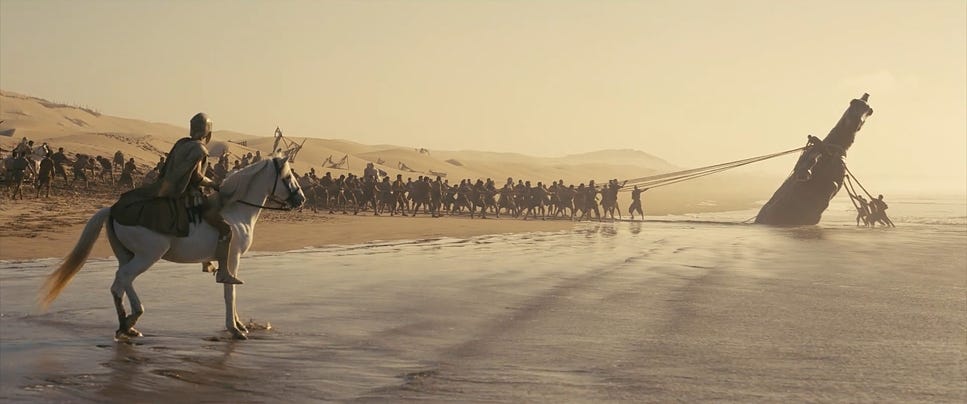
I’m not gonna weigh in on whether or not I agree with the criticisms - I haven’t even seen the movie! But I bring it up because it makes me wonder if misreading and mistranslating gets a bad rap. If maybe it’s even good for us.
Or - to pull a quote that makes me seem smarter than I am - here’s the literary critic Harold Bloom:
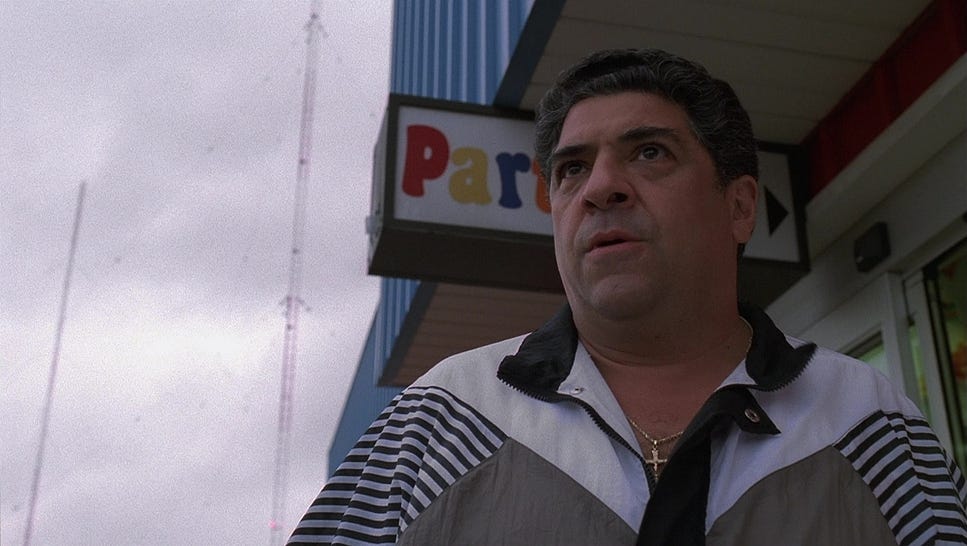
One of the many things I love about THE SOPRANOS is just how good the dialogue is. Quotable, smart, quietly devastating, fuckin’ hilarious - and almost always hiding something. Here’s David Chase:
I think about this all the time when I’m reading scripts. Who’s lying? Why? Is that what they really think? One of my personal script principles is that the worst, flattest, most boring style of dialogue is this: people saying what they mean.
A character says “I’m an only child”. OK, so I guess they’re an only child. Fine, whatever. Onto the next line.
But what if we know he’s got two siblings? What if we’ve just seen him at a family reunion? Well, now “I’m an only child” has a whole other meaning. It makes me lean in and wonder - why’s he saying that? Is he hiding something? Avoiding an uncomfortable truth? What’s this new version of himself he’s trying to present, and why?
In other words: half the fun is wondering what’s lurking behind the line.
I had a professor in college who said that every idea is a cathedral of fire. But when you go to write it…well, now you have to build it with stone.
What you’re doing when you write or speak is translating. And you’re doing it badly. You don’t have an option - you can’t do it well.
Your feelings, your thoughts, your dreams - they’re not in English or Spanish or Mandarin. Not really, deep down. They’re some inchoate other sense, their own emotional register. Your heart speaks a language that’s never come out of someone’s mouth.
So naturally, when you try to translate it into words, you fail.
You want to say something but it comes out wrong. You say one thing, but you meant something else. You intentionally hide what you’re feeling. You want to build a cathedral of fire - but it comes out rocky and stolid.
My college girlfriend grew up in Moscow. She moved to America in middle school, learned English by watching FRIENDS. She was perfectly fluent, not a trace of an accent.2 She and I certainly didn’t speak Russian - at this point in her life, she really only spoke it with her parents.
She told me once that English was her first language now - but that it made her sad that she didn’t dream in Russian anymore. Even her dreams of the dacha she went to as a little girl had been translated.
What are you hiding? We’re all hiding something. Maybe you didn’t kill someone - maybe you did. Maybe you don’t feel you can be honest about something. Maybe you’re not in the mood to talk politics. Maybe there’s a topic you want to avoid for fear you’ll burst into tears.
But you’re hiding something. We all are, all the time. Shouldn’t our characters be hiding something too? Shouldn’t that be reflected in the way they speak? Or maybe they don’t mean to hide it - maybe there just aren’t words for it.
I brought up Harold Bloom at the top of this essay because I wanted to point out that misreading, mistranslation, has a long and vital artistic history. And I think that’s in no small part because that’s how we speak - we try to translate our feelings into words. But we have to fail. Who wouldn’t?
That disconnect - between what a character feels and what they say - can be slight or it can be vast. It can tell us something about who they are, and who they want to be. But it’s also intriguing. It makes dialogue interesting. Lying, prevaricating, avoiding - it’s always more gripping than the alternative.
I realize I’m basically just arguing for subtext here - but, I dunno, I read enough scripts that lack subtext for me to think it’s worth pointing out that all good dialogue is bad translation. I don’t want to watch someone say what they mean. Hell, I almost never say exactly what I feel. Even - especially - when I’m trying to.
So eventually I’ll get around to watching THE ODYSSEY. And maybe I’ll feel like I’m disappointed in Nolan, or maybe I’ll love the film. But either way, I won’t judge it for mistranslating or misinterpreting a text I love.
After all, I do it all the time. Don’t you?
Hot take: good movie! See, this is why you don’t want me writing about this stuff.
Occasionally, I’d hear her miss a ‘the’ if she was frustrated or tired, but that was it.
Comments
Nothing yet. Say the first thing.
Sign in to join the conversation.