
The Democratic Party is no longer simply divided between moderates and progressives. It is increasingly engaged in a struggle over its future as establishment Democrats clash with an insurgent pro-China, Russia, and Iran democratic socialist movement that is reshaping primaries, attracting new activists, and drawing attention from some unexpected corners—including figures on the populist right.
New York City Mayor Zohran Mamdani’s rise has intensified concerns among centrist Democrats. While Republicans have frequently portrayed Mamdani as emblematic of the Democratic Party’s leftward shift, resistance from within the party has become just as significant.
Former New York Attorney General Letitia James recently expressed frustration with Mamdani’s efforts to reshape the party through endorsements of Democratic Socialist candidates.
“All of us are a little frustrated with the Democratic Party. But you don’t blow it up. That’s what MAGA has done.”
Her comments reflect growing anxiety among Democratic leaders who fear the party is embracing ideological positions that could alienate moderate voters, donors, and elected officials.
The political picture becomes even more unusual when President Donald Trump’s interactions with Mamdani are taken into account.
Trump has previously spoken favorably about the New York mayor, even giving him a public mention during a State of the Union address. Following Mamdani’s election victory, Trump and the mayor met at the White House on multiple occasions, where photographs showed the two shaking hands and smiling despite their obvious ideological differences.
At the same time, Trump has sharply criticized the broader movement surrounding Mamdani. Following New York’s Democratic primary, he posted on Truth Social:
“America the Beautiful will NEVER be a Communist Country!!!”
The contrast between Trump’s cordial relationship with Mamdani and his attacks on the broader democratic socialist movement illustrates the increasingly unconventional political alignments emerging in American politics.
Mamdani’s endorsements have already reshaped New York politics.
Among the candidates backed by his political network are Darializa Avila Chevalier and Claire Valdez, along with several successful State Senate and Assembly candidates. Their victories demonstrate that democratic socialist organizations now possess significant influence within Democratic primaries.
Avila Chevalier has also faced scrutiny over social media posts she made between 2018 and 2022. Those posts included criticism of Democratic leaders, support for abolishing prisons, police, and borders, advocacy for social ownership of the means of production, and controversial comments regarding a French origin of COVID-19 and opposition to interracial relationships.
She criticized mainstream Democrats, calling Joe Biden “a rapist” in 2020, although she later said she voted for him in that year’s presidential election. In 2021, she tweeted, “Fuck Kamala Harris,” after Harris delivered a speech discouraging migration to the United States.
In 2022, Avila Chevalier tweeted that the United States was involved in Russia’s invasion of Ukraine because “the Cold War ended and we’ve been bullying Russia ever since.”
It was only during her campaign that she apologized for several of those statements, saying many reflected her political frustrations at the time they were written.
Questions have also been raised about activist organizations connected to candidates within the broader democratic socialist movement.
On October 8, 2023, Avila Chevalier attended a pro-Palestinian rally in Times Square organized by Eugene Puryear and the Party for Socialism and Liberation. The demonstration drew criticism from New York Governor Kathy Hochul, Representative Alexandria Ocasio-Cortez, and then-New York City Councilman Brad Lander.
The Party for Socialism and Liberation has been reported to receive financial support from pro-China and pro-Russia businessman Neville Roy Singham, whose funding of various left-wing activist organizations has drawn increasing public attention.
Singham has also supported Code Pink, the anti-war organization co-founded by Medea Benjamin, whose activism has focused heavily on a favorable U.S. foreign policy toward Russia, China, Cuba, and other countries.
Political commentator Hasan Piker has likewise become influential among younger progressive voters and has campaigned for several Democratic Socialist candidates.
He has also appeared alongside prominent progressive figures while maintaining connections through his uncle, Cenk Uygur, who was interviewed by Tucker Carlson.
In May, the Treasury Department's Office of Foreign Assets Control served administrative subpoenas to Hasan Piker and Medea Benjamin as part of a sanctions inquiry tied to the Nuestra América Convoy in Cuba.
Back in April, Piker campaigned for Cori Bush in Missouri. Bush was originally recruited to run for office in 2015 by Lavoy “Zaki” Baruti Reed and Omali Yeshitela of the African People’s Socialist Party.
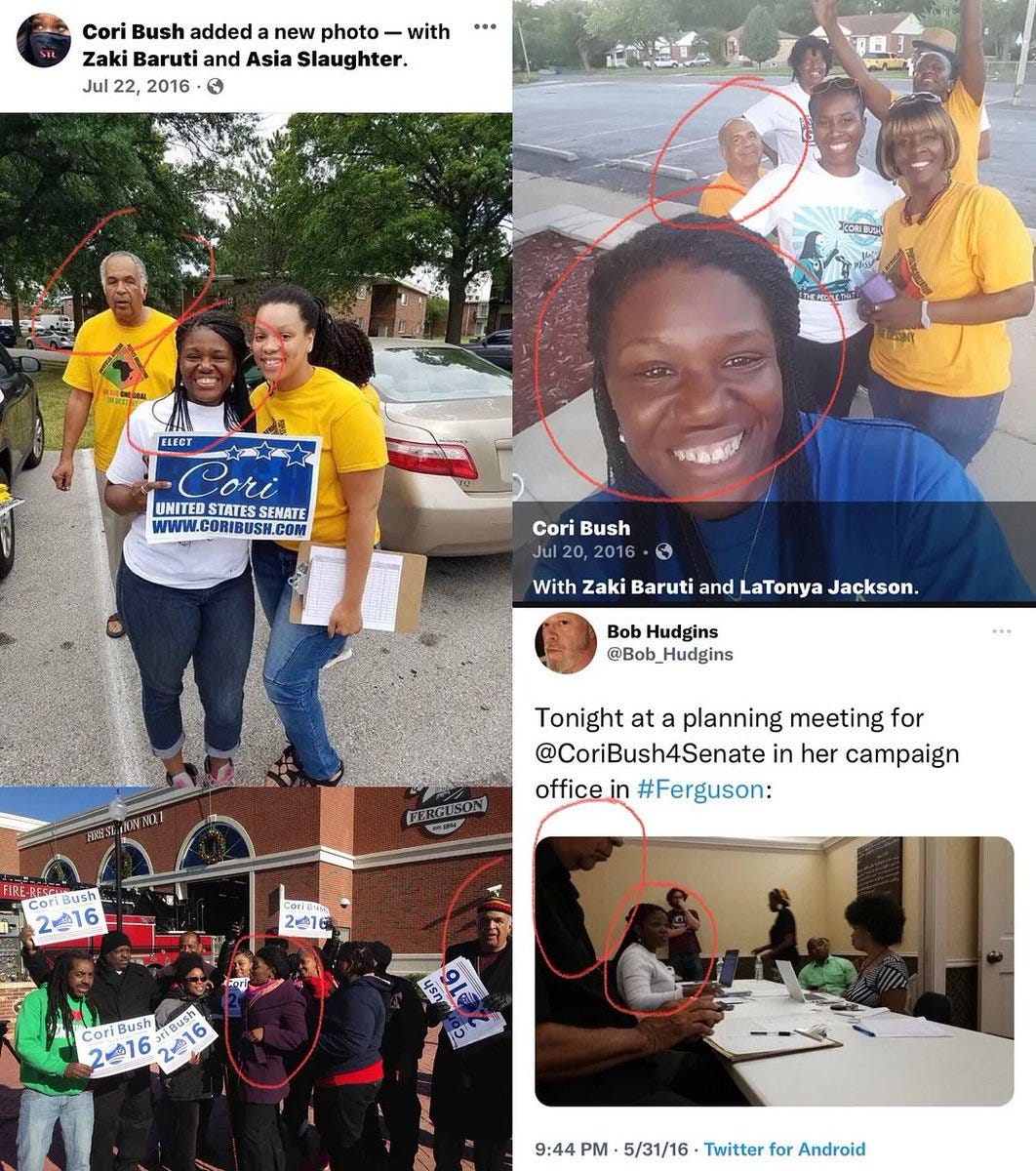
In September 2024, Yeshitela was convicted of conspiring to act as an agent of the Russian government.
Piker’s foreign policy views have also drawn scrutiny. Both The Atlantic and The Dispatch have characterized him as sympathetic toward left-wing authoritarian governments, citing statements in which he expressed admiration for China as his preferred model of socialism, referred to Uyghur detention facilities as “re-education camps,” described Mao Zedong as “one of the great leaders of this world,” and called the collapse of the Soviet Union “one of the greatest catastrophes of the 20th century.” Both publications concluded that Piker’s worldview reflects “broad sympathy for China, Cuba, Russia, and authoritarianism in general.”
Perhaps the most unusual aspect of today’s political landscape is the extent to which ideological extremes occasionally amplify one another.
Tucker Carlson has interviewed or spoken favorably about several figures associated with the anti-establishment left, including Cornell West.
Independent presidential candidate Jill Stein, who served as West’s 2024 campaign manager, has long attracted controversy over concerns about Russian influence. Senate Intelligence Committee reports concluded that Russian-linked social media operations amplified Stein’s campaigns during previous election cycles. Her appearance alongside Vladimir Putin and Michael Flynn at a 2015 Moscow event has remained a recurring point of criticism.
Carlson has also appeared on Alex Jones’ program while suggesting that his political future may lie outside the traditional Republican Party. He has expressed support for fellow Rockbridge Network member JD Vance as a future presidential contender.
The overlap extends into newer media circles. Graham Platner was interviewed on the Valhalla VFT podcast, while Valhalla VFT host Nate Cornacchia has appeared on both the Alex Jones and Jake Shields podcasts.

DeAnna Calderón@DCinTejas
@TheDemocrats need to find their balls and stop defending pro-Russia @grahamformaine. Valhalla VFT promoted Neo Nazi Graham Platner against pro-Ukraine, pro-NATO, and pro-Western Civilization @SenSusanCollins.
4:07 PM · Jun 28, 2026 · 285 Views
1 Reply · 2 Reposts · 4 Likes
Platner has been described as a populist progressive who is critical of the Democratic Party establishment and is challenging pro-Ukraine establishment Republican Senator Susan Collins.
These overlapping media ecosystems do not necessarily indicate ideological agreement. Rather, they illustrate how anti-establishment and pro-Russia and China voices on both the far left and far right can amplify one another when opposing common institutions, whether those institutions are mainstream political parties, corporate media, or the national security establishment.
For establishment Democrats, the central question is no longer simply how to defeat Republicans. It is whether an increasingly organized insurgent socialist movement, that aligns with autocratic regimes, will fundamentally transform the Democratic Party from within.
For establishment Republicans, the challenge is more complicated. While many continue to attack socialism rhetorically, some on the far right find the socialist anti-establishment messaging useful to attack Democrats during elections.
The result is a political landscape in which traditional left-right distinctions have become less predictable, and the proponents of the horseshoe theory have been vindicated.

The far left and far right both support the enemies of the United States and the West. It’s the political moderates and centrists in both parties that’s their target.
—D.C.
Comments
Nothing yet. Say the first thing.
Sign in to join the conversation.