
Today, by a frighteningly slim margin, the Supreme Court of the United States (SCOTUS) voted to keep birthright citizenship legal. It may have felt like a win at first, but what we actually did today was survive a litmus test. One that shows us just how far America has fallen. What we saw happen today shows us the portentous times to come.
On January 20, 2025, day one of his second term, Donald Trump signed 26 executive orders. By the end of week one, the count hit 36. The term “executive order” is generous. It’s really just a memo telling executive branch agencies how to behave within the confines of the law. It’s not a law, you can’t change the law with it, and it’s not the final say.
Among the executive orders that Trump swept his jumbo Sharpie across was Executive Order 14160, “Protecting the Meaning and Value of American Citizenship.”
This EO stated that any children born to an undocumented immigrant or an immigrant with temporary status — such as a tourist, visa holder, or someone here under temporary protected status — were not American citizens unless their fathers were. That they did not have birthright citizenship.
That order had since made the long, inevitable journey to the Supreme Court, a year and a half and several news cycles later. This is the highest court in the land. It was created strictly to uphold the U. S. Constitution and to ensure liberty and justice for all. They’re supposed to be our protectors that sit at the head of the judicial branch of the United States of America untouched by outside influence.
It’s truly a monumental job; perhaps the most important one in America. So, how the hell did we let the Federalist Society walk right in and take it?
If you’ve managed to remain unfamiliar with the Federalist Society until now, consider that innocence spent. And if you are? Well, you probably saw this coming.
Six of its nine justices in SCOTUS have ties with the organization or the men who conceived and control it. The Federalist Society did not build a pipeline to the Supreme Court by chance.
To understand how this happened, you have to understand who they are:
The Federalist Society (FedSoc) is a powerful, conservative lawyer network founded in 1982 by students at Yale and Chicago who felt ‘outnumbered’ by progressives on campus. Trace any case that makes the ACLU lawyers drink, and you will find a FedSoc member on the other side.
The society operates under a legal theory called originalism; they follow the belief that law in America should be interpreted under the original seven articles of the Constitution. Legal amendments — things that abolished slavery, gave women the right to vote, and gave all American’s equal protection — are things they believe should have never existed at all.
With chapters on over 200 campuses, the Federalist Society does not stumble onto its members. It finds them, cultivates them, and sends them out. And that’s the road that led to the birth of Leonard Leo — a lifelong friend of Justice Clarence Thomas — hand-selecting all three justices that Trump placed on the Supreme Court.
Trump appointed three SCOTUS justices during his first term: Neil Gorsuch (2017), Brett Kavanaugh (2018), and Amy Coney Barrett (2020).
The Federalist Society may have started as a fringe college society in 1982, but in 1986 that changed.
Leonard Leo, a law student at Cornell University, stumbled onto the Federalist Society and he is inspired. Since Cornell didn’t have a presence on campus, Leo went on to found the school’s first FedSoc student chapter.
From there Leo built and then used a massive network and billions of dollars in anonymous donations to strategically pack the U.S. court system — all the way up to the Supreme Court — with strictly conservative, ideologically aligned judges.
By also funding state elections and lawyers, he ensured these judges received the exact cases needed to overturn major progressive laws, such as the right to an abortion. Now that he has reshaped the courts, Leo is using a historic $1.6 billion fund to expand his conservative crusade beyond the legal system and into everyday American culture, business, and education.
We could spend the entire hour tonight just peeling back the layers of this thing to show you what’s really going on underneath. But frankly? The details are so deliberately convoluted, so completely exhausting, that it would take longer than any normal, sane person is willing to sit through right now. We’ll save that investigation for another day.
And now that you do, let us talk about just how completely the Federalist Society has woven itself into the Supreme Court of the United States, and how close that relationship came to setting a precedent that American democracy would not have recovered from.
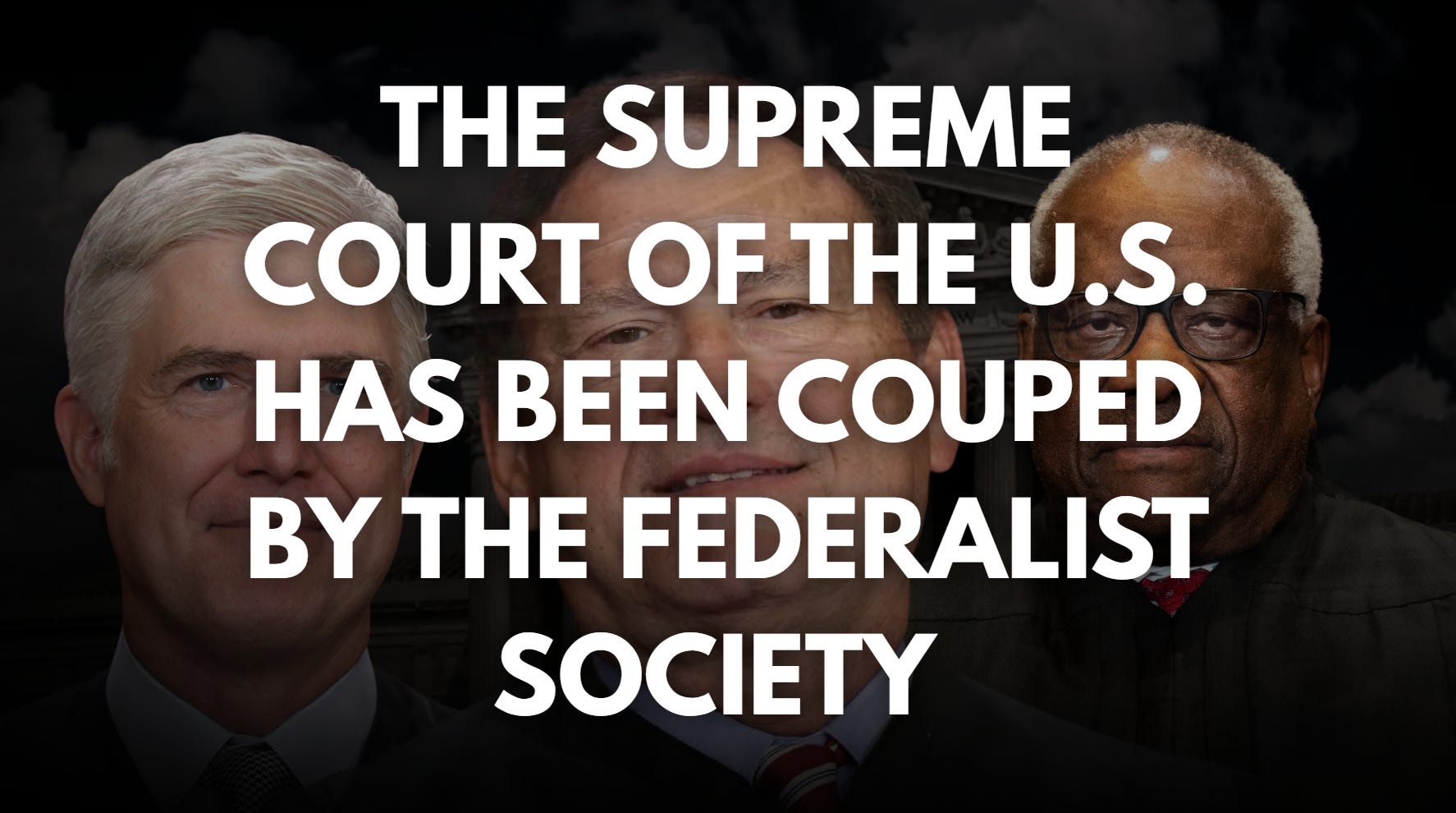
Justices Clarence Thomas, Samuel Alito, and Neil Gorsuch all voted today to get rid of birthright citizenship.
And remember what I said above: the Federalist Society does not believe in any of the constitutional amendments — including the Fourteenth Amendment.
Had it passed, the implications would have stretched far beyond birthright citizenship. It would have established that a president can, by executive order alone, functionally amend the Constitution without amending it. And these guys? They were OK with it.
The three Federalist Society appointees Trump put on this Court, Gorsuch, Kavanaugh, and Coney Barrett, all voted today. Two of them, plus the two FedSoc alumni already seated, refused to say the Fourteenth Amendment itself guarantees birthright citizenship.
Yes, refused. Read the opinion yourself.
Today’s decision in Trump v. Barbara arrived dressed as a headline victory. Every network ran the number 6 to 3 all afternoon. Birthright citizenship stands. The Fourteenth Amendment survives.
Chief Justice Roberts, joined by Sotomayor, Kagan, Coney Barrett, and Jackson, wrote that “citizenship, then and now, was the right to have rights, to freely participate in our political community. The Framers of the Fourteenth Amendment extended that promise to ‘every free-born person in this land.’ We keep that promise today.”
That 6 to 3 headline is a a technicality, and it’s actually worse worse than that. The real vote on the constitutional question was 5 to 4.
Justice Brett Kavanaugh joined the outcome. He rejected the reasoning. In his concurrence, Kavanaugh wrote that Executive Order 14160 doesn’t violate the Fourteenth Amendment at all. According to him, it only conflicts with a 1952 statute, 8 U.S.C. §1401(a), that Congress passed to codify what the Constitution already guarantees.
The Fourteenth Amendment, all persons born or naturalized in the United States, and subject to the jurisdiction thereof, are citizens of the United States, is, in Kavanaugh’s view, no barrier at all to a president stripping citizenship from newborns. He believes Congress could amend §1401(a) or otherwise enact new legislation establishing exceptions to birthright citizenship for children born to foreign citizens unlawfully or temporarily in the country, and he would have zero constitutional objection.
Senators Lindsey Graham, Ted Cruz, and Katie Britt already introduced that bill. It’s called the Birthright Citizenship Act of 2025, and Graham said out loud it was written to codify Trump’s executive order.
That’s the play. Today’s ruling was Leonard Leo showing us where his fifth vote sits and waiting for Congress to hand him the version he can actually win.
Thomas’s dissent runs 91 pages. Ninety. One. Pages. He argues the Fourteenth Amendment applies only to people “domiciled” in the United States, a word that appears nowhere in the amendment itself.
Under his theory, whether a newborn is an American citizen depends on whether their parents had established permanent residence, a question Thomas himself says “is sometimes a matter of great difficulty to decide.”
Gorsuch — a 2017 Trump appointee — he signed onto that dissent.
Alito filed his own to complain about “birth tourists” and to tell the millions of people who would have lost citizenship to take it up with Congress. The same Congress currently sitting on S. 304.
Leonard Leo spent thirty years building the pipeline that produced this exact 5 to 4 split. The Fourteenth Amendment was ratified in 1868 to overturn Dred Scott, to guarantee that no future court could strip citizenship from an American child based on who their parents were. That guarantee just survived by a single vote from a Chief Justice appointed in 2005 by a Federalist Society president.
Celebrate today. Then get to work. Share this information far and wide. Not enough people know about FedSoc. Not enough people know how deep organizations like this have meshed with America. And I am here to shine light on that, so dissent blooms.

Comments
Nothing yet. Say the first thing.
Sign in to join the conversation.