
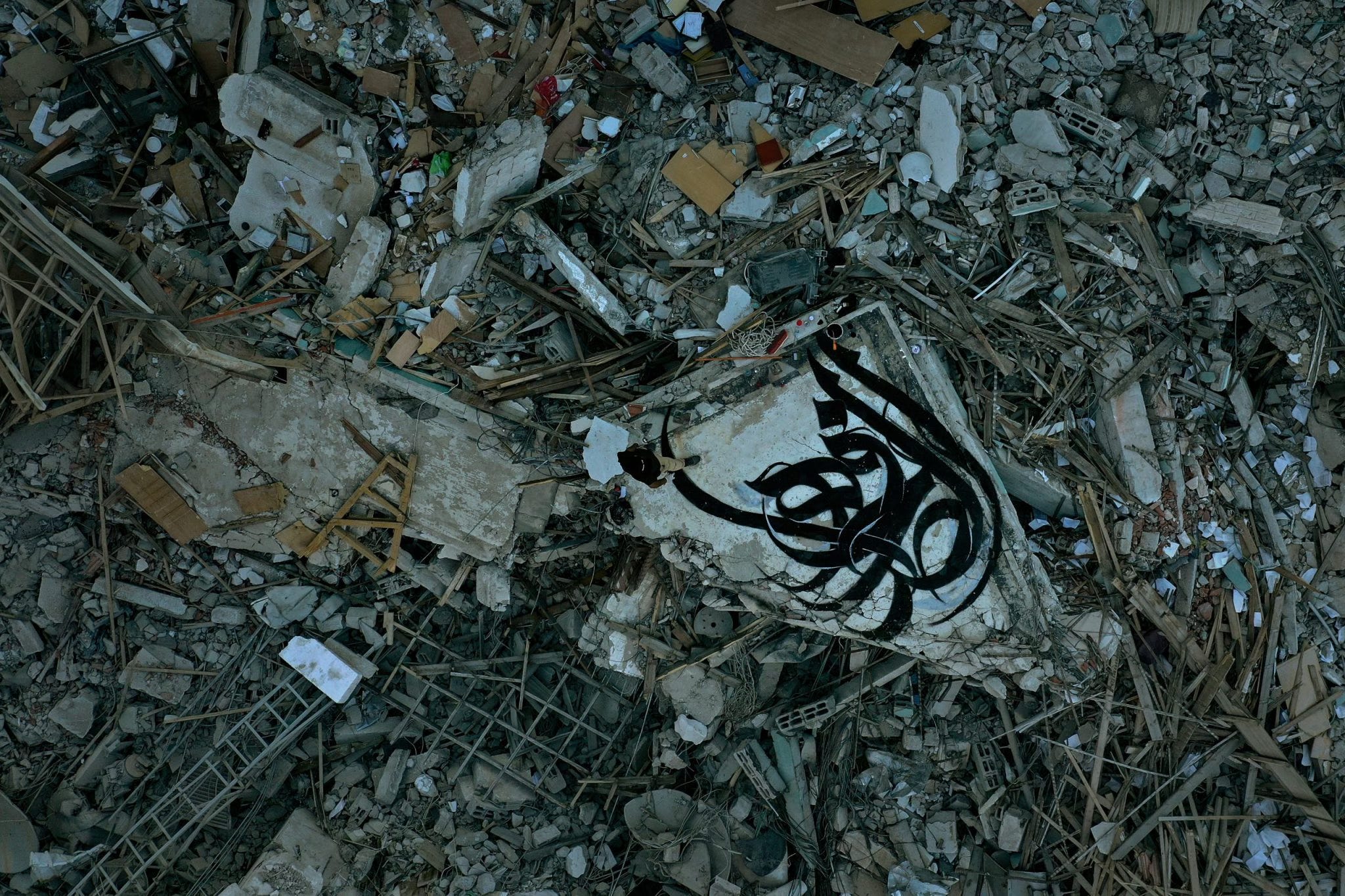
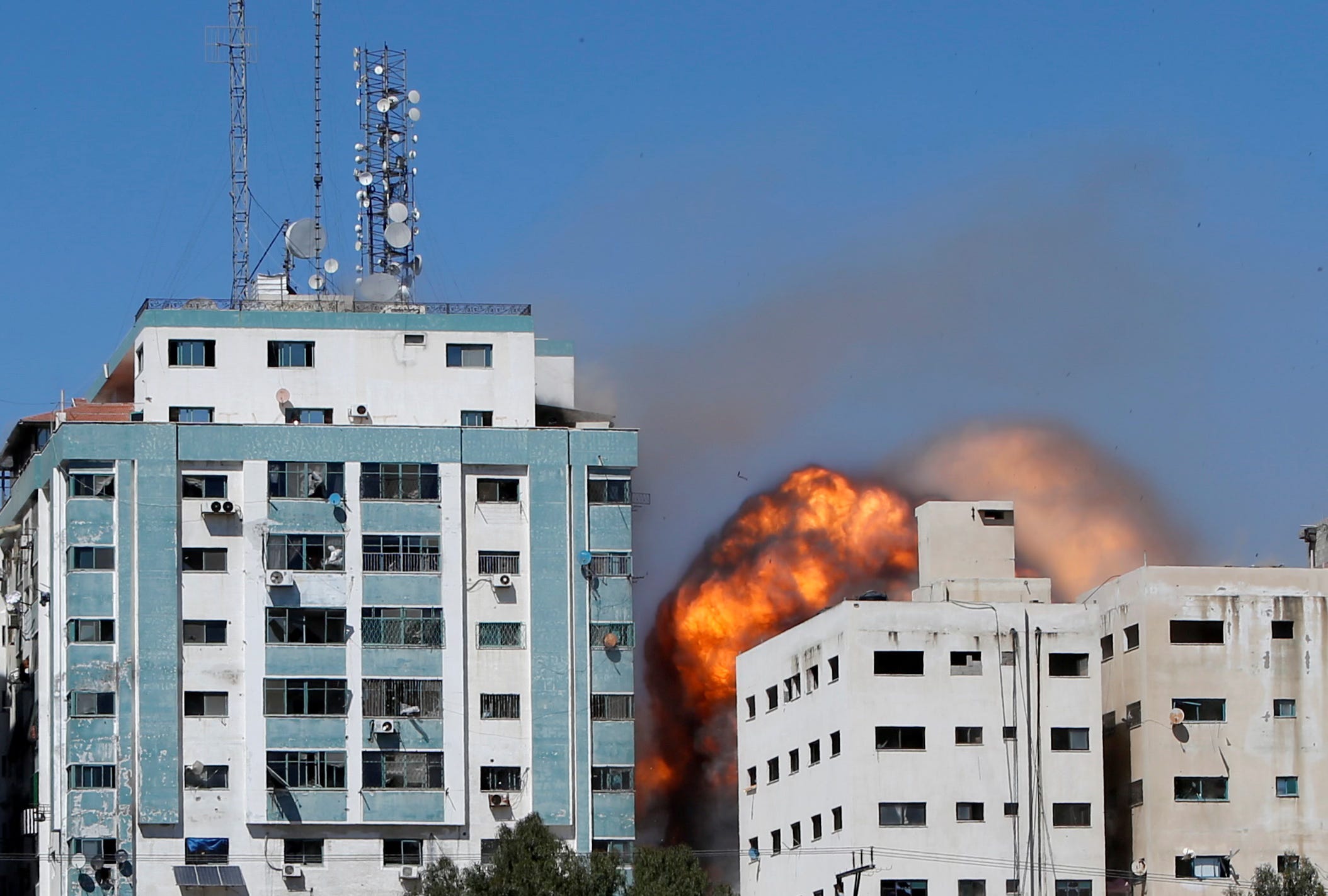
In Gaza, memory is not an intellectual luxury; it is a minefield. To understand what is happening today, you must return with me to the place I once believed was the “center of the world”: the eleventh floor of al-Jalaa Tower.
For many years, the Associated Press (AP) office in the tower was my fortress and my refuge. From behind its panoramic windows, I watched Gaza City wake up, breathe, and bleed. We practiced our journalistic rituals with solemnity: morning coffee, editorial meetings with the regional desk, and debates over choosing the most precise word in the AP Stylebook. We wore heavy blue vests marked “PRESS” as if they were magical talismans protecting us from shrapnel. We were the “observers,” sitting in the ivory tower—literally and figuratively—writing about death from a safe distance that guaranteed “objectivity.”
Today, al-Jalaa Tower is nothing but a heap of rubble and memories. With it, an entire era of journalism has been destroyed. When I look at images of the ruins now, I do not merely see shattered concrete; I see the grave of my professional memory. In Gaza, we have moved from the era of the “journalist as witness” to the era of the “journalist as victim”—a shift that changes the very essence of truth and the future of those who tell it.
Returning to my archives, I find that the transformation in journalism did not happen suddenly; it was a slow, painful collapse.
In 2006, after Hamas won the elections and the siege began, the tone of my reporting shifted. I was no longer writing about the “peace process,” but about the Gaza blockade and power struggle between the rivals Fatah and Hamas.
I recall filing a report about the disappearance of basic commodities. It was then that I began to notice the erosion of the line separating me from the story. I covered the missing of new born children in the morning only to return home and find myself part of that same crisis. Yet, we still felt that “the world was watching,” and that our presence as journalists for an international agency constituted a deterrent.
The 2009 war came to test that illusion. It was the first time we saw white phosphorus light up Gaza’s sky like demonic fireworks. We began to smell burning flesh up close. Still, we returned to the office, turned on the generators, and filed the images. My news organization at that time was still able to protect us logistically. We felt we were shielded by the force of international law and the prestige of American journalism.
In 2012, during the eight-day war, I wrote about the “speed of death.” The war was brief, but it left a lingering question: Are we covering the war, or is the war covering us? I began to see fear in my children’s eyes—a fear I could not suppress in my initial drafts, which editors would later rewrite to make more “neutral.”
I vividly remember the 2014 war. Airstrikes shook the walls of the office, yet we possessed “survival technology”: generators, BGAN satellite connections, and a team of editors in Jerusalem and Cairo reviewing every word. The major battle then was over terminology. We spent minutes debating whether to use “airstrike” or “explosion,” “martyrs” or “dead.” That “objectivity” was our professional shield, separating us from the hell on the street below us.
But I recall one brutal night during that war. I was sitting behind my screen, writing a breaking news story about shelling in the North Remal district. As I counted the casualties in my report, my phone rang. It was my wife, screaming because shrapnel had struck our home’s window. At that moment, the pen fell from my hand. How can I be a “neutral international journalist” when my family is the “news”?
If previous wars had cracked the wall of journalistic protection, the 2014 war brought it crashing down on our heads. The war lasted 51 days. We worked like machines, slept under desks, and shared canned food for days when we were unable to buy hot meals or to go back home. But the date I will never forget is August 13, 2014. That day, our team went to cover the dismantling of unexploded Israeli missiles in northern Gaza town of Beit Lahiya.
The team included the brave Italian journalist Simone Camilli, our translator and dear colleague Ali Abu Afash, and AP’s veteran photographer, Hatem Moussa. We were in the office waiting for the images when suddenly the ground shook—not from an airstrike, but from news that struck us like lightning: “The missile exploded on the team.”
Simone was killed. Ali was killed. And Hatem Moussa—Hatem, the agency’s tireless eye—returned to us torn apart. With his leg amputated and shrapnel piercing his body, we lost the “innocence” of journalistic work. I clearly remember the heavy silence that descended on the office. It was not just grief; it was existential terror. We realized then that the “PRESS” label meant nothing to iron and fire. Hatem’s injury was not a workplace accident; it was a bloody message that we were all deferred martyrs.
I wrote reports about the incident, but the words felt hollow. How do you describe “objectivity” while washing your colleague’s blood off the office floor? In 2014, journalism in Gaza lost its “distance.” We became the story.
That duality is what tears the Gaza journalist apart—a betrayal of the self for the sake of the profession. I would return home after a grueling day, the smell of gunpowder and smoke clinging to my pores, trying to wash it away with scarce water so I could hug my children without passing on the terror of the field. But the terror was not in my clothes; it was in my eyes.
Those events drove me to take my family and leave everything I had built in Gaza, searching for a place that could offer my children safety—a long journey that eventually led me abroad. But the war of October 7 came to erase everything that came before.
There are no longer towers for journalists to shelter in. Today, my young colleagues do not have the luxury of returning home; their homes have been destroyed, their offices have become tents, and their families are killed before their lenses.
I think of my colleague Samer Abu Daqqa, a cameraman for Al Jazeera whom I knew for years. What happened to Samer in Khan Younis during this war is a crime documented down to the minute. Samer was injured and bled for long hours inside a besieged school.
Imagine the scene: a journalist wearing his protective gear, bleeding, his colleagues just meters away screaming for help, yet ambulances were barred from approaching by military coordination. Samer was left to face his death alone, slowly, while drones—the buzzing zanana—watched his final breaths.
Samer’s killing was not “collateral damage”; it was an execution through the denial of rescue. It sent a message to every journalist in Gaza: “We will not only kill you; we will deny you mercy as you die.”
Beyond the headlines, a war rages inside journalists’ skulls. At AP, we trained in “safety protocols,” but no one trained us in “grief protocols.” The journalist in Gaza today suffers from compound trauma. They are not merely witnesses; they are victims pretending to be composed. Survivor’s guilt gnaws at the soul: Why did I survive while Samer was killed?
The journalist now faces a brutal role duality, putting the camera aside to carry body parts or help perform surgery without anesthesia, then returning to document the aftermath. This overlap kills neutrality. Journalism has lost its privacy; reports now revolve around the reporters’ own lives—one colleague speaks of searching for a bathroom, another of hunger. The journalist has become the “case study” of the humanitarian catastrophe.
This raises the question: where are we headed? Gaza’s media infrastructure has been annihilated. Yet from this devastation, a new form of journalism is being born.
The rug has been pulled out from underneath major agencies. The world now sees the war through the lens of TikTok and Instagram, with the photographer being the new generation. These young people—in their twenties, working with rudimentary equipment—have achieved a breakthrough in global awareness that our long reports failed to achieve for decades.
They did not graduate from Reuters or AP schools as I did. They were not trained in “cold neutrality.” They were trained in the school of direct oppression. They work under a suffocating siege, without protective gear or stable salaries, relying on expensive eSIMs to stay connected to the world.
But they face a terrifying fate. They suffer levels of psychological trauma that have no medical classification yet. They work while in mourning—burying a brother in the morning and filming a report in the evening. This forced dissociation leads to nervous collapse. Furthermore, as the war drags on, “compassion fatigue” has begun to affect Western audiences. The young journalist today feels he is screaming into a deep void. That sense of isolation is a silent killer.
As a veteran who covered previous wars, I must offer a professional reckoning of this genocide—a brutally harsh one.
The Masks Have Fallen: This war taught us that the “objectivity” I studied was sometimes a trap. Major Western media outlets fell spectacularly at the beginning of the war, adopting the Israeli narrative without verification—such as the “beheaded babies” myth—while casting doubt on every image coming from Gaza. The lesson is clear: there is no neutral professionalism during genocide; neutrality is complicity.
The Failure of Protection: The harshest lesson is that international laws protecting journalists are ink on paper. The blue vest did not protect Samer Abu Daqqa, nor Hamza Dahdouh. Relying on “international immunity” is a form of suicide.
However, we have learned the power of humanity. When journalists speak in their own voice, with their feelings and colloquial language, they are a thousand times stronger than polished press statements. Young journalists broke the fourth wall and spoke directly to the audience: “Hello, I’m still alive, and this is my breakfast.” This spontaneity defeated millions of dollars of propaganda. Truth is no longer monopolized by bureau chiefs in high towers; it has been decentralized.
I left my office in al-Jalaa Tower years ago, and now the tower itself no longer exists. But the spirit that inhabited that office has not died. It has moved from our generation—the generation of clean vests—to the generation of tents and broken phones.
The future of journalism in Gaza lies in transforming this spontaneous documentation into forensic evidence. Journalism must evolve to become a partner of international courts. Every video filmed by a young journalist is an indictment that does not expire.
But my greatest fear is the migration of minds. If these young journalists leave in search of trauma treatment, Gaza will sink into an information blackout, leaving only the Israeli narrative. The world must provide them with a safety net now, not later.
What I learned from Hatem Moussa’s injury in 2014, and from Samer Abu Daqqa’s killing in 2023, is that truth in Gaza is paid for in blood. To the world reading this: do not read casualty numbers and pass over them lightly. Behind every number is a journalist who risked their life to bring you a name—and perhaps paid with their life for that name.
Journalism in Gaza will not stop. You may break the cameras, bomb the towers, and kill the storytellers—but the story, the Palestinian narrative, is resistant to assassination. There will always be a hand rising from beneath the rubble, holding a phone with a weak battery, to write to the world one sentence:
“We are still here… and the broadcast has not ended.”
Ibrahim Barzak is a Palestinian journalist with more than three decades of experience in conflict reporting. He served as Gaza chief correspondent for The Associated Press between 1992 and 2014, and later served as editor-in-chief at 218 TV and as deputy news editor at TRT World. He was a Nieman Fellow at Harvard University in 2010.
Comments
Nothing yet. Say the first thing.
Sign in to join the conversation.