
We are drowning in data, yet starving for truth. The narrative around the conflict in Gaza has been as destructive as the bombs themselves—from stripping Palestinian victims of their humanity to the exclusion of foreign journalism and the delusions of regional media.
In the age of the smartphone, the saying “truth is the first casualty of war” was supposed to belong to the past. The promise was that the democracy of the camera lens would make it impossible to hide atrocities. And yet, as the dust settles on the latest catastrophic chapter of the Gaza war, we are confronted with a painful paradox. By every quantitative measure, this conflict has been one of the most documented in human history. It was livestreamed, tweeted, and displayed in an unbroken 24-hour loop of visceral intimacy. And yet it may remain the most fundamentally misunderstood.
We watched the war in 4K resolution, but we were looking through a distorted lens. A deep chasm opened between what was visible—the spectacle of kinetic violence, the daily body counts—and what was missing. And what was missing were not minor details, but the structural pillars of reality, deliberately obscured by military censorship, unintentionally filtered out by Western editorial bias, or warped by the populist hallucinations of regional media.
To understand Gaza’s devastation, we must look not only at the rubble, but at the narrative machine itself. We must ask: how can so much be seen, yet so little understood?
The Siege on Truth: The Death of the Independent Witness
The primary distortion of this war began at the border crossings. From the outbreak of the war until the writing of this article, the Israeli government kept the Gaza Strip almost completely sealed off to international journalists.
This decision—unprecedented in its duration and severity compared to other modern conflicts such as Ukraine or Iraq—turned Gaza into a narrative black box.
The result was a fractured reality. Leading global news organizations were forced into a professionally humiliating compromise: covering a war they were effectively barred from seeing. When foreign correspondents were allowed in, it was aboard Israeli armored vehicles and on tightly controlled “embedded” missions.
These tours offered a narrow view of the conflict: a guided visit to a specific tunnel here, a weapons cache there—always under the watchful eye of the Israeli military censor.
The audience saw the reporter wearing a flak jacket and assumed they were seeing the war. What they missed was the truth: the reporter could not pan the camera left or right, could not speak to the trembling Palestinian family in the nearby ruins, and could not independently verify the army’s claims.
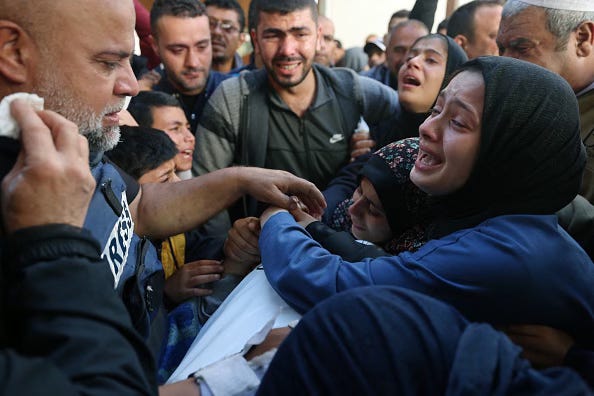
This exclusion placed the entire burden of bearing witness on local Palestinian journalists. These men and women—like Al Jazeera’s Wael Al-Dahdouh—became the sole custodians of the visual record. Yet they were covering events while dying themselves. They filmed the destruction of their own neighborhoods, often burying their children in the morning and returning to broadcast in the afternoon.
Speaking about this reality, journalist Al-Dahdouh said that in light of total isolation and the mass displacement of the population under relentless bombardment, journalists were left with only one choice: to continue working despite knowing that every step could cost them their lives. In a recorded message broadcast during a seminar organized by the United Nations Department of Global Communications in November—held under the title “Breaking Barriers: Confronting the Risks and Complexities of Media Coverage from Gaza and the West Bank”—he added that Palestinian journalists carried a profound sense of responsibility, realizing that “if we do not do our duty, even if it costs us our lives, the world will not see what is happening to two million people.”
More critically, their footage was often subjected by Western newsrooms to a “verification tax”—a skepticism rarely applied to the polished briefings of Israeli spokespersons. The absence of neutral, third-party international witnesses created a “verification vacuum,” allowing the denial of famine and the downplaying of civilian death tolls to persist in diplomatic circles long after the reality on the ground became undeniable.
A Hierarchy of Grief: The Dehumanization Gap
If the physical war was defined by restricted access, the narrative war was defined by a staggering imbalance in empathy. This “dehumanization gap” may be the most insidious element of what we missed.
The Passive Voice of Death
A linguistic analysis of headlines and news copy reveals a troubling trend. In much Western media, Israelis were “killed” or “slaughtered”—active verbs that imply a perpetrator. Palestinians, by contrast, simply “died.” Lives were “lost,” or they were victims of “explosions.”
This passive construction functions as a psychological buffer. It removes responsibility from the killer and presents Palestinian death as an inevitable tragedy, akin to a flood or an earthquake, rather than the result of specific military decisions.
The Identifiable Victim Effect
Psychologists speak of the “identifiable victim effect,” whereby people feel greater empathy and are more willing to help a single, known individual than an anonymous group. Media coverage leaned heavily on this bias.
What was visible:
Israeli captives and the victims of October 7 were (rightly) given names, faces, hobbies, and personal stories. We knew their parents’ names; we saw their bedrooms. Their humanity was presented in full, three-dimensional detail.
What was missing:
For months, Palestinian victims were reported as aggregate numbers. “100 killed in Jabalia” became a statistic, not a tragedy. We rarely heard about the dreams of a teenage girl killed in an airstrike or the career of a doctor buried under rubble—until months later. By the time features began to humanize Palestinians, “compassion fatigue” among global audiences had already set in. The delay in granting humanity meant that Palestinians, during the crucial opening months of the war, were not seen by many in the West as individual human beings, but as a “population” or a “security threat.”
The Illusion of Victory: Failures of Arab Media
Yet distortion was not the exclusive domain of Western media. A different, but equally damaging fog descended over much of the Arab media landscape. If the West suffered from a deficit of empathy, parts of the Arab world suffered from a surplus of illusion.
Across satellite channels and algorithm-driven platforms from Doha to Beirut, narratives of “steadfastness” and “tactical victories” often eclipsed the grim reality of material annihilation. Audiences were shown videos of burning Israeli tanks and red triangles marking targets, accompanied by analysts predicting the imminent collapse of the Israeli army or economy.
What was missing—often shouted down in rejection—was the strategic reality that Gaza had been rendered uninhabitable. The popular rush to project strength in the face of humiliation fueled the circulation of misleading assessments and, in some cases, outright disinformation. Old footage from Syria or previous Gaza wars was recycled as fresh “victories,” creating a dopamine loop of false hope.
This disconnect was an injustice to the victims. By framing the comprehensive destruction of Gaza’s infrastructure and the starvation of its population as part of some “masterful strategic lesson,” media narratives obscured the desperate humanitarian plea for a ceasefire. This created a state of cognitive dissonance in which the Arab street celebrated resistance while Gaza’s residents cried out that they had nowhere left to sleep. The refusal to confront the scale of the defeat—the loss of homes, schools, and history—was a form of abandonment disguised as solidarity.
The Cost of Absence: Erasing the Crime Scene
Why does the ban on foreign journalists matter so much? It is not merely a complaint about reporters’ working conditions; it goes to the core mechanism of truth itself.
The denial of access created a vacuum in which propaganda on all sides could flourish unchecked. Preventing journalists from entering was not just a security measure; it was a strategic erasure of evidence. It allowed the war to be waged in a “gray zone” where truth was malleable. The result was that Israel’s supporters could deny the scale of famine, and Palestine’s supporters could deny the complexities of urban warfare, because the neutral arbiters—the journalists—were confined to the borders.
What we saw were the explosions. What we missed was the forensic investigation.
In the end, the paradox endures: we have never seen a war more clearly in 4K resolution, yet we have never been more blind to the human and political reality on the ground. Rebuilding Gaza will take decades, but rebuilding the truth—sorting through bias, propaganda, and omission—may take even longer.
Ibrahim Barzak is a Palestinian journalist with more than three decades of experience in conflict reporting. He served as Gaza chief correspondent for The Associated Press between 1992 and 2014, and later served as editor-in-chief at 218 TV and as deputy news editor at TRT World. He was a Nieman Fellow at Harvard University in 2010.
Comments
Nothing yet. Say the first thing.
Sign in to join the conversation.