
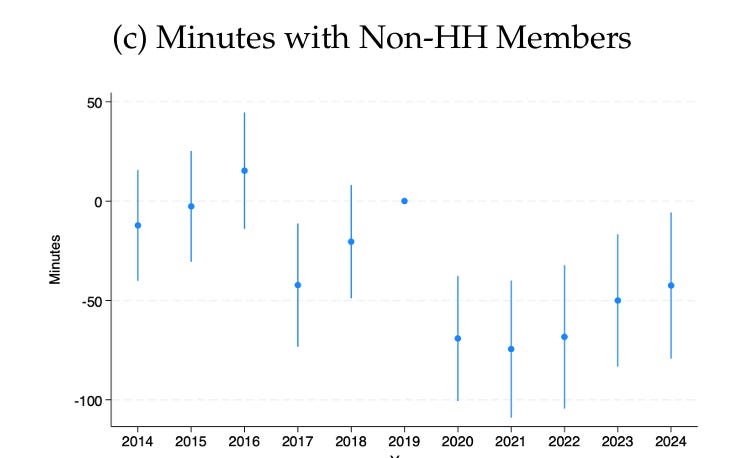
As the structure of work changes from work in an office to remote and hybrid work, the people we spend time with will also change. Benjamin Cowen and Todd Jones use the American Time Use Survey in their paper “Social Substitution? Time Use Responses to Increased Workplace Isolation” to explore whether those who work from home substitute time with coworkers with other social connections. They find that although time with family members is higher for those working from home, time with people outside the household goes down.
Panel c) of Figure 2 of their paper shows this. They are using what is now a pretty standard design for understanding the role of teleworking on behavior - using teleworkable jobs (relative to those that are not teleworkable) and looking before and after the big change in overall working from home in 2020.
This comes at a time when major health organizations, such as the World Health Organization and the US Surgeon General, have highlighted loneliness as a global health issue. This is not just a post-2020 or remote-work problem, though Cowen and Jones’ finding suggest that remote work may make it worse. Robert Putnam’s 2000 book Bowling Alone discussed the long-running decline of many civic organizations that once provided community outside of work.
Since reading this paper, I have been paying more attention to how I spend my time, and who I spend it with. I read it during the government shutdown, so I was both more isolated than usual and had more freedom to try to reduce that isolation by spending time in my community. I made a point to spend at least a little time with people outside my household each day, even if that just meant taking my book to the library or a coffee shop without actually socializing.
But I discovered that, at least in the “after work” hours, I already spend some time with people outside my household. I was coaching my daughter’s robotics team, swimming at the city pool, attending book club meetings, and going to my international folk dance group. My husband, who also works remotely, attends taiko classes (when he is not recovering from a woodworking injury to his hand), and refs soccer, along with also going to folk dance. Working from home is giving us time to do things for ourselves, our kids, and our communities that we didn’t have time for when we went to the office every day.
The community engagement that we do now is a change from life in DC, both pre- and especially post-2020, where I felt extremely isolated and lonely. I never really found a community there, and my colleagues lived in other neighborhoods, so I almost never saw them outside of work. I had some friends who were parents of my kids’ classmates, but as soon as their kids changed schools, those connections drifted away. That loneliness is a piece of what drove me away from DC and back to California. If I wasn’t going to have colleagues and friends to see regularly, I needed to be closer to my family.
Remote work could increase social isolation if workers aren’t intentional about taking advantage of the opportunities available to reinvest in their local communities. But it could also be a way to re-establish the connections that have been deteriorating for several decades. Both the structure of work and the structure of communities matter. Hopefully the pattern the Cowen and Jones found is not a steady-state, but the beginning of a recalibration towards more community engagement with the restructuring of our work and home environments.
No posts
Comments
Nothing yet. Say the first thing.
Sign in to join the conversation.