
The bravest are surely those who have the clearest vision of what is before them, glory and danger alike, and yet notwithstanding, go out to meet it.
The morning after Robert told them about Bloomsbury, Francis went to the vestry at All Saints’ and spent two hours with the seventeenth-century burial records and came back with a set of measurements and a theory about a yew stump.
It was Saturday. Doreen was at the library until noon. Robert was at the Blue Boar writing up the previous night’s account in the shorthand he used for things he wrote primarily to fix in his own memory rather than to transmit to anyone else — a distinction that had become, over four months, one of the more useful private disciplines of his professional life.
His left wrist rested on the table, palm-up. He had not slept particularly well, and had not expected to, and had stopped some weeks ago resenting himself for the expectation.
He had told them everything.
In order — the Corby inquest, the Harmon-Lessiter search, the Companies House anomaly that should not have existed and had taken him four months of careful, patient digging to confirm did exist, the two visits to the Bloomsbury address, the second visit and what he had found on the second floor and the stairs and the wrist and the hospital afterward.
He had told them about the spatial geometry of what he had encountered there and about the geometry of what the three of them had witnessed together in the channel at high water in June, and about the relationship between the two — a relationship he had understood, he told them, with the specific, unwelcome clarity of a man who had spent two years learning a language nobody wished to teach him, one impossible angle at a time.
He told them the understanding had cost him a left wrist that ached in cold weather, a management protocol he now ran automatically in every unfamiliar room he entered, and a private rule, observed without exception, against permitting himself to think certain thoughts in the last few minutes before sleep.
He had told them, at the very end, in the flat register he used for the things that mattered most, that what occupied the Blackwater and what had occupied that building in Bloomsbury were not the same kind of thing at all.
Doreen had said, “I know,” in a voice that made it clear she had known for some time and had simply been waiting for him to be ready to hear himself say it.
Francis had said nothing at first. He had listened with the complete, undeflected attention he had once reserved for the testimony of men who had been somewhere he had not and needed, above every other consideration, to be believed — a listening he recognised in himself now as something the war had taught him and the war, at least, had taught him well.
When Robert finished, he had sat a moment with his hands flat on the table, and then said only: “Thank you. That changes what I understand about Hangard Wood.”
He had not yet said what Hangard Wood had been.
Robert had not asked.
The account had been given and the account had been received, and whatever Hangard Wood was would surface in its own season, through its own quiet erosion, the way everything in this investigation seemed to surface — not by confession, but by the slow admission of weight that could no longer be carried alone…
Now Robert sat at the Blue Boar on a Saturday morning, writing, and down the street Doreen was in the library, and at the vestry Francis was finding a yew stump, and each of them was, in their separate ways, doing the only thing available to a person who has been told something unbearable and must, nonetheless, be at his desk by nine.
At noon Doreen came to the Blue Boar. She sat across from Robert, ordered tea, and looked at his notebook without reading it — the specific unfocused look she gave things when her attention was on something adjacent to what her eyes rested on.
“Thornton,” she said.
Robert looked up.
“We need to go to Osea,” she continued.
“The document’s last section names it specifically — not by its present name, by a locative description matching its position in the estuary. It’s a relay point in the geometric network. One of the secondary nodes.” She wrapped both hands around her cup of tea, not for warmth so much as for the small, grounding fact of the cup being there.
“If we’re to understand the full geometry before the anniversary — before we can do anything at all about the anniversary — we need to know what Osea keeps.”
“What does Osea keep?”
“I don’t know exactly.” A rare admission from her, offered without apology.
“The document uses a word I’ve been translating as relay, though it may sit closer to echo — a place where the signal from the deep channel is amplified and sent on to the shore.” A pause.
“What I do know is that the island’s basement, older than the Charrington family’s building works, houses the relay function. And that it will be staffed.”
“By whom?”
“By people who are not entirely people,” she said, with the flat, exact precision that had entered her speech since she had broken the seal on her own pages — language that had migrated, in the space of a single evening, from the careful and inferential to the direct and declarative, as though the act of reading what she had sealed had burned off some final, protective layer of professional mediation and left her, now, simply saying things as they were, rather than as it had once seemed safe to say them.
“Thornton,” Robert said again.
“Thornton has a provisioning run to the island most months,” she replied.
“I asked him.”
“When?”
“This morning. On the way to the library.”
Robert looked at her. She looked at her tea.
There was a quality to this exchange — the town’s Keeper of the Plume Library accosting a barge skipper about provisioning schedules before seven in the morning, having read the pages that had finally broken her open the night before — that struck Robert as entirely characteristic of her and freshly, specifically alarming in equal measure, because he had learned, across four months, that the speed of Doreen’s action before breakfast was a reliable barometer for how badly she believed a situation required it…
“When’s the next run?”
“Wednesday,” she said.
He said it on Monday evening, aboard the Maid of the Blackwater, in the cabin, where he said the things that needed saying in private.
The folding table. The tea, produced without ceremony or discussion, because the four of them had reached the point in their acquaintance where certain gestures no longer required explaining. This was, by now, a familiar configuration — they had sat in this cabin before, on the night of the June tide, and the cabin itself seemed to remember it, the way a room remembers the last serious conversation held inside it.
“The Charrington family took the island in 1903,” Thornton said.
“Before them, farmland — the Farrants worked it a hundred years. Before that, I don’t know who held it, but my grandfather said there was a caretaker family on the island before the Farrants, and a caretaker family before them, and going back as far as his knowledge and his father’s knowledge reached, the island had never, not once, stood unoccupied.”
“What kind of caretaking?” Francis asked.
“He didn’t specify.” Thornton’s voice took on the particular flatness he used for the sentence that meant, precisely, he didn’t specify, and I was old enough by then to understand that some specifications were not being requested.
“The Charringtons run the retreat there now. Wealthy people with drink problems. Clean air, abstinence, organised activity. It’s a genuine operation — I’ve supplied their kitchen since 1905, the residents come and go, the household accounts are kept honestly. The Charringtons are decent people doing what they believe to be a good thing.” He turned the mug slowly in his hands.
“But.”
“But,” Francis agreed.
“The permanent staff.” Thornton looked at the tea rather than at any of them.
“Four of them. They were there when the Charringtons arrived, and asked to stay on, and the Charringtons — who needed people who knew the island — agreed. They maintain the property. They manage the causeway and the boats.” A pause, longer than his usual considered ones.
“They have been there, in one composition or another, for as long as anyone I know of has been going to that island.”
“What do they look like?” Robert inquired.
Thornton looked at him — carefully, the attention of a man being asked, at last and directly, a question he had spent a great many years thinking about and had not expected to be asked aloud.
“They have the quality,” he said.
“The north shore quality. The Goldhanger families. The broad face. The still eyes.” He stopped.
“The one nominally in charge of the others — a man of perhaps fifty-five called Greer — has been there since I began the run in 1905. He was middle-aged then. He is middle-aged now. He was middle-aged in 1905, when he had no business being anything but a young man just starting out.” He set the mug down.
“I have been looking at the same face for eighteen years. It has not aged in the way faces age. I noticed it, properly noticed it, perhaps five years ago. I’ve been turning it over since.”
Nobody spoke.
“The same age,” Francis said, half to himself, the antiquarian’s habit of repeating an impossible fact until it settled into something he could hold.
“I have thought,” Thornton said, “that a man could go mad simply from being made to notice a thing like that, and being given no one to say it to who wouldn’t think him mad for the noticing.”
Robert was writing.
“The basement,” Doreen said.
“Under the main house.”
Thornton’s look at her carried the particular attention he reserved for being anticipated in something he had not yet said.
“You know about the basement.”
“I know there is one,” she replied.
“I know it’s old.”
“Old is a word.” He almost smiled, and did not quite complete the motion.
“I’ve been in the upper level — where they keep the provisions, the coal, the seasonal equipment. It smells wrong. Not damp-wrong, which you’d expect in a building on an island. Wrong a different way.” He paused, and the pause this time had weight in it, the specific weight of a man deciding, at last, to set something down he had been carrying so long its shape had become part of his own.
“There’s a second level below that one. I’ve been in it once, for reasons that weren’t intentional. I went through a door I shouldn’t have, looking for a misplaced crate, in the winter of 1917.”
“What did you find?” Francis asked.
The pause this time ran longer than any before it.
“Stone,” Thornton said at last.
“The walls below the second level are stone — not flint, not brick. Stone I can’t place to any period of building I know, and I’ve spent my whole life among old buildings on this coast. The floor is stone too, and wet — not with damp, with what comes up through it. Salt water.” He looked at his hands.
“There’s a sound, from further below still, that I have no words that fit it properly. I’ll say only this: it is not mechanical. Not tidal. Not any sound I’ve heard from this estuary in forty years of working its water. I went back through the door. I put the crate where I’d found it. I said nothing to anyone.”
“Until now,” Robert said.
“Until now.” Thornton looked at each of them in turn — Francis, Robert, Doreen — with the specific gravity of a man handing over something he had held alone for six years and was glad, whatever it cost him, to be rid of.
“You asked me once, the night of the June tide, what my grandfather said the island was. I told you: a waystation. A place of business for the things that come in off the deep channel. That was his word, and I have carried it beside everything else I knew for forty years without once saying it to a living soul who might do something with it.” He set his cup down with a small, deliberate finality.
“I haven’t been below the second level since. I don’t intend to go again. What you do on Wednesday is your own business.”
“You’ll take us then?” Francis said.
“I’ll take you.” He said it without hesitation, which Francis understood — watching him say it — to be its own kind of courage, the plain unglamorous courage of a man doing a frightening thing not because he had stopped being afraid but because the alternative, watching from the shore while three people he had come to respect walked into something he had spent forty years learning to avoid, was worse.
“You’re three people who know what you’re looking for. The provisioning run is legitimate cover. The Charringtons will be at the house. Greer will be at the boathouse.” He paused.
“Stay above the second level.”
He said it with the specific flatness of advice he already expected to be ignored, and offered anyway, because a man who has spent his life on tidal water learns that giving good advice is worth doing even when — especially when — you know it will not be taken…
Francis met his eyes.
“We’ll see what’s there.”
Thornton nodded, slowly, without surprise.
“I know,” he said.
“That’s why I said it.”
October had remade the estuary. June had offered the silver version — the flat metallic calm of a high-pressure system sitting for days over the coast, handsome in the unshowy way of the Essex shoreline.
October was the estuary at its most essential self: sky greying by eight and staying grey with the settled, unthreatening commitment of weather that has made up its mind, the light flat and without depth, the water gone the colour of old pewter, the saltmarsh on the north shore turning amber and rust with the season’s slow accounting, the curlew giving way to the geese arriving from wherever geese arrived from to take up the argument the curlew had left off.
The Maid of the Blackwater left the Hythe at nine, riding the first hours of the flood — they needed a good three hours’ depth above the bar at the island’s eastern approach, and Thornton took her down-river with the particular economy of a skilled bargeman, the appearance of doing almost nothing while the vessel did precisely what was asked of it, which Francis had come, across these months, to recognise as a species of grace entirely its own.
They stood in the well and watched the estuary slide past.
The Northey causeway showed itself as they passed — the narrow line of shingle and mud, passable at this state of tide, running out to the island’s southern tip.
Francis had watched Northey from the water since boyhood, but the watching had a different quality to it now; what he knew changed what his eyes did with what they saw. The north shore of the island, the channel side, was where the depth ran wrong. Nothing showed at the surface. He looked anyway, because looking, he had come to understand, was no longer a choice so much as a compulsion the last four months had installed in him — the same compulsion, he suspected, that had kept Marsh writing impossible depth soundings into a professional notebook until the professional notebook could no longer hold the shape of a professional man.
Robert was checking his camera’s shutter, not the water. Doreen was watching the water directly, deliberately, hands in her coat pockets, chin very slightly lifted, with the composed, methodical bearing of a woman who has decided to face a difficult ward round and intends to do it properly.
Francis, watching her watch it, thought of a phrase from somewhere in his reading — he could not place it, only that it concerned courage being not the absence of fear but its proper subordination — and thought that Doreen Webb, was very possibly the bravest person he had ever stood on a barge beside, including men he had recommended for decorations that were never awarded.
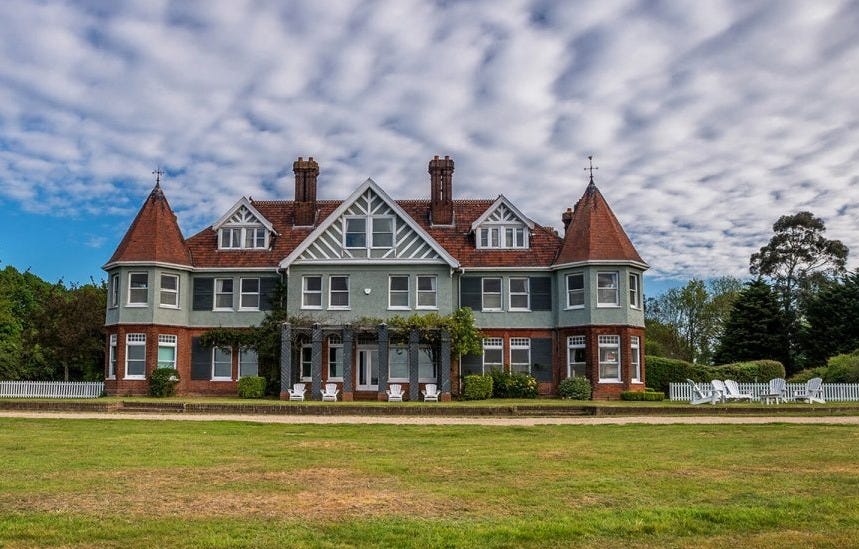
Osea rose on the port side at a quarter past ten — larger than Northey, and higher, the main house visible on its slight western rise, a late-Victorian building of reasonable size and no particular distinction. The boathouse sat at the waterline, timber, running alongside a short jetty.
Thornton brought the barge in with the practised ease of a man who had done this a thousand times before and had never, until this particular Wednesday, done it with quite this weight in his chest.
Greer was at the boathouse.
Francis studied him while Thornton made the barge fast, with the same complete, unprojecting attention he brought to a significant find in the field — the attention that Occult study and two years of proximity to the impossible had, he privately acknowledged, sharpened in him almost past comfort.
Greer was a man of perhaps fifty-five, medium height, broad without heaviness, dressed for the work of maintaining things. He wore the north shore face — the Goldhanger jaw, a fraction too wide; eyes the pale grey-blue of estuary water in October, set a fraction too far apart — and watched their approach with an expression that was not unfriendly, and was also, unmistakably, not the expression of a man surprised to see them.
He was the same age he had been in 1905.
Francis knew this because Thornton had told him, and because he could now see it for himself in the specific absence the face presented — not the absence of an old man’s face grown old, but the absence of the accumulating weather that settled, over decades, around every human eye and mouth, the visible record of a life having happened to a person.
The distinction, once you knew to look for it, was as plain as a falsified depth sounding to a man who had spent thirty years reading tides.
“Mr Thornton,” Greer said. His voice was flat and unhurried, the coastal Essex rather than the county’s, the register of a man who had learned English from the water rather than from a schoolroom.
“Greer. Brought the order.” Thornton’s tone gave away nothing.
“And a few extra passengers today — colleagues of mine from Maldon, interested in the island’s history. Mrs Webb, librarian. Captain Bembow, antiquarian. Mr Hurlbut, journalist.”
“Is he.” Greer regarded Robert without inflection, the flat regard of a man reading a page rather than a face.
“Not here about the retreat,” Robert said, with the easy, unhurried confidence of four months’ practice at exactly this kind of exchange — the improved fluency Francis had watched him build, story by story, until deflection had become something closer to instinct than performance.
“I’m working on a piece about the island’s pre-Roman history. The red hills in the district.”
“We’ve no red hills on Osea,” Greer said.
“No. But there’s material in the tidal margins, if a man knows where to look. The stilt-post evidence in the causeway timbers is interesting in itself.”
This happened to be true — Francis had told Robert it was true, and had furnished him with enough of it to carry the subject as far as Greer might press it — and Greer looked at them a moment longer with those still, wide-set eyes, weighing the cover story against some internal register that Francis could not read and suspected he was not meant to.
“I’ll let Mrs Charrington know you’re on the island,” Greer said.
“Of course,” Francis replied.
“We’ll start on the eastern shore, if that’s convenient. The causeway-side mud is what interests us most.”
Greer looked at him a beat longer than the sentence required, and then turned and walked up toward the house without further word.
Thornton began unloading. Francis and Robert helped carry crates into the boathouse — the practical arrangement by which provisions reached the kitchen without the barge crew ever needing to approach the main house, an arrangement the three of them had been counting on since Monday night.
Doreen was already inside, assessing it…
The boathouse was timber-framed, built out over the water on the island’s north-facing shore, a wide double door to the jetty and a solid single door at the rear opening onto a stone passage that ran back under the island’s western shoulder toward the main house.
The upper floor held the ordinary equipment of maintained watercraft — ropes, oars, spare blocks. The lower floor, below the tideline, opened to the water through a slatted gate that rose and fell with the flood.
A second door, set into the rear wall, did not lead to the stone passage at all. It was low, cut directly into the island’s bedrock, fitted with iron hardware considerably older than the timber structure raised around it. It was not locked.
They found this because Francis tried the handle in the three minutes Greer spent at the main house and Thornton remained occupied at the jetty.
The door opened onto steps, and the steps went down into stone.
“Thornton advised we stay above the second level,” Robert said. He stood in the frame, notebook in his left hand, right hand flat against the timber, performing the small doorframe ritual Francis had come to recognise — occupancy, egress, geometry — with the specific attention of a man who had just located exactly the configuration he most needed to avoid and was about to walk into it regardless.
“Yes,” Francis said, looking down the steps. The passage below breathed up salt and cold rock and something else — the concentrated, unmistakable version of what the upper cellar’s smell had only hinted at, a smell with no honest analogy in forty-eight years of Essex coastal life except, perhaps, a stretch of subsided trench near Thiepval in the second winter of the war, where the ground had opened into something that predated the war entirely and had merely been disturbed by it, and the smell had come up through the duckboards, and none of them, not the sergeant, not the padre, not anyone, had been able to say what it was, only that a man wanted, urgently, to be somewhere else…
He went down anyway.
He went down because there was no other way to learn what waited there, and because what waited there was precisely what they had crossed the estuary to find, and because he had, across the war and two years of this quieter one, become practised at deferring the body’s ordinary claustrophobia in favour of the mind’s insistence on knowing.
He had been deferring it, in one form or another, his whole adult life. He had grown, he thought with a flicker of something that was almost but not quite black humour, to become disturbingly good at it.
Doreen followed. Then Robert.
The passage ran seven feet high and four wide, cut through the London Clay and lined with the stone Thornton had described — not local, not from any tradition of dressing an English archaeologist’s eye would call familiar, the blocks large and precisely fitted without mortar, ancient by any reasonable estimate and yet in a state of preservation that owed nothing to the tidal chemistry that should, by every rule Francis knew, have eaten such stonework to rubble centuries before.
He put the figure at over a thousand years and could not, without reference materials he did not have to hand, push the estimate further, and found the not-knowing more unsettling than a firm date would have been, because a firm date at least would have given him somewhere to stand.
Thirty yards. The passage ended at a room.
Twenty feet square, ceiling low enough that Francis could stand with barely six inches to spare. The floor was the wet stone Thornton had described, salt water standing in the seams between the blocks and moving — not with the tide, which could not reach this far, but in a slow, deliberate, circular motion, as though the room were a shallow dish and something beneath the floor were stirring its contents with the patient, unhurried attention of a creature in no particular hurry to finish.
At the far end, a second passage opened, lower than the first, descending further.
The walls carried marks. Francis lifted Thornton’s borrowed lamp and found the same marks — the same grammar, the same structural relation of angle to proportion that had been worked into the Hesketh object, incised on the chest’s lock plate, copied with careful fidelity into the margin of Doreen’s research notebook two years before either of them had known what they were looking at.
Larger here, scaled to the room, but unmistakably the same language…
Doreen studied the wall with the exact quality of attention Francis had watched her bring to the cataloguing room, to the vestry record office, to every surface that had ever demanded her full professional focus: looking without yet interpreting, holding the two apart by an act of discipline that had, he understood now, been the whole of her professional life’s training, and was proving, tonight, to be the very thing keeping her upright.
Robert stood at the near wall, back against it, notebook open, sketching the room in the quick, comprehensive shorthand he had built — floor plan, ceiling height, the two passage mouths — without once looking directly at what he was drawing, a discipline Francis recognised as the particular, hard-bought skill of a man who had trained himself to take a room in whole and then set it down on paper without needing to look at it a second time.
His breathing was slightly elevated. Francis heard it in the room’s specific, pressing quiet.
“The lower passage,” Francis said, low.
“I’m not going down it.”
“Good,” Robert said, without inflection, which from Robert was itself a kind of eloquence.
“I want the wall markings photographed.” Francis looked at him.
“The camera’s in the boathouse.”
Robert had left it there deliberately — carrying a camera down an unknown stone passage was a different calculation from carrying a notebook, and he had made the calculation without needing to discuss it.
He met Francis’ eyes.
“Stay here,” he said.
“Both of you. I’ll fetch it and come straight back.”
He went. Francis and Doreen stood alone in the stone room.
Doreen had her research notebook open to the drawing, and was working her attention between the page and the wall with the alternating rhythm of a woman confirming a diagnosis against a chart she had studied a hundred times before and still, out of professional discipline, checked once more.
“This room,” she said quietly. Not a question.
“Yes.”
“It’s one of the nodes. Not the primary — that’s in the deep channel below Northey. This is secondary. What the document calls an ankerpunt, but in a different register from the hill site. The hill is a land anchor. This is a water anchor — a boundary point, in the tidal zone, belonging fully to neither the land nor the open sea.” She said it the way she might once have described a lesion’s precise anatomical position, and Francis understood, hearing the register, exactly how much of herself she had needed to spend to be able to say it in that voice rather than another.
“How many,” he said.
“Secondary nodes?”
“The document mentions seven. I’ve identified four through the geometric relationships in the third section. This is one. The hill is one. Two more I’ve calculated but not confirmed.”
“The seven anchors of the network,” Francis said slowly, looking toward the lower passage, thinking of the sound Thornton had described coming up from beneath it.
“And the bewaarder moves through them. That’s how it watches land and water at once. It uses the network the way a man uses a road.”
“Yes,” Doreen said.
“I believe so.”
The water on the floor kept its slow circling. The lamp caught it and threw a pattern onto the low ceiling that was almost, and not quite, a reflection, because the light was wrong for a reflection and the motion was wrong for one, and Francis stopped trying to find the word for what it actually was, because he had begun, this past year, to suspect that some things simply did not have one — that language itself had limits the same way sight and hearing had limits, and that the true horror might not be what it did to a man’s sanity but what it revealed about the poverty of the vocabulary he had been given to describe his own existence with…
Robert returned with the camera. He stood at the doorframe, at the threshold, breathing with the deliberate, managed care Francis had learned, across these months, to recognise as the protocol running at full capacity, and then came in and set up with the professional efficiency of a man whose hands knew their trade better, just now, than the rest of him did, and photographed the wall panel by panel with the same even attention he had once described bringing to a coroner’s inquest — the professional self doing its work while the personal self attended, elsewhere, to other things.
He had photographed three panels when the sound began below.
It was not a loud sound. This was the first thing Francis understood about it, standing very still in the low stone room: whatever anticipatory machinery ran beneath conscious thought had been braced for something dramatic, something that announced itself the way a shell announced itself, and what came up instead from beneath the lower passage was quiet — the sound of something moving through water at depth, with the unhurried deliberateness of a creature for whom water was simply the medium of its existence and movement through it required no more effort, and no more urgency, than a man’s breathing required of him.
The sound grew louder.
“Up,” Francis said.
Robert was already closing the camera case. Doreen had the notebook shut and under her arm. Francis lifted the lamp.
The sound grew louder faster than the distance alone accounted for.
They went up the passage at the pace Francis had spent since 1915 learning to find in exactly this kind of circumstance — faster than walking, short of running, the calibrated middle speed that covered ground without advertising the covering of it, because running got a man killed and standing got a man killed and only the pace between the two offered any honest chance at all.
Four feet wide, seven high, thirty yards, and they were three-quarters up it when the sound stopped.
Francis stopped too. He held the lamp low against his leg so its light would not travel back down the passage behind them.
Nothing. Dark, quiet, the smell of salt and the other thing and nothing further.
Then the sound resumed — closer, and from a point that was not the lower passage at all.
It was in the room behind them. Something had come up through the lower passage and was now between them and the deeper dark below, producing the sound of a thing newly arrived from water into air — a rhythmic, wet exhalation that answered to no configuration of breathing Francis had ever encountered and yet unmistakably served breathing’s function.
The Webley was in his hand. He did not remember drawing it; his hand had done this without troubling to consult him, the way it had been doing since Delville Wood in July of 1916, when reaching for the pistol had migrated from decision into reflex, because the alternative to the reflex, in that particular summer, had generally been dying before the decision could be completed.
He turned.
In the lamplight, at the passage mouth where it opened into the stone room, there was something.
He had perhaps three seconds of clear sight of it, and the three seconds produced nothing adequately answered by anything he had permitted himself to expect — and he had been careful, deliberately, not to expect too precisely, because specific expectation, he had learned in dark dugouts and collapsed saps where the exact texture of what waited was never predictable, was a liability a man could not afford.
What was wanted, always, was general readiness rather than a picture too firmly drawn.
He had general readiness, and a Webley, and something under twenty-three seconds before Doreen’s hand closed on his coat from behind and her voice — precise, not loud, the voice she used to direct people in shock back toward usefulness — said: “Francis. Move. Now.”
He moved. Doreen beside him, Robert two paces ahead where he had been since the sound resumed, already at the door with his hand on the frame, the door already opening under it.
They came out into the boathouse.
Francis turned in the doorway and fired twice down the passage — the report enormous in the confined stone, reverberant and wildly disproportionate to whatever effect it produced, which was, on brief and honest reflection, discouraging rather than none.
He shut the door.
The boathouse held no one but the three of them. Out on the jetty, Thornton could be heard going about the ordinary business of a provisioning handover — rope, wood, water, entirely unremarkable.
“Get to the barge,” Robert said, in the flat declarative register of a man coming out of four minutes at full protocol capacity into the different mode that action required, and moved for the jetty door without waiting to see whether the instruction would be argued with.
Francis looked at Doreen. She was steady. She had gone the colour of chalk, but she was steady, and there was a specific, unexpected comfort in finding that the things a man had come to rely on were, after all, still there to be relied upon.
“Come on,” he said.
They went out onto the jetty.
Thornton understood everything in the time it took Francis to reach the barge rail and Robert to cast off the stern line — understood it from the way they moved, and from the Webley still in Francis’s hand, which Francis only noticed himself still holding when he saw Thornton’s eyes go to it.
Thornton asked nothing. He went straight for the bow line.
The bow line was fast to the jetty cleat. Thornton had his hands on it when the boathouse door opened.
What came through was not Greer, nor any of the other permanent staff. It was the thing from the stone room, which had come up the passage behind them with an ease its size and the confines of the space had no business permitting — because a passage presented air with obstacles it did not present to water, and the lower building was connected to the channel below in ways none of them had had time, in the brief fear of the last five minutes, to properly map.
Francis fired. In the open jetty air, at perhaps fifteen feet, the Webley Mk VI was a considerably more serious instrument than it had been in the reverberant stone, and the effect, this time, was more discouraging still. Three rounds. Not immediately enough.
Thornton was at the cleat and the thing stood between him and the barge. Sixty years old, forty of them on this water, he had the plain, urgent understanding of a man in a bad position and no time to improve it, and he did the only thing available to him — dropped below the bow rail and rolled toward the channel side of the jetty.
The thing’s reach found the space he had just occupied and then, correcting with a swiftness that had nothing human in it, found the space he now occupied instead.
It caught his arm. Below the elbow.
Thornton made one sound. Only one. Then his free hand found the cleat again and held it, and he made no further sound at all, which Francis understood, watching him, to be the barge skipper’s own version of the protocol Robert carried — and every bit as disciplined, and every bit as costly.
Robert was already at the bow with a boat hook he had found somewhere in the three seconds between reaching the barge and Thornton going down — the reflexive grab for whatever tool lay nearest, the reporter’s answer to the officer’s hand finding a pistol — and he drove it between Thornton and the thing, not to wound, only to obstruct, to buy the additional six inches that stood between Thornton keeping the arm and not keeping it.
It worked, in the way such things worked when working meant purchasing seconds rather than solving anything — and the seconds it bought were the ones Francis needed for the fourth and fifth rounds, which finally reached whatever in the creature registered pain, and it drew back.
Francis hauled Thornton aboard. Robert was already at the engine, which was not an engine that started readily — the Maid of the Blackwater‘s auxiliary was a concession to modernity the barge herself seemed periodically to reconsider — but Robert knew, from months of small familiarity, exactly where the fault usually sat, found the fuel cock, and the engine caught with the particular reliability of a thing that had simply been waiting for someone who knew where to look.
Doreen had Thornton’s arm before the barge had properly cleared the jetty.
She had gone for the first-aid kit the instant they were aboard, because she was a nurse and the assessment had been immediate and the priority beyond question, and everything else — the estuary, the boathouse, the thing that might or might not follow them off the island — could wait its turn behind a wound that could not.
She worked with the quality of attention thirty-four years had built in her: completely focused, clinically exact, her back to the water entirely.
Not from fear of it. From work. There was, Francis thought, watching her, a difference between those two postures that most people never learned to hold apart, and Doreen Webb had built her whole adult life on knowing precisely where the line between them fell.
Francis stood at the stern and watched the island recede as the engine drew them clear. Nothing followed off the water. The boathouse door stayed shut. The main house on its western rise showed no disturbance at all — curtains undisturbed, no figure at the door, the whole of it sitting in the flat October light exactly as it was meant to look: a private retreat establishment going quietly about its autumn business.
Greer was not at the boathouse.
This was the detail Francis kept returning to, standing at the stern with the Webley now reloaded and his hands, he noted with the same automatic private satisfaction as always, entirely steady.
Greer had gone to inform Mrs Charrington of their arrival and had not come back — had either known, before the Webley’s first report reached him through stone and timber, precisely what would happen in that passage, or had understood it the instant he heard it, and had made, in either case, the decision of a man managing an outcome rather than intervening in one.
Managing. The same word Doreen had used of the Rivercourt window five years before. The same quality precisely. The estuary managed. It had always managed. The question the last hour had settled, once and for all, was whether the three of them intended to go on being managed, or had, without quite meaning to, just stopped.
He put the pistol away and went forward to where Doreen knelt over Thornton in the bow well, the October wind coming hard off the water around them, and crouched beside her.
“How bad?”
“The wound itself is manageable.” She did not look up, cleaning it with the systematic thoroughness of a woman who understood that wound care was, before anything else, a question of time and contamination and very little besides.
“Deep laceration, clean edges. No significant arterial involvement. He’ll want proper suturing.” She began the temporary dressing.
“And the rest?”
She worked in silence a long moment before she answered.
“I don’t know yet,” she said.
“I need to watch it.”
Robert had the tiller, taking the barge back up-river through the October grey with the ease of a man who had spent enough hours aboard to know exactly how she moved and what she wanted from him, his eyes on the water only as much as navigation strictly demanded.
The management protocol had come down to standby — active, available, not at capacity. It would return to full capacity tonight, in the room at the Blue Boar, before sleep, and he knew this without needing to think about it and had already, Francis noticed, touched the pocket where the Friar’s Balsam sat, a small unconscious reassurance to himself that the tools for tonight’s reckoning were where he had left them.
Thornton sat against the bow coaming, his arm in Doreen’s hands, his face turned up to the flat grey sky. Not pale — weathered past the point where pallor showed — but held in the particular stillness that follows an injury, the body deciding, in its own unhurried time, what it thinks about what has just happened to it.
“I said stay above the second level,” he said. His voice was entirely ordinary, which struck Francis as its own small marvel.
“Yes.”
“I should have been more specific about the distance.”
“Yes,” Francis said, and found, unexpectedly, that he wanted to laugh, and did not, because the laugh and the horror were, just now, occupying exactly the same narrow space in his chest, and he had learned in France that a man who let the one out sometimes could not stop the other from following it.
Thornton looked down at his own arm.
“That’s wanting more than a dressing.”
“A doctor. Probably a hospital,” Doreen said.
“Witham Cottage. Tonight.”
“The Charrington account.” Thornton said it with the practical focus of a man who had spent forty years understanding that consequences attended everything, even this.
“I’ll need a reason for leaving before the order’s complete.”
“Engine trouble,” Robert said from the tiller, without inflection — not offered as a suggestion but delivered whole, the cover story ready-built for immediate use.
Thornton glanced back toward the stern.
“The engine seems to be running perfectly well.”
“It’ll stop in about two hundred yards,” Robert said.
“And then it’ll start again. Engine trouble.”
A pause.
“Yes,” Thornton said.
“All right, then.”
The engine stopped in approximately two hundred yards. It resumed after a suitably convincing interval, and they went on up-river at the reduced pace an auxiliary engine kept after a partial fault, and by the time they passed Northey the story had settled into place the way stories settle for people who are professionals at carrying them: background, consistent, entirely uninteresting, done…
Doreen sat back on her heels and studied the dressing. Her expression was the one she wore for a diagnosis she did not doubt and found, all the same, deeply inconvenient.
“The wound margins,” she said to Francis, quietly, pitched below what would carry to Thornton, who was watching the Northey shore go by with the particular attention of a man thinking about something adjacent to what his eyes rested on.
“They’re not behaving as I’d expect.”
“What would you expect?”
“Straightforward response. Inflammation. Possible early signs of infection. Ordinary healing.” She looked at the dressing.
“What I’m seeing is different. The margins aren’t inflamed. They’re — changed. In a way I have no clinical reference for whatsoever.” She met his eyes.
“I’ll need to watch this very closely over the coming week.”
“And if it doesn’t heal correctly?”
She was quiet a moment.
“Then we will have to decide,” she said, “what correctly means, in this particular context.”
She stood, returned the kit to the canvas bag, and went to the bow rail, where she looked out at the estuary going past — grey October water, the amber marsh, the particular flatness of an east Essex sky that was, in its own understated way, its own species of enormousness.
She looked at it directly. Steadily. For a long time, without once looking away — and Francis, watching her from a few feet off, thought that if there was a definition of courage worth keeping, it very possibly looked exactly like this: not the absence of the thing that terrified you, but the decision, made once and then renewed every subsequent minute, to go on looking at it anyway…
They were back at the Hythe by two. Robert brought the barge in — Thornton’s arm was dressed, his colour improved, though the hand itself was not one he would be gripping anything with for some while — and Doreen went up to the telephone exchange on the High Street to arrange Thornton’s admission at Witham Cottage Hospital.
Francis sat with Thornton on the barge while Robert secured the mooring and Doreen was gone.
They said nothing for several minutes. The town carried on above them — High Street noise, the Moot Hall, the baker’s and the ironmonger’s, all of it the unremarkable furniture of an afternoon in Maldon — and below, the water was running out on the first of the ebb with the quiet, unhurried commitment of a thing simply answering gravity, exactly as it had for however many thousand years preceded this particular October afternoon, and would for however many thousand it had left.
“I’ve worked this river forty years,” Thornton said at last.
“My father before me. His father before him.” He watched the water.
“In all that time, in everything I was ever told about what’s under this estuary — what my father told me, and his father told him — I was never once told it was safe. I was told how to be sensible about it. I was told the rules.” A pause.
“Not one of those rules involved what you did today.”
“No,” Francis said.
“You’ll go back,” Thornton said.
“Not Osea. Northey. The primary site.”
“Yes.”
“Before the anniversary.”
“Yes.”
Thornton looked at the white dressing on his arm, which gave no outward hint of what lay beneath it.
“How long have you got?”
“Four weeks,” Francis said.
“Maybe less.”
“And what do you mean to do, when you get there?”
Francis considered this honestly, with the specific care of a man who had been considering it since June and had not yet arrived at an answer that satisfied him.
“Understand it,” he said finally.
“Well enough to know whether it can be disrupted. And how.”
“Disrupted.” Thornton repeated the word with the flat inflection of a man handling something whose full weight has not yet been properly reckoned with.
“This has been here longer than the town. Longer than the town’s name. And you mean to disrupt it.”
“Yes.”
Thornton was quiet a while, looking at the estuary as though it might, this once, answer him back.
“My grandfather told my father,” he said eventually, “that the arrangement between the shore families and whatever’s in that channel wasn’t a bad arrangement, as arrangements go. Both sides got something from it, and the cost was manageable — for people who understood the rules.” He stopped.
“Samuel Pratt didn’t understand the rules. His family never knew them. The rules aren’t explained to people who weren’t born already knowing them.” He turned to look at Francis directly.
“Do you know how many Samuel Pratts there have been? However long this has been running?”
“I don’t.”
“Neither do I,” Thornton said.
“And that’s the trouble with an arrangement managed long enough. The cost of the managing goes invisible to the people doing it. You stop counting the dead because counting them would mean admitting there was a ledger at all.” He looked back at the water.
“I have spent forty years not counting. I find, this afternoon, that I have started.”
Doreen came back from the exchange. Admission was arranged for that evening at Witham Cottage. The Chronicle’s van — Robert’s doing, evidently arranged by telephone in the same span of minutes — would be at the Hythe within the hour.
“Francis.” She stood on the quay above the barge, looking down at him with the expression she had worn since the night she broke her own seal — a woman done with managed uncertainty, arrived at last in the country of what is to be done.
“We need the vestry records.”
“I found the yew stump.”
“I know. The 1654 document. I want to see it.”
“Tonight.”
“Tonight,” she confirmed.
“Thornton to Witham. Us to the vestry. Robert writes it up.” She looked at him.
“You’re covering Thornton’s admission for the Chronicle. Engine trouble. A laceration from unspecified mechanical contact. Nothing more.”
“Already written,” Robert said, which was, Francis reflected, exactly the kind of thing Robert said now that he would not have said four months ago — not because the competence was new, but because the trust that let him say it plainly, without the old reflexive hedge, was…
“Good.” Doreen looked out at the estuary, and did it more easily than she had that morning — not easily, precisely, but more easily, and Francis understood, watching her, that the distance between intolerable and hard was not a small distance at all, and that she had just travelled the whole of it in the space of a single day.
“The anniversary is three weeks and six days from today,” she said.
“We need the Washington grave understood before anything else makes sense. The grave is the land node. It’s what Washington refused, and what has stood unsealed since his refusal.”
“And the bewaarder?” Francis said.
“Moving through the network. It was at Osea before we arrived — whatever came up through that lower passage while we stood in the stone room was not accident.” She paused.
“It was assessment. The same quality Greer had. The same quality in the channel in September of 1918.” She looked at her own hands, and then at the estuary, and then, finally, at Francis.
“They are doing what they have always done,” she said.
“Managing. We were the thing being managed.”
“We were,” Francis said.
She looked at him.
“We were the thing being managed,” he said again, “until we went down into that room. We’re something different now. I don’t yet know what the difference costs. I suspect we’re about to find out.”
“What are we now?” Robert asked.
Francis looked at the Hythe, the barge, the estuary running out behind it all, grey and patient and enormous. He looked at Thornton on the bench, arm in its clean white dressing, face turned toward the water — the same face that had been turned toward this particular stretch of water for forty years, as patient, in its own human way, as the barge that had carried it.
“We’re people who have been in the room,” he said.
“That changes what they have to do about us.” He shouldered his field bag.
“Which means the time we thought we had is shorter than the calendar says it is.”
He climbed onto the quay. Doreen was already walking toward the High Street. Robert fell in beside him, notebook in hand, left wrist held now at his side, palm-inward, not up — the default position he kept the protocol in when it was standing down rather than standing ready.
“The Webley,” Robert said.
“The effect.”
“Discouraging,” Francis said.
“Not incapacitating.”
“Right.” A beat.
“We need to think about that.”
“Yes,” Francis said, and found, walking up the hill away from the water with the two people he had somehow, without quite planning it, come to trust more than he had trusted anyone since 1914, that the thought did not frighten him nearly as much as it should have.
Perhaps that, too, was a cost. Perhaps fear itself was a resource, like sanity, like time, that a man could spend down to something thinner and harder and more useful than fear had ever been.
“We do…”
They walked on.
The Hythe fell away behind them, and the barge, and Thornton with his arm and his forty years and his grandfather’s rules, and the ledger he had, this particular afternoon, only just begun to keep.
The town received the three of them the way towns always received people coming up from the water on an ordinary Wednesday — without interest, without drama, entirely indifferent, going about its own unbothered business exactly as it had every Wednesday before this one and would, in all likelihood, go on doing every Wednesday after, whatever became, in three weeks and six days, of the people currently climbing its hill.
Below them the estuary went on doing what it always did — out, patient, absolute, ancient, toward the deep channel and the North Sea and whatever occupied both of those and had been managing this coast since long before the coast had a name to be managed under.
Three weeks and six days…
Comments
Nothing yet. Say the first thing.
Sign in to join the conversation.