
You have now worked your way through nearly the entire architecture of your natal chart. You know your luminaries and how they light your inner and outer worlds. You know your personal planets, your social planets, your generational planets. You have met the Centaurs, worked with Lilith and Selena in the dark and bright of the Moon’s hidden points, traced Vulcan’s forge at the heart of your chart, and reckoned with the asteroid goddesses, the trans-Neptunians, and the great geometric patterns that hold everything together.
There is one layer left, and it is unlike any of the others…
Every planet in your chart moves. That is the whole premise of the natal chart as a working tool — planets transit, return, progress, station, and their changing relationship to your fixed birth positions is what gives astrology its capacity to describe a life unfolding in time.
But there is a layer of your chart that does not move, or moves so slowly that it might as well not. This is the layer of the fixed stars: the fifteen Behenian stars and the four Royal Stars that the astrological tradition has worked with for thousands of years, sitting behind and beneath the wheeling planets like the walls of the room in which the whole drama takes place.
What follows below shows you, practically, how to find these stars in your own chart and what it means when you do.
For the complete cosmological teaching on the fixed stars — their nature as ancient stellar ‘consciousness’, the esoteric doctrine of stars as the ‘soul’s’ pre-incarnational memory, and the full mythological and cross-cultural history of stellar wisdom traditions from Babylon through Ptolemy, Al-Sufi, Ficino, and Agrippa — please refer to the companion piece, Ancient Stars Mark Every Soul.
Here we focus on what that piece intentionally sets aside: how to actually locate these stars in your own natal chart, what each one means when found there, and how to work with them consciously.
Every other chapter of this series has taught you to read relationship: planet to planet, planet to house, planet to angle, all of it built from the ongoing geometric dance of bodies that orbit the Sun roughly as you do, on roughly the same plane, over spans of years or decades that a human life can hold and track.
The fixed stars break this pattern entirely.
They are not part of our solar system. They are other suns, at distances so vast that the light reaching you left its source decades, centuries, or millennia ago. They do not orbit anything nearby. They do not station or retrograde.
Against the wheeling motion of the planets, they simply sit — moving, in truth, but at a rate of only about one degree every 72 years, a drift caused not by the stars’ own motion but by the slow precessional wobble of Earth’s axis. In a single lifetime, a fixed star’s position within the tropical zodiac shifts by less than a single degree.
This means the fixed stars in your chart are not describing a lesson you are learning or a cycle you are moving through. They are describing something closer to a permanent note struck into the instrument of your chart at the moment of your birth — a fixed frequency, sounding continuously, colouring whatever planet or point happens to sit close enough to receive it…
Practically, this changes how you work with them. Fixed stars do not form aspects the way planets do. There is no fixed-star trine, no fixed-star square. They speak through conjunction, and conjunction alone — and the orb of that conjunction is far tighter than anything you have used elsewhere in this series.
Where a planetary conjunction might be read within an eight or even ten degree orb, a fixed star conjunction is only considered active within about one to two degrees of exactitude. Outside that narrow band, the star is not speaking to that point.
This is a discipline worth taking seriously: it is tempting, once you know a star’s degree, to stretch the orb until you find the story you want. Resist this. A fixed star that misses your planet by four degrees is simply not touching it, however evocative the mythology.
Unlike the planets and points covered elsewhere in this series, fixed stars will not usually appear automatically on a standard natal chart wheel. You will need to look them up specifically.
The most straightforward method uses Astro.com, already established as this series’ primary chart-drawing resource.
Under the Extended Chart Selection, look for the “Additional objects” or “Fixed stars” options — Astro.com offers a dedicated fixed star listing that will show you the current tropical degree of the major traditional stars, including all of the Behenian fifteen and the four Royal Stars covered below. Generate this alongside your natal chart, then simply compare degrees: note the exact zodiacal position of each of your planets, your Ascendant, your Midheaven, your Descendant, and your IC, and check each against the fixed star list for anything falling within one to two degrees.
A note on precision: because the fixed stars drift so slowly, the degrees given throughout what follows represent their approximate current-era tropical positions. If you are working from a birth date decades in the past or reading this many years from now, allow for a small amount of additional drift — roughly one degree of movement per 72 years — though for all practical purposes within a single human lifetime this adjustment is negligible.
In keeping with the framework established by its companion piece, what follows works with the sixteen stars that the tradition considers most significant for natal practice: the fifteen Behenian stars catalogued by Agrippa, plus Fomalhaut, the fourth Royal Star not otherwise included among the Behenian fifteen.
This is a deliberate and disciplined scope, not a comprehensive survey of every named star in the sky — the wider catalogue of fixed stars used by specialists (Vindemiatrix, Sheratan, Zosma, and hundreds more) lies beyond what this series currently covers, and beyond what most natal readings require.
Sixteen well-understood stars, correctly and precisely applied, will teach you more than a hundred loosely applied ones…
Before working through the fuller Behenian list, it is worth learning the four Royal Stars in some depth, because a conjunction to one of these four carries unusual weight in a natal chart.
Known to the ancient Persians as the four Watchers of Heaven, each stands (or once stood, around 3000 BCE) at one of the four cardinal points of the year — equinox or solstice — and each carries both a gift and a corresponding test.
Aldebaran (approximately 10° Gemini), the Eye of the Bull, gives worldly prominence, endurance, and a magnetic integrity — a ‘consciousness’ that stands fully behind its own word. Its test is honour: the same fixed determination that gives Aldebaran its strength can calcify into rigidity, an inability to admit fault or bend to changing circumstance. A planet conjunct Aldebaran gains staying power in whatever domain that planet governs, at the cost of needing to watch for stubbornness curdling into self-righteousness.
Regulus (0° Virgo, following its ingress from late Leo around 2011–2012), the Heart of the Lion, is the most solar of the four Royal Stars, sitting almost exactly on the ecliptic. It bestows honour, leadership capacity, and the ability to hold power without being corrupted by it — when its test is met. That test is forgiveness, specifically the willingness to release grievance rather than pursue revenge. A planet conjunct Regulus tends toward prominence and recognition in its domain, but the native must watch for the particular danger of hard-won achievement being undone by an unwillingness to let go of old wounds or old scores.
Antares (approximately 10° Sagittarius), the Heart of the Scorpion, gives transformative depth, passion, and magnetic intensity — the capacity to go all the way into an experience rather than stopping at its surface. Its test is obsession: the same depth that produces greatness can, unreleased, produce destruction. A planet conjunct Antares carries an unusual capacity for total commitment in its domain, alongside a genuine risk of that commitment becoming fixation.
Fomalhaut (approximately 4° Pisces), the Mouth of the Southern Fish, is the loneliest and most isolated of the Royal Stars in the night sky, and it gives visionary idealism — the capacity for art, music, and a quality of spiritual sensitivity that reaches beyond the personal. Its test is the gap between vision and reality: the risk of being unable to compromise the ideal, or of abandoning it for temporary security. A planet conjunct Fomalhaut brings unusual creative or prophetic sensitivity to its domain, with the corresponding challenge of staying grounded enough to bring the vision into form.
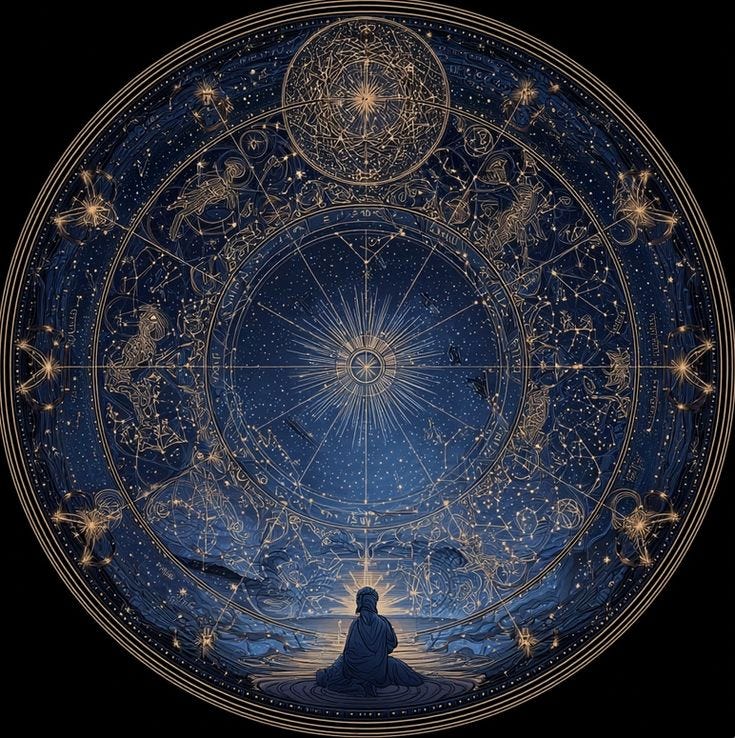
What follows is a condensed, practical portrait of each of the fifteen Behenian stars — enough to work with a natal conjunction directly. (Aldebaran, Regulus, and Antares repeat the Royal Star qualities above, since all three hold dual status.)
Algol (approximately 26° Taurus) — the most historically feared star in the Western tradition, associated with the severed head of Medusa. A conjunction here concentrates raw transformative power in whatever it touches: approached directly, or denied, it can become the most destructive force in the chart; approached with self-awareness as a shield, it becomes the deepest source of initiatory gift. This is not a placement to soften in the telling — it asks for a real reckoning.
The Pleiades (approximately 0° Gemini) — the Seven Sisters, a cluster rather than a single point, associated with grief, collective memory, and the capacity to hold and transmit experience across generations. A conjunction here often marks a life touched early by loss, alongside an unusual gift for holding others through theirs.
Aldebaran (approximately 10° Gemini) — see above.
Capella (approximately 22° Gemini) — the Goat Star, associated with the nourishing abundance that sustained Jupiter in his vulnerable infancy. A conjunction gives intellectual versatility, curiosity, and the capacity to hold multiple perspectives at once — with a shadow tendency toward scattered energy that struggles to commit to a single direction.
Sirius (approximately 14° Cancer) — the brightest star in the night sky, associated in the esoteric tradition with initiatory brilliance beyond the personal. A conjunction confers real capacity for illumination in its domain — ambition executed with skill — but carries a genuine risk of burning too hot for the vessel that carries it, consuming what it was meant to serve.
Procyon (approximately 26° Cancer) — the Little Dog Star, associated with quickness, restlessness, and a mind that sees the ending before it is spoken. A conjunction gives real speed of understanding, with a tendency for that pace to outrun what it is meant to serve.
Regulus (0° Virgo) — see above.
Alkaid (approximately 27° Virgo) — the final star in the handle of the Great Bear, associated with penetrating, analytical cutting-through to essential truth. A conjunction gives real mental acuity, with a tendency to wield it without adequate gentleness.
Algorab (approximately 13° Libra) — the Crow Star, traditionally the darkest of the fifteen in its raw expression, associated with destructiveness and shadow greed — and also, in the shamanic reading, with the crow’s particular gift for navigating the boundary between visible and invisible worlds. A conjunction here asks the native to work consciously with what is usually kept hidden, rather than deny its presence.
Spica (approximately 24° Libra) — one of the most purely benefic of the fifteen, the ear of wheat in Virgo’s hand, associated with the harvest that follows genuine, patient effort. A conjunction gives artistic and intellectual distinction and honours earned through real merit rather than luck.
Arcturus (approximately 24° Libra) — sitting within a degree of Spica, the Herdsman who tends what Virgo’s wheat has grown. In the esoteric tradition, Arcturus has been described as a guide-star specifically oriented to the challenges of incarnate human development. A conjunction gives a benevolent, protective quality of governance in its domain — tending and guiding rather than dominating.
Alphecca (approximately 12° Scorpio) — the bright star of the Northern Crown, the gift given at the threshold of transformation. A conjunction confers artistic sensitivity and a particular grace in expression — the capacity to hold real complexity with apparent ease.
Antares (approximately 10° Sagittarius) — see above.
Vega (approximately 15° Capricorn) — the Lyre of Orpheus, associated with the power of beauty and music to move what force and argument cannot. A conjunction gives a musical, magical quality of persuasion — and carries the Orphic test: the moment when trust must replace looking back, when what has been loved must be released rather than grasped.
Deneb Algedi (approximately 23° Aquarius) — the tail-star of Capricorn, associated with wisdom applied through restriction, and the capacity to remain simultaneously in the world and beyond it. A conjunction gives a practical-mystic quality — the ability to transform difficult daily circumstance into a vehicle for higher purpose.
When you find a fixed star sitting within one to two degrees of a natal planet, luminary, or angle, you are not looking at a fleeting influence but a permanent colouring — a note that sounds continuously through that point’s entire expression across the life, in a way that transiting or progressing planets, by their nature, cannot replicate.
A few practical principles for working with what you find:
The tighter the orb, the stronger the activation. A conjunction within half a degree speaks with far more authority than one at the outer edge of two degrees.
The nature of the planet involved matters as much as the star. Algol conjunct the Moon expresses very differently from Algol conjunct Mars — the same stellar frequency, filtered through entirely different planetary instruments.
House and sign context still apply. A star conjunct your Sun in the fourth house colours home and family; the same star conjunct your Sun in the tenth colours career and public reputation. The star supplies the permanent note; the house and sign supply where and how it plays out.
Angles carry particular weight. A fixed star conjunct the Ascendant, Midheaven, Descendant, or IC often manifests with unusual visibility — in physical appearance, life direction, or public reputation — because the angles are themselves the most externally expressed points in the entire chart.
Absence is also information. Not every chart carries a tight fixed star conjunction on every major point, and that is not a deficiency. A chart with few or no tight stellar conjunctions is simply one whose deepest architecture is built primarily from planetary relationship rather than stellar permanence — no less complete, no less meaningful, just differently weighted…
Returning, as this series always does, to the chart drawn from the place, date, and time of Opeaus’ first published article, we can now search his planetary and angular positions against the sixteen stars covered above.
Mars at 22°26’ Gemini conjunct Capella at approximately 22° Gemini — orb 0°26’.
This is the tightest fixed star conjunction anywhere in the chart, and it lands on a planet already carrying significant weight in earlier articles in this series.
Capella’s nourishing, versatile, multi-perspective quality is fused directly into Opeaus’ Mars — the planet of will, drive, and direct assertion. Where Mars in Gemini already inclines toward quick, intellectually agile action, Capella intensifies this into something closer to a permanent stellar signature: a capacity to act across multiple fronts, to fight for more than one idea or interest at once, to bring real versatility to how conflict and assertion are handled.
Capella’s shadow — the scattered energy that cannot settle on one direction — is worth holding alongside this gift. Opeaus’ will is genuinely capable of holding multiplicity; the discipline is choosing, at the point of action, which front to press.
Moon at 14°30’ Libra conjunct Algorab at approximately 13° Libra — orb 1°30’.
Algorab’s traditional reputation is the darkest of the fifteen Behenian stars, and finding it conjunct the Moon — the emotional and instinctive nature — is worth sitting with honestly rather than softening.
What this conjunction actually asks of Opeaus is what the crow itself teaches in the shamanic reading: a willingness to look at what is usually kept invisible in the emotional and domestic sphere (the Moon’s natural territory, doubled here by its Libra placement’s concern with relational balance and its tenth house placement’s concern with public standing) rather than deny or prettify it.
Given this series’ consistent findings elsewhere regarding Opeaus’ work with Nessus, Lilith, and the shadow-integration themes running through his chart, Algorab conjunct the Moon reads as confirmation from an entirely independent layer of the chart: the emotional work of bringing hidden patterns into consciousness is not incidental to this chart but structurally built into its most permanent features…
South Node at 13°22’ Scorpio conjunct Alphecca at approximately 12° Scorpio — orb 1°22’.
Alphecca is the star of the Northern Crown, the gift given at the threshold of transformation, and its presence on the South Node is a particularly elegant piece of chart architecture.
The South Node describes what a soul carries in from the past — default patterns, earned mastery, the comfort zone it must eventually move beyond in service of the North Node’s growth. Alphecca conjunct this point suggests that Opeaus arrives into this incarnation already carrying real artistic and expressive grace as inherited mastery — the capacity to hold complexity with apparent ease is not something to be developed from nothing but a crown already resting, somewhat unconsciously, on his brow from prior soul-work.
The task, consistent with all South Node placements, is not to abandon this gift but to ensure it serves the North Node’s forward motion (in Taurus, in the fifth house — grounded, embodied creative self-expression) rather than becoming another comfortable retreat into what is already known.
Black Moon Lilith at approximately 24° Cancer conjunct Procyon at approximately 26° Cancer — orb 2°00’.
This sits right at the outer edge of an acceptable orb, and is offered here with that qualification clearly stated rather than overstated.
If active, Procyon’s quickness of mind — the capacity to see the ending before it is spoken — combines with Lilith’s shadow material in the eighth house to suggest a mental swiftness around precisely the ancestral and emotionally intense territory this series has already identified as Lilith’s domain in this chart: a fast, almost pre-emptive perception of manipulation or danger before it fully declares itself.
Given the width of the orb, this is worth holding as a secondary note rather than a primary finding, and readers doing this work on their own charts should apply the same caution to anything sitting at the two-degree boundary.
Ascendant at 13°55’ Sagittarius and Antares at approximately 10° Sagittarius — orb 3°55’.
It is worth naming this one explicitly, precisely because it is not a conjunction.
Antares sits close enough to the Ascendant, and carries a compelling enough mythology (transformative depth arriving right at the threshold of outward self-presentation) that it would be easy to reach for it in a less disciplined reading.
But nearly four degrees exceeds any reasonable fixed star orb, and the honest reading is that Antares is not active on this Ascendant. This is offered as a working example of the orb discipline described above: the chart does not need borrowed drama, and the three genuine conjunctions already present — tight, exact, and independently confirming patterns already established elsewhere in this series — carry more than enough weight on their own…
No fixed star from the established sixteen falls within orb of the Sun, Mercury, Venus, Vulcan, Jupiter, Saturn, Uranus, Neptune, Pluto, Chiron, Pholus, Nessus, the North Node, Selena, the Midheaven, the IC, or the Descendant in this chart.
This is simply accurate rather than a gap requiring explanation — as noted above, absence of stellar conjunction is not absence of meaning, and the great majority of this chart’s architecture, as the rest of this series has shown in detail, is built from planetary relationship rather than fixed stellar permanence.
The three tight conjunctions that do exist — Mars-Capella, Moon-Algorab, South Node-Alphecca — are concentrated rather than scattered, and each one independently reinforces themes this series has already identified through entirely separate chart factors: versatile, multi-front willpower; emotional shadow-work as a permanent rather than transient feature; and inherited expressive grace carried forward as unconscious mastery…
Exercise One: The Full Search. Using Astro.com’s fixed star listing alongside your own natal chart, systematically check every planet, luminary, and angle in your chart against all sixteen stars covered in this article. Record every conjunction within two degrees, noting the exact orb for each. Be honest about width — if you find yourself wanting to stretch a three-degree gap into a “conjunction,” that impulse is worth noticing rather than acting on.
Exercise Two: The Tightest Conjunction. Identify the single tightest fixed star conjunction in your chart — the one with the smallest orb. Spend real time with this one placement. Read its portrait above (or in the fuller companion piece) slowly, and journal on where you already recognise this quality operating, unbidden, as a kind of permanent undertone in the relevant area of your life.
Exercise Three: Angle Check. Pay particular attention to any fixed star conjunct your Ascendant, Descendant, Midheaven, or IC. Because the angles are the chart’s most externally visible points, a conjunction here often shows up in ways others can observe about you even before you consciously recognise it in yourself — in how you are perceived, in career direction, in the shape your public life or private foundation takes. If you have such a conjunction, ask someone who knows you well whether the star’s described quality resonates with how they experience you.
Exercise Four: Gift and Test Together. For each conjunction you find, write out both the gift and the test explicitly, in your own words, rather than only the gift. Every fixed star quality covered in this article carries both. A reading that only names the gift is doing you a disservice; the test is where the conscious work actually happens.
Exercise Five: Absence as Information. If your search turns up few or no tight conjunctions, resist the temptation to manufacture significance by widening your orbs. Instead, journal on what it means that your chart’s architecture is built primarily from planetary relationship rather than fixed stellar permanence. This is not a lesser chart — it simply asks to be read through the tools this series has already given you in the articles preceding this one.
Every other layer of your chart has taught you about growth, cycle, and change — the wheel turning, planets returning, progressions slowly reshaping the landscape of a life across decades.
The fixed stars teach something different: that beneath all of that motion, certain notes in you were struck once, at birth, and have not stopped sounding since…
This is not a fatalistic teaching. A fixed star conjunction, like every other placement in this series, describes potential rather than destiny — a permanent colouring that can be worked with consciously or expressed unconsciously, met with self-awareness or collided with blindly.
Algol met with denial becomes destructive; Algol met with the reflective shield of self-knowledge becomes the deepest source of transformative gift. The principle holds across all sixteen stars: the permanence of the note does not remove your choice in how it is played.
What the fixed stars offer, that no planetary placement quite can, is a sense of the parts of you that were simply always going to be there — not lessons assigned for this lifetime’s curriculum, but something closer to your instrument’s fixed timbre, present from the first note.
Finding them in your own chart is less like discovering a new teaching and more like recognising, at last, a quality of your own voice that you may have been hearing your whole life without quite knowing its source.
For the full cosmological context of what these ancient lights actually are — living stellar ‘consciousness’, pre-incarnational memory, the classroom’s walls rather than its curriculum — the companion piece Ancient Stars Mark Every Soul remains the deeper source this practical guide draws from and points back to…
Opeaus Blair — August 2026
Comments
Nothing yet. Say the first thing.
Sign in to join the conversation.