
Between the conception and the creation, between the emotion and the response, falls the shadow.
The Bath Wall path ran west from the Hythe toward Heybridge Basin along the crown of the old earthwork, which was not Roman and not medieval but simply old in the way of the Essex coastal defences — built, rebuilt, built again, each generation adding its course of clay to a structure whose founding logic was as simple as the landscape itself: water on one side, land on the other, and the sea not to be trusted.
Doreen Webb had been walking it since 1885. She had walked it in every weather and at every season and in conditions of grief and in conditions of professional satisfaction and once, in the winter of 1917, in a state she did not revisit in detail, after what happened to Thomas.
She had walked it through the war years when the estuary had been full of patrol boats and the horizon was sometimes lit by things that were not lightning. She had walked it in the particular stillness that followed the Armistice, when the town was trying to understand what it was now that the thing it had been building itself around was finished.
She walked it on Tuesday evenings after she closed the library. On Saturdays when the weather permitted. On occasional Sunday mornings when she went past All Saints’ without going in, because she had ceased to find what the church offered compatible with what she had seen, and she had never been the kind of woman who sought comfort in contradictions.
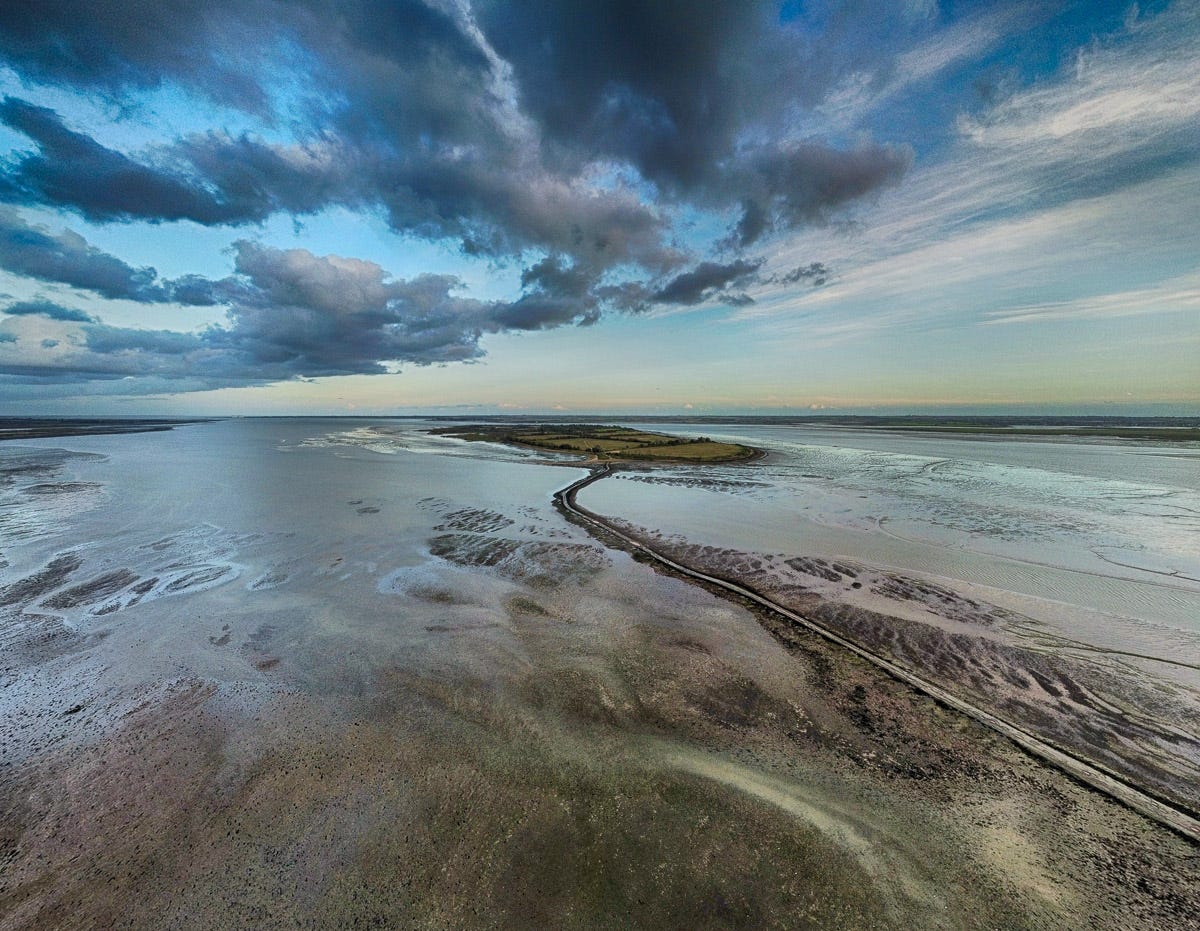
This was a Tuesday evening in the last week of June 1923, and the weather was the kind of settled, salt-smelling, high-pressure Essex summer weather that was not dramatic and was therefore exactly itself — the sky the particular blue that gathered over the estuary in the long evenings when the light came from a low angle and made the water look like hammered metal and the mudflats look like they were made of pewter.
The tide was flooding. She could tell by the slow movement of the water in the channel to her left and by the way the exposed mud margins were narrowing, the water advancing across them with the patience of something that had been doing this four times every day for longer than the earthwork she was walking on had existed.
She had her stick. She had her coat. The coast wind was not cold but it was present, which was how the coast wind usually was on the Blackwater — not dramatic, simply present, an atmospheric fact that required acknowledgment rather than management.
She was thinking about the Dutch document’s third section.
She had been thinking about the third section for six days, since the table in Francis Bembow’s study and the anomalies folder and the conversation that had lasted until nearly eleven o’clock and then stopped, the way conversations stop when there is nothing more that can usefully be said before morning.
Robert Hurlbut had taken his bicycle back to the Blue Boar. Francis had said good night at the door with the particular Bembow quality of a man who was going to sit back down in his study and not sleep until three.
Doreen had walked home up Cromwell Hill and made a cup of tea and sat with the research notebook open at the third section until nearly midnight without writing anything, then closed the notebook and gone to bed and slept badly, which was not usual.
The third section’s vocabulary. The geometrische verhouding — and what it described. And Hurlbut’s land transfer record, one shilling, and the name le Crey in a 1532 survey. These things lay in her mind the way objects lay in a collection box before they were catalogued: present, proximate, and without a system yet that would show how they related.
She had catalogued many collection boxes.
She walked past the point on the Bath Wall where, at certain tidal heights, you could see both directions along the estuary — east toward the Hythe and the town, west toward the Heybridge Basin lock and the canal.
She stopped here sometimes. She did not stop today, because the tide was at a height that brought the water very close to the level of the path, and there was something about the way the water was moving that she did not like.
It was not the direction. The tide was flooding correctly, east to west, as it always did on the flood. It was the quality of the movement — something that she registered not through any specific sensory channel but in the way she had learned to register certain qualities in hospital wards, where the condition of the room told you something about what was going to happen in it before any individual indicator made itself available. A quality of intention.
She did not use that word about water. She was aware that she was using it. She did not use it with an apology.
She walked another fifty yards and stopped again.
The sound the water was making was not the sound it usually made at this height on a flooding tide. The usual sound was a soft, continuous, essentially uniform advance — water coming in across mud, water filling the channels between the saltmarsh roots, water arriving the way water arrived when it was answering gravity and nothing else.
What she was hearing was different. Not dramatic. Not loud. Simply different in a quality she could not have named in professional language, which was the language she reached for, instinctively, when something needed naming.
She found a bench. The bench had been put there by the Maldon Borough Council in 1912 to commemorate something she could not now remember.
She sat on it. She put her hands flat on her knees, which was the thing she had learned to do, and she breathed with the methodical attention of a woman who had trained herself to breathe methodically when breathing was the thing that was needed.
She was not going to go any further along this path tonight.
She sat for three minutes exactly — she had a watch; she used it. The water continued to do what it was doing. She looked at it once, in the last seconds, and then looked away and stood and walked back east the way she had come.
She did not run. She was not a woman who ran from things. She walked at her normal pace, which was considerable.
The curlew called behind her from somewhere over the water, the long descending note that was the sound of the estuary making itself known to whoever was paying attention.
She did not look back.
When she reached the Hythe she stopped, because there were two men at the rail of the second barge, which was Jack Thornton’s barge, and the men were Francis Bembow and Robert Hurlbut, and they were both looking at something in the estuary to the north with the particular stillness of men who had stopped doing everything else.
He had come to the Hythe to look at Northey Island.
This was a professional thing, or at least, had been. In the morning he had spent three hours with the Admiralty charts in the study — the 1911 survey charts, the earlier ones, the one prepared under the oversight of the Blackwater conservancy in 1896 that he had obtained from the county record office the previous autumn and which he had read many times without finding in it what he had been half-looking for.
In the afternoon he had written a careful letter to Edmund Foxcroft at UCL describing, in the language available to two professional men who had published in the same journals, the context and character of the Goldhanger artefact, without describing the artefact itself or its surface markings, because the surface markings were not yet a thing Francis was prepared to put in a letter to anyone.
Foxcroft would know there was more. Foxcroft was not a fool. But Foxcroft was in London and Francis was here, and the letter served the purpose it was written to serve, which was to establish a professional line of communication that might be needed later.
Then he had gone to the Hythe because the evening was fine and because he had been indoors for eight hours and he wanted to look at the estuary.
He did not say that the artefact was part of it. He did not say that the notebooks’ depth measurements were part of it. He did not say that standing on the Bath Wall path or the Hythe quayside and looking at the water had become, over the past three weeks, something other than the habit it had always been.
He simply went…
Thornton was aboard. There had developed, since the conversation in early June that had ended with Francis giving Thornton his reading of the notebooks’ third section and Thornton giving Francis the barge-family knowledge about the north channel, a working relationship of the specific kind that developed between men who had exchanged serious information and respected the exchange without making a social occasion of it.
Thornton did not come up the hill. Francis did not pretend to be here for any other reason than the one he was here for. They acknowledged each other by name and left it at that and stood at the barge rail looking at the water.
Hurlbut arrived at half past seven. He had his camera, which he was carrying in the way he always carried it when he was not actively photographing — under his arm, not around his neck, the economy of a man who had worked out the most efficient configuration of his equipment and maintained it as a professional standard.
He stood on the quayside and looked at the barge and at Francis and at Thornton with the expression of someone who had not come to the Hythe specifically but who had arrived here by the logic of where the evening’s thinking had taken him.
“Is there room on that rail for a third?” he asked.
Thornton looked at him for a moment with the quality of attention he gave to most things, which was full and calm and arrived at conclusions without advertising the process.
“Come aboard,” he replied.
They were looking at the water for twenty minutes before it happened.
The light was doing the thing it did on the Blackwater in late June — going slowly, the sky keeping a residual brightness in the northwest long after the sun was down, the water holding the light the way flat water held it, which was long and level and without depth.
The tide was well up. The mudflats on the Northey side were entirely covered. The island itself, in the low evening light, was a dark horizontal smudge, featureless, the willows and the low rough grass making its outline irregular against the sky.
Francis was the first to see them.
They were perhaps sixty yards out in the channel — perhaps seventy. The light was at an angle that made distances unreliable. They were moving upstream, which was not in itself unusual; things moved in the channel at high water, fish and waterfowl and the occasional harbour seal that worked its way up from the Colne in summer.
But the movement was not that. The movement was not the random, purpose-neutral movement of animals. The movement was directional and deliberate, a series of forms — he counted four, perhaps five, the surfaces indistinct in the low light — moving upstream at a consistent depth below the surface, showing only occasionally at the water’s surface as a disturbance, a displacement, a shape that resolved and unresolved as the light caught it differently.
Not fish.
He said nothing. Beside him, Robert had gone very still.
They were moving upstream past the Hythe. Not toward the Hythe. Past it. With the particular unhurried quality of things that were going somewhere specific and were in no urgency about getting there, because the tide was their mechanism and the tide would deposit them where they needed to be when the tide was ready.
Francis watched them. He was thinking about Hangard Wood. He was thinking about the four in the morning light and the forty yards and the thing that had looked at him, through the smashed ground and the pre-dawn grey, and assessed him and found him irrelevant.
He was thinking about the estuary and the two feet of extra water above the usual tide mark and the particular flat, metallic quality of the water tonight, which was not the quality of water that was answering gravity and nothing else.
He did not reach for his Webley. He was aware that this was a considered decision.
“Yes,” he said, quietly, as though someone had asked him a question.
Robert said nothing. He had the camera in his hands. He did not raise it.
Thornton was at the rail on the far side of Francis, and he was looking at the water with the expression of a man who had been told this thing by his father and had lived alongside the telling for forty years and was now seeing it himself for the first time. His face was very still. His hands on the rail were very still. He was not afraid, exactly. He was the kind of man who did not easily become afraid. But he was something.
They passed. The shapes passed. The disturbance in the water’s surface diminished and then was gone, and the channel above the Hythe was ordinary again, the water flat and the light fading and the willows on Northey blurring into the general darkening of the east.
Nobody said anything for nearly a minute.
“Right,” Thornton said, at last.
“You’d better go and get Mrs Webb.”
Francis turned and looked at the Bath Wall path.
She was already there…
He had not raised the camera.
He thought about this afterward, which was the same night, lying in the narrow bed in the room at the Blue Boar with the estuary visible through the window as a darkness that was slightly different from the darkness of the rest of the world — slightly more present, slightly more occupied.
He had had the camera in his hands. The light had been low but not impossible; the fast plate he had loaded that afternoon would have registered something at sixty yards with the right exposure.
He had not raised it.
He knew why. He did not interrogate the why, because the why was the kind of territory that his management strategies existed to keep at a manageable distance, and the management strategies were, tonight, working at capacity, and additional demands were inadvisable.
He wrote in his notebook instead.
He had been writing since he left the Hythe at half past nine — after the tea in Thornton’s cabin and the conversation that had lasted until the sky was properly dark and even then had only stopped because there was nothing more that could be usefully said tonight.
He wrote in his room and he wrote in the shorthand that he used when he was writing only for himself, not the more systematic shorthand he used in court reports and council meetings, but the private version that had drifted over eleven years into something that was barely decipherable to him now on a re-read and would have been entirely opaque to anyone else.
He wrote what he had seen. He wrote the number of forms, the depth, the direction, the quality of movement.
He wrote the spatial geometry.
He had been thinking about spatial geometry since the disturbance in the channel passed the Hythe, and he had been thinking about it with the specific quality of attention of a man who was recognising something rather than encountering it for the first time.
The geometry of the movement — the distribution of forms across a width of channel, the relationship between them, the specific angle at which they had been moving relative to the surface — this was a geometry he knew.
Not from the Blackwater. From a room in Bloomsbury, in October 1921, from the twenty-five seconds between opening a door and being at the bottom of a flight of stairs with a broken wrist and two cracked ribs and a jaw that was going to need four stitches and a cover story.
In the room there had been something and the something had been in the process of moving when he interrupted it.
The movement had a geometry. He had looked at the geometry, in the twenty-five seconds that were both too long and entirely too short, and had understood — not categorised, not named, but understood at the level of animal recognition — something about the thing’s relationship to space.
It did not move the way things moved that had evolved in air. It moved the way things moved that had evolved in water, in depth, where the three-dimensional field of movement was inhabited fully rather than partly, where direction was not north-south-east-west but was a sphere and every point on the sphere was equally available.
He had never written any of that down. He had it in his head and it lived there with the specific quality of things in the head that can’t be placed anywhere else, like a piece of furniture too large for the room and too valuable to discard.
Now he wrote: Channel geometry corresponds. Same logic of movement. Water not medium but native element.
He stopped.
He looked at the window. The darkness in the direction of the estuary was still slightly more present than other darknesses.
He held his left wrist. The wrist that had healed incorrectly. He did this sometimes — not massaging it, not pressing it, simply holding it with the right hand in the way that acknowledged it was there and had a history.
He thought about what Thornton had said in the cabin, after Mrs Webb had come in from the Bath Wall with that quality she had of being entirely self-possessed about things that would have knocked most people sideways.
Thornton had said: The tide tonight is two feet above the predicted table. I’ve been watching Blackwater tides for forty years. When the tide is two feet above the table and the moon is this size, they come in from the channel. My father told me this and his father told him. They come in and they go somewhere and the tide goes out and they go with it.
Mrs Webb had said: Where do they go?
Thornton had said: Somewhere up-estuary. Toward the head of navigation. Toward the town. He had said it with the simple flatness of a man reporting a route. My grandfather said they came in from the open sea and what they were coming to was the place in the north channel below Northey, and the place below Northey was not where they lived but where they — he used the word attended. The way you’d attend a church or a market. A place of business.
He had not elaborated on what business.
Francis had asked. Thornton had looked at his glass and said: He didn’t say. He was not a curious man, my grandfather. He was a practical man. He thought knowing what they attended to was less important than knowing when not to be there.
Mrs Webb had written something in her notebook. Robert had looked at what she wrote — she had not hidden it — and it was: 1623. Ritual calendar. Tidal configuration. Attendance.
She had underlined the last word.
Robert looked at his own notebook. He turned back several pages to a diagram he had drawn at the table in Francis Bembow’s study, when they had been constructing the picture from its separate parts. He had mapped the land parcels on the north shore. He had marked the old hill. He had marked the deep channel location from Marsh’s surveys. He had marked the Cray land transfer, the shoreline strip below the seawall.
He drew a line from the channel marking to the old hill.
He drew a line from the old hill to the shoreline strip.
He sat with the diagram for a while.
Then he wrote, underneath: The object from the hill. Placed in the floor. Placed facing the channel. He had noticed this at the site, the orientation of the find-spot relative to the estuary. He had not said it. He had filed it as insufficient, as a datum without yet enough company.
It had company now…
He put the notebook in his coat pocket and lay back on the narrow bed and looked at the ceiling and was very careful not to look at the estuary through the window, because the management strategies required that he maintain some boundaries about what he looked at directly and what he acknowledged obliquely, and the distinction, tonight, was doing real work.
He was going to have to tell them about Bloomsbury.
Not tonight. Tonight was full. But soon — soon, because what he had seen in the channel and what he had seen in the room in Bloomsbury were the same category of thing, and Bembow knew enough to know that Robert knew more than he’d said, and Mrs Webb would get there by a different route but she would get there, because she got to everything eventually by systematic process and patience.
And when she got there, it would be better to have told them himself than to be deduced.
He was thirty-five years old and his chest hurt, the low persistent ache that the coastal air aggravated and that the Friar’s Balsam helped with on good days and didn’t on bad ones, and outside the window the estuary was dark and doing whatever it was doing.
He was going to need more notebooks.
The cabin of the Maid of the Blackwater was nine feet by seven. It had a table that folded down and a bench that ran along the port side and a small iron stove that was not lit tonight because the June evening did not require it, and two shelves of books that were not reading books in the usual sense but were working books — tide tables, chart supplements, the Blackwater conservancy regulations for 1921, a copy of Reed’s Nautical Almanac for the current year.
There was a photograph nailed to the aft bulkhead that Francis identified as an older man in a barge skipper’s jacket, which would be Thornton’s father. There was a small brass compass on its own shelf, polished in the way of instruments that were used regularly and considered. There was a window that looked forward over the deck and the Hythe and the water, and Thornton had not closed the curtain, and the water was still slightly present in the darkness beyond it.
They had tea. Thornton had tea the way he did everything — without discussion, simply producing it in the right quantity at the right moment.
Mrs Webb took her cup and wrapped both hands around it and sat on the bench with a composure that Francis recognised as genuine rather than performed. She was not distressed. She was organised. There was a difference, and Doreen Webb’s version of it was very clean.
“The tide,” she said to Thornton.
“Two feet above the table.”
“Two feet and three inches,” Thornton said.
“I measured from the mark.”
“Does that correspond to any pattern you know? Any regularity?”
Thornton sat. He thought about it in the way he thought — not quickly, but completely, without the slightly performative deliberation of men who wanted to be seen to consider things carefully.
Actually considering…
“It happens,” he said.
“Not regularly. Not on a clock. But it happens at the same kind of time — late June or July, when the moon is this size and the wind has been in the north for a week or more. My father said it happened three times in his memory. His father said it happened every few years, more or less. The families on the north shore know when to watch for it.”
“The Fellowship families,” Francis said.
Thornton looked at him.
“I don’t know what they call themselves. I know which families have been on that shore since before my grandfather was born. I know which ones keep certain things to themselves.” A pause.
“The Crays are the oldest. Going back further than the others. The Crays and the Virley families — the ones on the peninsula south of Goldhanger Creek.”
“Cray came to see me,” Francis said.
“Last Sunday.”
“I heard.”
“He asked me to put the object back.”
“Yes.” Thornton looked at his tea.
“He would.”
“Why?”
A pause that had weight in it.
“Because the thing that was placed in that hill,” Thornton said, “was placed there by something that knows it’s there. And that something has arrangements with the families on that shore that have been in place for longer than any man alive, and the arrangements depend on certain things staying where they were put.”
He looked up.
“That is my understanding anyway. I don’t have any more detail than that.”
“Where does the detail come from?” Robert said. He was in the corner of the bench with his notebook open on his knee, but he had stopped writing, and the notebook was open in the way that notebooks were open when the holder was keeping them available rather than using them.
“From my father,” Thornton said.
“From his. From a particular kind of attention to the particular piece of water I have worked my whole life.” He looked at Robert without hostility.
“And from a conversation I had on this barge in March of last year, with a man who came down from London asking questions about north shore drownings in the same way you have been doing. He had a folder. He was a careful man. He asked good questions.”
Francis and Robert both looked at him.
“He was from a society of some kind,” Thornton said.
“He called it an antiquarian society. He was interested in North Sea archaeological finds. He was very interested in the red hills at Goldhanger. He was very interested in whether anything had been found in the deep excavations on Hesketh’s land.” A pause.
“He gave me a card.”
He produced it from the shelf behind the compass, in the way of a man who had anticipated this moment and placed the card where he could retrieve it without searching. He set it on the table.
Francis picked it up. It was a calling card — good card stock, engraved in the conventional manner, the ink a dark grey that was almost black. It read:
The Antiquarian Society of the North Sea Research Committee Dr. H. Vandermeer — Corresponding Secretary
An address in Holland Park was printed below. And below that, in handwriting, a telephone number.
Mrs Webb leaned across and read it without picking it up. She sat back and said nothing.
“What did you tell him?” Francis said.
“I told him I was a barge skipper and I didn’t know about archaeological finds,” Thornton said.
“I told him I worked the estuary commercially and didn’t pay attention to what was in the mud.”
He looked at the card.
“He was a polite man. He thanked me for my time. He said that if I ever heard of anything unusual on the north shore he would be grateful to be informed.” He paused.
“He said it the way men say things when they have many ways of being informed and what they are offering you is an opportunity to be chosen rather than compelled.”
Doreen enquired: “Was he Dutch?”
“His name was Dutch. His English was native.”
“What did he look like?”
Thornton thought about it.
“Tall. Dark. Thin in the face. The kind of man that people don’t remember specifically, which is sometimes a skill and sometimes a character trait.” He looked at the card.
“He knew things about the north shore that a man with a London Holland Park address and an antiquarian society membership would not know. He knew about the Cray land transaction. He knew there had been finds in the red hills. He did not say how he knew these things.”
He turned the card face-down on the table.
“I kept it,” he said, “because things you keep become useful and things you throw away don’t. I did not contact him. I have been watching to see who else he contacted.”
“And?” Francis said.
“Abel Cray,” Thornton said.
“He was at the Goldhanger Arms two nights after the London man was on my barge. He was not usually at the Goldhanger Arms. He was there for an hour, with a man whose description matches. And he left before Cray did, and Cray sat for twenty minutes after with the expression of a man who has been told something he didn’t need to hear.”
The cabin was quiet. The water moved against the hull with the small, even sounds that water made at high tide against a moored barge — intimate sounds, close to the wood, below the waterline.
Francis pocketed the card. He would return it. He intended to return it. He put it in his pocket and thought about the Antiquarian Society of the North Sea and the letter he had received from them in April — a perfectly phrased, professionally appropriate letter inviting him, as a Fellow of the Society of Antiquaries and as the author of several monographs on Blackwater coastal archaeology, to attend their autumn dinner in London.
He had not replied. He had not thrown the letter away.
He thought about that now.
“The dinner,” he said, half to himself.
Doreen looked at him. “Which dinner?”
“The Society invited me,” he said.
“In April. I haven’t replied yet.” He looked at the table.
“I think perhaps I should.”
She could not sleep, which was not usual. Doreen Webb was a woman who slept with the disciplined thoroughness of a former nurse — sleep was a clinical resource and she managed it accordingly, and she had been sleeping well, or as well as she ever slept, which was well enough to function at full capacity, which was what mattered.
Tonight she lay on the narrow bed in her rooms on Cromwell Hill and looked at the ceiling and was not sleeping with a quality of attention that suggested the ceiling had something to tell her.
At three o’clock she got up, put on her coat over her nightdress and her outdoor boots, and went down to the kitchen and made tea and sat at the kitchen table with the research notebook open at the third section and a pencil in her hand and the kitchen window giving onto the back yard and the dark and, beyond the dark, the estuary.
She could not see the estuary from the kitchen window. She could smell it.
This was normal — Cromwell Hill was not far from the water, and in still air the estuary smell came up easily, salt and mud and the particular organic character of something very large and very old that was alive in the way that a system was alive rather than the way an animal was alive.
She was thinking about the sealed pages.
She had been avoiding thinking about the sealed pages for five years with the specific and disciplined avoidance of a woman who knew precisely where the thing she was avoiding was and had made an informed decision to let it remain there until she was ready for it.
She was not ready. She was not yet ready…
But she was — closer. She could feel the proximity of readiness the way she could feel the proximity of things in the cataloguing room when she had been assembling a picture for months and the last pieces were becoming visible. Not there yet. Close.
Do not consult until prepared to act on contents.
She had written that in her own hand, sealed it herself, and in five years she had not broken the seal.
This was a level of discipline that most people who knew her would not have been surprised by, because self-management was a characteristic so fundamental to Doreen Webb that people tended to assume it came naturally. It did not.
It was a practice maintained by daily attention, and tonight the daily attention was at reduced capacity, because what she had felt on the Bath Wall path and what she had seen in Thornton’s cabin and what she knew about the third section and the geometrische verhouding and the word attendance in her own notebook were all pressing on the seal from the outside with more force than they had ever applied before.
She put the pencil down.
She opened the notebook to the back. Three blank pages, then the fold. The sealed paper strip across the fold, with her own writing across it in the careful hand she always used for things that needed to be clear.
She had considered, more than once, what she would see when she opened it. She had gone to that consideration and then declined to continue it, because the sealed pages were not a thing to prepare yourself for by imagining their contents. They were a thing to open when you were ready to act…
She had told them what she needed to tell them about the Dutch document. She had not told them about the sealed pages. She had not told anyone about the sealed pages.
She was beginning to think that this had been, for some time now, a decision she was maintaining not because it was the right decision but because the alternative required her to open something that had been sealed for five years, and the act of opening it would not simply reveal information.
It would be, in some way she did not entirely want to examine, the end of the decision not to act.
She was fifty-nine years old. She had been a nurse for more than thirty years and a librarian for four and she had catalogued uncountable collections and ordered uncountable shelves of material and she knew what it cost to keep something locked instead of filed, because locked things required continuous energy and filed things did not.
She put her hand on the research notebook.
She left it there for a moment.
Then she closed the notebook and put it back in the canvas bag and sat with the tea until it was cold and then made more.
At five o’clock the sky began to change — the particular pre-dawn east-coast quality of light that was neither dark nor day but a grey that had depth to it, a sky in the process of becoming.
She heard the estuary in the new quiet. The tide was going out — she could tell, from long practice, by the sound of the water on the shingle at the Hythe, which was a different sound at the ebb than at the flood.
The tide was going out and whatever had come in with it was going with it.
She thought: they attend and then they go.
She thought: what would be worth attending to, across a time that makes the Harker estate collection look like yesterday’s newspaper.
She thought: we have been here for four thousand years and they have been here for longer.
She looked at the window. The sky was pale now, the east brightening toward the colour of pewter and then toward something lighter than pewter, and in the yard the shapes of things were becoming distinguishable.
She thought about Thornton’s card, in Francis Bembow’s coat pocket.
She thought about the dinner in London.
She thought: whoever sent that invitation knows exactly what Francis Bembow has been researching and has calculated that now is the right time to make contact.
She thought: the question is whether they are right.
She went to wash her face and get dressed. There was a library to open and a third section to work through and a series of conversations, she thought, that were going to need to happen soon, in the right order, before events made the order moot…
The morning was clear and warm and smelled, more strongly than most mornings, of the estuary — salt and mud and the very faint mineral character of something that Francis had never been able to name and had stopped trying to name and simply acknowledged as the smell of the Blackwater on a morning after a high tide.
He met Robert on the High Street at a few minutes past eight, both of them going in the direction of the library, and they walked together without conspiring to.
“Did you sleep?” Francis said.
“No,” said Robert.
“Did you write?”
“Yes.”
“Come and see Mrs Webb with me.”
“I was going to,” Robert replied.
Doreen was already in the cataloguing room when they arrived, because she had opened at eight and whoever needed to spend the first half hour in the cataloguing room rather than at the public desk was doing so, and today that was her.
She had the Dutch document’s transcription open and she had her pencil and she was working through the third section with the focused, painstaking attention of a woman who had been doing this for fourteen months and had arrived, this morning, at a place in the text that was either becoming clearer or being forced to become clearer by the weight of everything she now knew.
She did not look up when they came in.
She simply said: “Close the door.”
Francis closed the door. They sat — Robert on the filing-cabinet chair, Francis against the shelves. Nobody spoke for perhaps two minutes, which was the time it took Doreen to finish the annotation she was working on and put the pencil down.
“The third section,” she said.
“The part I could not place in any professional discipline. I have a proposal for what it is.”
“Go on,” Francis said.
“It is a schedule.” She turned the notebook so they could see the page.
“A temporal schedule, expressed in terms of tidal configurations and lunar phases rather than calendar dates. It is a list of — intervals. Times when something occurs, described in the same observational language as the rest of the document but with an added element I hadn’t been able to parse. A verb that I’d been translating as to arrive or to come but which has a secondary meaning in the maritime vocabulary of the period.” She tapped the page.
“The secondary meaning is to attend. To come for a purpose and return.”
Robert said nothing. He was writing in his notebook.
“The intervals are not regular in a simple sense,” Doreen continued.
“They are not weekly or monthly. They correspond to specific tidal configurations — the same configurations Thornton described last night. High water above the predicted level by a significant margin. A particular lunar phase. A particular wind direction over the preceding days.” She looked at them both.
“The 1623 document describes these configurations as occurring approximately every few years, without prediction precision, in the late spring or summer season. It describes what occurs at these times in the language of — “ she stopped, chose the word carefully — “scheduled commerce. Not ritual. Not worship. Commerce. Exchange. An arrangement.”
Francis thought about Cray. There are people in the village that’d rather it came back to the site. Things found in the earth belong in the earth. He thought about the word management and about the Fellowship of the Blackwater and about what it meant to describe the deep colony below Northey Island as an arrangement rather than a threat.
“What does the arrangement involve?” Robert asked, “On the human side.”
“I don’t know yet,” Doreen said.
“The vocabulary around that element is the most opaque. What I can say is that the arrangement has a component that involves the red hill site — the old hill on Hesketh’s land specifically, which is named by a locative description that corresponds to the grid position of that hill — and the object placed in the salt-working floor is referenced in the document as — “ she consulted her notation — “het ankerpunt. The anchor point.”
A silence.
“The anchor point,” Francis said.
“Yes.”
“Meaning the object in the floor is functional,” Robert said.
“Not symbolic, not decorative. Functional.”
“That is my interpretation.”
“Functional in what sense?” Francis asked.
“I don’t know,” Doreen replied.
“The document doesn’t say, or says it in vocabulary I cannot yet read. But the term ankerpunt is used in cartographic and navigational Dutch to mean a fixed reference point from which other positions are calculated. A datum. The thing from which you measure.” She paused.
“If I am reading this correctly, the object in the old hill is a fixed datum from which — whatever occurs in the channel — is calculated or navigated or positioned.”
The cataloguing room was quiet. Through the closed door the sound of the library was faint but present — a visitor arriving at the front desk, the particular sound of the door. Through the window the morning light was coming in at the angle that made the room feel, at this hour, both larger and more particular than it was.
“Cray wants it back,” Francis said.
“In the ground.”
“Yes,” Doreen said.
“And the Society in London knows there’s been activity at the site.”
“If Thornton’s account is accurate, yes.”
“Which means whatever occurred last night —” Robert gestured in the direction of the estuary — “may be known to both of them. By different means.”
“Yes,” Doreen said.
“Which puts us,” Robert said carefully, “in a position of knowing something that two separate organisations consider significant, without yet knowing what it is significant of.”
He said it without drama. He was thirty-five and he had a reporter’s habit of stating the situation plainly before deciding what to do about it. Francis, who was thirteen years older and had a different set of reasons to appreciate plainness about dangerous situations, found this quality in Hurlbut consistently useful but never said so.
“The dinner,” Francis said.
“I am going to accept the invitation.”
Robert looked at him. “Alone?”
“Not alone.” He looked at Robert.
“I’ll need an assistant.”
“That’s extremely flattering,” Robert quipped.
He wrote something in his notebook.
“I’m not your assistant.”
“No,” Francis said.
“But you’re a better reader of rooms than anyone I’ve worked with since the war, and the room we’re going into is one where that will matter more than my Fellow of the Society of Antiquaries credential.”
Robert looked at him for a moment. He looked at Doreen. Doreen’s expression said that she had arrived at the same conclusion some time ago and had been waiting for them to reach it.
“All right,” Robert said.
He wrote something else in his notebook.
“One more thing,” Doreen said. She reached into the canvas bag and produced the research notebook and placed it on the table, unopened. She placed her hand flat on the cover, in the way that she placed her hands flat on things when she was making a decision.
“The sealed pages,” she said.
“I have not opened them. I told myself I would not open them until I was prepared to act on their contents.”
Neither man said anything. They had not known about the sealed pages. They were not going to pretend they had.
“I am not opening them today,” she said.
“When I open them, I will tell you what they contain. That is all I am going to say about it for now.”
She withdrew her hand, then put the notebook back in the bag.
“Francis,” she said.
“I want you to write to Edmund Foxcroft today. Not the letter you already sent — a different letter. One that asks him specifically whether any of the objects in UCL’s pre-Roman North Sea collection have surface markings of a geometrical character. Whether any of them have been subjected to any analysis that failed to identify the material.”
“I was going to do that,” Francis said, slightly.
“I know you were. Do it today.”
She turned back to the transcription. The conversation was over…
Robert stood to leave. At the door — standing for one second in the frame, which Francis had come to understand in the past three weeks was not hesitation but inventory, a brief assessment of the room — he said, without turning around: “The shapes last night. The way they moved.” A pause.
“It is not the first time I have seen that geometry.”
He went out and closed the door behind him.
Francis looked at the door. He looked at Doreen.
Doreen said, without looking up from the transcription: “I know.”
There was a letter, on the morning of the following Thursday, from London.
It was addressed to Francis Bembow, Esquire, at the Market Hill house, on the cream laid paper of the Antiquarian Society of the North Sea. The hand on the envelope was not the secretarial hand of the April invitation. It was an individual hand, dark and fine, writing English with the particular precision of a person to whom English was either an acquired proficiency or a tool used with more care than native speakers used it.
Francis opened it in the study. He read it standing up, which was not his normal habit for letters.
It read:
Dear Captain Bembow,
I write to renew the Society’s invitation to our autumn dinner, and to say that I hope you will find it possible to attend. The particular questions your recent work on the Blackwater’s pre-Roman coastal sequence raises are ones our membership finds increasingly relevant. A number of our fellows have been occupied with related material, and I think you would find the conversation productive.
I should be glad if you would come as my personal guest for the evening. I understand you may have a colleague accompanying you.
We meet on the fourteenth of September.
Yours faithfully, A. Vandermeer
He read the letter twice. He looked at the window. He looked at the estuary through the gap between the houses.
I understand you may have a colleague accompanying you.
He had told no one — no one except Doreen and Robert, in the cataloguing room — that he intended to bring Robert to the London dinner. He had said it three days ago, in a room with a closed door, to two people, and he had not subsequently written it down or discussed it with anyone else.
He folded the letter and put it in his breast pocket, next to the calling card from Thornton’s cabin.
He sat down at his desk. He looked at the study, which was full of the accumulated material of thirty years of serious scholarship — the reference library, the field notebooks going back to 1896, the maps, the drawings, the correspondence files arranged by year and region. He had built this room the way he built everything, with care and patience and the sustained attention of a man who understood that the interesting questions were the ones that resisted quick resolution.
He had spent five years after the war sitting in this room trying to understand why it no longer felt entirely safe, and he had concluded, over many evenings with a pipe and the sound of the estuary through the window, that the war had done something to his ability to feel safe in any enclosed space that called itself home.
He understood now that this was not, or not entirely, due to the war.
He opened the drawer where he kept his writing paper. He wrote to Edmund Foxcroft, in full, including the surface marking description and a request for any analysis of the material composition of comparable North Sea finds. Then he wrote to the Antiquarian Society of the North Sea, accepting the invitation for the fourteenth of September, and noting that he would bring Mr Robert Hurlbut of the Essex County Chronicle as his guest.
He addressed the envelopes. He stamped them.
He sat for a moment with the envelopes on the desk in front of him.
The estuary was doing what it always did — moving, tidal, ancient, indifferent to what was thought about it from the study windows of antiquarians on Market Hill. The smell of it was in the room. It was always in the room, on a southerly, on a still day, any day when the study window was open and the channel was at the right height to carry the smell of the mud above the smell of the town.
He had always considered this one of the pleasanter qualities of the house.
He picked up the envelopes and went to the hall and put on his hat and his coat, because the post office closed at four and it was half past three, and he walked up Market Hill and along the High Street with the two letters in his breast pocket and the particular quality of a man who had decided something and was committed to the decision.
He posted them.
He stood for a moment outside the post office in the afternoon light, the High Street going about its business around him in the way that the High Street always went about its business — the cart from the ironworks going up past the Blue Boar, two women with baskets coming out of the baker’s, a boy on a bicycle avoiding the cart with a narrowness that made the cart driver say something emphatic. The smell of bread and horse and the slightly metallic quality of the street surface in summer heat.
And beneath all of it, faintly, the estuary…
He walked back down the hill.
Robert was sitting on the step of the Market Hill house with his notebook open. He did not look up when Francis arrived.
“I posted the letter,” Francis said.
“To the Society?”
“Yes.”
Robert closed the notebook.
“Good,” he said. He stood.
“Doreen has finished the third section.”
Francis looked at him.
“All of it,” Robert said.
“She sent a note to the Blue Boar this afternoon. She said to come to the library tomorrow morning. Both of us. Eight-thirty.” He paused.
“She said to come prepared for a longer conversation than usual.”
He said it with the even, flat quality that he used when he was reporting something that required no editorialising. Some things required no editorialising. Some information arrived with its own weight already provided, needing only to be transmitted, and the professional skill of transmitting it was in getting out of the way.
“Doreen didn’t say,” he said, “but she wrote at the bottom of the note — it was in her own shorthand, the margin notation kind she uses when she’s working. I can’t read it, but she didn’t close the fold and I could see the last line.” He paused.
“It looked like the word she writes when she’s finished something and it came out as she expected but the expectation was the bad kind.”
Francis looked at the Hythe. The water was there, below the town, and it was at a normal height tonight, and it was going out with the ebb tide the way it always went out, patient and absolute and without any particular interest in what was said about it on doorsteps on Market Hill.
“We’ll go at eight-thirty.”
“Yes,” Robert said.
They stood for a moment. Along the High Street the late afternoon was going about its business. The cart from the ironworks was coming back down. Someone had dropped a basket of onions and was collecting them with the philosophical efficiency of a person who had dropped baskets of onions before. A dog was involved. The boy on the bicycle was gone.
The estuary was in the air between them, below the smell of the town and above the smell of the street, present in the way it was always present: ancient, indifferent, going out with the tide…
Comments
Nothing yet. Say the first thing.
Sign in to join the conversation.