
“The difficulty lies not so much in developing new ideas as in escaping from old ones.”
— John Maynard Keynes
My grandfather spent over 40 years working at a post office in communist-era Poland. He learned it as a young man, got good at it, and that was that. The knowledge he built in his twenties carried him through his sixties and rewarded him with a pension. The world changed around him plenty, but what he knew held.
Your grandfather very likely has a similar story. Your father, too. You only have to go back a generation or two to feel how different that world was. A world where a craft, once learned, would serve you for life.
That world is gone. It has been since at least the turn of the millennium, but AI’s latest run makes it feel truly existential (and yes, exhausting).
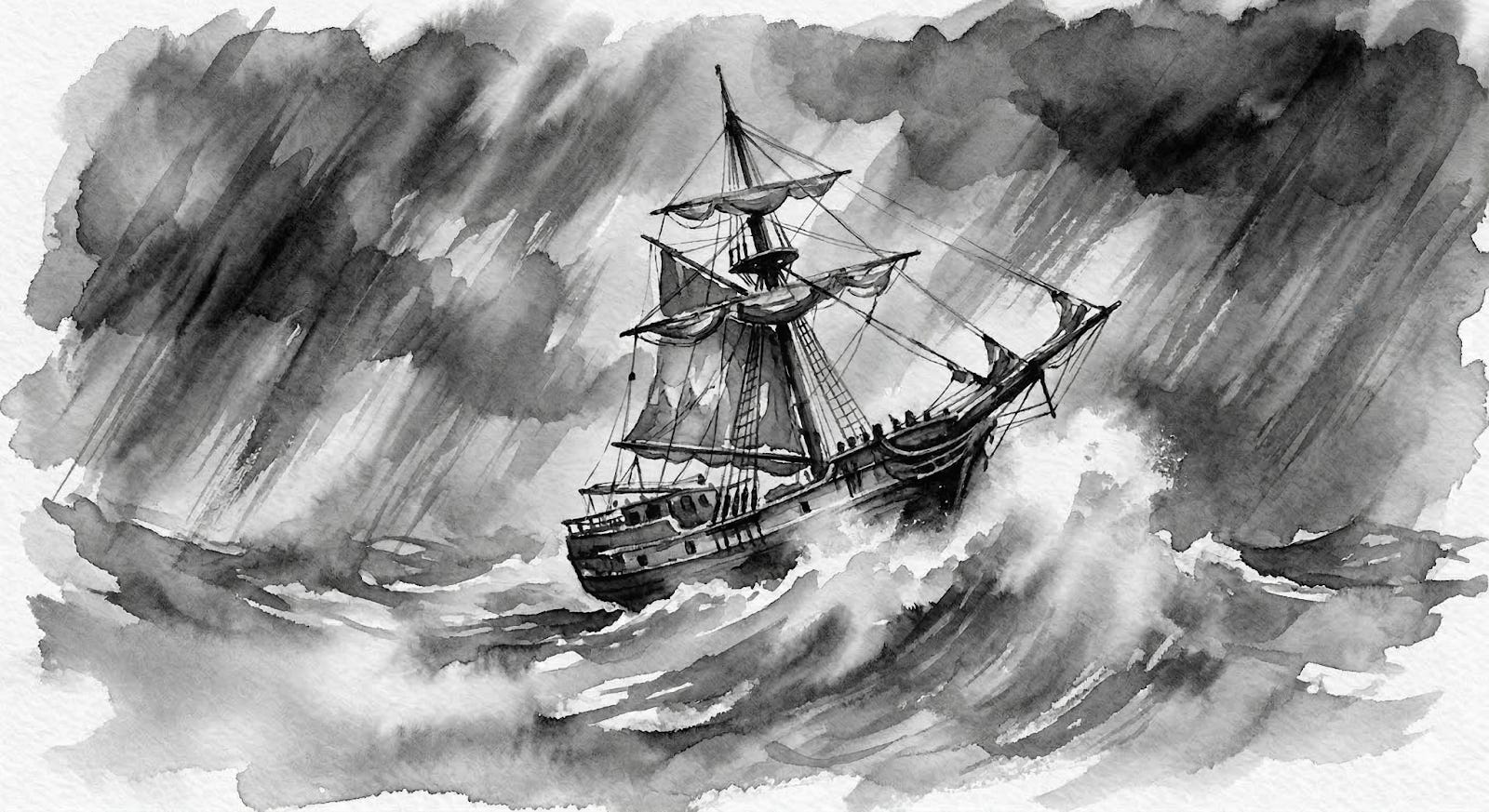
This isn’t another post about how much things have changed. That story’s been told. This is about the speed at which it’s happening, and what it means for us not in some distant future, but in the coming years. Maybe THE coming year. The gale isn’t approaching; we’re already in the eye of the storm.
In 1942, an economist named Joseph Schumpeter opened a section of his book with a line that would grab the attention of more than a few readers now: “Can capitalism survive? No. I do not think it can.”
The book is titled ‘Capitalism, Socialism, and Democracy’. He wasn’t a Marxist. He wasn’t rooting against capitalism. He understood it better than almost anyone in his time.
Schumpeter called what he saw “the perennial gale of creative destruction.” The gale was the mechanism by which capitalism renewed itself. New industries sweeping away old ones, new techniques making old skills obsolete, new wealth emerging from the rubble.
It was a beautiful, brutal cycle.
But Schumpeter also saw where it led. He compared himself to a doctor: he could see the gale clearly and describe its force precisely, but clarity wasn’t the same as comfort. The thing he was describing would, over time, hollow out the very institutions that sustained it.
Ray Dalio sees the same pattern through the lens of lessons learned through history. His work on long-term debt cycles argues that empires and economies move through predictable stages: a rise built on productivity and innovation, a peak fuelled by credit and confidence, and a decline marked by debt, inequality, and institutional decay. The cycle takes roughly 75 to 100 years to complete. What Schumpeter described as creative destruction, Dalio frames as the late stage of a cycle that’s been turning for centuries.
And a lot of people believe we’re in that late stage right now. The inequality metrics, the institutional distrust, the financial system held together by mechanisms that look increasingly fragile. You don’t have to be a doomsayer to feel it. The cracks are visible. People feel dissociated from the systems they participate in. On edge, waiting for a tipping point.
Now layer in AI, and you have something like gasoline on a fire that was already burning. The gale was already blowing. AI didn’t start it. But it’s accelerating everything — the creation and the destruction — at a speed no one fully anticipated. The wind is blowing faster, the flames are spreading, and no one can say with certainty which direction they’re headed.
Most people today cite creative destruction like a permission slip. Schumpeter invented the term and thought it would eventually kill the thing it described. That tension matters, because the language gets invoked a lot right now.
When Jack Dorsey cut over 4,000 people from Block on February 26th, he took the company from over 10,000 employees to just under 6,000, framing it explicitly as an AI decision. “Intelligence tools have changed what it means to build and run a company,” he wrote. The stock jumped 24% the same day.
What was obvious beyond the headline: Block had ~ 3,800 employees at the end of 2019. The workforce nearly tripled during COVID. An Oxford Economics report published just weeks earlier found that many layoffs blamed on AI were actually corrections for pandemic-era over hiring. It’s mismanagement wearing AI as a disguise. But the fact that AI was the credible excuse makes it very clear how much true value it has the ability to unlock.
For context:
Nov 2022: ChatGPT launches. Reaches 100 million users in two months. Fastest consumer app adoption in history.
Nov 2022 – 2024: A blip in time. Better models, further adoption, but nothing fundamentally changes. It’s actually easier to make fun of the mistakes AI makes than to recognize the capability it possesses.
2025: Models start getting quite good. People pay attention as companies start considering themselves AI-forward or AI-native.
Mid 2025: Agentic goes mainstream. Models don’t just answer questions, they start to take action.
Oct 2025: Claude Code gets a full web version and iOS app. Non-programmers start using it for “vibe coding” over the winter holidays. Techies are hyped.
Nov 2025: OpenClaw launches as an open-source AI agent. It goes viral within weeks and becomes one of the fastest-growing open-source projects in GitHub history.
Then 2026 arrives, and the pace enters lightspeed.
Jan 12: Anthropic launches Claude Cowork, aka Claude Code’s capabilities brought to non-technical users, controlling spreadsheets, files, and workflows from a desktop app. Software stocks start sliding.
Feb 5: OpenAI launches Frontier, an enterprise platform for building and managing AI agents. The same day, Anthropic released Claude Opus 4.6, its most advanced model. Two competing visions of how AI enters the workplace, announced on the same morning.
Feb 14: Peter Steinberger, OpenClaw’s creator, announces he’s joining OpenAI. The project moves to an independent open-source foundation.
Feb 16: Manus, the autonomous AI agent Meta acquired for $2–3 billion in December, launches personal AI agents inside Telegram.
Feb 17: Anthropic drops Sonnet 4.6. Claude’s computer-use benchmark score jumps from under 15% to 72.5%, approaching human-level performance.
Feb 24: Claude Cowork gets its enterprise release w/ connectors for Google Drive, Gmail, DocuSign, FactSet. Software stocks take another hit.
Feb 25: Perplexity launches Computer, a multi-model autonomous agent that orchestrates 19 AI models in parallel to complete entire projects end-to-end.
Feb 26: Microsoft launches Copilot Tasks, a cloud-based agent that runs its own browser and computer to execute multi-step work on your behalf. The same day, Block announces its 4,000-person layoff.
All of that in less than eight weeks. The first quarter of 2026 moved faster than most entire years in the previous decade.
It’s fast. It’s furious. It’s overwhelming.
Our brains love the infinite dopamine machines of TikTok loops and Instagram reels. But we all know our species can’t keep up with the cognitive load we throw our way. Technology is outpacing evolution multiple times over.
But now, the speed with which AI is moving is something on a whole other scale.
When power looms arrived in England in the early 1800s, handloom weavers had roughly two to three decades to feel the pressure build. Wages started falling around 1814. The crisis peaked in the mid-1820s. It was a catastrophe, but it moved at a pace where at least some adjustment was imaginable. A generation could absorb it, even if painfully.
Electrification reshaped American manufacturing over roughly four decades. Factories running on steam in 1880 were running on electric motors by 1920. Forty years for a wholesale transformation of how industrial work was organized and who got to do it.
Personal computing and the internet took roughly 20 to 25 years to reach majority adoption. The World Wide Web went live in 1991. By the mid-1990s, early adopters were online. By 2000, about half of American adults used the internet. By 2010, it was closer to 80%. Long enough that most workers could see it coming, even if the transition was disorienting.
The smartphone grew to dominance over about 15 years. BlackBerry put email in people’s pockets starting around 1999. The iPhone arrived in 2007 and redefined what a phone could be. By 2015, more than two-thirds of American adults owned a smartphone. A full arc from novelty to near-universal adoption in a decade and a half.
ChatGPT reached 100 million users in two months. Most people are touching AI daily without knowing it, but deliberate adoption (aka people who know they’re using AI tools and are choosing to) is still somewhere around 40-55% of the US population, depending on how you define “use.”
That only took ~3 years. That’s much more than a product launch. It’s a clear signal about the pace at which the current gale is moving.
Creative destruction is described at the industry level. But it has a very personal implication that shows up in the rapidly decreasing half-life of knowledge.
What you know has an expiration date. Samuel Arbesman, an applied mathematician, wrote a whole book about it (The Half-Life of Facts) cataloging the measurable rate at which facts, techniques, and professional knowledge stop being true or useful. A medical understanding from 1975 might be outright wrong by 2000. A coding framework that was industry standard in 2018 might be legacy software by 2024.
My grandfather’s trade carried him for 40, maybe 45 years before significant revision was required. One craft. One career. One lifetime.
A coding language or data tool today? Optimistically you’re looking at three to five years before something better has largely replaced it.
And the half-life doesn’t just apply to technical skills, it touches everything. The management frameworks that shaped how you run a team, the market assumptions that guided your last strategy, the professional instincts you built over a decade that may no longer match the environment you’re operating in. Some of what you know is aging gracefully. Some of it is expiring faster than the produce in your fridge.
Think about a machinist who spent a decade learning to read metal. They know how it behaves under different pressures, where tolerances live, what a worn tool sounds like before it fails. That knowledge lives in the hands as much as the head. It takes years to accumulate.
Then the shop installs CNC equipment. The machine does what his hands used to do. He doesn’t lose his job immediately. But the knowledge that defined him, the thing he stayed late to get right and genuinely proud of, starts to make him feel like the actor in a movie with no plot.
That’s not an economics story. It’s an identity story.
We build a sense of footing from competence accumulated over time. When the half-life shortens, the footing shifts faster than most people expect. It’s not that people can’t learn new things. It’s that the version of themselves built around what they knew starts to feel unreliable.
And beyond just keeping up with the information is the challenge of actually working with it. You get excited about a tool, build a workflow around it, and start to feel competent. Three weeks later something better arrives. You’re not switching from ignorance to knowledge. You’re switching from one competence to another, and the transition costs are still high, both functionally and cognitively. Being behind used to be a temporary state you moved through. For a lot of people now, it’s become the permanent backdrop to everything they know and do.
Schumpeter described this at the civilizational scale. But individual workers feel it first, years before the economists have the data to name it. The macro trend doesn’t announce itself. It shows up as a vague unease in one person’s career, then another’s, then in the broad stroke statistics like unemployment rate, years later.
The individual is the early warning system for the thing the economists are still trying to measure. I think you’re much more likely to get an earlier and clearer signal from a group of therapists.
Lets try and make the gale more navigable.
Creative destruction is indiscriminate at the surface level. But if you look closely, it has a clear preference: it devours the specific and rewards the general.
Think about physics. Specific formulas get refined, corrected, and superseded. But the foundational principles like conservation of energy, or the laws of thermodynamics have a half-life measured in centuries, not years. Newton’s laws didn’t become obsolete when Einstein showed up. They became a special case inside a larger, richer framework. The principles deepened. They didn’t disappear.
Your career has the same architecture. There are skills with short half-lives: specific platforms, particular tools, the way a given industry happens to organize itself this decade. And there are skills with long ones: judgment, synthesis, the ability to translate across domains, how to read a room and a spreadsheet. The gale hits both. But it hits them on very different timelines.
For the last few decades, the world has rewarded specialization. Go narrow. Go deep. Become the person who knows one thing better than anyone. And it worked when the half-life of that one thing was long enough to build a career on. The specialist thrived because the terrain under their feet held still.
But the terrain is moving now. When the thing you’ve specialized in can be automated, disrupted, or replaced in a multi-month or multi-year window, depth in a single domain becomes a fragile bet. The people I see navigating this era well aren’t the ones who know the most about one thing. They’re the ones who can move between things, taking a principle from one domain and applying it to a problem in another. Generalists with depth. People who understand the layer underneath the specific skill, and can rebuild on top of it when the surface shifts.
The practical move isn’t to stop learning specific skills. Those are still required to participate. It’s to keep investing in the layer underneath: the meta-skills that let you pick up the next specific skill faster than everyone who was only ever building on top of the last one.
Go deep on the principles, not just the applications. Hopefully this blog can help with that.
It may be bold of me to say this, but whatever field you’re in, there’s a version of the work that expires in three years and a version that holds for thirty. The question worth asking is: which one am I working to build upon right now?
Audit your brain like a book shelf: Take stock of what you actually know and estimate its half-life honestly. Some of it is already depreciating. Some of it is more durable than you’ve given it credit for. You probably have more of the latter than you think, you’ve just been less deliberate about naming it and building on it. As a general rule: something that’s survived 100 years is much more likely to survive the next 100. That’s how half-lives work.
Invest in knowledge transfer: Every time you apply a principle from one domain to a problem in another, you’re extending the shelf life of that principle and testing how deeply you actually understand it. This is the purpose of MentalWealth is, at its core.
Stay curious before the urgency hits: The machinist who got curious about CNC before the shop installed it was in a very different position than the one who waited. The gale doesn’t reward passivity, but it does reward people who notice it coming early and start repositioning before the pressure peaks.
Be married to outcomes, not ideas: This might be the hardest one. We get attached to our frameworks, our takes, our ways of making sense of things. But when new information arrives (and it’s arriving faster than ever) the smart move is to update the decision, not defend the old one. The goal was never to be right about your first read. It was to get to the best answer with whatever you know now.
I realize this blog post might read like a warning. A case for turning the taps off before we flood our brains with AI. Maybe it sounds like I’m waving the doomsayer flag.
I’m not. This is what I’m hearing in conversations, what I’m feeling in my own career, what I think a lot of people are wrestling with in isolation. The point isn’t to sound an alarm. The point is to recognize where we’re at so we can do a better job navigating where we want to go.
We’re building identity from a different foundation than the generations before us. My grandfather could plant his flag in a craft and let it define him for a lifetime. That’s not available to most of us anymore. The ground moves too fast. Which means who we are can’t be tethered to what we know how to do right now. It has to be tethered to how we learn, how we adapt, how we respond when the thing we were good at yesterday stops being the thing that matters tomorrow.
That’s a harder way to build a sense of self. It’s also, I think, a more honest one.
Change is inevitable and innovation seems to always inherently yield more opportunity than it destroys. Waiting on the sidelines just keeps you stuck. The longer you wait, the further you watch others go while you stay behind. And at some point, getting back on starts to feel impossible.
Schumpeter couldn’t fully account for human adaptability. We have a strange capacity to find the durable thing inside the temporary one, and to keep moving while the gale sweeps away the rest.
This time is no different. This time, the playing field is more equal than it’s ever been. Almost anyone can afford a $20 subscription.
My grandfather sailed through calmer seas. The gale found him eventually, but it moved slowly enough that what he knew could hold for a lifetime. We don’t have that luxury. We are ships in the eye of the storm. The wind is picking up, the water is moving faster, and the question isn’t whether the gale reaches you.
It already has. The only question is what have you built that won’t easily be carried away.
Did you like this post? I’m sure others would then too! I would really appreciate a share and some kind words.
No posts
Comments
Nothing yet. Say the first thing.
Sign in to join the conversation.