
“The secret to success is the willingness to be heartbroken”
— Rory McIlroy
In ninety editions of the Masters Tournament, only four men have won it in back-to-back years.
Jack Nicklaus in 1965 and ‘66.
Nick Faldo in 1989 and ‘90.
Tiger Woods in 2001 and ‘02.
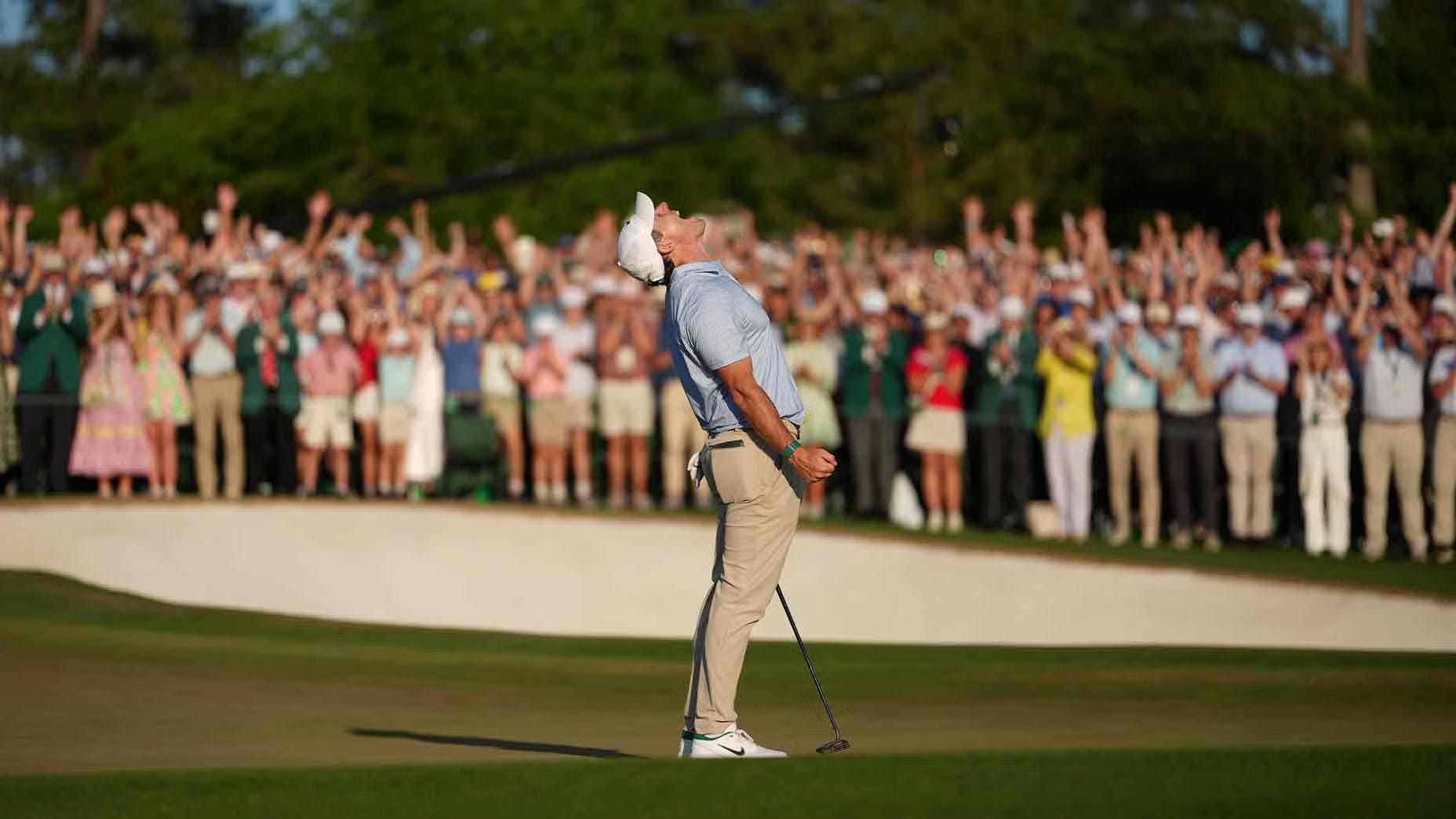
And now Rory McIlroy. 2025 and 2026.
Ninety tournaments. The best golfers alive showing up every April. And in nine decades, only four of them could do it twice in a row. Every other champion came back the following year and fell short.
To be real, I didn’t care about golf until Netflix taught me to. Full Swing did for golf what Drive to Survive did for Formula 1. Instead of lap times and tire strategy, it was fairways and four-day pressure cookers. But the formula was identical: unpack the nuanced complexity, zoom in on the humans inside it, and suddenly you can’t look away.
This is the aspect I’ve always loved about sport. The superhuman nature of the pro athlete. Less about the sport, but how the individual navigates it.
I watched a few episodes and realized the problem was never golf. The problem was that I had no context. I was watching outcomes without understanding what it took to produce them. To understand how remarkable this back-to-back run is, you have to appreciate the statistical forces working against them — forces that, the vast majority of the time, win. Context is the on-ramp for appreciation, so lets gain some.
In 1886, a Victorian polymath named Francis Galton measured the heights of 928 adult children and their parents. He noticed something that bothered him. Tall parents tend to have tall children, sure. But those children were, on average, shorter than their parents. Short parents had short children too, but those children were, on average, taller than their parents.
Everything drifted toward the middle.
Galton called it “regression towards mediocrity.” We now call it regression to the mean. In simpler terms: extreme outcomes (very tall, very short, very good, very bad) tend to be followed by outcomes closer to average. The further something lands from the centre, the more likely it is to drift back.
This isn’t some property of physics. Nobody is pulling outcomes toward the middle. It’s just that extreme performances usually require some combination of skill and luck, and while skill tends to persist, luck doesn’t.
Michael Mauboussin, an investment strategist who wrote a whole book called The Success Equation about untangling skill from luck, places every competitive activity on a continuum. Pure skill on one end, pure luck on the other. Most things land somewhere in between.
Golf sits in an interesting spot. It’s clearly a skill sport. No one accidentally shoots 65 at Augusta National. But over four days, the variance is enormous. Wind shifts between rounds. Pin placements change. A ball lands on a slope and kicks left instead of right. The same golfer playing the same course can score five strokes differently from one day to the next, and that difference could have nothing to do with whether they’re playing well.
Mauboussin’s insight is that as skill levels converge, luck becomes a bigger factor in determining who wins. This is called the paradox of skill. The better the field, the more the outcome depends on the margins.
A Masters victory takes four consecutive days of everything lining up. Skill gets you to Augusta. It keeps you in contention. But to actually win, you need four days where the margins break your way.
For decades, athletes and fans shared a common superstition: the Sports Illustrated Cover Jinx. The “curse” suggested that any athlete who appeared on the cover of the magazine was destined for a sudden slump, a loss, or an injury immediately afterward.
We spent years looking for psychological reasons. Did the fame get to their heads? Did they lose their “hunger” once they reached the cover?
The reality is much simpler. You don’t get on the cover of Sports Illustrated for being average; you get on the cover because you are at the absolute peak of your performance. You are an extreme outlier. Statistically, the most likely thing to happen after an extreme outlier performance is a return to your own average.
The “jinx” wasn’t a curse, it was just the math doing what it always does. But as humans, we are wired to find a story. We are watching arithmetic and calling it psychology.
This is easy to see and well understood in financial markets. S&P’s SPIVA Persistence Scorecard tracks what happens to top-performing mutual funds over time. The results are quite brutal. Of hundreds of top-quartile funds, virtually none stay there four years later. The funds at the top of the rankings one year are roughly no more likely than any other fund to be at the top the next.
It’s easy to be unemotional about fund performance. After all, we’re talking about numbers that derive their entire value from other numbers. Regression feels intuitive when the subject is a ticker symbol. You look at the data, nod, and move on.
It gets uncomfortable when the subject is a person. When the “extreme outcome” is someone’s best day, and “drift back toward average” means watching them lose something they worked their whole life for. The math is the same. But the stakes feel completely different.
Regression predicts drift. It predicts that the winner will come back down. The math just works that way. And most of the time, it’s right.
But not always. Sometimes someone takes the math and refuses to participate. And when they do, it feels almost magical.
Most of us underestimate (or at least tend to forget) what we’re looking at when we watch professional sports. Making the PGA Tour is an extraordinary feat. Roughly 30 million people play golf in America. About 200 of them have Tour cards in a given year. That’s the top 0.0007%. Of those 200, about 90 qualify for the Masters. Of those 90, maybe 15 are genuine contenders on Sunday. Of those 15, one wins.
That’s the first level of extraordinary. And for most champions, regression takes care of the rest. They come back the next year and the math does what math does, pulling them back toward the middle.
But there’s a level above that. Athletes who don’t just perform at the extreme once, but keep showing up there, year after year, in the face of the gravitational pull trying to force them back toward the middle.
Wayne Gretzky scored 2,857 career points in the NHL. The next-closest is Jaromir Jagr at 1,921. The gap between first and second, 936 points, is larger than most Hall of Famers’ entire careers. Strip away every one of Gretzky’s 894 goals and he’d still be the all-time leader on assists alone.
Michael Phelps won 23 Olympic gold medals across five Games spanning sixteen years. Regression says peak athletic performance doesn’t sustain across that many cycles. Phelps didn’t get the memo.
Serena Williams won four consecutive Grand Slam titles in 2002 and 2003. Then she did it again in 2014 and 2015. She defied regression twice, a decade apart.
These athletes fight a headwind that most fans can’t even see. Regression is invisible. It doesn’t announce itself. It just makes the extraordinary a little less likely every single time.
Mauboussin’s framework helps explain why a handful of them win anyway. When someone’s skill level sits so far above the field that even the luck component can’t close the gap, regression has less to grab onto. The dice still roll, but the margin is wide enough that the dice don’t matter as much.
Rory McIlroy is now in that conversation.
Rory had been heartbroken by this tournament more than once. In 2011, at 21 years old, he led by four going into Sunday and shot 80. Triple bogey on 10. A four-putt on 12. One of the most painful collapses in Masters history.
He won four other major championships after that. But the Masters kept saying no. Year after year, he’d go to Augusta and leave without the jacket. A decade of contending and coming up short.
Then came the 2024 U.S. Open at Pinehurst. Two-shot lead with five holes to play. A par putt from two and a half feet on the 16th caught the edge and spun out. Bryson DeChambeau took the title by one.
Ten months later, he came back to Augusta and won the Masters in a sudden-death playoff over Justin Rose. Career Grand Slam complete. The monkey that had been on his back for fourteen years was gone.
And then he did it again. April 2026. He built a six-shot lead through 36 holes, the largest in Masters history at that point. The ghosts showed up on Saturday. He shot 73, gave back every stroke, and entered Sunday tied with Cameron Young. The scenario was built for collapse. Everything regression would predict was lining up.
He birdied three holes between 8 and 13 on Sunday. Won by one over Scottie Scheffler. Fourth person ever to go back-to-back. First since Tiger in 2002.
Regression said 2025 was partly luck. Rory’s response was to show up and do it again.
Before Full Swing, I had no frame for any of this. Golf was a sport where quiet people hit a ball and other quiet people clapped. I couldn’t tell the difference between a good round and a great one, between a win and a miracle.
Netflix gave me the context: the rivalries, the heartbreaks, the nuance of the sport, and the human cost of competing at the highest level. The mental models give the structural context: why repeating is so hard, why regression pulls everyone back, why the handful who resist it are genuinely extraordinary.
Without either layer, Rory’s back-to-back Masters is just a sports headline. With both, it’s one of the most remarkable things to happen in the history of sport.
This applies well beyond the fairway. Most of us move through the world missing things we’d care about if we had the right lens. We watch the outcomes and skip the context. We see the score without understanding the fight. And then we wonder why we’re not moved by things that should genuinely astonish us. Context is the difference between watching and appreciating.
Regression is a pattern, not a verdict. Extreme outcomes tend to drift back toward average. This is math, not destiny. Knowing it helps you interpret the world more honestly. Bad quarters aren’t always mismanagement, and great quarters aren’t always genius. Far more variables that predict outcomes exist outside of your control. But the rare exceptions to regression are where the most interesting stories live.
Understanding more leads to more appreciation. Before you dismiss something — a sport, a person’s work, someone else’s perspective — try adding context first. You might find that the thing you thought was boring or wrong was just missing the lens that makes it legible. Golf was paint drying until I understood what it cost. Perspectives work the same way. The thing you’re diametrically opposed to might just be missing context you haven’t sought out yet. You might just unveil something really neat, and shift your worldview in the process.
Separate the narrative from the numbers, then look for what survives both. We tell stories about “clutch” performers and “chokers” when often the data is just regressing. But once in a while, someone’s results hold up under both the statistical and the narrative lens. Those cases deserve your full attention.
The comeback is the signal. Anyone can perform well once. The person who falls apart, walks away, comes back, and performs again is showing you something luck can’t explain. In your own career, in your own setbacks, it’s the willingness to show up again after the worst version of the thing is the closest you get to proof of the real thing underneath.
If you enjoyed this post, consider sharing. It likely means others would enjoy it too :)
No posts
Comments
Nothing yet. Say the first thing.
Sign in to join the conversation.