
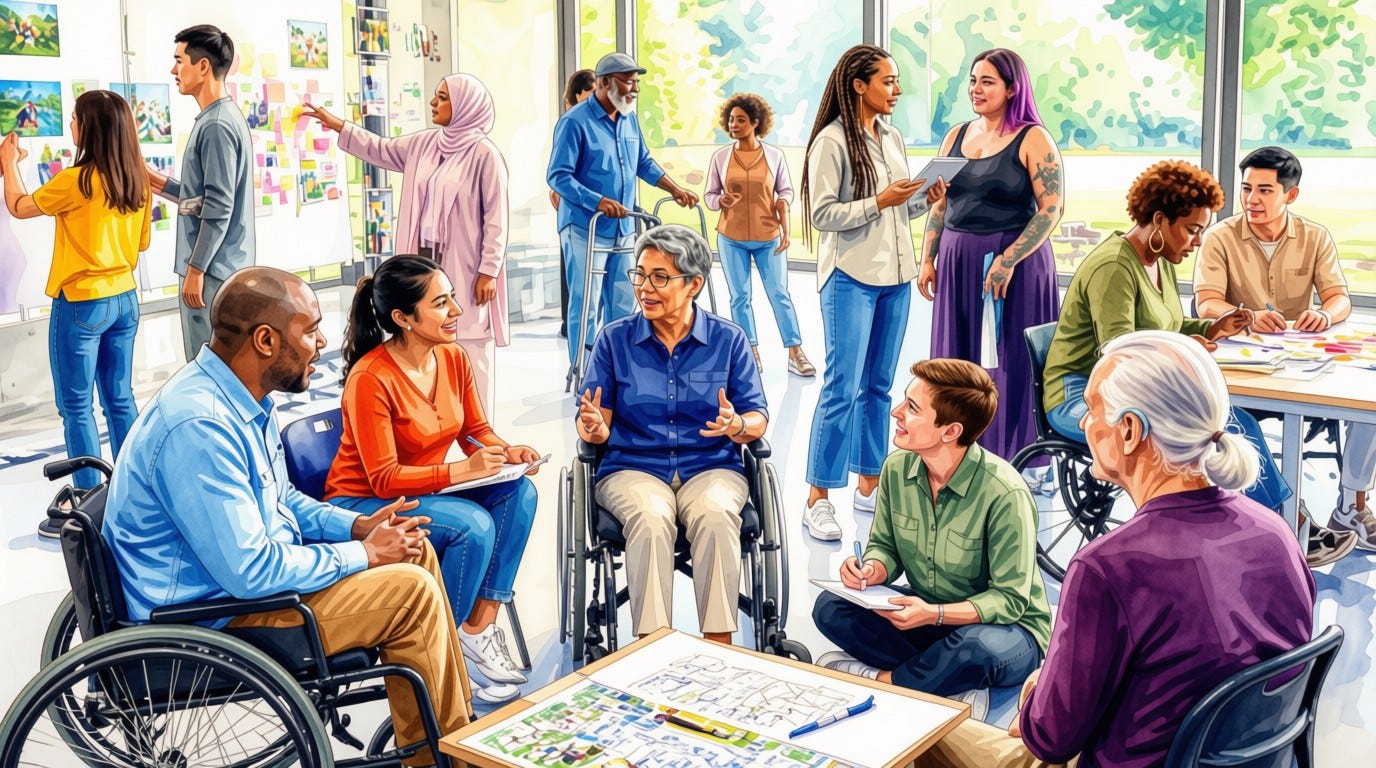
Last week, more than 2% of this community signed up for the Say No to Crip Crow Lobby Day on August 25th. You demonstrated that we are doers, not just observers. Today, we build on that effort with 10 ways to practice daily leadership in our movement.
In a vibrant, robust democracy, every voice matters. For individuals with disabilities, engaging in civic life is not merely a right but also an essential means of empowerment and advocacy. Although voting is often emphasized as the fundamental aspect of democratic participation, genuine civic involvement extends well beyond casting a ballot.
On Tuesday, our monthly “Disability Conversations” episode explored the lived realities of access needs. Today, we present 10 structural ways to turn those needs into civic power.
Based on the most recent data from the 2022 Behavioral Risk Factor Surveillance System (BRFSS), over a quarter of adults in the United States, approximately 30%, reported having a disability in 2022. The perspectives, experiences, and voices of disabled adults are vital to formulating policies and developing public spaces that are equitable and accessible for everyone. Civic engagement is fundamental for highlighting disability-related issues, fostering inclusion, and ensuring that policymakers are held accountable.
However, barriers such as inaccessible polling stations, a lack of accessible information, and attitudinal obstacles continue to limit representation. Consequently, alternative engagement methods are essential. All individuals must have equitable opportunities to participate meaningfully, regardless of their circumstances.
Engaging with local, state, and national elected officials is an effective way to ensure one’s voice is heard. Persons with disabilities may compose letters, dispatch emails, or contact representatives to share personal experiences, advocate for legislative amendments, such as enshrining the Olmstead decision into law, and offer insights into the difficulties encountered. If you want to learn more about how to make sure that the Olmstead decision is enshrined into federal law, visit the Say No to Crip Crow Campaign Site.
Many government agencies and non-profit entities offer advisory positions specifically for individuals with disabilities. Such roles enable respondents to contribute insights on policies, programs, and services that directly impact the disability community. For instance, state and local disability commission councils frequently seek participants for public input panels to inform policies on accessible transportation, education, or housing. I am presently a member of my city’s disability commission advisory board because it is important, in my belief, that you can’t complain if you don’t participate in the civic process.
Public hearings and forums let community members give direct feedback on proposed legislation, city planning, and public services. Participating virtually can eliminate transportation barriers and ensure access for individuals with mobility or immune system concerns.
Social media platforms and writing platforms such as Substack offer valuable opportunities to share personal experiences, promote accessible solutions, and facilitate global connections among advocates. Storytelling is a potent advocacy tool, as sharing lived experiences can influence policy reforms and foster empathy.
Many organizations depend on volunteers to advance their missions, such as Disability Community for Community. Disability Community for Community has leadership roles for people with disabilities, such as Campaigns Lead, Campaigns Co-Lead, Framing Lead, Grassroots Lead, Grassroots Co-Lead, Western Regional Legal and Policy Coordinator, and Southern Regional Legal and Policy Coordinator. Volunteering with organizations like Disability Community for Community helps build more resilient communities.
Op-eds, letters to the editor, and personal essays can draw attention to disability issues that are often overlooked. Writing for mainstream or disability-focused publications opens important dialogues about accessibility, representation, and rights. Disability Community for Democracy is always looking for guest contributors for Nothing About Us Without Us. If you are interested in learning more, please email info@disabilitycommunityfordemocracy.org.
Empower your peers, friends, and family to get involved. Do this through educational workshops, resource sharing, or organizing accessible events. Community mobilization is key to building momentum for change.
People with disabilities often face underrepresentation in leadership. Joining boards of directors or steering committees ensures diverse perspectives are represented at all decision-making levels, influencing policy and organizational priorities. Our subsidiary nonprofit, Disability Supporters for Democracy, Inc., is seeking individuals with disabilities to join its board of directors. The two board positions we need to fill quickly are Director of Civic Engagement and Director of Fundraising. If you are interested in learning more, please email info@disabilitycommunityfordemocracy.org.
Many individuals are unaware of their rights or opportunities to get involved. Peer support, mentoring, or civic education training can strengthen collective knowledge and confidence.
Organizing or participating in advocacy campaigns can raise awareness of legislative priorities and community needs.
To ensure these avenues are truly inclusive, accessibility must be woven into every civic activity. This means:
Providing sign language interpretation, captioning, and materials in multiple formats
Ensuring physical and digital spaces are accessible
Offering flexible participation options (virtual, in-person, asynchronous)
Respecting a wide variety of communication styles and technologies
Recognizing intersectionality and the unique challenges faced by individuals with multiple marginalized identities
Assess Your Interests: Identify the most significant issues and causes that are of personal importance to you.
Research Opportunities: Explore advisory boards, volunteer roles, and participation opportunities with organizations such as Disability Community for Democracy, Inc.
Connect with Your Community: Participate in online groups, attend meetings, or contact disability advocacy organizations.
Use Your Voice: Whether you post on social media or share your stories with elected officials, each action helps shape our collective future.
Voting is essential; however, it constitutes merely one component of the democratic framework. With so many accessible avenues for engagement, individuals with disabilities have both the capacity and the obligation to assume their rightful roles as civic leaders. By expanding participation, we ensure democracy works effectively for all members of society.
🏛️ Building the Infrastructure of our Disability Democracy Movement
Nothing About Us Without Us is the coordination center for our collective power. To scale our impact in 2026, we are seeking disabled leaders to serve as anchors for the following volunteer leadership roles:
Campaigns & Mobilization: Campaigns Lead, Campaigns Co-Lead, Grassroots Lead, and Grassroots Co-Lead.
Strategic Messaging for Disability Community for Democracy: Framing Lead.
Regional Shields: Western Regional and Southern Regional Legal and Policy Coordinators.
Governance (Subsidiary Nonprofit): Director of Civic Engagement and Director of Fundraising.
The Requirement: In line with our mission, we warmly welcome individuals with disabilities to apply for all leadership positions.
How to lead: We are building our community shield together. If you are ready to move from observation to active participation, email info@disabilitycommunityfordemocracy.org for more information.
‘Nothing About Us Without Us’ is a community-supported publication that truly values your involvement. If you’re enthusiastic about staying updated with our latest posts and would like to support us, consider becoming a free or paid subscriber. Our paid members are among our most dedicated supporters. Please join the 5% who explore deeper levels of access with us.
Other Ways to Engage with the Disability Community for Democracy, Inc.
Your support is crucial to Disability Community for Democracy, Inc. Your contributions enable us to sustain our passionate and effective advocacy. Below are several ways in which you can support us:
If you enjoy what we do, consider supporting us on Ko-fi! Every little bit means the world!
If you’re able to contribute, consider setting up a recurring donation through this link to make giving easier and more consistent.
Or purchase our new Summer Say No To Jim Crip Crow, Say No To Jim Crip Crow, Humanity is NOT for Debate Unisex Oversized Boxy Tee (Light Color Shirts and Black Letters), or Humanity is NOT for Debate Unisex Oversized Boxy Tee (Dark Color Shirts and White Letters) swag in our online store.
To stay up to date on how to get involved and participate in our special events, sign up for our mailing list by clicking here or follow us on Instagram, BlueSky, Facebook, Threads, and YouTube.
If you’re unable to assist, we’d really appreciate it if you could share our publication with your friends and family! Thank you so much for your support.
Did you know that all subscribers can ‘like’ and paid subscribers can comment on this post? Follow the link below to join the ‘Nothing About Us Without Us’ community on the Substack app and join the conversation. It’s FREE to use and ad-free.
Available for iOS and Android
No posts
Comments
Nothing yet. Say the first thing.
Sign in to join the conversation.