

Crypto remains arguably the most self-contradictory knowledge space I know. A social phenomenon launched by Bitcoin on the ambition of transparent, uncensorable wealth was transformed, by the brutal appreciation of the very asset that started it, into something else entirely: a machine perceived as capable of producing very large wealth very fast. That belief has rested, at every point in this short history, on two things, different in the telling and connected underneath. The first is the ability to act without intermediaries who are, at best, a source of elevated costs and, at worst, in blatant conflict with the person they are meant to serve. The second is the straight access to sources of return previously closed to most actors—often by regulation.
However you cut it, the post-Bitcoin era of crypto is still in its promised-hyper-return phase. Exception made for niche use cases like emerging market dollar access or international payments where the benefit of hopping partially on new rails flows all the way to the consumer. And with equity and token values dramatically compressed, that promise now rests almost entirely on the direct access to extraordinary credit yield. Extraordinary (in comparison with risk-free rates) yield can generally have four sources: rarity—genuine yet temporary alpha, cost reduction—often via disintermediation, broader economic participation—making the pie larger, or higher risk—often passed along to whoever is least equipped to price it.
Credit is a difficult beast to tame. While headline yield is visible and stable, risk is not. Quality degrades quietly and reprices violently, and leverage carries the break through everything attached to it in disproportionate manner. We have been here before; in crypto, in old school finance, and in the most disparate habits of societies. This newsletter, sixty-nine issues in, has chronicled a fair amount of it.
We are bound to keep walking the thin path between innovation and speculation, education and proselytism, belief and cult. While we do it, I beg everyone to look at the observable incentives of those they are interacting with. It is very often sufficient to model incentive alignment to predict the behavior of a complex system. Crypto taught us that too. We should just all be honest enough to admit it.
Stay safe, and keep moving forward.

Developing Appropriate Risk Pricing Frameworks for Decentralized Lending
Governance, On-Chain Risk Management, and the Vault Curator Concept
Addressable Market, Profitability, and Implications on Token Valuation
This DR is the second chapter of a series on permissionless on-chain lending markets. The first chapter attempted to develop appropriate risk pricing models for Morpho's isolated markets—the most elementary lending building block we have today. Unexpectedly—for me, given the nerdiness of the exercise, that piece attracted significant attention in DeFi circles by pointing at a weird macroscopic phenomenon: the concurrent commercial success and apparent irrationality of on-chain lending today. While everybody would agree that on-chain lending is far from a risk-free endeavor—credit risk being merely the first entry on a long list of factors bearing on the exposure, observed spreads on selected Morpho markets ranged, at the time of that writing, around 0 to 20 bps over the risk-free rate. The loan was, in the eyes of the lender, risk free. This makes even less sense once we notice that the lent asset (USDC) is itself at best risk-free-adjacent, and should therefore already deliver the risk-free yield to its holder before any lending overlay is applied.
For a few weeks the DeFi circles ran hot. Some pointing at the phenomenon as financially absurd, others mounting a professional defense. The sharpest pushback probably came from my old friend, Steakhouse's adcv and MonetSupply. Adcv argued that on-chain lending (or at least its safest subset) should be modeled as a repo rather than a short put, and that historically observed LGDs would land the model's outputs exactly on observed rates, while Monet redirected the whole conversation toward fundamental and technical risk (custody, oracles, access control) as the true loss vector. The world was about to observe Monet’s point at work. Many, including The Defiant, chronicled the debate. A lot of attention (and AI tokens) was spent stress-testing the quantitative framework I proposed, too often confusing the finger for the moon, when one simple question would have sufficed: would you lend your money into an on-chain pool for the risk-free rate if you could access the risk-free rate directly from its risk-free source? The answer, quite clearly, is no. Two weeks later, with Cassandra's sense of timing, came the Kelp event—and the world woke up to the fact that even for the OG of overcollateralized lending, whose depositors were then being paid roughly those same spread levels, risk-free rates do not mean risk-free exposure.
Risk-free rates do not mean risk-free exposure.
On Morpho, if borrowers face markets as their access primitive, lenders are typically intermediated by vaults. This is one of the examples of Morpho’s elegant genius: vaults act as the most powerful liquidity aggregators in DeFi, attracting a long list of assets/ borrowers seeking that liquidity, and the blessing of the gatekeepers of such liquidity. The compounding network effect has been evident.
In the cbBTC/USDC market on Base (at c. $1.4b of supply—Morpho's largest) more than 90% of liquidity arrives via vaults, with the largest single direct lending address representing about 2% of the pool. Lenders, in other words, have delegated control.
What is a vault → In simple terms, a vault is an ERC-4626 wrapper—a standard co-authored by Fei’s Joey Santoro. I always felt that Morpho spiritually owed a lot to Fei and Rari. A vault performs three functions:
Pooling: small on-demand deposits aggregated into allocable size.
Delegated allocation: mandated markets selection, exposure caps setting, rebalancing.
Liquidity transformation: matching of instant-ish redemption on positions that are, individually, subject to utilization by less liquid credit markets.
Not every vault is the same → Steakhouse's flagship Prime USDC vault on Base currently deploys almost the entirety of its liquidity into that single cbBTC/USDC market, where lender/borrower equilibrium is de facto guided by the market's parametric interest rate model. Market utilization sits at c. 89% vs. the 90% target above which the adaptive curve starts repricing. This vault is not performing allocation in any meaningful sense; it is performing watching. Depositors are paying a fee (currently zero) for someone with better monitoring to exit the market before the depositors themselves know there is something to exit from. In the context of a retail platform like Coinbase's, watching has a lot of value. What a watcher is, legally, is a different matter entirely.
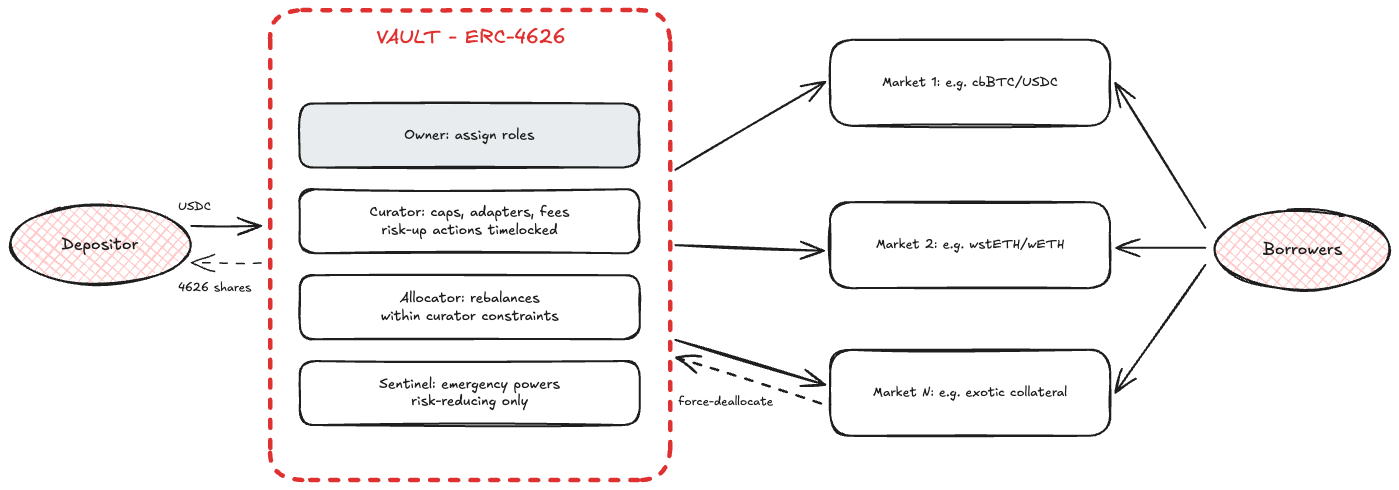
On risk management → Morpho Vaults v2 (currently holding c. 30% of protocol deposits) separate four roles:
Owner: assigns roles but holds no direct power over assets or risk parameters.
Curator: the vault’s chief risk officer, configuring adapters, caps, fees; with risk-increasing actions timelocked—the window itself is also curator-configured.
Allocator: executes rebalancing within the curator’s constraints and manages the liquidity sleeve, but cannot introduce unapproved risks.
Sentinel: emergency powers restricted to risk-reducing actions: force-deallocation, cap cuts, revoking pending timelocked changes.
Those roles, albeit distinct, can technically be covered by the same subject, or by subjects acting in concert—nothing at the smart contract level prevents it, the technical documentation merely recommends1 separation, and there is no public inventory of who actually holds what across the c. 320 production vaults. The separation of powers is merely a design affordance.
Caps in v2 are keyed to abstract risk-factor identifiers rather than only to markets, and this is genuinely beautiful design. Curators can define an id for any common risk factor (collateral asset, oracle, protocol) and cap exposure to that factor across every market that carries it, in absolute dollars or as a share of the vault. Adapters, meanwhile, make each vault protocol-agnostic: a v2 vault can allocate through a uniform interface to Markets v1, Vaults v1, and future venues as adapters are enabled.
The vault, in other words, is becoming a general-purpose, self-describing balance sheet.
Curators are central in the vault construct, and vault debate. They set the mandate, whitelist markets, size caps, manage liquidity, and often promote the vault. It is a lot of work. In traditional finance, these five functions are performed by at least three different entities that are, by design, in tension with each other. But apparently not in crypto. Curated-vault AuM across DeFi stands at $8.7b as I write—per DefiLlama's risk-curator aggregation, which counts TVL attributed to c. 60 named curator entities. That number is up from c. $5.5b at the beginning of the year, and from c. $200m (a 40x) in the summer of 2024. Morpho, the dominant venue, currently reports c. $11.8b in deposits and c. $4.2b in active loans.
The gap between deposits and loans is partly the story of this piece.
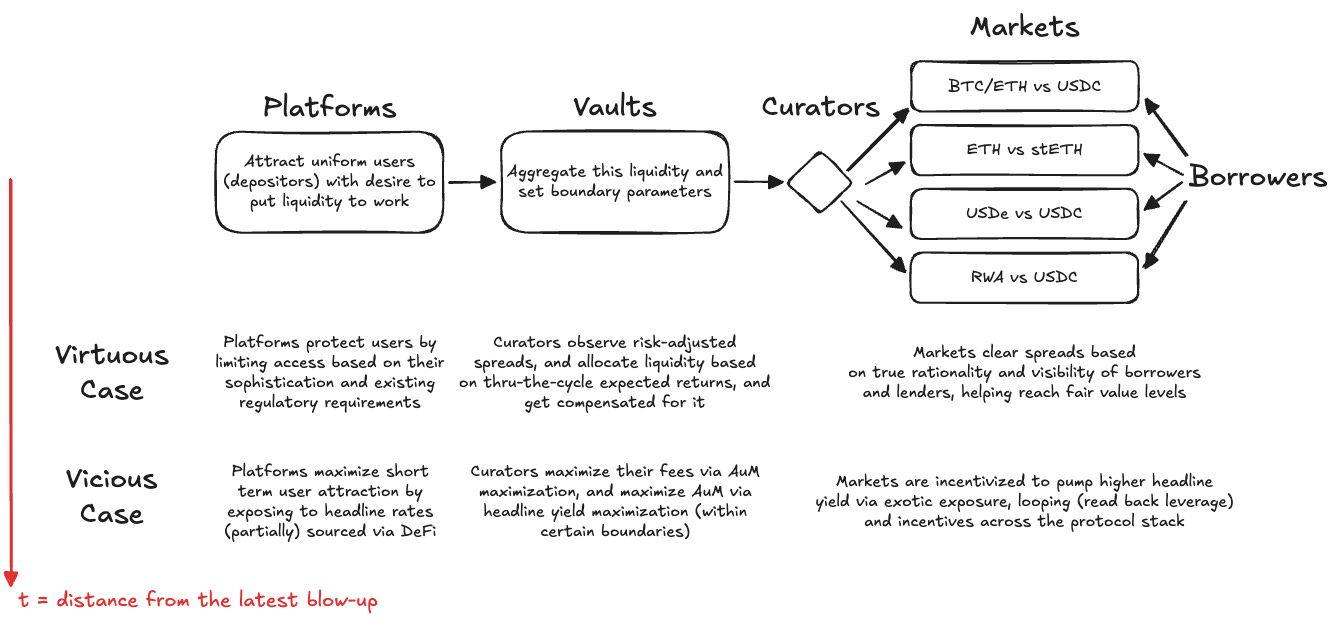
On concentration → In September 2025 the top five curators held less than half of curated TVL. Today they hold c. 83%—Steakhouse $3.04b, Sentora $2.15b, Gauntlet $1.41b, K3 $374m, Hyperithm $265m, based on DefiLlama. These numbers move daily. Platform deals have been fueling this growth: Coinbase, Kraken, Fireblocks, and now Robinhood. The rest, disproportionately involved in the looping-and-exotic-collateral business, is getting liquidated by flows. Distribution-led lending franchises are thriving, while leveraged-betas with a vault wrapper are not. This is not surprising considering where we are in the cycle.
On fees → v2 contracts support performance (up to 50% of yield) and management (up to 5% of assets) fees to curators, both timelocked, and both paid by minting shares to the fee recipient. The observed practice is informative of where market power resides. Performance fees are more prevalent than management ones, although most bluechip vaults are running on zero-fee mandates. Curators seem to employ a barbell approach (at least for the fees paid on-chain) charging 0% on the AuM drivers (bluechip vanilla BTC/ETH exposure) and higher figures for higher-risk-higher-touch ones. The pattern is clear and understandable, but it is also philosophically at odds with the industry’s regulatory-defensive posture of passivity: you cannot simultaneously be paid like a manager and described like a passive watcher.
A performance fee is, among other things, an admission of discretion.
Nota bene, fees charged programmatically at the vault level are not the only layer that can intermediate the depositor from the asset’s yield, or actually impact the balance of incentives among actors. What is happening outside of the smart contracts is impossible for us to see here.
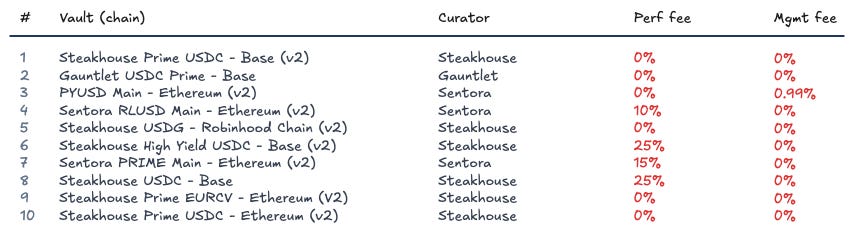
Nota bene 2, platforms like Coinbase, Kraken, or Robinhood benefit from the underlying risk-free yield (minus a 0-25 bps issuance cost) on the stablecoin deposit leg float across all those vaults.
On separation of duties → Curators operate inside the oldest pillar of managerial capitalism: the separation of capital from the labor of allocating it. In that capacity they have been preceded by a long lineage of adjacent players; I put some of them together in the table below.
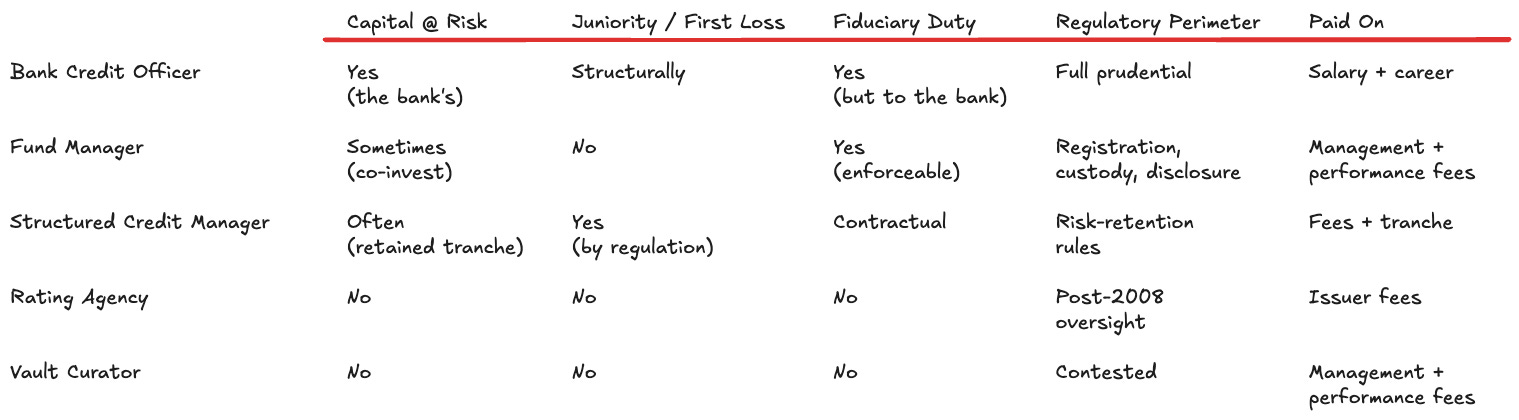
The closest analogue we have, based on the curator’s duties and own risk exposure, would be the pre-2008 rating agency. An entity whose only capital is reputational. Rating agencies, however, merely opined on allocations. The truth is that curators are a new hybrid, ranging along a spectrum from programmatic technical watchers to unregistered asset managers with no fiduciary duty, no capital rules, and no disclosure regime—a spectrum on which, as we will see below, a regulator has already opined.
From a fair market perspective, the curator is also the actor positioned to correct the mispricing we measured in chapter one, by allocating or pulling liquidity from fairly priced or mispriced markets. A curator who prices credit like a creditor would refuse to enable markets whose parameters (LLTV, oracle, IRM) cannot clear a required spread at target utilization, size caps as underwriting limits, use the timelock as a covenant period, and (why not) publish their assumptions and their models.
Each of the above is, effectively, an underwriting decision, and a curator who makes them chooses to be a pricing entity rather than a mere technological facilitator.
The current market equilibrium, however, seems to run the opposite way: caps chase deposit growth, deposits chase headline yield, yield most probably chases risk. A performance fee on other people’s yield is, therefore, today maximized by AuM and headline rate, not by risk-adjusted spread. Franchise value aside, nothing in the fee table pays for saying no. In a market tilting progressively retail, this is not a detail. Reputational capital, however, is real—ask the curators who no longer have any. The smart franchises are treating it accordingly, at the onset of what promises to be a very long sector evolution in which technical expertise and informational asymmetry will keep paying rent for years. The economy, however, remains a micro incentive game.
The transparency boundary → Curators are arguably the most observable credit delegates in financial history. Allocations are on-chain in real time, NAV is computed by contract rather than marked by a manager, parameters are public state. A sufficiently motivated depositor can reconstruct a vault's entire risk book—something no bank depositor, fund LP, or CDO investor could ever do. Transparency, it turns out, is not a property of the system but a boundary within it, and the boundary (for precisely the exposures that matter) sits one hop below the vault. While the vault's book is transparent, the underlying collateral can be exactly as opaque as it was before anyone put it on a blockchain. In the previous chapter we defined this as the unobservable σ. This is, to be precise, not an indictment of the entire DeFi lending category; for BTC or ETH the boundary problem is trivial. But the same cannot be said for tokenized structured exposures such as USDe or so-called RWAs. For those assets, wrapping unobservable volatility in an observable token standard does not make it observable; it makes it quotable, which is arguably worse: a continuous price on an opaque mark manufactures a precision that is not there, invites the informed to trade against the uninformed, and gaps exactly under stress—i.e., when the boundary actually matters. We should note that during 2025–26, the vault ecosystem has been steadily increasing the share of collateral that sits beyond that boundary.
The recently launched Robinhood vault deserves a full description as the archetypal pattern. The vault is currently composed of Maple’s and Ethena’s assets as sources of yield. Maple’s syrup products (USDC, USDT, and USDG based) are themselves ERC-4626-style receipts on Maple’s institutional lending desk: users deposit a plain stablecoin, Maple lends it out overcollateralized, fixed-rate and short-duration, to trading firms, with the receipt token accruing the interest. Syrup-based Morpho markets are therefore lending vaults collateralized by lending vaults. The structuring compounds, and the end depositor (the residual claimant) is left holding a long list of Greeks. At the time of writing, syrupUSDG markets constitute c. 25% of Robinhood’s earn product. I must say I was surprised by Robinhood’s adventurous behavior, especially considering that syrupUSDG is the conservative end of the barbell: the other end is the USDe market—a tokenized multi-strat hedge fund, currently 64% of the total vault yielding a mere blended 3.84%. Retail customers are depositing, through the Robinhood app, into a permissionless vault, 64% into an unregulated tokenized hedge fund, and 25% into a securitized trading-desk credit, to yield a native 3.84%, i.e. basically the 3-month treasury rate. Plus incentives.
DeFi runs at block speed, while underlying credit deterioration does not. This means that typically most risk (credit or liquidity) events materialize in the form of a depeg, and/ or a run to the door for redemption. The same can apply to vaults. While vault shares redeem on demand, underlying loans do not. In calm markets this mismatch is invisible because organic inflows and idle sleeves absorb exits; under stress, the mechanics deserve a more precise description.
November 2025 gave us good production data. When withdrawals exceed the liquidity sleeve, the vault must deallocate from markets—which requires those markets to have unborrowed liquidity. Utilization spikes toward 100%, and the adaptive interest rate model responds as designed, repricing borrow rates sharply upward to induce repayment. In the week of the Stream collapse, utilization pinned at 100% across nominally unaffected safe vaults, borrow rates on stable markets repriced violently. The system mostly cleared: Gauntlet’s USDC Prime vault processed withdrawals of c. 40% of its TVL within 48 hours with zero bad debt—Gauntlet’s own market report is my source.
But this interest-rate-induced clearing deserves qualification: a punitive rate spike is a mechanism funded by the borrowers’ capacity to repay at panic prices, and it is capped by the ultimate solvency of the collateral.
In permissionless lending with a liquidity mismatch between liabilities (vault deposits) and assets—loans in markets, the withdrawal sequencing is the governance model. Exit is first-come-first-served out of a finite liquidity sleeve. In banks, masters of liquidity mismatching, deposit insurance exists to absorb the ultimate fear and protect solvent-yet-illiquid assets across any confidence gap. In the absence of macro-prudential safety nets, and especially without any fiduciary obligation not to front-run or at least inform partially within the depositors queue, every depositor’s rational strategy is preemptive exit at the first ambiguous signal.
v2 has been trying to reduce this incentive, with in-kind redemption via permissionless forced deallocation: a depositor who cannot be paid in cash can flashloan liquidity into the underlying market, force-deallocate the vault’s position (a penalty of up to 2% applies) and exit holding the pro rata slice of the loan book.
While the step towards incentive-completeness is real, it aims at liquidity rather than solvency conditions that might hurt a set of depositors exposed to diverse information. Redemption dynamics are another reminder that we should be granular based on collateral types rather than assessing the vault model holistically.
Multi-player games are about information, actions, and commitments. In Schelling's terms, strategy is indeed about commitment: players who can credibly bind themselves change what everyone else will rationally do. Institutions, and smart contracts, are commitment technologies: deposit insurance binds the sovereign so depositors need not watch the bank, capital rules bind management so the sovereign's promise stays far from its trigger, a smart contract can bind actors via automated and sometimes unmodifiable deterministic rules. Game theory teaches us that it is sufficient to look at the incentives of all players, their credible commitments, and the game's dynamics to understand the equilibria of the game.
In the case of vaults, how does their structure impact the payoffs for the various players in the game? With instant redemptions available, I believe that redemption dynamics (or more in general the behavior of the queue) encapsulates most of the strategic interactions among actors. We call this problem space the Vault Game.
Our Vault Game has one state variable and three strategic players.
The state variable is θ: the true backing quality of a vault’s (technically, a market’s) unobservable collateral. USDe, for example, is a wrapped position whose real book (custody, exchange counterparties, funding regime) lives past the transparency boundary mapped above. With θ = 1 the wrapper is perfectly and fairly evaluated by the market; with θ < 1, the fair value sits under the par the market and oracle keep quoting. In the case of pseudo-stablecoins, we could think of θ as the distance from the peg. While true degradation is continuous, repricing is discrete. Within that timing mismatching window lives the entire game.
The players are the following:
Depositors, a continuum of stablecoin lenders in the vault. They come in two kinds, of which more below.
The arbitrageur, the one actor who can observe θ and trade the asset in the open market.
The curator, the actor setting the cap on the asset exposure ex ante, holding the unplug switch, earning a fee on gross yield, and posting no capital. As established at length above, the unplug stops new exposure only.
Platforms and issuers are in the game too, but as parameters rather than players: the platform sets a subsidy—the Merkl-paid gap between the headline and the native market yield, and the issuer sets disclosure intensity for the collateral. This will significantly simplify the game without losing too much substance.
We focus the game on vaults backed by complex collateral only, for a couple of reasons, one theoretical and one empirical. Theoretically, as we are about to show, a vault on perfectly observable collateral has no game in it, as it degenerates into the market it wraps, and there is nothing to model beyond what has already been discussed in the previous DR chapter. Empirically, the fully observable kind is no longer where the growth is: through 2025–26 the vault ecosystem has steadily raised the share of collateral sitting past the transparency boundary—synthetic dollars, staked receipts of receipts, tokenized structured credit and fund shares.
Fully observable collateral → In the case the collateral value is fully observable— like cbBTC, marked truthfully, and liquidated atomically, the vault can assert fair value at any moment. A late exiter loses nothing to an early one, and staying dominates for any positive spread. The strategic game collapses: the vault is a market plus a queue whose strategic value is zero. That is probably why nobody has ever run on a cbBTC vault.
The result looks trivial but is not: permissionless lending against commodity-like, digitally-native, perfectly observable collateral is a well-formed market even through a vault overlay. Extrapolating it across the credit spectrum, however, is heavily misguided; in that case, the strategic content of a vault is exactly the opacity of its collateral—the queue starts to matter the moment information flows imperfectly.
Introducing θ volatility → Now let θ fall below 1. In our game, depositors by definition cannot observe it; they see only proxies—rates, flows, a post, a delisting. In other words, they see θ through noise. Exits can be served at par from the liquidity sleeve, first come, first served; if too many exit at once the sleeve exhausts, utilization spikes, and the late hold claims on residual assets whose worth is impacted by the unobservable θ itself—the fair value. Staying, meanwhile, collects the yield—subsidy included.
Under uniform information across depositors, the intermediate range of θ carries two stable equilibria: everybody runs or nobody runs. It is impossible to say which one is the dominant strategy across homogeneous depositors. This makes runs (and payoffs) impossible to predict, and also potentially very messy.
Depositor distribution → We now split the depositors in two: attentive depositors and sleepers. Attentive depositors are more reactive to proxied degradation—or they are more involved in monitoring. Retail depositors tend to be sleepers, not due to irrationality, but rather to excessive monitoring costs based on the value they have at stake. The fraction asleep, λ, is not a psychological constant but a design outcome. The characteristics of a vault, including the platform the vault is attached to, determine λ and therefore what is the equilibrium payoff distribution in the Vault Game. The question becomes: “who collects the attention rent?”.
The role of the subsidy → Platform-led subsidies lower the run threshold by raising the payoff of staying. Through subsidies, a platform is purchasing θ-tolerance. It is a bribe to stay asleep, or a way to artificially inflate λ.
The sleeve and the sleepers → When λ is high, few depositors ever contest the exit door: the sleeve is drawn on only by the attentive minority, so the probability of being served at par stays near one for whoever runs. In the context of free re-entry, a near-certain par exit is a cheap option, and rational attentive players exercise cheap options early. The model’s attentive depositors exit at higher θ the more asleep the pool is around them. Sticky retail deposits are not a source of stability for the vault; they are fast-money liquidity.
In-kind redemptions → While most expect v2’s forced deallocation to suppress runs by capping the late mover’s disadvantage, a kinder late-exit payoff has two opposite effects: it softens the loss of being last, but it cheapens the act of leaving. What it buys instead is distributional for the payoff: the unserved exiter is not provided a certain payoff but takes part in another stochastic sub-game.
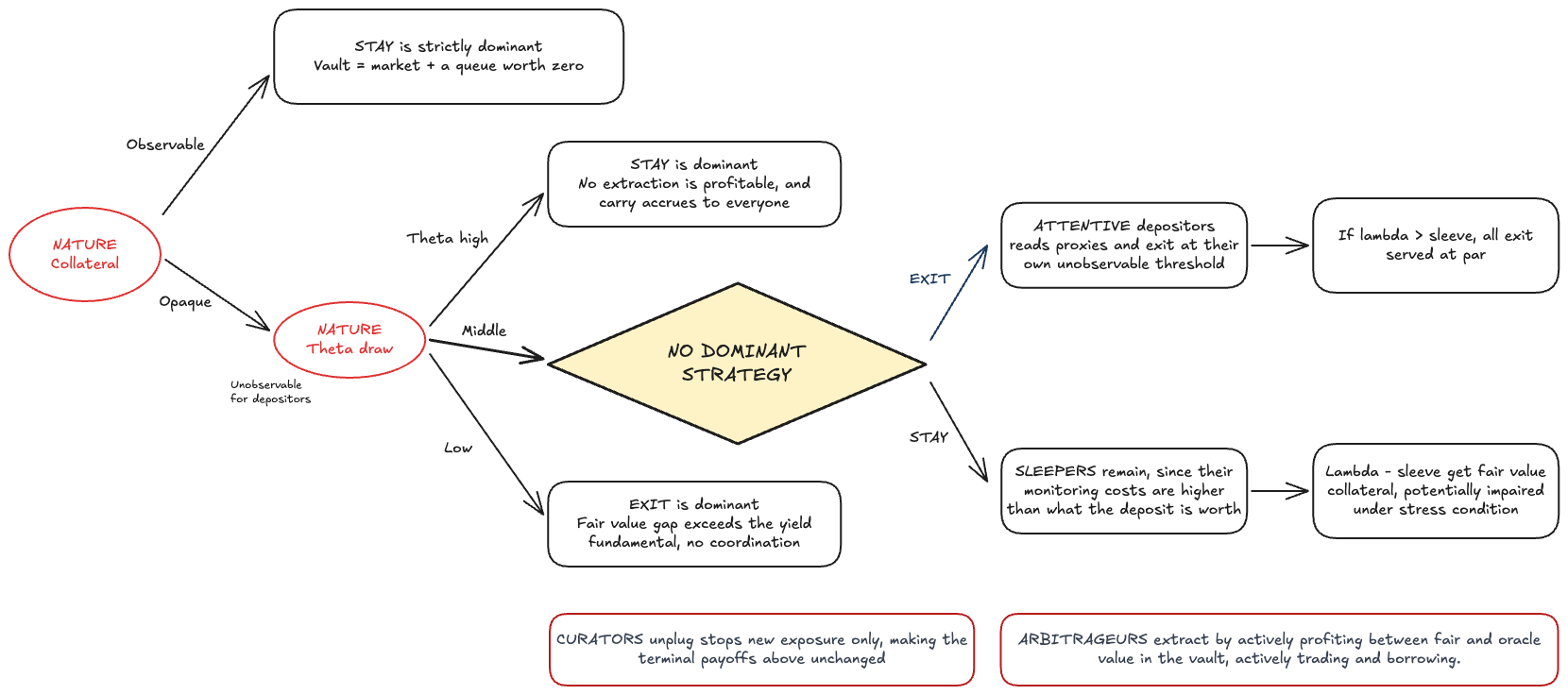
Raise λ and losses migrate → The depositors who react slowly to degradation are, by construction, the ones left holding it: the gap lands on whoever is still present at revelation. While our modeling is inconclusive on the relationship between λ and the arbitrageur’s window, a sleeping majority allows the trade: the arbitrageur needs unborrowed liquidity to draw on, and the sleepers are the providers of such liquidity. They are simultaneously his counterparty and his funding. The curator can stop the mismatch getting worse, but he cannot undo it. His unplug is ex post by design. He is also, plausibly, the best-informed actor in the structure after the arbitrageur, since monitoring the exposure is his business, or rather his liability holders’. But the value of that information to depositors decays precisely as its value to the curator rises: fee duration and potential collusion with the arbitrageur argue for keeping the market open, the depositor’s interest argues for closing it, and the two arguments diverge as θ falls.
Nothing here alleges anyone is misbehaving. Our intention is to model incentives rather than motives. If we believe in the rationality of actors, what a bad outcome requires is simply a bad setup: opaque collateral, insensitive depositors, misaligned curators. It is worrisome that today this setup is the category’s growth engine. As credit quality or liquidity conditions deteriorate, every incentive in the room rotates against the depositor: the arbitrageur’s trade improves, the platform’s retention problem makes the subsidy more attractive rather than less, the curator’s fee runs on, and the (retail) depositor’s own information arrives last.
Macroprudential authorities are not in this product and, on current form, will not be until it is large enough to matter to something else. That leaves the microeconomic actors: the platform, paid in client retention and therefore holding a real commercial interest in not distributing something that eventually impairs its users; and the securities regulator, whose remit includes making sure the public is not routinely seated at tables where the odds (and the incentives) both run the other way, with no protection mechanism.
Neither appears to be doing much scenario work. It is, however, why this newsletter still has something to write about.
On July 22, Commissioner Hester Peirce—the SEC’s most consistently crypto-sympathetic voice, published a formal statement under the Crypto Task Force banner titled, with directness, “Headstands and Summervaults: A Statement on Crypto Vaults and Lending Strategies.” It is an individual commissioner’s view, not Commission action, and it proposes no rule. But, given the upcoming departure of the commissioner, and her industry standing, the tone feels of particular importance.
Vaults, says the commissioner, “fall along a spectrum from programmatic allocations determined solely by immutable smart contracts, to allocations at the sole discretion of another person or group of persons.”
On the Howey leg: “A vault, for example, could be a common enterprise in which users invest money with a reasonable expectation of profits to be derived from the vault deployer’s and curator’s entrepreneurial or managerial efforts.”
On the ‘40 Act leg: “A vault that holds securities or allocates assets to investments in securities could fall into investment company territory.”
On lending: parties “setting interest rates, deciding which assets to accommodate, setting loan-to-value limits, and establishing liquidation thresholds, may want to analyze whether their activities implicate the federal securities laws,” and on-chain loans “can bear the hallmarks of notes that are securities.”
On the curator directly: “Involvement in managing vaults and lending strategies also may implicate investment adviser issues.”
The piece concluded: “If you do headstands, backflips, and other gymnastics to read the law so that it does not apply to crypto assets and activities that are well within the scope of the federal securities laws, you will have a painful fall.”
I don’t think it requires anything else from me.
v1 documentation stated outright that Owner, Curator, and Guardian “should be different addresses“; the v2 docs recommend an Owner multisig, a separate Curator multisig, and hot-key Allocators.
No posts
Comments
Nothing yet. Say the first thing.
Sign in to join the conversation.