
It all seemed so easy when he started.
Warren Buffett graduated from Columbia in 1951. He had $19,700 to his name.
Over the next five years, he would compound his net worth at a rate of 55% annually.
He bought things like Western Insurance at 1x earnings. He bought Greif Brothers Cooperage at 2.5x earnings.
When he launched his investment partnership in 1956, he had today’s equivalent of $1.3 million under management.
But as his assets grew, the game got harder. He became an activist, forcing businesses like Sanborn Map and Dempster Mill to do what he wanted.
He was also forced to own more securities. By the time Buffett became a millionaire (1962), his partnership owned stakes in dozens of businesses:
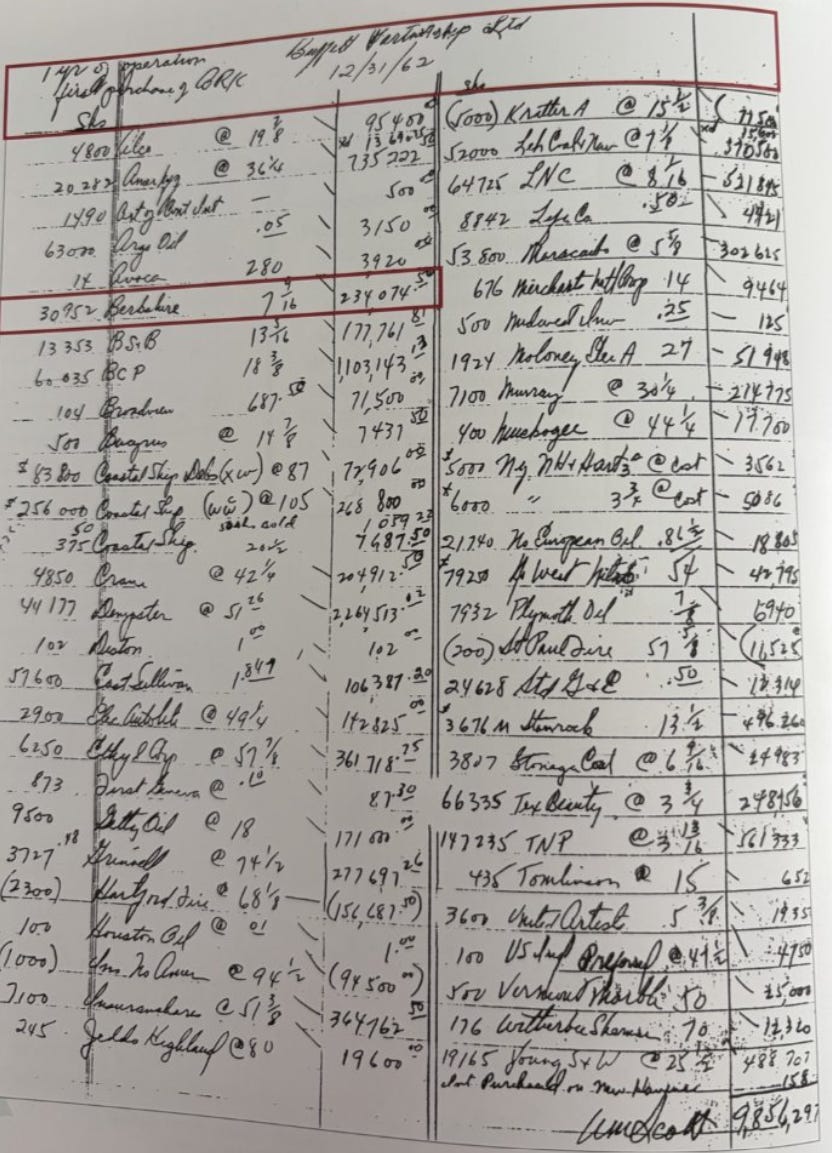
Seeing as how Buffett is the greatest investor to ever live, he found a way to evolve his strategy, go up market and continue to deliver world class returns to his investors.
He compounded his investors’ capital at a 24% CAGR for more than a decade.
But as the market took off in the late 1960’s, even the Oracle knew he couldn’t keep up. And he didn’t want to deal with the fallout that would inevitably come when prices shot back.
So he closed his partnership in 1969.
And he waited…
It took a while for the frothiness to unwind.
In the early 1970’s the Nifty Fifty were all the rage. Investors would seemingly pay any multiple for blue chip growth stocks (funny how history repeats itself).
Polaroid was selling for 91x earnings.
McDonald’s sold for 86x earnings.
Johnson & Johnson went for 62x earnings.
Then the music stopped.
The market was down nearly 50% from its highs in 1972.
That’s when Buffett got busy buying.
Buffett’s most important purchase in the early part of the 1970’s was Blue Chip Stamps as the zero cost float provided leverage for other investments. He added to his position throughout the decade. Some of the prices paid were absurdly low.
During 1974, Blue Chip’s market cap got down to $23mm.
(Table came from Turtle Bay - it’s an excellent website run by an honorable friend)
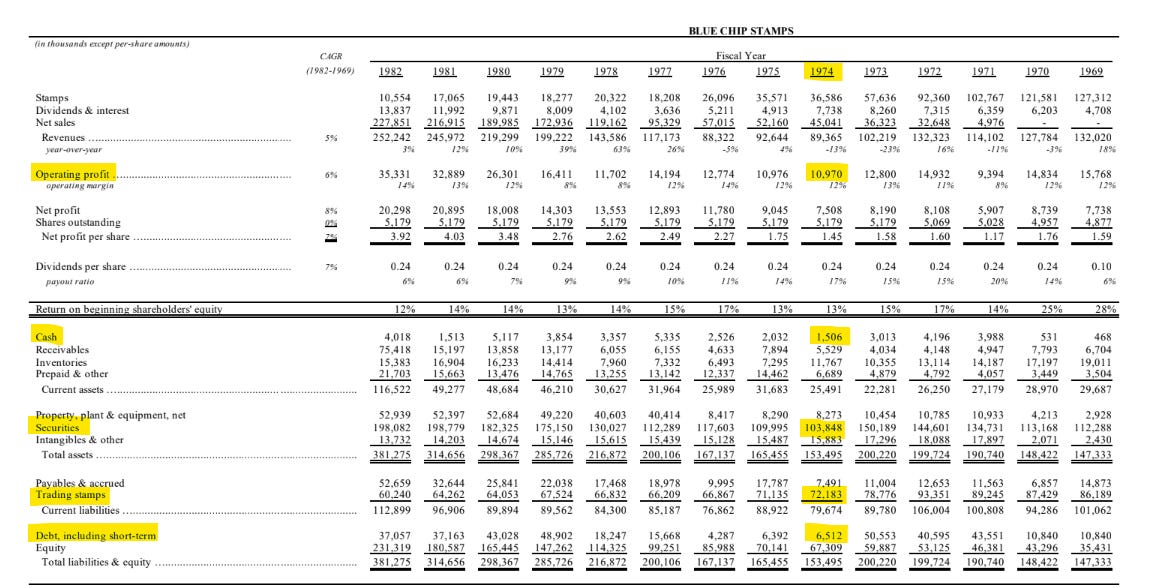
Blue Chip traded down to 2x EBIT.
Cash and securities ($105mm) net of all stamp liabilities and debt ($79mm) were greater than Blue Chip’s market cap.
Shares were trading at 34% of book value.
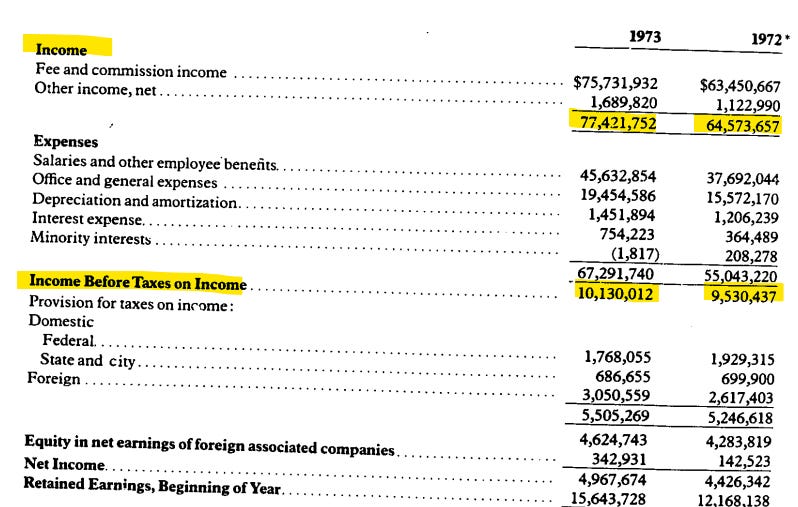
Buffett bought O&M throughout 1973 and 1974.
His basis valued the business at $29mm.
Ogilvy’s enterprise value was roughly the same as its market cap. So, Buffett was buying the shares at ~3x EBIT.
O&M grew its operating profit at a 23% CAGR from 1970 to 1974.
Buffett’s shares doubled in value within 2 years of his purchase.
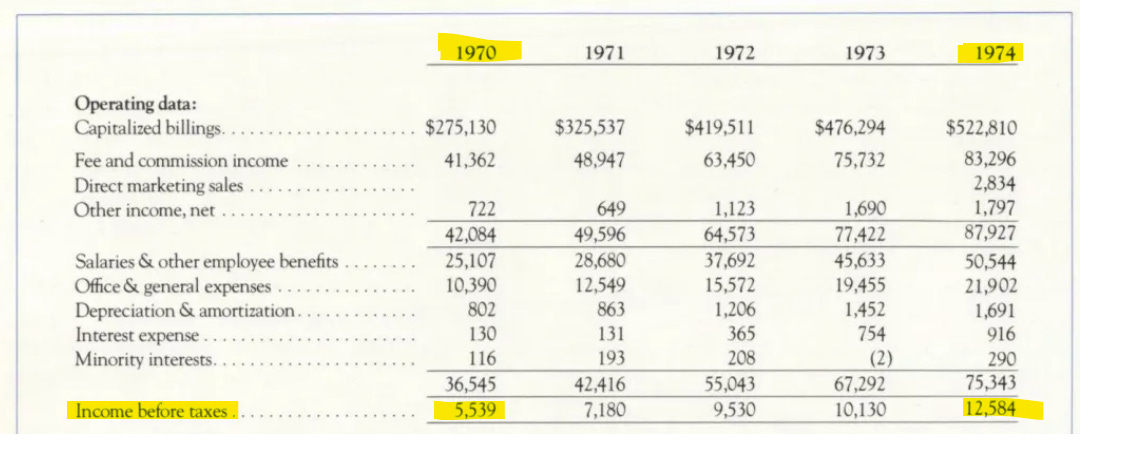
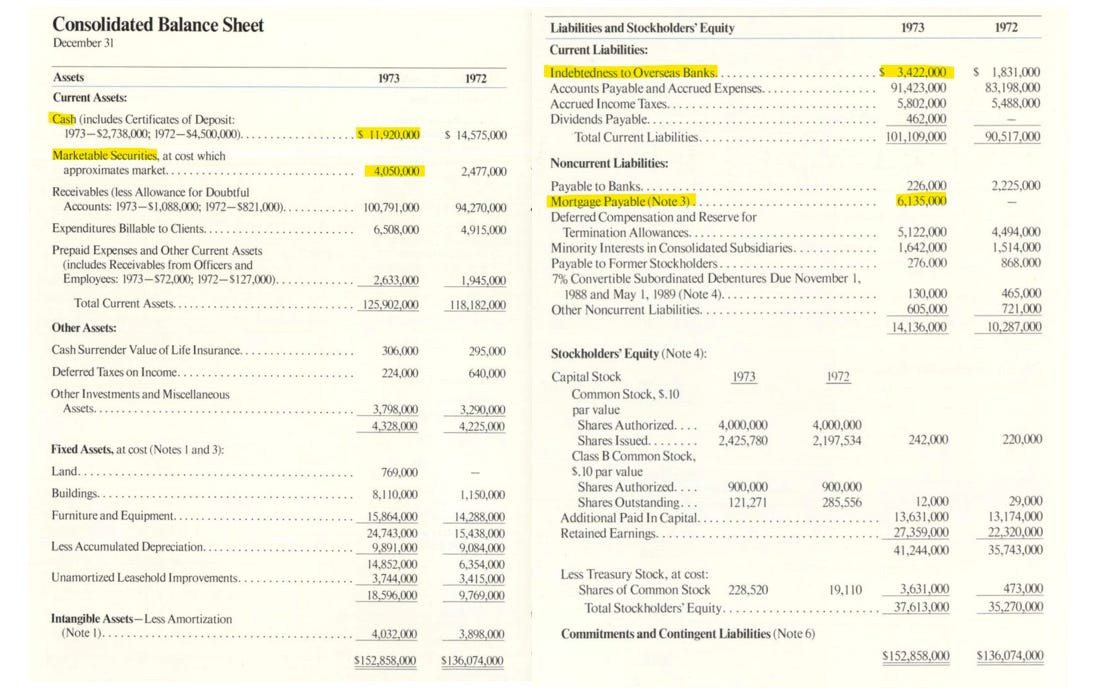
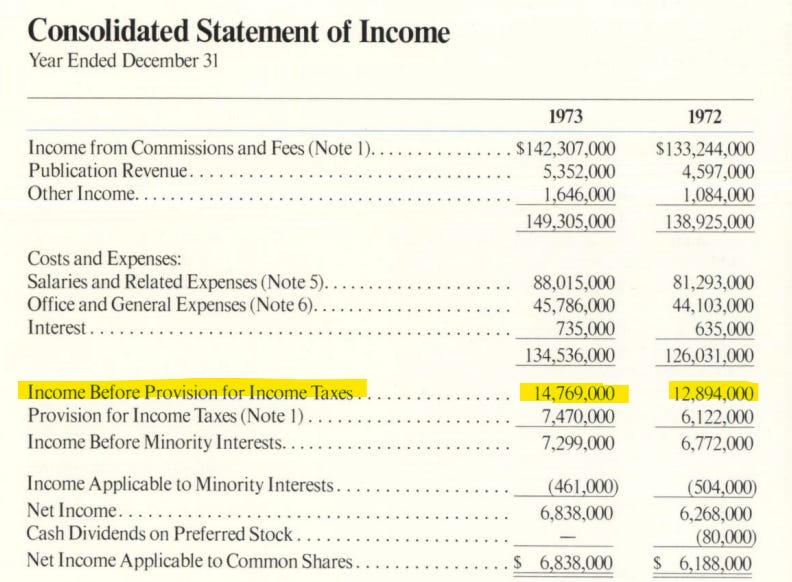
Interpublic fell 73% from its 1972 highs when Buffett began buying.
Buffett’s basis valued the business at a $25mm market cap. The enterprise value was only $19mm. Interpublic earned $14.8mm of operating income in 1973.
Buffett’s investment was up 10x in 10 years!
Buffett famously invested in The Washington Post at an $80mm valuation. He said the Post could’ve easily sold for at least $400mm in a negotiated transaction at that time.
The Post was doing $28mm of EBIT when Buffett invested, so it was selling for ~3x operating income.
Affiliated Publications was selling for a similar valuation as the Post and had a dominant franchise.
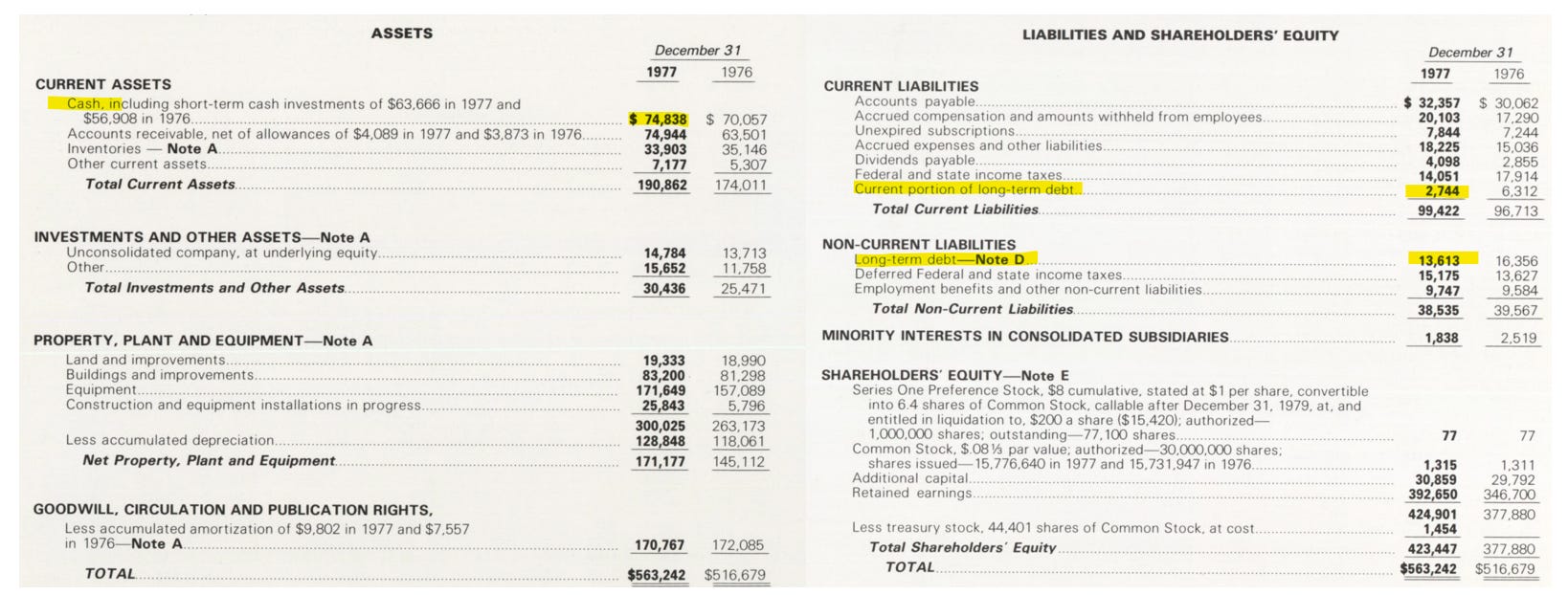
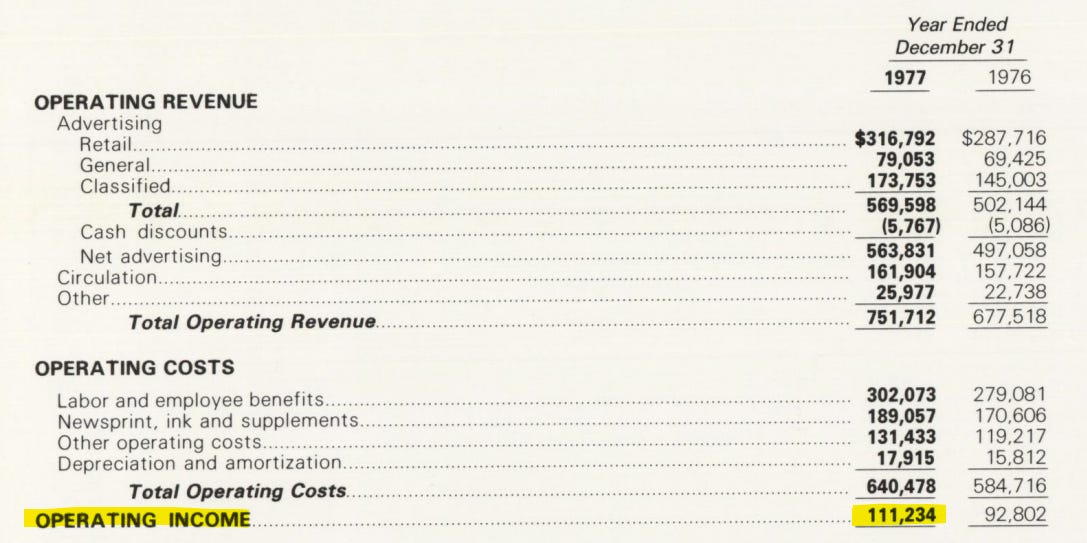
Then there was Knight-Ridder Newspapers. Look at its valuation:
Market Cap: $540mm
Enterprise Value: $480mm
EBIT: $111mm
EV/EBIT: 4.3x
Berkshire’s book value compounded at a 30% CAGR from 1973 to 1985.
We’ve all heard the stories of See’s, GEICO and The Washington Post, so I won’t go over those companies.
I wanted to show financials and valuations for dominant household names so we can all understand how cheap stocks were at this point.
The 1970’s made Buffett, but he was also perfectly prepared for the opportunity.
He didn’t stretch to buy businesses at lofty valuations. He waited for the prices to come to him.
This was a difficult time for American business, but it was hardly unprecedented. I believe there is a reasonable probability that businesses get this cheap again.
The good thing for small investors is that you don’t have to wait for blue chips to get bombed out. You can find cheap, durable, profitable businesses today.
Here’s a business I wrote about recently.
At the time it was trading at a 77% of its net cash and investments and less than 5x EBIT. It was also buying in shares in a large and systematic manner.
Amazingly, even though the stock is up 50% in the last year, its even cheaper today.
Now it’s trading at 62% of net cash/investments. It’s got a profitable business, and they keep buying in ~8% of the stock each year. I’m intending to write an update next week, but for anyone doubting these great bargains still exist, you should read the original piece here:
Thanks for reading.
DISCLAIMER: THIS IS NOT INVESTMENT ADVICE. I MAY OWN SECURITIES MENTIONED IN THIS ARTICLE. THIS IS NOT A RECOMMENDATION TO BUY THIS STOCK OR ANY OTHER STOCK. I MAY BUY OR SELL ANY SECURITY AT ANY TIME. I MAY NOT TELL YOU IF AND WHEN I BUY OR SELL. THESE STOCKS ARE ILLIQUID AND YOU SHOULD UNDERSTAND THE IMPLICATIONS OF THAT IF YOU BUY THEM. THIS IS NOT TAX, LEGAL OR FINANCIAL ADVICE. I AM NOT YOUR FIDUCIARY. THIS IS THE INTERNET AND YOU’RE LISTENING TO A GUY NAMED DIRT.
No posts
Comments
Nothing yet. Say the first thing.
Sign in to join the conversation.