
"As long as the music is playing, you've got to get up and dance."
- Chuck Prince, CEO Citigroup; July 2007
Here’s the simple math.
Assume you want to earn a 10% return on your investment.
Let’s say you pay 32x earnings for a business with a 1% dividend yield.
In order to achieve your 10% return, you need two things to happen:
Business grows earnings at 9% per year.
Multiple remains at 32x when you decide to sell.
That’s not impossible. Some businesses grow earnings at far greater than 9% for a very long time.
But what if the business you were buying had not demonstrated any ability to grow at that pace? What if this were a large, stable business that really can’t grow earnings more than 6-7% per year historically?
Worse yet, what if the comps for this business trade at 15x earnings, instead of 32x?
Well, then, you might be in trouble.
As you probably guessed by now, I’m not talking about the valuation metrics of one particular business.
I’m talking about the S&P 500 today.
There are a few counterpoints to be made to my argument.
AI is going to change the world. It’s incredible technology. But can it permanently lift the growth rate of corporate earnings from 6.5% to 9%? That’s a huge task when your economy is already the largest in the world.
In the short to medium run, will AI cause more destruction in corporate earnings that expansion? I don’t know, it’s at least a possibility.
Then we’ve got the whole ciruclar nature of suppliers investing in customers - a practice that I believe is likely to cause more harm than good. The bulls say these circular relationships are immaterial to the large companies. But if it’s immaterial, why would you engage in the behavior at all?
And finally, we’ve got reinvestment risk associated with some of the largest companies in the index. Google earned $130B of net income in 2025. In 2026, it expects capex to be ~$185B. Amazon is worse. It earned $78B of net income last year and is expecting to spend $200B on capex in 2026. Meta earned $70B last year and they’ll spend $135B on capex this year.
These companies represent material portions of the index, and their earnings are becoming increasingly reliant on the prosperity of AI.
If your business earns $100B of profit but ultimately invests that $100B in a zero return investment, your business may as well have earned zero.
I think it’s extremely unlikely that AI capex results in zero incremental profit in the long run, but it’s not at all certain that these companies will achieve reasonable returns on the incremental capital deployed.
But I don’t want to spend too much time trashing the index when there are more worrisome things happening in markets.
Which brings me to my next point.
“So let’s just take a company that has marvelous prospects, is paying you nothing now, and you buy it at a valuation of 500 billion. Now, if you feel that 10 percent is the appropriate rate of return, that means that if it pays you nothing this year, but starts paying next year, it has to be able to pay you 55 billion in perpetuity. But if it’s not going to pay until the third year, then it has to pay you 60.5 billion in perpetuity to justify the present price. Every year that you wait to take a bird out of the bush means that you have to take out more birds. It’s that simple. And I question whether people who pay $500 billion implicitly for a business by buying 10 shares of stock at some price, are really thinking of the mathematics implicit in what they are doing.”
- Warren Buffett, Berkshire Hathaway Annual Meeting, May 2000.
Spacex is set to go public next month.
I read the S1 and felt like I was watching “Whose Line is it Anyway?”. You know, the show where everything’s made up and the points don’t matter.
This was my favorite excerpt:
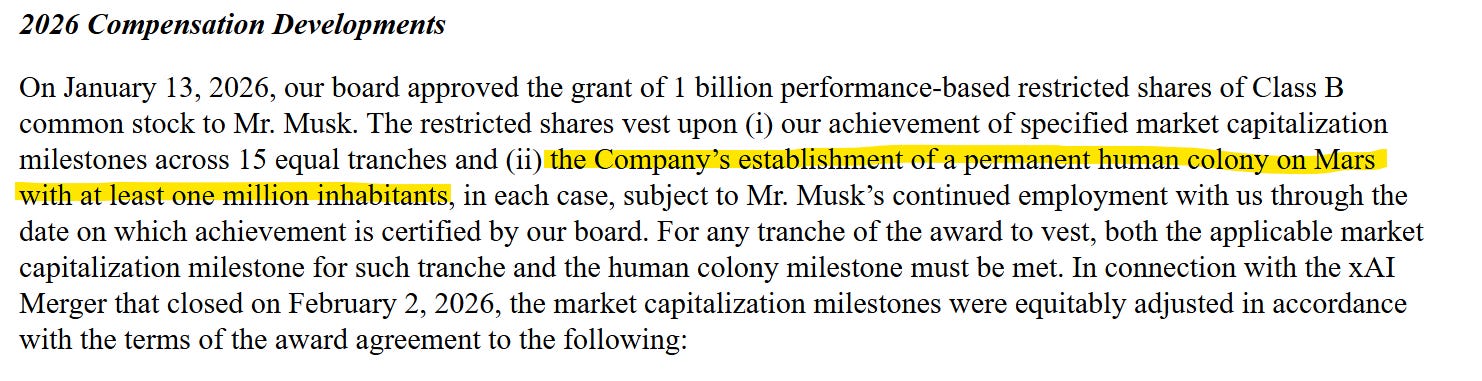
Spacex is eyeing a ~$1.8 trillion valuation, from the latest reports I’ve seen. SPCX did $18.7B of revenue and generated a net loss of $4.9B in 2025. Free cash flow was severely negative: -$15.8B (adjusting for stock-based comp).
So the business is valued at ~100x revenue, and revenue has been growing at a ~34% CAGR over the last two years. Q1 2026 revenue grew 15% yoy.
The business has never sustained profitability, as evidenced by a $41B accumulated deficit.
The term “retained earnings” does not appear in the S1.
Let’s go back to our Buffett quote at the top of this section. If you pay $1.8T for a business, and want a 10% return, you need it to send you $180B in year one. If it sends you $0 in year 1, you need it to produce $198B in year 2, and every year after that until the end of days. If year 2 also produces $0, you need year 3, and every year beyond that, to produce $218B.
I don’t think it’s likely that SPCX will reach profitability in the next couple years.
No company on planet Earth has ever generated more than $200B of profit in a single year.
I was trying to find a way to frame the insanity of the SPCX situation.
According to ChatGPT, General Motors (in the 1950’s) was the largest company in American history when measured on GAAP revenue as a percent of GDP.
This isn’t a perfect metric, but I think it helps us get a rough feel for how large a company can become as compared to the ecosystem in which it exists.
GM’s revenue was equal to ~2.3% of American GDP. This shouldn’t be surprising as GM had ~50% market share in the second most expensive asset Americans owned.
Walmart’s revenue is ~2.2% of GDP today. Standard Oil was estimated to be ~1-2% of GDP.
Now let’s take this metric and apply it to SPCX.
U.S. GDP is ~$32T today. Historically speaking, it would be difficult for a single business to earn more than $750B in annual revenue.
But SPCX will conquer the world (and Mars), so let’s assume it shatters the record. Maybe SPCX revenue can be 3% of GDP, beating out every business in history by 30%!
That would imply SPCX revenue of $960B. So what kind of profit margin can we expect for this business. Let’s take a look at the segment data to get a clue:
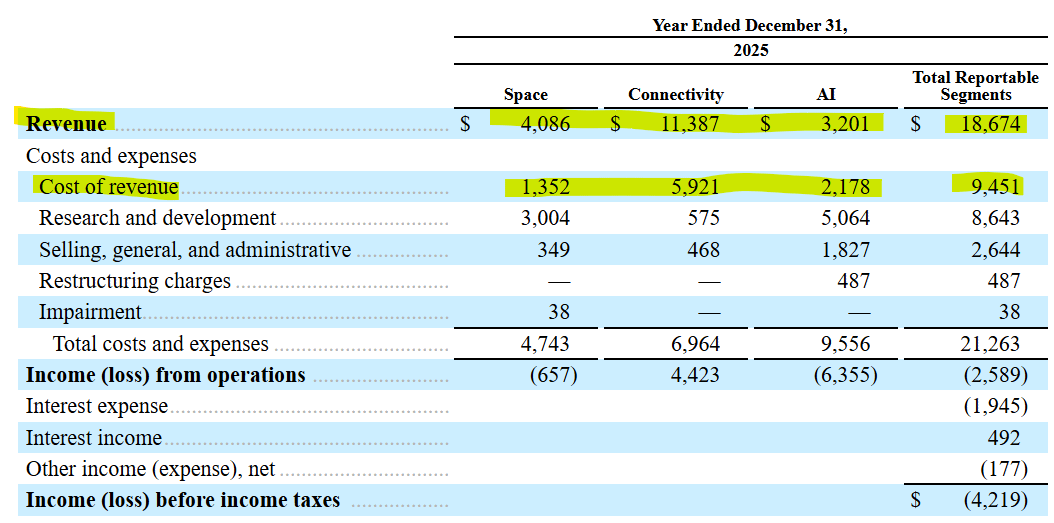
SPCX consolidated gross margin is 49%. Its only profitable segment carries a 48% gross margin.
We’re dealing with an asset intensive business here. Can gross margins be meaningfully greater than 50% in the long run? I am not qualified to say yes or no on that.
But let’s say SPCX is a killer business at scale and it can achieve 20% operating margins, and 15% net margins. And let’s say it takes us 10 years to work our way there.
So, at a $1.8T valuation, we need $180B of cash in our pocket this year to generate a 10% return.
If we are unable to earn an cumulative profit above $0 for the next 10 years, then year 11 (and every year after that) needs to pay us $466B!
Alright, so we need $466B of profit in year 11. At 15% net margins, that means we need $3.1T of revenue.
If nominal GDP compounds at 7% for a decade, then GDP will have grown to ~$64T. So, SPCX in year 11, will need to have grown its revenue to ~4.8% of GDP ($3.1T / $64T) - a percentage more than double any company in history.
To get to $3.1T of revenue in 10 years, SPCX will need to grow its top line at 67% annually. The past couple years have shown revenue growth in the 30’s…
Hmm, this is getting difficult.
So to recap, here’s what we need to justify today’s valuation:
Revenue growth rate to double.
Find a path to 15% net margins.
Find a way to swallow more of the economic pie than any company before you ever has.
Don’t burn too much money along the way.
Of course it’s a little more nuanced. My example shows SPCX getting to a certain profit level in year 11 and then not growing at all beyond that. If they have staying power, profits ought to grow in time.
The issue is that if you get to this massive size, you won’t be able to grow very fast. You will have consumed so much of the world’s economic resources at that point that growing at a high clip won’t be possible.
Additionally, I’m using a 10% required rate of return for my math. I’m guessing the incremental buyer on day 1 might scoff at a 10% hurdle. His required rate of return might be significantly higher. A 15% discount rate requires $1.09T of year 11 profit in my above example.
And lastly, I’m assuming you can buy at $1.8T on day one. My guess is that this thing pops like crazy when it opens. In which case buyers pay a higher price and the math becomes even harder.
I see some variation of this statement thrown around a lot lately:
“We can’t be in a bubble if this many people are calling it a bubble.”
I believe that’s just the social media algos pushing you content that you’ll engage with.
This is the first time in our history that we’ve had such widely distributed media platforms. Fintwit wasn’t a think in 1999 or 2007.
Now more than ever, you can live in your own little echo chamber. If you believe we will colonize Mars, there’s a dozen podcasters out there that believe the same thing.
It’s clear to me that there is a lot of wacky pricing going on out there. Micron is up 10x in a year. From the outside looking in, the VC landscape appears to have abandoned any startup that isn’t AI related.
The largest, most cash generative businesses in the world have decided to invest every dollar of profit into this ecosystem.
The market is increasingly reliant upon the outcome of this one industry.
I think the S&P is overvalued.
“Price is my due diligence”
- Warren Buffett
My friend Joe Raymond wrote a case study about BBDO/Omnicom recently.
You can read it here: BBDO Case Study.
BBDO generated an 18% IRR for 57 years!
The business had a consistently high ROE. If you were a buyer in 1969, you experienced a 20% IRR for the first decade of ownership.
But if you were a buyer in 2000, you earned a 1% IRR for the first decade of ownership.
Why?
Because BBDO traded at 7.5x earnings in 1970. And in 2000 it traded for ~30x earnings.
Price matters.
Buying stocks at 30x earnings or 100x revenue doesn’t work out well, on average.
So, what do we do?
As Munger says - “Invert, always invert!”
If you buy stable business at 6x earnings, and those earnings are either returned to you or intelligently reinvested in the business, you will earn a ~17% return on your investment.
You won’t have to make heroic assumptions about the future.
Let mean reversion be a tailwind, instead of a headwind.
My Mount Rushmore of investment characteristics are as follows:
EV/EBIT below 5x.
Net cash on the balance sheet.
Long history of profitability (earning a profit 90%+ of the time).
Reasonable capital allocation.
I’ve found that investments meeting these criteria work out really well on average. There are very few companies that can meet this threshold. They’re mostly small, unknown businesses.
You won’t hear about them on CNBC. People won’t mention them at parties.
But they can create outsized returns with limited risk. And that’s the whole point of the game after all.
Yes, I do believe we’re in a bubble.
Yes, I do believe asset prices should be lower.
But I’ve felt this way for a long time, and I’ve been wrong the whole way.
I’m making a macro call - and my track record in making these kinds of statements has been horrible.
Fortunately, it doesn’t change the way I invest. I’m nowhere near intelligent enough to buy things that require conviction about future decades.
I’m more or less always fully invested. So it’s not like I’m taking my capital and running for a bunker.
I just think my life will be a lot easier if I buy underpriced assets.
DISCLAIMER: THIS IS NOT INVESTMENT ADVICE. I MAY OWN SECURITIES MENTIONED IN THIS ARTICLE. THIS IS NOT A RECOMMENDATION TO BUY THIS STOCK OR ANY OTHER STOCK. I MAY BUY OR SELL ANY SECURITY AT ANY TIME. I MAY NOT TELL YOU IF AND WHEN I BUY OR SELL. THESE STOCKS MAY BE ILLIQUID AND YOU SHOULD UNDERSTAND THE IMPLICATIONS OF THAT IF YOU BUY THEM. THIS IS NOT TAX, LEGAL OR FINANCIAL ADVICE. I AM NOT YOUR FIDUCIARY. THIS IS THE INTERNET AND YOU’RE LISTENING TO A GUY NAMED DIRT.
No posts
Comments
Nothing yet. Say the first thing.
Sign in to join the conversation.