
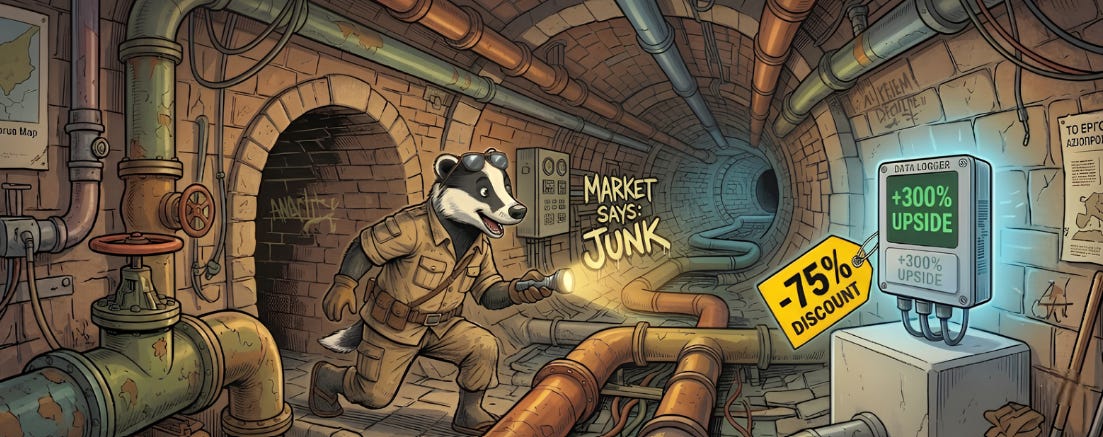
nobody likes a water leak at three in the morning.
I do not. I doubt you do. my wife likes it least of all, because a leak at that hour means she is awake, and if she is awake, I am awake, and the morning that follows is not a good morning.
the good news is we have not had one in a while. blackouts, yes, now and then. but my wife has made her peace with blackouts, because a blackout is the one event on earth that stops me reading annual reports at the lunch table. the power goes, the laptop dies, and for twenty minutes she gets a husband instead of a man muttering about working capital into his soup. she does not pray for blackouts. but she does not entirely mourn them either.
I mention all this because, not long ago, my city’s water utility bought a few hundred data loggers from a company reasonably well known inside its own small world. sensors, remote units, the boxes that sit in underground chambers and report a leak before it reaches the street. the bill was considerable. it is probably also why the leaks around here have quietly stopped.
a while later I got talking to a plumber who works the municipal contract. he told me the spending was not a whim. it was a directive. a legal one, from Brussels, and once the boxes went in, the data cut the city’s water losses by close to a fifth. then he told me the part that stuck. he said I would not believe how much water Europe throws away every year for the lack of exactly this. a quarter of everything treated and pumped, gone before it reaches a tap. Italy loses over 40%. Bulgaria more. billions of euros a year, poured into the ground, in the dark.
I thanked him. then I did what I do with most genuinely interesting things, which is nothing, for a while.
two months later I was doing my daily A-to-Z. every company on the exchange, one after another, the way other people do their sets at the gym. somewhere in the middle of the list I walked into the company that had supplied those boxes to my town.
I made a noise. an involuntary one, out loud. the noise a man makes when he finds the keys he had given up for lost. my wife came in from the kitchen and asked if I had hurt myself. I said I had found a company. she looked at the screen. she looked at me. she went back to the kitchen. I heard her tell the cat that this was going to be a long month. the cat, to its credit, already knew.
I almost had not recognised the company at all, because my screener still describes it as a manufacturer of road signs and electronic equipment. it has not made road signs in years. it sold that business. nobody covers the stock, so nobody ever corrected the file, and the most-read sentence about this company describes a business it no longer owns. I have since written to the data provider asking them to update it. politely. I am not holding my breath. part of me hopes they take their time, because that description is half the reason the stock is still this cheap.
the rest of the screener line was worse. revenue down 41%. earnings per share of minus €8.45. operating margin near zero.
a wrong description, numbers out of a horror film, and a home country we play tonight in a World Cup semi-final. worth my time?
as it turns out, yes. because that 41% is not what it looks like. and buried in a segment note of that wreck is the best small business I have found in fifteen years of doing this.
and I want to be careful with the word best, because I know who reads this. some of you buy cigar butts. some of you buy compounders. some of you only move when there is a catalyst with a date on it. fine. this one has a door for each of you.
if you are a deep value person: the whole group trades at 4.3 times EBITDA. below the bottom of both of its peer groups. both halves, at the same time. I did not think that was possible either.
if you are a quality person: one third of the sales produce ninety-six percent of the profits. a 23% margin, on a 78% return on capital, with not one down year in the disclosed record. I checked that three times, with trousers on and a spreadsheet open, because segments that never go down usually turn out to have gone down somewhere. this one has not.
if you are a growth person: the demand for what this segment sells was written into a European directive, with dates in it and thresholds per municipality. businesses whose customers are legally obliged to buy more are not common at any price. remember the plumber.
if you are a catalyst person: the debt amortises itself out of the company’s own free cash flow, roughly a third of the market cap migrating quietly from the creditors’ side to mine by 2028, whether the market watches or not. deleveraging is the only catalyst in finance that does not require an audience.
and if you are only here for the entertainment: the founding family lit a fire that cost somewhere between 80 and 120 million euros, watched the stock fall from 47 to 6, and then performed surgery on itself. late surgery. expensive surgery. but real. the fire is out. the screener has not noticed. the market is still pricing the smoke.
now the number, because you have been patient. I built the model the way I always do, by insulting my own idea to see if it survives the insult: the crown jewel priced below every listed relative except the runt of the litter, the other half priced below the cheapest peer in Europe, and a discount on top of all of it because a family holds the keys and families do not open doors for my spreadsheet. that version, the deliberately ugly one, an +130% upside from the current price. the base case prints roughly +200% upside. I got up, made another coffee, and checked whether I had accidentally typed the market cap in rupees. I had not.
and there is a clock on it. sometime in 2027 the annual comparisons roll clean, and the same screener that today prints revenue minus 41% and an EPS of minus €8.45 will print rising revenue, expanding margins and falling debt. every quality filter in Europe finds it on the same morning. the trade is to be there before the file updates.
let me show you.
Comments
Nothing yet. Say the first thing.
Sign in to join the conversation.