

About a year ago I did a podcast with a pretty well-connected person in the venture capital community and they said something that stuck with me about how AI was going to impact the future of work: That “a thousand flowers would bloom.”
The line is a misquote of Mao Zedong’s, “let a hundred flowers bloom, let a hundred schools of thought contend.”
I had heard the expression before and thought it was an odd application of its use. I guess it makes sense if you’re a venture capitalist that a thousand flowers would bloom... then most will die and only a few will survive. I think that’s the implication, right? Many will bloom, most will die, and some will survive until the next season. Only the strong survive. Survival of the fittest.
Does that sound like the ethos of HR?
I’m looking at an HR industry where everyone is expected to build their own AI applications to make the future of work possible. At every organization, a thousand flowers of new AI applications will bloom. And I guess many will die, and some will survive. Is this what we want? Will it work?
When I look at the market for how HR is transforming I see two patterns forming that are incompatible with one another. One is a pattern of a wholesale complete transformation of HR that is unrecognizable, futuristic, so AI-laden it’s hard to see what role humans play in the future of work. In the other pattern, I see the quiet pleas of the normal HR person to keep things the same. Nothing changes. Maybe the wave will pass us without us getting hit? It won’t.
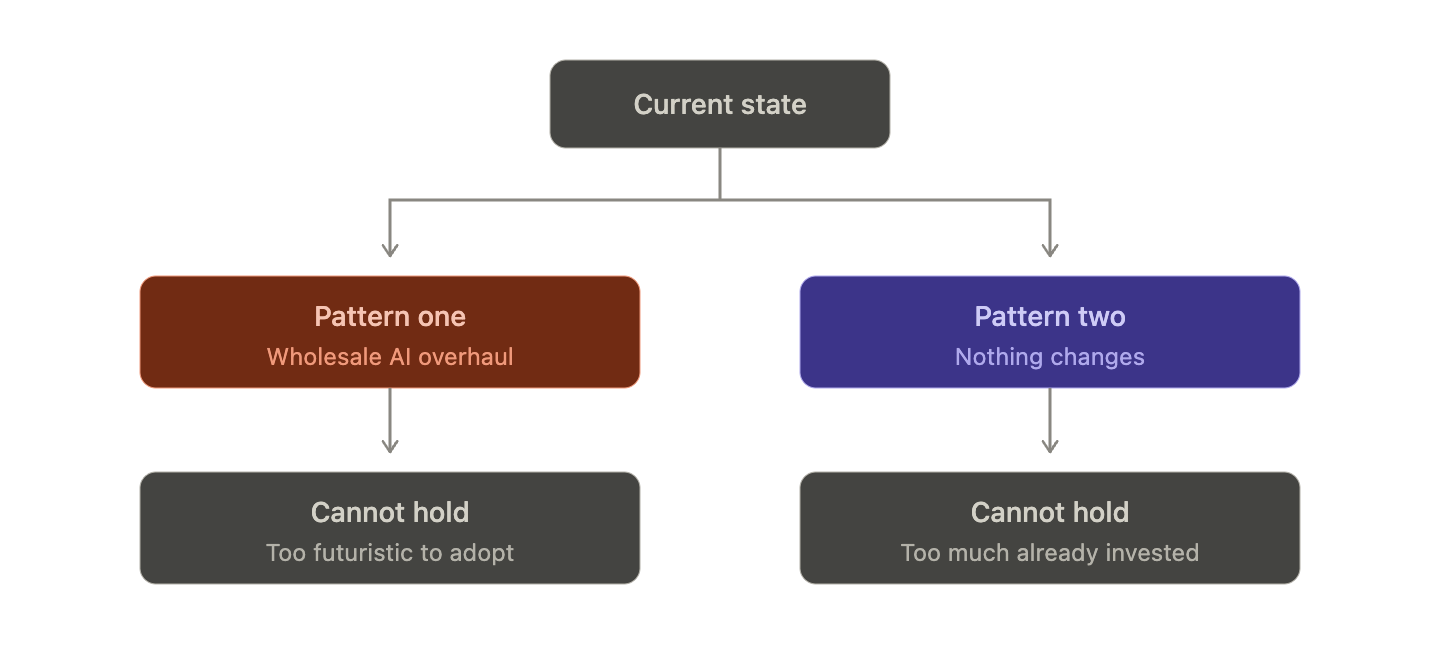
I guess I’m at this point where I don’t think either of these patterns is true. They cannot hold.
The first pattern cannot be true. It just can’t. The reason is simple. No technology change can get rapid adoption if the people who are expected to adopt it don’t understand it. Remember when everyone was supposed to learn to code? Remember when everyone was going to learn a second, third or fourth foreign language? Remember when everyone was going to be a STEM graduate? It’s not going to happen. HR people are simply not going to adopt something en masse if it is too futuristic or it doesn’t make sense to a normal person.
A thousand flowers blooming of AI applications in HR looks a lot like waste to me. Duplication of efforts. Technical debt. No common source of truth. The list of problems goes on..
The second pattern also cannot be true. It just can’t. The reason is simple. HR and IT, organizations, society, and even nations have too much invested in the current technology transformation underway for nothing to change. I think you’d be hard pressed to find an HR person who can’t point out ANY positive change that has come to them individually or to their teams because of AI. It might not be wholesale change yet, but change is happening incrementally. Like it always does.
Too much has been written about change management and change fatigue and transformation over the last few years. To keep it short, I’m going to give the formula for making AI change happen in organizations. Likely without needing too much change management.
Here are the principles of change that are necessary:
Change needs to be simple
Change needs to be the path of least resistance
Change needs to be (relatively) cheap
Change needs to make work easier
Change needs to be human
This is why I get excited about the concept of people intelligence (referring to the article from the picture above). When I look at how the principles of people intelligence are shaping up, I don’t see a thousand flowers blooming. I see an instantiation of the principles of change from above. I see the capability of getting HR insights becoming more simple. I see the lives of HRBPs and managers getting easier, with decisions that don’t require going into 10 different systems or needing an analyst to help, making it the path of least resistance. I see the days of multi-hundred thousand and million dollar contracts for basic HR technology ending, and this type of technology becoming a commodity. I see the low-value-added tasks of many HR centers of excellence and shared services become automated, making the hard, inane work of those functions easier, and ultimately more human-focused.
I see a positive future that is neither too dystopian nor too much like the present. Not too hot, not too cold. Just right.
I suspect you’d like to learn more about what I’m seeing. If you are curious to continue the conversation about what the future of people intelligence looks like, let’s talk. I want to hear from you.
Maybe a thousand flowers won’t bloom. And maybe that will be OK.
To find out more about the company building the future of people intelligence or to book a demo at hrbench.com/directionallycorrect.
For access to all of Cole’s previous articles, go here.
No posts
Comments
Nothing yet. Say the first thing.
Sign in to join the conversation.