
Something that’s hard to understand doesn’t seem like the obvious analogy for explaining things, but sometimes it works.
There’s a usual diagram that accompanies explanations of machine learning, especially the deep learning flavor that’s typical of what the trendy kids are calling artificial intelligence these days. In the diagram, data comes in on the left and goes out on the right. The important part happens in the middle—in the hidden layers, which don’t get much explanation in the usual introduction. They do something important, but they’re hidden.
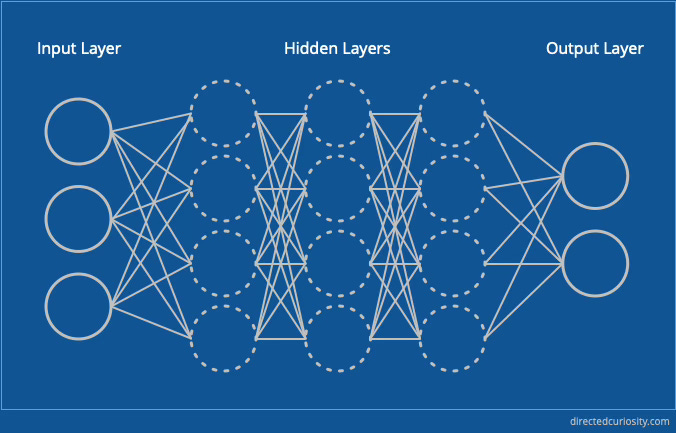
I don’t understand most of the science of how these things work (John Kelleher’s Deep Learning helped), but I’ve seen this diagram enough to realize that understanding how neural networks work perhaps isn’t necessary for everyone thinking of using one. Key terms are uttered, the diagram is shown, we move on.
I’m talking to people in the data business, and even if they don’t understand deep learning any better than I do, they’re familiar with the diagram. The hidden layers are the core of the black box: essential to the system, but most of us can ignore them. And that’s the part that works as analogy for the data market.
Let’s take the same diagram and play with the labels. Data comes in on the left, in many forms and from various sources. It goes out on the right, enabling a user-facing software application, or perhaps delivering a metric or report. In between—and usually depicted as a simple line—there’s a network of organizations collecting and exchanging data, adding value as it progresses toward that final customer.
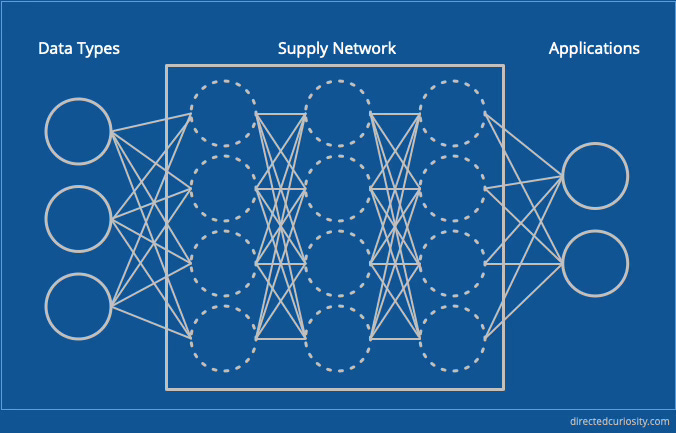
A normal conversation focuses on the value of the application to its customer: how this application turns that data into this value. What I’m doing with the Data Market Study is mapping out the hidden layers between the source data and the visible applications serving end users and customers. Looking closely at what others ignore is the point.
“AI was never a technology; it was always a research agenda, and more than a research agenda it’s a thought exercise or conjecture that says you can automate thinking if you can describe it in smaller pieces.”
– Genevieve Bell
I’ve enjoyed Ross Dawson’s work for years, especially the interviews behind Thriving on Overload. Now he’s focusing on the potential of humans working with AI. His ventures map looks familiar in a stressful way, too.
A market for training datasets?
I always loved the story about the hospital learning from F1 pit stops.
Hazards of following academics on social networks:
Co-Intelligence: Living and Working with AI
*Quote attributed to Einstein, but as always, there’s a story.
Comments
Nothing yet. Say the first thing.
Sign in to join the conversation.