
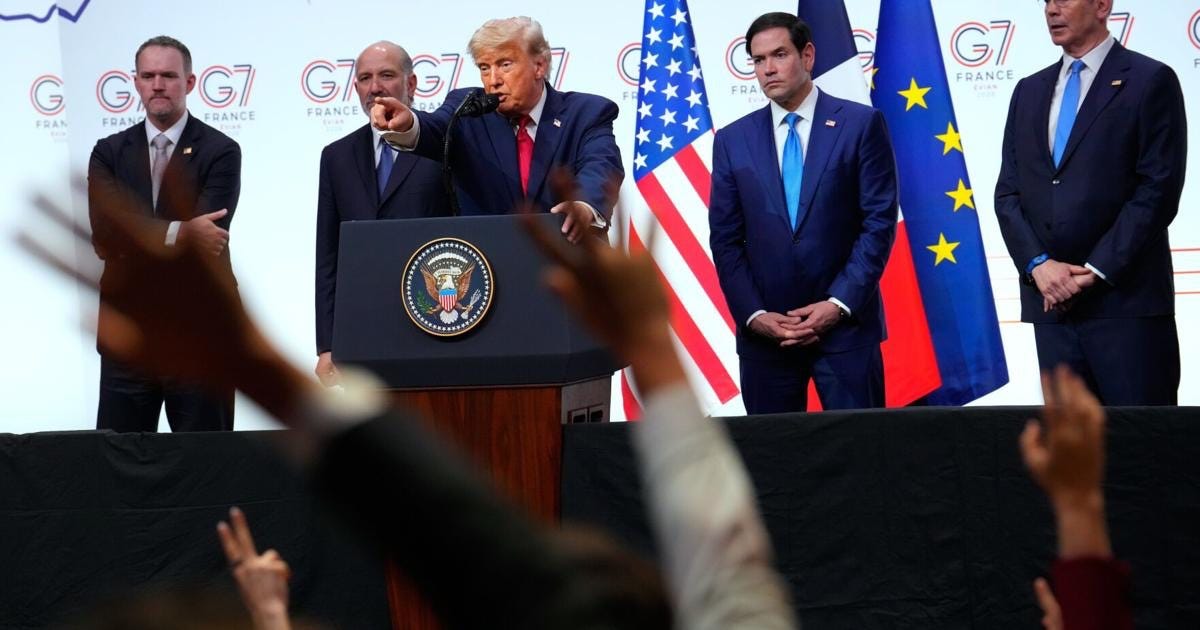
In a rare moment of candor amid a rambling press briefing, Donald Trump said he took a deal to end the Iran war to prevent economic calamity.
“If we didn’t do this deal, we could have dropped more bombs for another three weeks,…four weeks, two years….you would never have the Hormuz Strait open,” Trump told reporters at a press conference at the G7 summit in Evian, France, today. The stock “market would have, instead of going up….would go down at levels that nobody ever saw before, maybe, except for 1929.”
“I did not want to see economic catastrophe,” Trump said. “If you kept this going, that could have happened.”
But a senior US administration official suggested there were still details to be worked out both in a 60 day memorandum of understanding reached between the United States and Iran, and in a final deal the parties will attempt to negotiate (which is highly unlikely to be finalized within 60 days, if ever). Currently Vice President JD Vance is expected to lead a US delegation to an MOU signing ceremony with the Iranians due to be held in Switzerland this weekend.
“I think the meeting this weekend in Switzerland will be quite critical in order to …see how we get to the next phase,” a senior U.S. official, speaking on condition of anonymity, told reporters today. “This document basically has insinuations of what all the different parties want to do. But it has to be a situation where both parties meet together and they both agree on kind of the full magnitude of what both parties are going to do, and then come up with a sequencing agreement on who’s going to do what when, and that’s really where the crux of negotiations will go.
“If one party is obviously not meeting the expectations of the other party, we’ll hopefully know within days or weeks, not months, and I think that then obviously President Trump maintains a ton of optionality on what he’ll do,” the US official said.
“Obviously our blockade was working, so we’ll give everyone a little bit of relief for the negotiating period, and then we’ll see what happens with it,” the official said.
Trump later threatened to bomb Iran again if a final deal is not reached in 60 days, though that threat itself would seem to be a violation of the first paragraph of the MOU that he and Vance electronically signed on Sunday (June 14).
“If it doesn’t get done in 60 days, that’s all right,” Trump said. “We go back to bombing. I don’t want to do that., …but we might have to.”
“The United States of America and the Islamic Republic of Iran and their allies in the current war, by signing this MOU, declared the immediate and permanent termination of military operations on all fronts, including in Lebanon, and undertake from now on not to initiate any war or any military operation against each other and to refrain from the threat or use of force against each other….,” Paragraph 1 of the US Iran MOU states.
“The big picture is that the Iranians believe that they have achieved not just survival and preservation of the regime, but they have achieved a position that will enable them to change the strategic equation in the region,” former State Department Iran expert Suzanne Maloney, now vice president of the Brookings Institution, told an Iran panel hosted by the Carnegie Endowment for International Peace today. “Iran will be reintegrated in the region in economic terms that can be quite beneficial to the regime.”
The Trump administration’s misplaced hopes to try to reach a grand bargain deal with Iran in a short time frame are likely to fail and that could lead to renewed conflict, Carnegie Endowment Iran expert Karim Sadjadpour said.
“The danger here is…that this hope for a grand bargain doesn’t succeed,” Sadjadpour told the Carnegie Iran panel. “There is a danger here that President Trump could go back to conflict. Obviously, that isn’t his preferred outcome, but I’m not of the view that we’re totally out of the words, and that this conflict is over.”
“Every time I hear the words ‘grand bargain’ apply to the Middle East, it makes me very nervous,” veteran US diplomat and Carnegie scholar Aaron David Miller responded. A transactional deal is possible, but a transformed US Iran relationship in the near term is unlikely, he said.
**
Comments
Nothing yet. Say the first thing.
Sign in to join the conversation.