
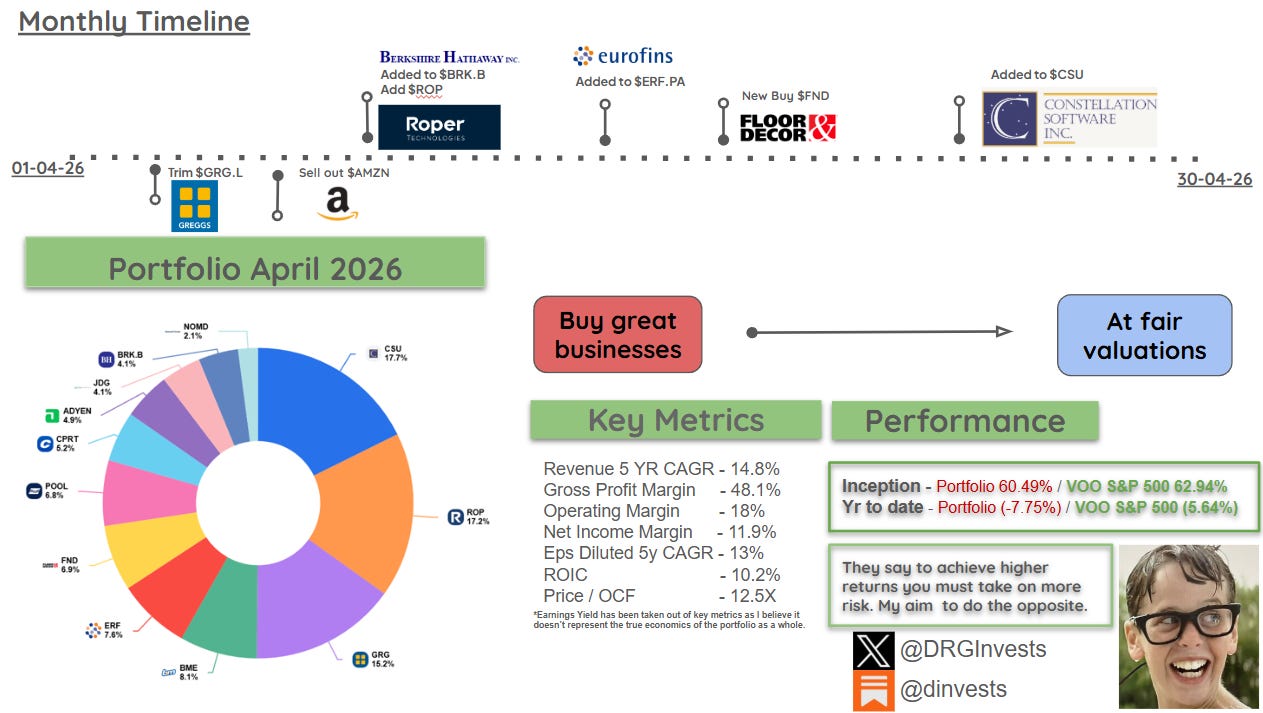
Sold Amazon
Trimmed Greggs
Added to existing holdings Roper Technologies, Constellation Software, Berkshire Hathaway and Eurofins Scientific.
New buy Floor and Décor.
Transferred my ISA to another brokerage.
Hello and welcome to this months portfolio update.
I want to start by recognising the huge increase from the market which was up 10% in April, the best monthly increase since November 2020. This price increase takes the index into the green YTD and now up 5.5% for the year. The surge in price was due to a few key contributors.
Federal Reserve held interest rates steady for a third consecutive meeting.
Strong earnings releases. Approximately 83% of business who’ve reported earnings have beaten estimates.
Alphabet, Microsoft, and Amazon reported strong growth in their cloud divisions, cited as a proxy for AI demand.
Potential geopolitical De-escalation.
As a value investor, I cant help but acknowledge the potential risks involved with buying at all time market heights. Another point I want to acknowledge is that the market can also be euphoric for many more years to come or what Buffett quoted “The market can remain irrational longer than you can remain solvent”. Many investors are boasting throughout social media with how easy investing has become which is concerning. “This 10% expected annual return” is becoming a hot topic among new investors who quite frankly give no consideration for price and value. With historically high earnings multiples and margins, a low dividend yield and repurchases not really moving the needle towards shareholder yield, future returns look challenging to expect historical market returns. Shareholder returns are produced through the following five factors.
Sales growth.
Increase in earnings multiples,
Increase in margins,
Dividend yield,
Share buybacks.
“The opposite diminishes returns”
I learned this “Five factor analysis” from one of my favourite investors Christopher Bloomstran who’s President and Chief Investment Office at Semper Augustus. During his annual letters he emphasises the importance of this simple framework which I’ve implemented into my analysis to try and calculate possible future stock returns.
Just being rational and conservative here. To achieve a 10% return P.A at these heights an investor would need multiples and margins to remain at historical heighs (Emphasis on these two) along with an 9% annual sales growth while collecting a 1% dividend yield. Looking into the long-term averages, sales growth typically increases around 5.5% annually 🤷♂️. If you believe multiples and margins will increase then you might have a case to achieve this desired 10% return, I personally don’t. So, if we use the average increase in sales growth of 5.5%, keep the multiple and margins at current levels while collecting a 1% dividend yield then the long term total shareholder returns from here look like 6.5% P.A. This scenario given above takes no consideration to the possible contraction of multiples and margins which could be disastrous to future returns.
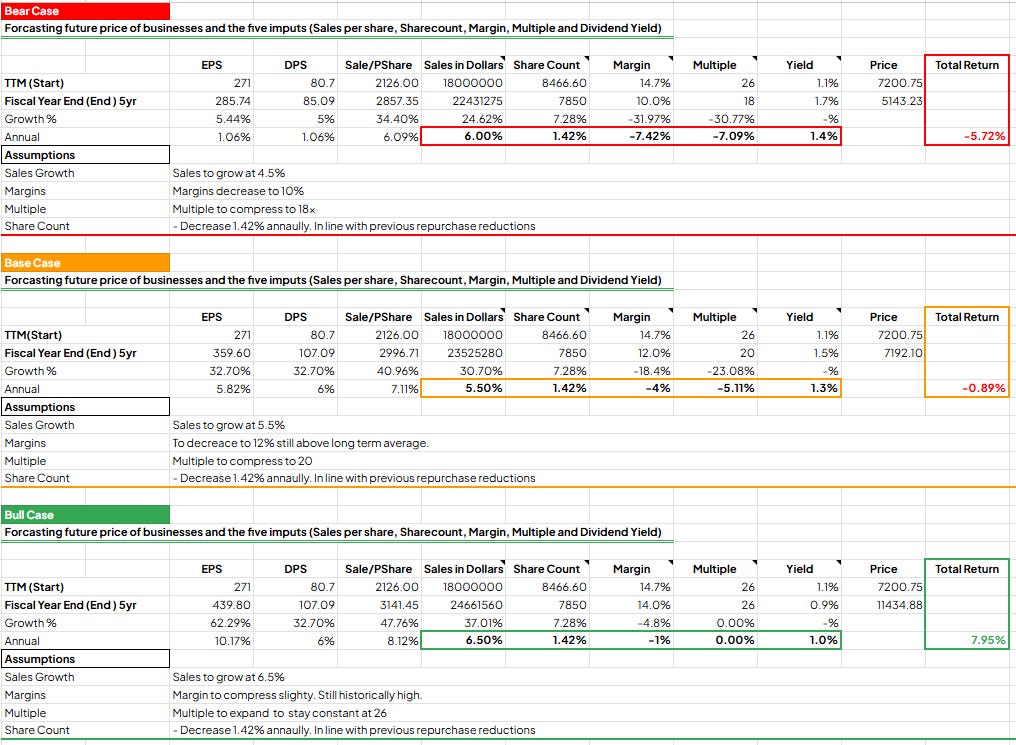
Below is a table on how returns could look if contraction was to happen. I’ve put in a bear, base and bull case on my thoughts and assumptions. The assumptions in each case can be seen in each column.
An example on the base case scenario.
Sales to grow at 5.5% (Midpoint of historical average)
Margins to decrease to 12% (100bps above the 10 year average of 11%)
Multiple to contract to 20x (Modern day average)
Share count to decrease by 1.42% (An annual average decrease)
Taking these into account we get a 5.5% increase in sales growth, 1.43% decrease in share count along with a 1.3% dividend yield. We haven’t yet taken into account any possible contraction in the multiple and margins. In the example both contract to 20x and 12% which takes away a combined annual return of -9.11% taking the total return over a 5 year period of -0.89% per year. This is just an exercise but highly possible at the current prices.
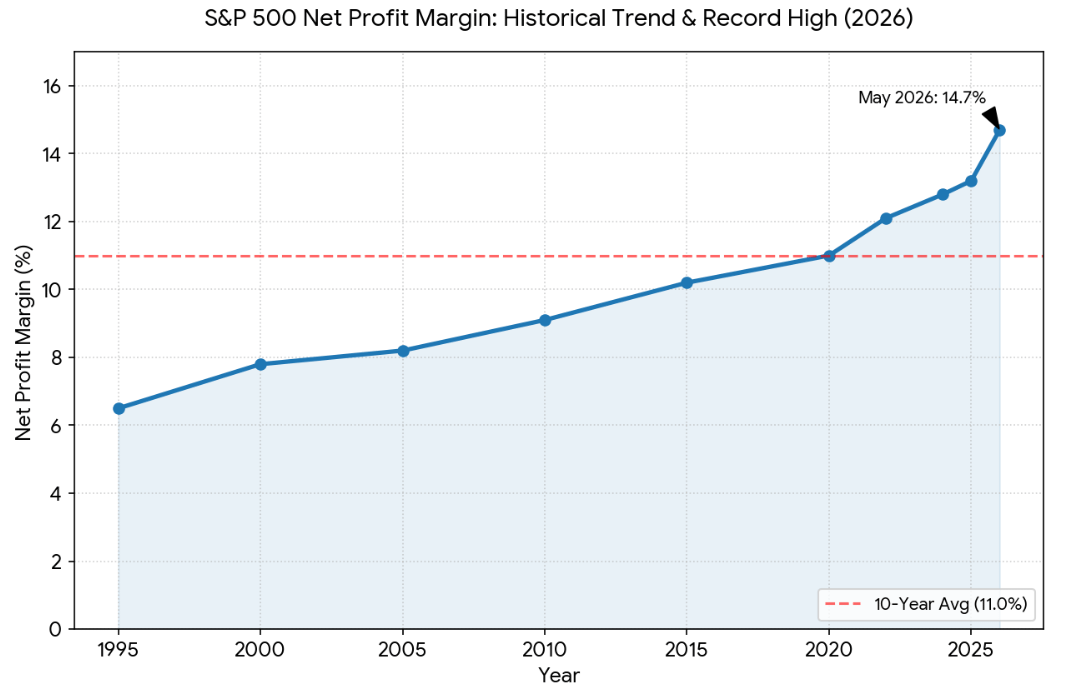
Obviously, these are only assumptions and returns could unfold to be much higher or lower (I don’t have a crystal ball). In the image below it shows how the margins of the index have evolved over time. Currently we are at the summit of historical margins ever recorded at 14.7%. I you believe margins will increase along with the multiple then maybe there’s a case for double digit returns, however I wouldn’t bet on it. Over time, margins and multiples tend to revert back to the mean though different economic cycles. So the big question is what returns will the market produce going forward at these elevated levels?
This month I welcomed back a former business in Floor and Décor $FND. I wrote about the business back in December which can be accessed here. I added FND 0.00%↑ after a large sell off in share price and one I believe is very reasonable considering the long runway of growth and the continuous increase in its competitive advantage.
For those not familiar with the business. Floor and décor is a specialty retailer that sells home improvement products focusing on hard surface flooring. Their business model is simple. Sourcing a large variety of hard surface flooring directly from the manufacturer in very large volumes and passing on the cost savings to the customer through their large warehouse stores. They are classed as a “Category killer” due to the fact they focus so intensely on a single category that it makes it nearly impossible for smaller, local stores or even general big-box retailers to compete.
The investment thesis is based on Floor and Décor, through their self financed growth model to continue opening stores in untapped markets while keep stealing share from competitors. Currently the business operates through 276 warehouse stores with the ambition to operate 500 in the future. As the business scales, they should achieve even stronger leverage for better pricing from manufacturers which in turn will offer customers better in store pricing, increasing the companies competitive advantage from rivals.
Conviction remains high among my top holdings and it showed again this month. I added to my existing positions;
Roper Technologies
Constellation Software
Eurofins Scientific
Berkshire Hathaway
All these companies continue to trade at what I believe to be highly attractive prices. Constellation and Roper now make up 35.8% of the DInvests portfolio. Adding Greggs to the list the percentage increases to just over 50%.
I sold out of Amazon due to a few reasons.
My first concern was the huge $200Bn in capex spend projected for 2026 (Way above operating cashflow)
This high capex cycle would have to produce very high cash flow for decent future returns.
With high investments in chips to build out its data centres and the expected lifespan of these chips to be around 6 years (Current depreciation rate from companies Google and Microsoft) Some consider the lifespan from an operating lens to be less as newer and faster chips are brought to market making current chips “obsolete”. Who knows what the future maintenance capex will look like to stay competitive in the new era of AI.
When I look at Amazon from an operating cash flow perspective, I always try and figure out future capital spend which produces free cash flow. If Amazon was asset light with minimal capex spend or was asset heavy but was coming to an end of a high capex cycle, one could argue it was undervalued. This isn’t the case today in my opinion. Amazon looks like it will continue to invest heavily in years to come and as investors we have no real idea what these returns will produce. I wasn’t comfortable holding at these prices and decided to sell and allocate the capital into easier hurdle investments.
One thing is certain. Amazon is an amazing business and truly one of the best but from an investment point of view there are just too many unanswerable questions when I think about capital spending.
Greggs was trimmed slightly to better position my portfolio through a diverse lens. Greggs was by far my largest holding, over 20% at one point. Conviction is still present and accounts for 16% of the portfolio.
This is where it looks UGLY. Performance was flat overall in April, only increasing 48bps which severely lacked the markets surge of 10% making comparative performance disastrous. Patience is needed and I honestly believe the day will come where returns will surpass my chosen benchmark in great fashion.
As the portfolio is highly concentrated in a few names, performance will come in chunks.
Year to date the DInvests portfolio has declined -7.27% whilst the benchmark has advanced to a gain of +5.5%. Since inception the portfolio has a total gain of +60.49% compared to +62.9% for the market.
The month has really turned the table for performance conversation. I now own none of the magnificent seven which are the backbone for the markets impressive performance over the past three years. Many will argue the market is overvalued which I cant say for my portfolio as a whole. I own high quality businesses that I believe over time will produce highly satisfactory returns from todays prices.
That’s it for the April monthly update and I hope you’ve enjoyed it.
If you’ve got this far then thank you.
If your not subscribed and want more of this type of content then please hit the subscribe button above. For 2026 all my posts will be free.
See you in the next one.
DInvests
DRGInvests on X.
Disclaimer: I hold a beneficial position in the stocks mentioned in this article. My buys and sells aren’t recommendations. I can’t guarantee the accuracy of the information provided in the newsletter. All statements express personal opinions and information gathered online. Any estimates, forward looking statements and assumptions made in this newsletter are unreliable. Always do your own research. Any information in this newsletter is for educational and entertainment use only and should not be taken as investment advice.
No posts
Comments
Nothing yet. Say the first thing.
Sign in to join the conversation.