
Dinner Music is a labor of love. If you’ve discovered new music that you love through the project, consider becoming a paid subscriber to continue supporting it, plus you’ll get access to the past playlists, subscriber-only playlists and posts.
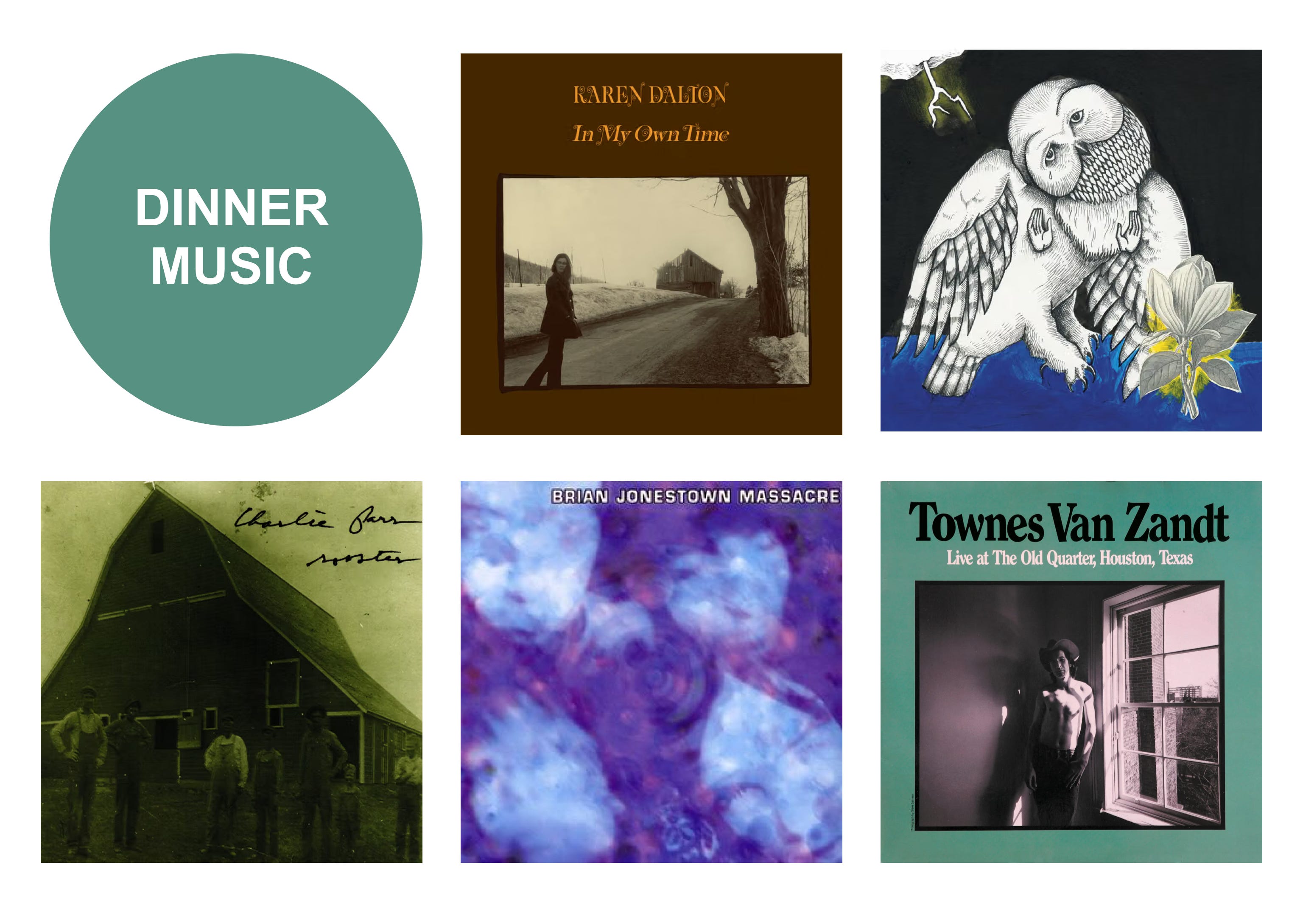
This week we’re listening to albums and a playlist selected by the poet Kai Carlson-Wee, author of RAIL. I heard him read at a writers conference last year in Los Angeles, an event that happened at the Philosophical Research Society, a sort-of new age organization—“we’re not a cult!”—housed in 1930s-era Mayan Revival buildings at the top of a hill in the Los Feliz neighborhood, where a particular chair, for a time in the mid-century, was always left empty in case Elvis Presley showed up, which he did, often. The location doesn’t mean a lot in relation to Kai’s poetry, his particular mysticism feels more rooted in a midwestern Protestantism (“I don’t believe in nostalgia”), but it does provide an interesting backdrop to our conversation, which began simply because he read poems about freight trains and I think about freight trains a lot, since they run behind my house day and night, as one is doing right now, hum-screaming along while I’m writing this. We talked about Texas and the Sunset Limited train line, the only route he had never ridden. (Too hot). Since we talked of Texas, we talked of Townes Van Zandt, who I’ve written about a few times, most recently for never cursed. Kai mentioned that he taught Pancho and Lefty in a class at Stanford, where he taught for 15 years, after he’d attended as a Wallace Stegner Fellow. I wanted to know more about that.
Our conversation covers poetry, music, the music of poetry, base jumping, Dean Potter, church, ex-girlfriends, ice cream, natural sounds, and more. It’s a conversation about the hazy line between poetry and music. When is a thing one, or the other? Do we need to make a distinction?
If you have thoughts about this, please tell me!
Enjoy.
Also, buy his poetry collection RAIL. “The lived experience behind these deft and subtle poems seems necessary, and reiterates the fact that resilience is not only a feature of the American character, it is a recurring tenet of American art.” -Maurice Manning
Comments
Nothing yet. Say the first thing.
Sign in to join the conversation.