
The primary purpose of this post is to save the picture below, since apparently it is not hosted anywhere. Even the Medium blog post just links to my personal page.
So here it comes, all hail Substack!
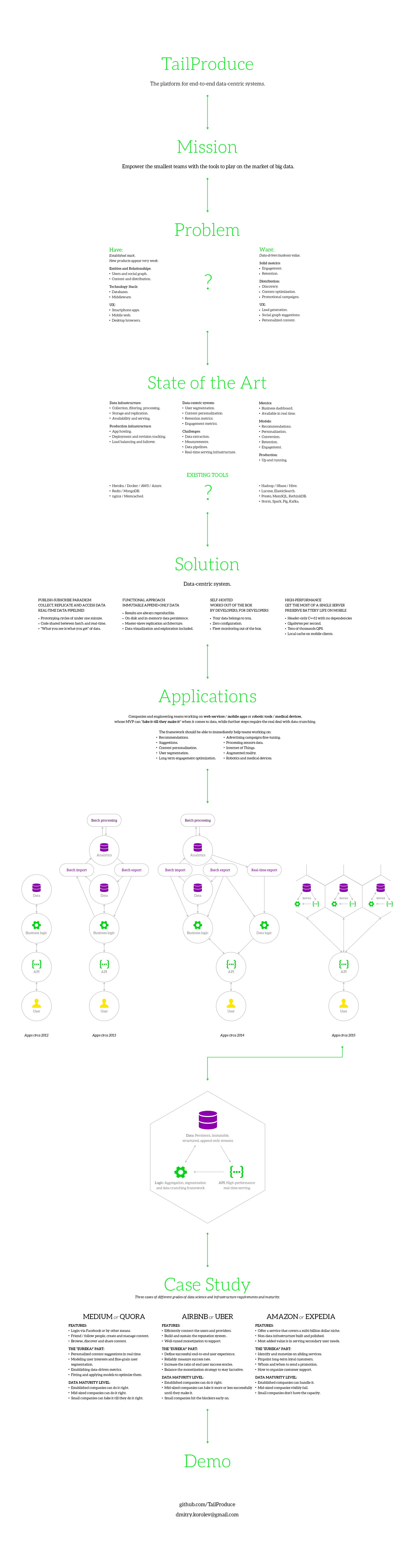
Can't believe this diagram is more than ten years old!
The greatest wisdom of my life since then — apart from the obvious part that it’s important to not forget to live one’s own life, and that the people around are more important than projects that come and go! — is that a good enough technical presentation is by far not enough to make a dent.
Between 2015 and 2017, we did go ahead and built Current based on this diagram between: code, announcement, design. We used it in production, for one real project (nine digits peak valuation, users, traffic, ultimately acquired), and two toy ones (also with real users and traffic, but less traction).
Seriously. Not to brag, but it's a really well laid out vision of what is badly needed today. The claim that had we built this, as the species, we'd be living in a better world today is 100% true. And yet, we, humans, have not built anything similar, and we are stuck manually optimizing out-of-sync schema-diverged Postgres and MySQL replicas since.
This is my point of professional growth. You come to a new place. You fix some obvious things. You improve what’s most needed to be improved. You earn trust and respect. They assign you to one of the largest problems in the company. And then you get stuck.
You get stuck in a remarkably self-replicating situation. I almost have deja vu-s.
— So, we have this problem with data integrity and consistency and audit, right?
— Right.
— Had we shipped the right solution two years ago, we’d be golden a year ago, right?
— Right.
— Had we shipped it a year ago, we’d be in great shape now, right?
— Yes.
— So it was a mistake not to do the right thing in the past, right?
— Absolutely.
— Look, now it’s not too late. Or this shit will continue. Let’s do the right thing!
— Well, now is not the best time. We have other priorities.
— But look, tech debt, development velocity, enablement, future product features …
— Told you, not the right time. Unblock team A, then team B. Now go and work.

So, next time I have a big idea, I'll make sure to go all in with having enough people buy into it first.
Because, evidently, no rational argument does the job of making VP-level folks aware that a certain investment of single-digit dev-quarters will pay off greatly, and very soon. The counter-argument always is that we have bigger fish to try. And people who are working on allocating budgets are quite good at convincing themselves and each other that their next big idea is just what the company needs.
Except, on average, their next big idea is, at best, marginal. While had the company invested just a tad more into more reliable foundation, new features would have been shipping at 10x speed already. I have seen it many and one times. And I expect to see this many and one times over again.
Because the game of patting each other on the back is quite strong in the vast majority of companies that did experience hyper-growth after hitting the gold with their product-market fit. And if the company did not experience hyper-growth, there’s not much value a solid fist principles engineer can bring to the table in the first place.
The saddest part is that one would assume the AI revolution should make things better. But so far it appears to be making things worse. My take would be to have a few people, the core team, work elbows deep on data models and their consistency & evolution, while user-facing features can be given away to more frontend-friendly teams to vibe-code.
Alas, this is hardly the case today. Although it already is crystal clear that:
AI-generated code, with developer-in-the-loop, is quite effective when it comes to making visible user-facing changes that don’t change the underlying data models,
BUT, when it comes to altering those data models, we still need humans who understand what consistency and correctness and reliability stand for.
On the bright side, Web3 folks are evidently good at building data models, Rust is a good language that AI Agents speak pretty well these days, and tech solopreneurship is just starting to take off. So, we may well see the light at the end of this tunnel soon!
No posts
Comments
Nothing yet. Say the first thing.
Sign in to join the conversation.