
Here at the Dignity of Work Institute, we amplify the voices of workers – ALL workers, as Kayla discussed. And as you might see from our research – or any conversation with just about anyone who isn’t living off a trust fund – Americans are not pleased with the current state of affairs. When we asked people last year, on a scale of 1-to-10, how much change they thought the economy needed for people like them to get ahead, half said 8, 9, or 10. A full 30 percent said 10-out-of-10, tear it all down. Poll after poll – not to mention the results of election after election – confirm this.
Why are Americans so angry? We have a theory of the case.
The economy today does not value work or the people who do it.
That’s not an inevitable consequence of capitalism – it’s the direct result of decades of decisions that have shaped the playing field of the modern economy, rigging the rules further and further in favor of multinational corporations and against workers – i.e., the rest of us.
Despite how divided we seem as a country, most Americans’ aspirations have a lot in common. In our research, we hear the same thing over and over: People want to be valued for the work they do, to be able to have some security and stability, to save for the future, and to build better lives for themselves and their children. And they believe that through hard work, they should be able to get there.
Work is fundamental to who we are as Americans. We’re hustlers, dreamers, strivers. It’s one of the clearest through-lines from the conversations we’ve had with people from all walks of life. A huge majority, 60 percent, said they have worked more than one job at some point in their lives, and one in five had worked three or more jobs at a time. People – particularly young workers – talked about taking on gig work, and some even described it as an “opportunity.” Americans are united in their belief that through their own efforts, they will get ahead.
But if work isn’t valued, Americans can’t earn their way to a better life – no matter how hard they work. And that link – between work and economic success – has been broken for about half a century now.
Economic policy wonks and people working in the labor movement pretty much all know this story:
From 1948 to 1973, productivity increased 97 percent, and wages followed suit – growing about 91 percent.1 But since then, productivity has continued its steep climb, while workers’ compensation has barely budged.2
This might be every progressive’s favorite – or least favorite – chart:
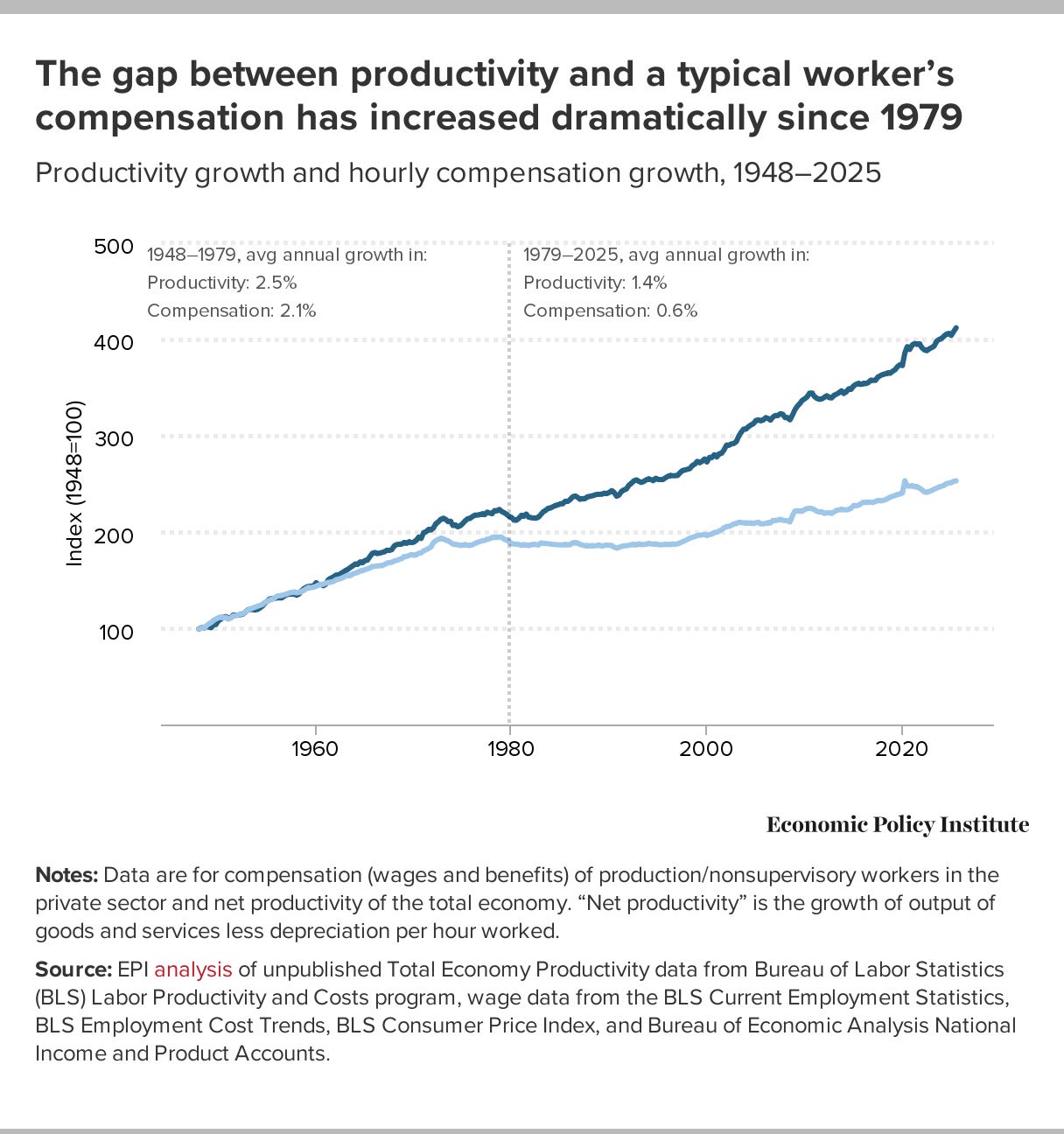
If Americans got paid under the old rules – if productivity and wages still rose together – today someone making $50,000 a year would instead make anywhere from $72,000 up to around $100,000.
And wouldn’t you know, when we asked workers what salary they would need to earn to feel some measure of economic stability, the number most landed on was at least $100,000.
In other words, if Americans were getting what they earned, people’s paychecks would be enough to afford some measure of stability.
But today, even working full-time – or more than full-time – doesn’t guarantee economic security. More than one in five adults are working multiple jobs just to get by. Even people who are middle class on paper don’t feel stable.
Companies cut costs by pushing people into gig jobs, temp work, and subcontracting. They’ve been doing it for decades, but app-based business models have made it easier than ever.
They invest less in other benefits like pensions and health care. They lay people off and work the remaining employees harder than ever – often without having to pay a cent in overtime.
If big companies are not investing in workers, where ARE they putting their money? No, it’s usually not research and development or building new facilities. And they certainly are not using the savings gleaned from squeezing workers to lower prices.
Instead, corporations plow their profits into stock buybacks and other financial schemes that funnel gains – gains produced by workers – to the very top, and do little to create a more innovative and dynamic economy.
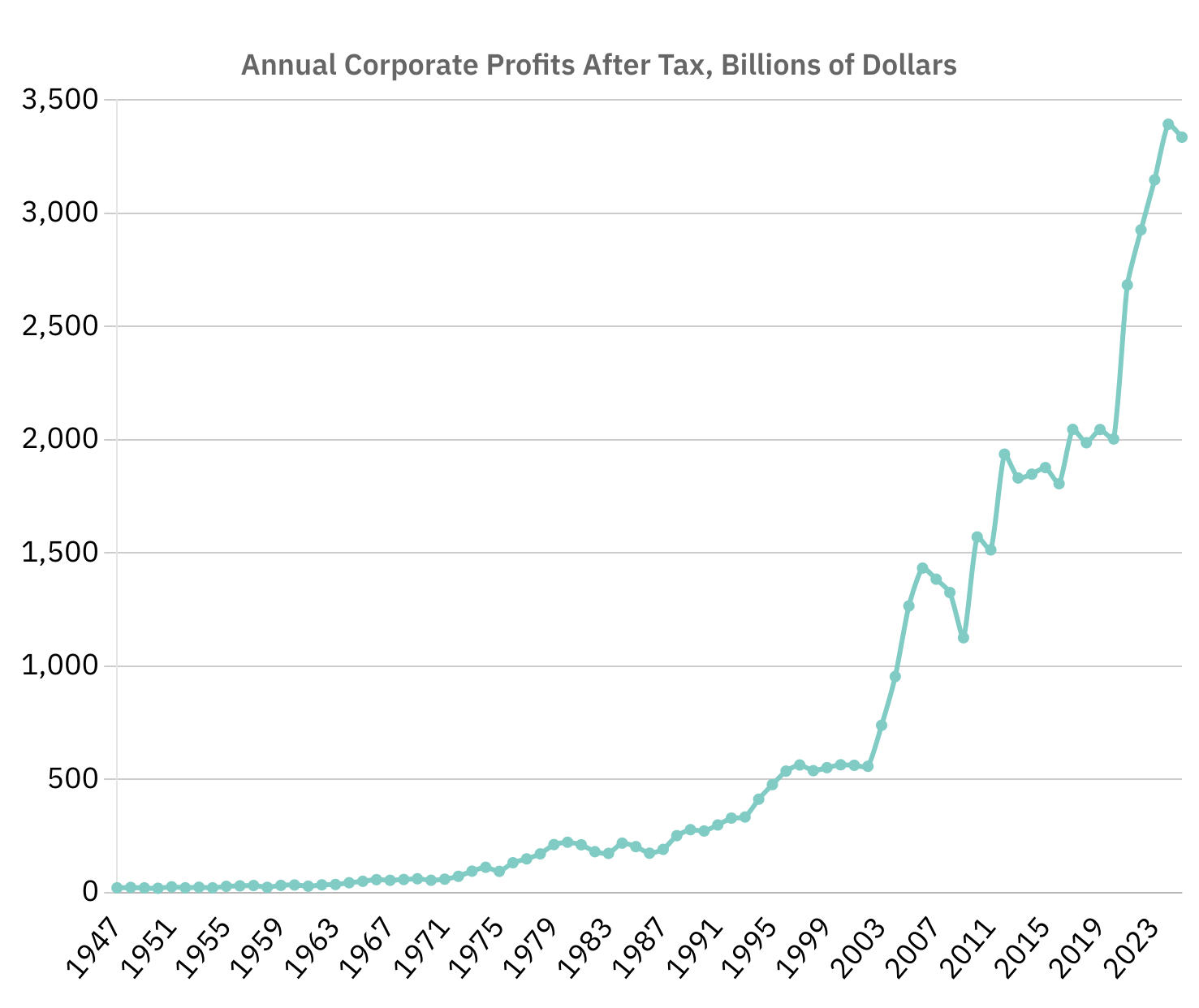
And we see the result: people work harder than ever, with less and less to show for it. It’s the same work, but with lower paychecks, fewer benefits, and less economic security and opportunity.
This erosion in the value of work shouldn’t be news to anyone who works in economic policy or for progressive causes. The financialization of the economy and the perverse incentives it creates have been well-documented for years.
But we believe the framing matters.
It matters how people working on these issues conceive of this problem, as they go about trying to solve it. This isn’t just some kind of math equation, where we could fix the economy if we could only stack up enough policy proposals that, on paper, increase total net income after transfers for Americans below a certain income level.
This gets to the heart of the story Americans tell about ourselves – that we’re a land of opportunity, where skills and effort are the key to a better life. That story is becoming more and more of a fairy tale – but, crucially, Americans still want to believe in it. Enhancing the value of work, and restoring the connection between hard work and success, are fundamental economic challenges of our time.
It comes back – of course – to dignity. And until working people get their fair share for the work they do, Americans will remain angry, frustrated, and in constant search of political and economic change.
Susan Fleck, John Glaser, and Shawn Sprague, Bureau of Labor Statistics, Department of Labor, The Compensation-Productivity Gap: a visual essay, Monthly Labor Review 57, 59 (January 2011). Retrieved from http://www.bls.gov/opub/mlr/2011/01/art3full.pdf.
Economic Policy Institute. (2024, August). The Productivity–Pay Gap. Economic Policy Institute. https://www.epi.org/productivity-pay-gap/
No posts
Comments
Nothing yet. Say the first thing.
Sign in to join the conversation.