
Today’s post is rather long and theory-y. I hope you enjoy it! To compensate, I have a healthy mix of updates in the “what I’ve been up to” section below.
Recently, while cleaning my house after getting my wisdom teeth extracted, I listened to an episode of the Met’s podcast, Immaterial. This was the first episode of the second season, and it’s primarily about the process of restoring a sculpture of Adam carved by Italian Renaissance sculptor Tullio Lombardo. After an unstable pedestal caused the sculpture to shatter across a gallery floor in 2002, the conservator Carolyn Riccardelli was given the big job of putting Adam back together.
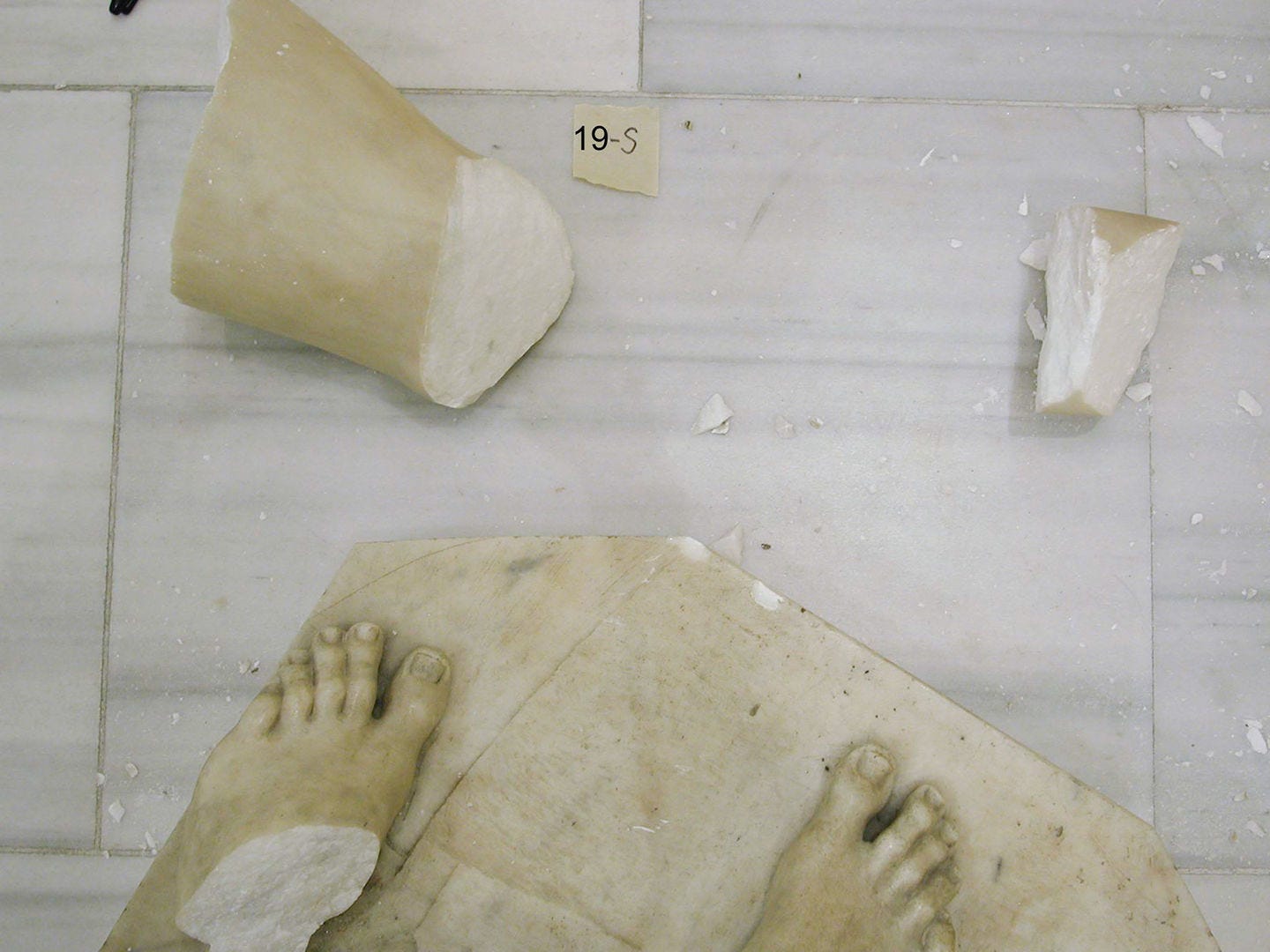
There’s a moment in the podcast, after Lombardo’s masterpiece has been reassembled (with dissolvable glue!), where Ricciardelli goes to look at it in its new, special-built gallery. She reflects:
To see it standing, to see it look whole, and to see it displayed in the galleries again, so that people could enjoy it…that’s a pleasure that I can say that I’ve done that too. And just to, like, have had the experience of feeling so connected to a work of art and really, feeling connected to an artist.
And when you start to look very closely at an object and spend a lot of time on it, and you see tool marks and fingerprints and clay and things like that, like, you really do feel a connection. And that’s a big…it’s a privilege to be able to feel that connection and get that close to a work of art.
You can hear the wonder and the love in her voice, that connection to a work of art that comes from being with it for so long, concentrating on it, understanding how it works. In the past few weeks, I’ve been thinking through some of the final stages of translations that I’ve done with Lénaïg over the past three to four years. We have spent so much time with these texts. At the height of translating Adrienne Rich, I almost felt like she was speaking through me—I kept thinking phrases and realizing they were hers; they’d live in my mind on loop. It helped that I was falling in love at the time—Rich is better known as a political poet, but I do think that her Twenty-One Love Poems are some of the most powerful and tender sets of love poetry out there.

For me, translation is a way to climb inside a text, partially a form of deep reading. This isn’t because I have some particular faith in my translation process—on the contrary, I think I need translation in order to really know what a text is saying at all, because I’m a pretty lazy reader. I echo the words in order to mime writing them, and through writing them get back to the action of the author, which is where the words begin.
Now, when I read the collections by Rich or Laura Vazquez, even in the original, it’s an echo of my former self that comes back too, the one that at one point channeled them. It’s channeling, yes, like a spirit—but also a kind of walking-alongside, because the works had a life before me and they will live on afterwards. As Riccardelli says, “it’s an honor to be part of the life of the sculpture.” I’m honored to be with every text I have translated, and very excited to have the ones we’re now finishing out in the world next year, through and after me.
After Adam’s accident, Met curators and conservators decided not to show evidence of fragmentation in the reassembled piece. Instead, they decided to have Adam repaired to be as close as possible to his original form, a process which took twelve years. The labor required was immense and literally self-effacing. Why? Because Adam’s fall was the museum’s fault, and occurred while the sculpture was in the museum’s custody—not a part of the artwork’s life that they wanted to show.
If we articulate translation or restoration as a way of taking part in the life of an artwork—or the afterlife, if you ask Walter Benjamin about translation—then this decision raises another question: what are legitimate moments of that life?
The resonance with translation seems obvious to me—traditionally, translators are encouraged to be as invisible as possible. Some translators choose to interpret this imperative as giving the reader an experience of “reading an original”—no awkward phrasing that is often called “translationese,” instead hewing to the hegemonic ideal of what literature in the target language should sound like. Other translators choose to preserve certain qualities of a text, such as the use of particular literary devices or repeated words, over the “fluidity” of a text, or of preserving certain names or sounds in particular. Emily Wilson, for instance, is big into preserving some form of meter in her new translations of the classics. Whatever the reading of “invisibility” in translation, which others have written about at great length,1 the terms seems to reflect a similar idea that the life of a text, the way it made its way into the book in your lap, ended some time in the past—a time that was much closer to the idyllic vision of a completed authorial manuscript than to the translator’s furious typing in the years since.
The whole thing reminds me of the notion of texxture (with two X’s!), a concept coined by theorist Renu Bora. I learned about texxture through Eve Sedgwick’s writing on affect theory in a sophomore-year seminar with Ada Smailbegovic, but since then, it has somehow managed to come back over and over in my thinking about text, software, embodiment, and materiality. Where “texture” refers to any surface quality of an object or material, “texxture” specifically refers to a quality of an object which exposes the ways in which it was made or affected by other objects—fingerprints on a clay pot, chisel marks in a wooden sculpture, or the cracks in stone from breaking.
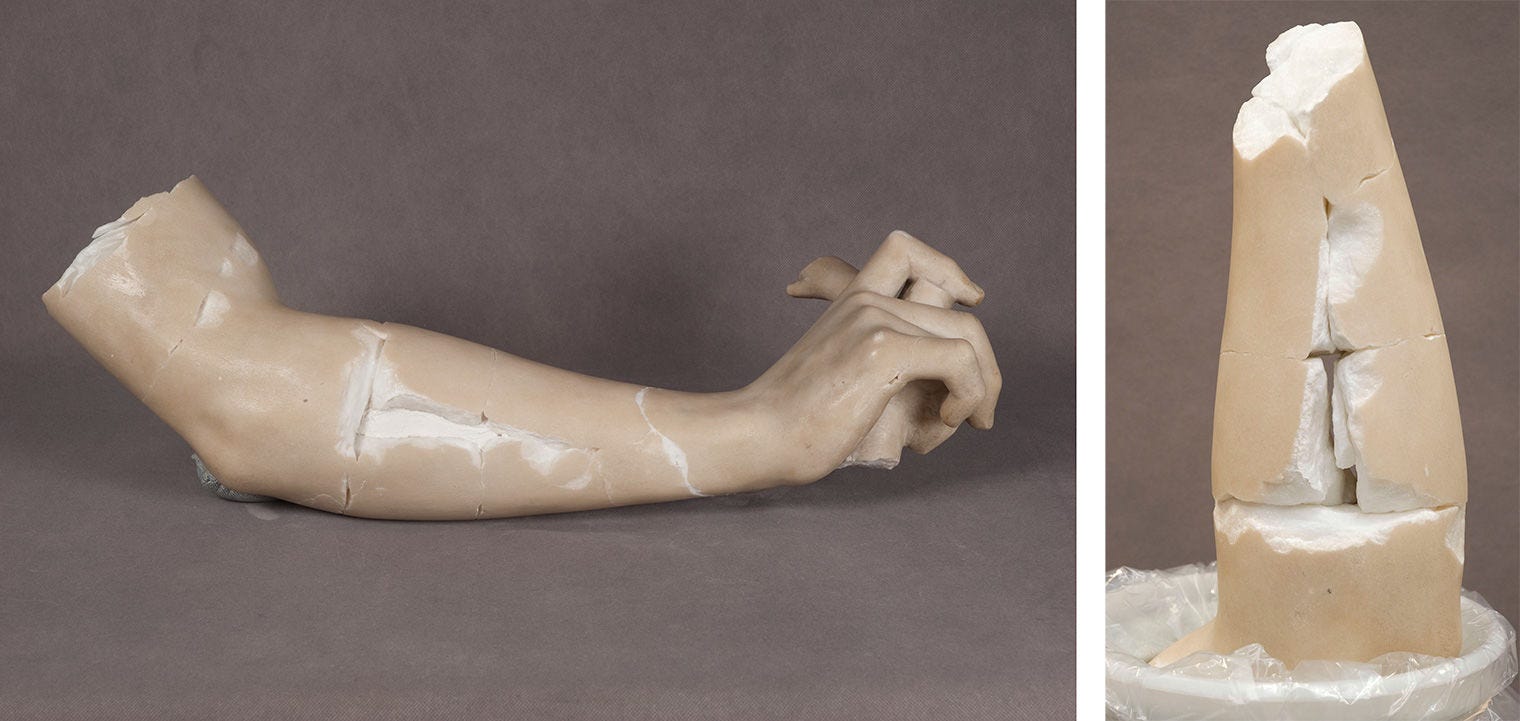
I’ve been part of a lot of conversations in translation studies that effectively call for the exposure of textual texxture—the ways in which the text had to be wrenched, sometimes against its will, from one language to another, or the marks of misalignment between the two languages.2 I’d be interested in whether the same conversations are happening in art conservation, and whether new perspectives are emerging.
I joined the Reboot editorial board! If you have rigorous takes on tech for a general (if technologist-heavy) audience, pitch us!
I’m especially looking for pieces relating to disability/accessibility, translation/creative labor, NLP, and professional issues in the tech industry.
I got my wisdom teeth removed :( After growing them in my head for five years, they were pretty gigantic and had wacky roots!3 I am hoping to make them into earrings. Luckily there was not too much pain involved and people were very kind to me while I was in acute recovery. Unluckily, I still am afraid to eat foods with little crunchy bits or drink with straws. I have so far eaten four kinds of soup and two kinds of porridge during my recovery. I am not yet tired of ice cream.
I started TAing an NLP course! I will let you know if my students think I’m smarter than ChatGPT :-/
I am thinking (read: spiraling) re:what to do next after my Master’s program. Sometimes you have to go through a good old existential crisis in order to figure out the next steps in life. It’s very unpleasant but in my experience gets results.
I love my neighborhood and I had some wonderful times here in the past three weeks!
I got a surprise tarot reading by wandering into my neighborhood bookstore.
I got my autumnal red coat4 repaired at the tailor’s! It is good as new, which is saying something since I bought it vintage.
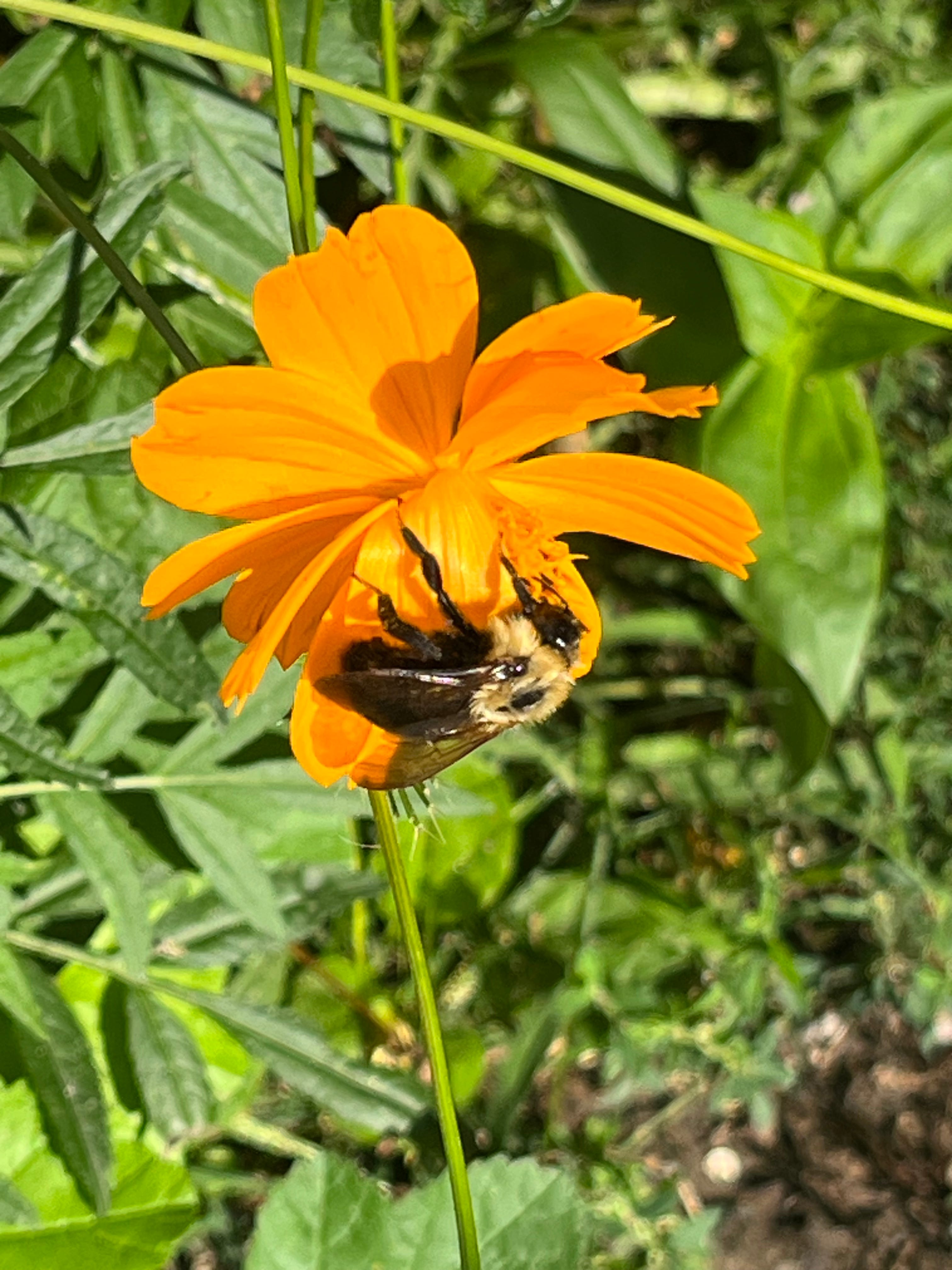
The cosmos are blooming, and three weeks ago, I spotted a native carpenter bee5 pollinating one.
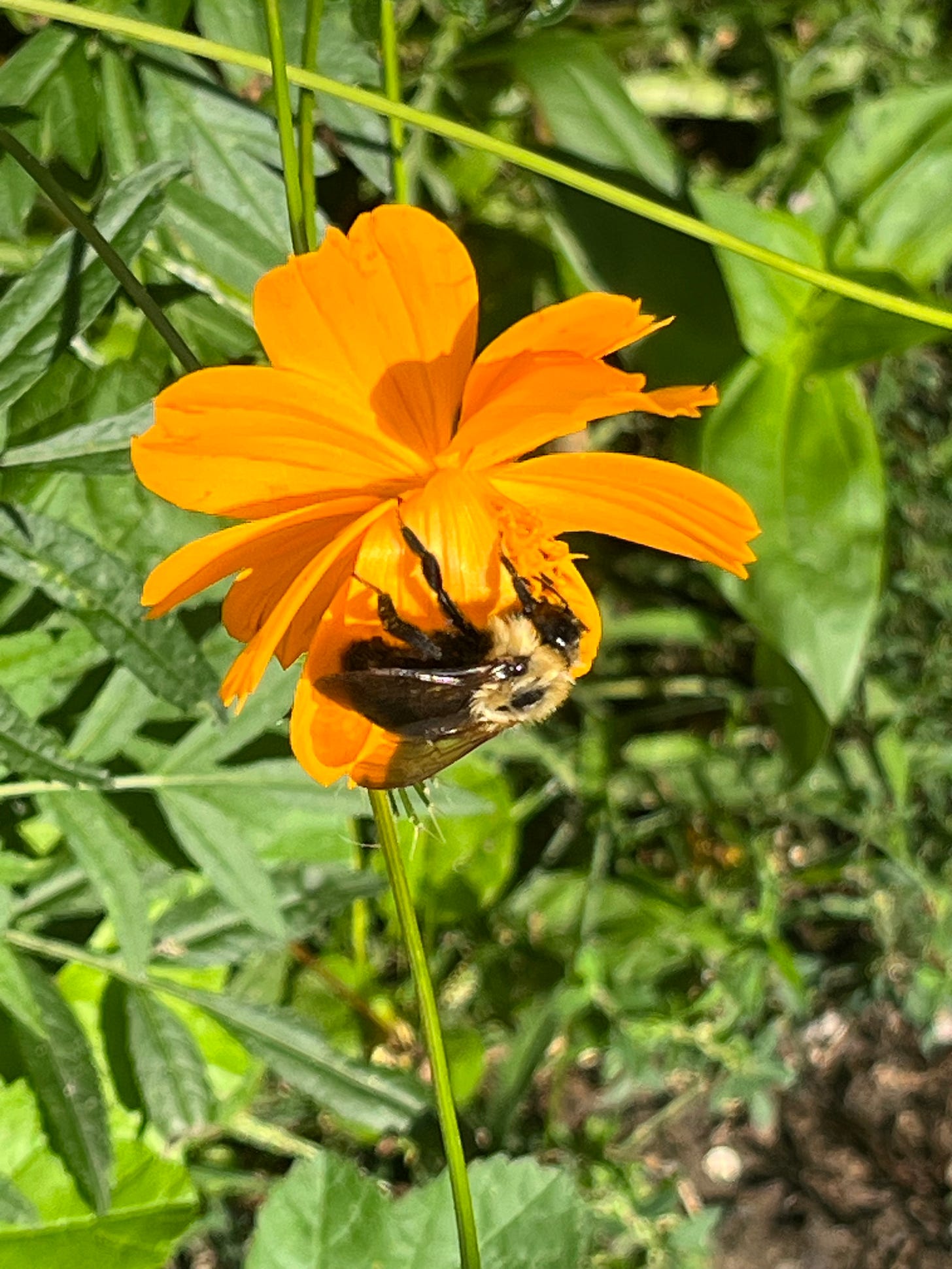
Probably DebBEE (see footnote linked above). I tried a new kind of sourdough at my truly fantastic neighborhood bakery.
I stumbled across live jazz by The Obrigados at my local park in Montréal!
Notably, I read this piece on genealogies of translation theory by Lawrence Venuti in my undergrad translation seminar.
Some of my favorite essays on this include Say Translation is Art by Sawako Nakayasu and Nay Rather by Anne Carson.
Did you know that your teeth roots are super close to your sinuses? Like, kind of scary close?
Not to be confused with my winter red coat or my disintegrating red summer rain jacket.
I strongly suspect this bee was DebBEE, the bee that my partner and I rehabilitated when we were quarantined with Covid.
No posts
Comments
Nothing yet. Say the first thing.
Sign in to join the conversation.