
Welcome [back] to Digital with Discernment! As usual, this long-form piece is written with numbered headings and semi-standalone sections that can each be read in about five minutes. I hope this format enables you to engage with these ideas at the pace of your real life full of “human things.” You can also print this PDF version, if you prefer.
Thank you for reading!
Nearly two years ago, for his eighth birthday, my oldest son was gifted an apple tree. I think the man who delivered it must’ve sensed we didn’t quite know what we were doing — I certainly didn’t, despite the fact that my mother grew up playing and working in her grandparents’ apple orchards — so he took the extra time to help my husband choose an appropriate spot in our backyard and nestle the little tree safely into its new home. All our children delighted over it, reminding us to water it, or watering it themselves, and trying fervently (though largely in vain) to teach the toddler to be gentle with it.
Last winter my husband and I privately worried that the little tree wouldn’t bud or flower, once spring arrived — a miscommunication with our neighbor had left it without water for a week, in the heat of the previous summer — though happily, it seemed none the worse for wear come spring. Then all of us delighted over its blossoms, tiny leaves, and “baby” apples, and wondered how many more seasons it would be until we could enjoy its fruit (the squirrels must’ve gotten the lot last year).

Now that I feel spring just around the corner, I’ve started to ponder the little tree in earnest once again — as well as the older crab-apple tree in our front yard, which desperately needs a trim — and an old saying has returned to the front of my mind:
“If I knew that the world was to end tomorrow, I would still plant my apple tree.”1
When I first heard this saying years ago, I found it quite strange, but lately the sentiment feels more relevant than ever — and I’d venture to guess I’m not the only one.
Nowadays, of course, we don’t know that the world is ending tomorrow, but it seems certain that a cataclysmic change is underway, and that the particulars of the world five years from now are nearly impossible to predict. In the midst of an onslaught of alarming headlines — never mind keeping up with all the details of the stories that follow — it’s hard not to feel some sense of the futility of it all. You don’t need to believe that AI is literally going to wipe out the human race, or even that it’s going to overwhelmingly replace humans in any given field, to feel some degree of helplessness or foreboding.
For me this has manifested less in day-to-day distress (thanks to the fact that I’ve reduced my intake of “news” as much as possible), and more in a sense that nothing I could share here really, truly matters. Every company I want to call out, every news story on which I could comment — they’re all simply symptoms of a much wider, deeper problem (as I’ve written before, at least twice, in fact).2
This has felt all the more true as the interval since I last published has increased. Out of everything that seems incredibly urgent and important, what is important enough to begin here again? If I can’t make all the connections that I see crystal-clear to my readers, am I simply wasting our valuable time?
And yet, the more I’ve reflected on where we find ourselves, the more I’ve found myself embracing the spirit of “planting an apple tree.”
The work of faithfully caring and preserving, nurturing and protecting doesn’t matter less when it feels like the world is ending — in fact, I believe it matters more.
Now, I’m not saying we should all just give up on grappling with the deeper questions surrounding modern technology — for example, I still fully intend to shape my perspective about “AI thought partners” into coherent written form, and I hope, in the not-too-distant future, to share detailed reflections on Anthropic CEO Dario Amodei’s essay “Machines of Loving Grace” and Neil Postman’s book Technopoly: The Surrender of Culture to Technology. I firmly believe that this type of careful consideration is, in fact, a key part of protecting what’s most important, including those whom we hold most dear.
However, I’ve grown increasingly convinced that I’ve been operating on unfounded assumptions about what I “should” write, and that I must reassess how I can best serve my fellow Technopoly dissidents.3 That is, I started Digital with Discernment with the idea that my writing here should be “professional,” narrowly focused on digital technology, and accessible (or even “appealing”) to the widest possible audience. However, as the months and now years have gone by, the landscape has dramatically changed; it’s now much easier to find people who share a techno-skeptical perspective, even in person, and resources for challenging digital technology’s dominance are now plentiful and readily accessible.
I’ve also come to deeply appreciate the writer-reader dynamic that Substack fosters. Of course no digital “relationship” should be expected to match embodied life together with other humans, and I have no intention of overcorrecting and sharing copious or highly personal details of my life — but I’ve learned that, on Substack at least, it can be valuable to invite others into the interplay among your seemingly unrelated passions and interests.
To put it simply, it’s time for me to concern myself less with what I think readers might expect from me, and more with how my overall body of work advances human resistance to the “Machine.” And to that end, I intend to focus more on helping my readers make regular use of a handful of “tools for Technopoly dissidents” — especially those that I’m zealously preserving within my own family.
If you’ve been around here for a while, or checked out the “About” page (which could probably do with a bit of updating), you won’t be surprised that fostering a love for reading and a taste for good books is very important to me. However, I’ve shared very little about another passion of mine that is arguably more fundamental to what it means to be human — music. I think it’s time to rectify that.
Make a one-time financial contribution
As you’ve probably noticed, in our modern, highly commercialized society, it’s “normal” to defer to “professional” musicians — those who seek to profit off of our society’s insatiable appetite for novelty and often provocative “content” — and passively listen to whatever we are “served up” through our digital devices. I certainly don’t intend to minimize or overlook the work of truly passionate people who dedicate their lives to the pursuit of excellence in music; however, I find it deeply troubling that the most easily accessible music — the music pushed by the big platforms and algorithms, which somehow seeps into even the most intentional life “offline” — is not meant to be at all edifying.
“Your obsession feeds our connection,” the lead singer of a wildly popular “demon boy band” declares. “Give me all your attention; you know I’m the only one who’ll love your sins.” Netflix even has a new 3-minute “lyric video” of this song, which children can conveniently access and sing along with from a “Kids” profile on the platform, and I simply can’t stand this state of affairs any longer.
To be clear, I don’t mean this as a judgement if your kids have listened to or sung these or similar songs — or even if you’ve never paid much attention to song lyrics. My family’s real life doesn’t fully match the ideals in my head, and I know from experience with my husband (who is overall more musically inclined than I am) that listening to lyrics doesn’t come naturally to everyone.
It’s also important to note that I personally haven’t heard the song I refer to above very often, or any of the other songs from that soundtrack — and yet I still struggle not to get these songs stuck in my head. If I have so much trouble as an adult, I’m sure kids are much more vulnerable to having this “content” colonize their minds.
It’s time for us to reject this exploitative paradigm. It’s time for us to remember that making music is fundamental to the human experience, not reserved for those with special talent, and certainly not meant to be controlled for profit. Maybe we won’t reverse the dominance of companies that subvert our human need for music for their own ends, but we can definitely refuse to go along with their manipulation.
It’s time to explicitly resist and refuse the dominance of Technopoly through our everyday choices about music.
I am by no means an expert in music, but what I have, I want to share: that is, a lifelong love for singing, and an extensive mental storehouse of hymns — religious songs that have been sung for hundreds, and often well over a thousand, years.4
My work on this subject moving forward will be to increase the richness of your mental storehouse of life-giving music and poetry, and increase how often you use that storehouse in your daily life, especially with your children. My goal is not to “expose” you to this music, but to help you “take it into your body,” as Eleanor Robins writes (or at least into your brain chemistry, per Brad Leithauser).5 I want you to have it readily available to you when the shallow, profit-driven music of Technopoly has once again been thrust into your mind, or suddenly resurfaced from where it burrowed with incredible speed. I want you be able to sing this music to your children every night for so many nights that their daily antics are interspersed with the tunes that they’ve brought into their own bodies, too.
I want you to feel confident in your ability to choose the words which come to fill your mind, and drive out the words that Technopoly would choose for you.
In the years after the publication of his 1992 book Technopoly: The Surrender of Culture to Technology, cultural critic Neil Postman gave many live talks across the United States, and I’ve been delighted to find that some them are available online. This lecture from 1997, from which I’ve quoted before, is well worth watching (or simply listening to) in full — I love how Postman’s optimism and infectious sense of humor shine through — but the transcript of another lecture is where I found a line that stood out to me as new, and which is especially relevant here. Shortly after Postman explains that he intends to focus on “the effects of technology on religious faith” in this particular talk, he says:
“The printing press gave the Western world prose, but it made poetry into an exotic and elitist form of communication.”
The thing is, I’ve always found poetry intimidating, to a greater or lesser extent. For a long time I felt like I didn’t “get” much of it, and then I transitioned to sensing that I really should read more of it; most recently I had resolved that poetry is important, but also that I needed to figure out a way to formally incorporate it into my family’s life. And then it occurred to me — I think while explaining the poetic word order in one of my oldest son’s memory assignments — that hymns are actually poetry set to music.
If a technology from 500 years ago is implicated in creating this artificial barrier in my mind between “true” poetry and the music I love, then I think it’s difficult to understate the impact that the technologies of the last twenty years have had on humanity’s relationship to poetry and music.
That’s why I’m proposing that we “pursue poetry” together, in much the same way as I described above — seeking to bring it into ourselves, so we further loosen Technopoly’s grip on our minds, our emotions, and our families. I know there’s a magic in what Leithauser calls “the music that occasionally lifts off of words carefully deployed on a page” — even if it’s found in what I wouldn’t have called poetry. I want to experience more of that magic in our daily lives.6
I firmly believe that Neil Postman was right when he said that Technopoly eliminates alternatives to itself by making them invisible and therefore irrelevant. I also fervently hope that my work can help make our human heritage of music and poetry unmistakably visible, and audible, before it’s lost in the digital noise.
However, all of this is somewhat of a long-shot experiment, which I won’t be able to make much of on my own —so if what I’ve written above resonates with you, I’d love your support. If you know of anyone who is already working at this “intersection” of Technopoly resistance and music or poetry, please let me know in the comments. If you have a favorite poem (or quite a few!), I’d love if you’d share them with me — all the better if you also share why you love them! If you have thoughts or feedback on how I might pursue the goals I laid out above, please let me know — and if you want to collaborate more consistently, please send me a private message on Substack, or an email at digitalwithdiscernment@proton.me. I look forward to hearing from you!
One more note before I begin this work in earnest — specifically to any readers who’ve read this far into this piece, despite not being Christian themselves. Thank you for sticking with me as I’ve shared my perspective on what believe is an important area of resistance to the Machine, and I hope you’ll stick around as I work out the details of what I’ll be sharing here in the future. At this point I can’t say for certain how I will structure my work moving forward — how much or exclusively I’ll focus on technology, how integrated or separate my reflections on music might be, etc. — but please know that I wholeheartedly welcome your contributions to the goal of filling our minds with edifying music and poetry. I sincerely hope, like I hope for all my readers, that you’ll make this goal your own. Please don’t hesitate to reach out!
And now, I’m excited to share the hymn that has become my unexpected companion these past couple weeks, “O Love, How Deep”. I “rediscovered” this hymn in the thick of coloring and folding origami valentines (I always overestimate how much my kids can contribute to my “good ideas” about valentines). When the work was really getting tedious, I thought that it might be nice to sing a hymn about love while I worked — and before I made a conscious search of my memory, the opening stanza of “O Love, How Deep” had sprung into my mind. I suppose I had stashed it there years ago — I don’t remember the last time I sang it or heard it — but I quickly had the rest of the stanzas committed to memory reasonably well (with quick glances at my family’s hymnal in between steps of the coloring or origami).
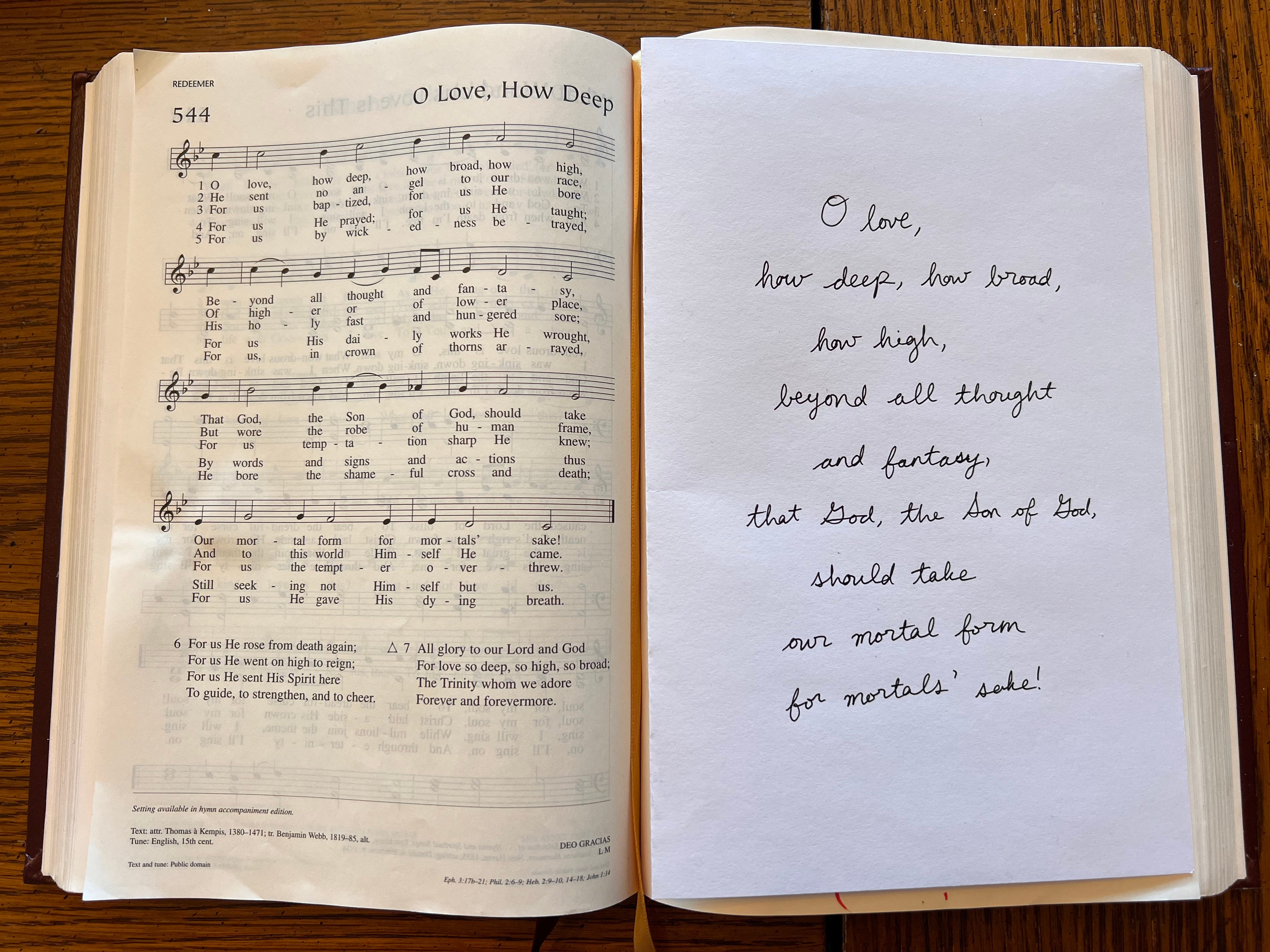
As I said above, my commentary isn’t the point, so I’ll keep it short. “O Love, How Deep” dates to the 15th century; the original text is attributed to Thomas à Kempis and was translated by Benjamin Webb in the 17th century. In this age of disembodied “intelligences,” I deeply appreciate that the first two stanzas highlight the embodiment of Christ, and I was struck by how stanzas three and four repeat “for us” — but this structure made perfect sense in light of this lovely little article I found about Thomas à Kempis, and how much he valued humility. The words of stanza three felt especially relevant to this time of the church year (when many of us remember the fasting and temptation of Jesus), and the close of stanza four was especially striking this time of the calendar year, when my “daily works” have often felt like a bit of a slog (I gather I’m not the only one). You might consider saving stanzas five, six, and seven for Holy Week and Easter, in a joyfully expectant kind of way (that’s what I’ve done below, but you can find the full text of the version I’m using here).
This short recording is great, especially with the organ. I hope it works well to help you commit the hymn to memory, so you can sing it for yourself and your family.
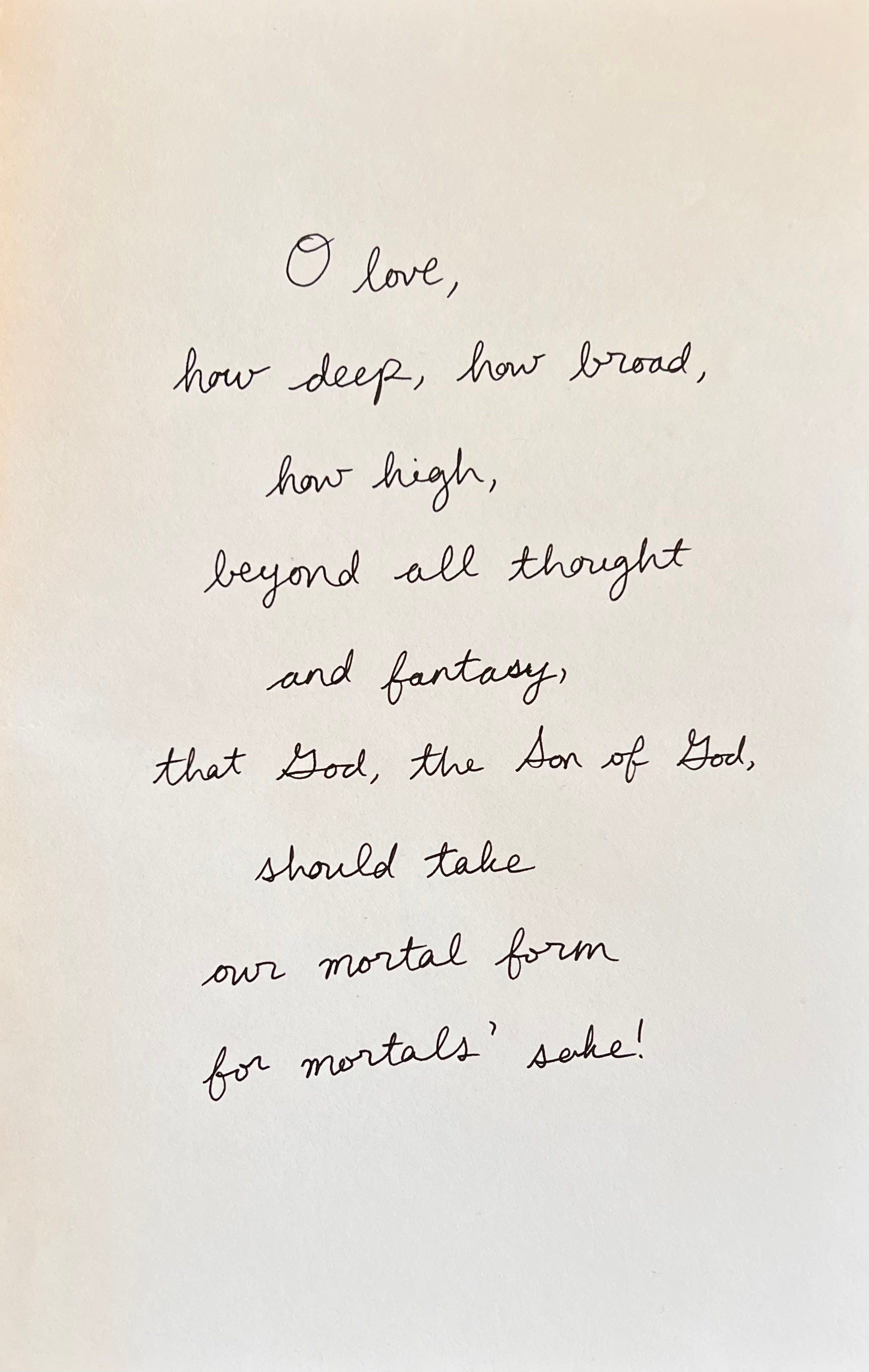
I’ve also hand-written the first stanza with the idea that you might like to print it and post it somewhere around your home as a visual prompt; you can access and download it using the button under the image below. (It should fit well on a half-page landscape, and though it’s a bit counterintuitive, do not select “black and white” if you have a color printer. Let me know in the comments if further instructions would be helpful.)
Make a one-time financial contribution
Again, please let me know if any further guidance or resources would help you bring this hymn into your home, and yourself.
Happy singing!
Text within this block will maintain its original spacing when published
O love, how deep, how broad, how high,
Beyond all thought and fantasy,
That God, the Son of God, should take
Our mortal form for mortals' sake!
Text within this block will maintain its original spacing when published
He sent no angel to our race,
Of higher or of lower place,
But wore the robe of human frame,
And to this world Himself He came.
Text within this block will maintain its original spacing when published
For us baptized, for us He bore
His holy fast and hungered sore;
For us temptation sharp He knew;
For us the tempter overthrew.
Text within this block will maintain its original spacing when published
For us He prayed; for us He taught;
For us His daily works He wrought,
By words and signs and actions thus
Still seeking not Himself but us.
This statement is often attributed to sixteenth-century German theologian Martin Luther, but on looking into it more, I learned that it was first recorded in the 1940s among the German Christians resisting Nazi rule. You can also find a few variations of the saying online, presumably the result of translation from the German; I’ve included a hybrid here, since that’s what I remembered.
And yes, I’ve failed to hit “send” on a piece that was essentially ready to publish because of this very concern — not to mention other pieces in earlier draft form.
By “Technopoly dissidents” I mean people who are also fervently opposed to “the surrender of culture to technology.” Note that I use the terms “the Machine” and “Technopoly” somewhat interchangeably; I tend to favor the latter because I appreciate Postman’s succinct definition, but do recognize that it’s easy to mix up the words “Technopoly” and “technology” (and, of course, I am not by any means opposed to all technology).
Some hymns have been written more recently, but hymns are distinct from more “modern” Christian music. In her book Beyond Mere Motherhood: Moms Are People Too, Cindy Rollins says, “The nicest thing about hymns was (and I say ‘was,’ as they do seem to be passing away) that they connected one generation to the next through the common culture of music.” I feel similarly, except I refuse to use the past tense — thus my work here.
No posts
Comments
Nothing yet. Say the first thing.
Sign in to join the conversation.