
Two weeks ago Zach Rausch and Jon Haidt from the Substack After Babelmarked an important milestone in their collaboration with The Center for Humane Technology, which they describe in their succinct and compelling piece, “Solving the Social Dilemma: Many Paths to Social Media Reform”. In it they outline the results of what I’m sure has been tireless work focused on organizing, categorizing, and analyzing a wealth of information related to social media reforms. I deeply appreciate all their efforts to compile and refine the 94-page Google doc that their Substack piece introduces, and I’d highly recommend that any readers of Digital with Discernment who haven’t yet subscribed to After Babel do so.
I especially recommend diving into the series After Babel has recently started, “Voices of Gen Z,” including pieces like “Algorithms Hijacked My Generation. I Fear For Gen Alpha.” by Freya India and “Do you know where your kids go every day?” by Rikki Schlott. More broadly, I admire the obvious openness to a variety of perspectives that Haidt demonstrates in several ways, including his introductions to each piece in the “Voices of Gen Z” series, his efforts to amplify the work of a number of others,1 and his calls for feedback found near the beginning and end of “Solving the Social Dilemma” (and elsewhere).
I offer my thoughts below in this spirit of constructive feedback and collaboration across a range of perspectives. Like a growing number of writers in the Substack community, I write from the perspective of fighting against the harms of not just social media, but of digital technology in general. I hope to inspire an even wider group of people to join this fight in earnest, especially those who haven’t seen themselves reflected in the lists of specialists who are usually called to take action on this work. You don’t have to be a legislator, technologist, or entrepreneur to make a difference to our society’s technological future. In fact, if you find yourself outside of those groups, you’re exactly the person I’m looking for.
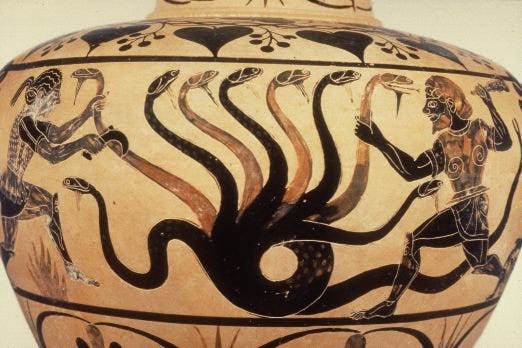
In his note at the beginning of “Solving the Social Dilemma: Many Paths to Social Media Reform”, Jon Haidt compares the present-day fight against the harms of social media to the mythical battle of the demigod Hercules against a monster called the hydra. Though there are countless legends of battles against serpentine monsters, the story of the hydra has captured imaginations for millennia in large part due to the outrageous difficulty of the challenge Hercules faced — for Hercules found that when he cut off one the hydra’s many heads, it regenerated into two new heads as quickly as he could move on to cutting off another. There are minor variations among versions of the story; for example, in some versions Hercules fights the hydra with his mighty club rather than a sword. However, the element that seems remarkably important to ancient versions of the story is conspicuously absent from many modern references and retellings — the involvement of Hercules’s nephew, Iolaus.2 For example, the version available through the Perseus Digital Library Project reads, in part:
“Hercules set off to hunt the nine-headed menace, but he did not go alone. His trusty nephew, Iolaus, was by his side. [He] shared many adventures with Hercules…and he is often depicted as Hercules' charioteer. … With his club, Hercules attacked the many heads of the hydra, but as soon as he smashed one head, two more would burst forth in its place! … Hercules called on Iolaus to help him out of this tricky situation. Each time Hercules bashed one of the hydra's heads, Iolaus held a torch to the headless tendons of the neck. The flames prevented the growth of replacement heads, and finally, Hercules had the better of the beast.”3
In the children’s version that my family owns, the tension in Hercules’s call to Iolaus is palpable, despite the simplified wording (especially when read aloud):
“‘Iolaus, Iolaus!’ He did not know if the boy was still with the horses.
“‘Here I am! Here I am!’ cried the boy. He had been afraid when he saw the hydra, but he had not run away.
“‘I must have fire,’ shouted Hercules. ‘Get some as fast as you can.’
“Iolaus ran to the forest. He set fire to a big tree. He carried the burning sticks to Hercules. He was just in time. The hero’s foot was held fast by the hydra.4
I imagine that in many cases, brave Iolaus is omitted to simplify matters. In fact, there are centuries’ worth of artistic depictions focused exclusively on Hercules and the hydra, like the one that illustrates Haidt’s note. However, I would argue that the whole dynamic of the story is changed dramatically when we neglect to mention Iolaus’s critical role the defeat of the hydra.
I’d like to spend a little while extending and revising Haidt’s metaphor of the battle against the hydra. First, I think it’s important that we speak of the hydra as encompassing more than just social media (though I think social media comprises a significant number of the hydra’s current heads). In their presentation “The A.I. Dilemma” and subsequent work, Tristan Harris and Aza Raskin of the Center for Humane Technology describe social media as “humanity’s first contact with AI.” Harris explains:
“When you open up TikTok [or other social media] and you scroll your finger, you just activated the supercomputer the AI pointed at your brain to calculate and predict, with increasing accuracy, the perfect thing that will keep you scrolling. …
“We now have, every single day, an AI — which is a very simple technology, just calculating what photo, what video, what cat video, what birthday, to show your nervous system, to keep you scrolling. But that fairly simple technology was enough, in the first contact with AI, to break humanity with information overload, addiction, doomscrolling, sexualization of kids, shortened attention spans, polarization, fake news, and breakdown of democracy.”
Therefore, we need to explicitly grapple with the harms of AI in general, not limit our examination to the harms of social media (which is powered by what Harris and Raskin refer to as “curation AI”). Additionally, I would argue that we must consider some earlier technologies as other “heads” of the hydra. Though social media certainly caused or exacerbated many of the problems of our present age, I’m convinced that Cal Newport (author of Digital Minimalism) and others are correct in their assessment that the smartphone and other digital technologies are significantly detrimental to human wellness (and relationships) in and of themselves. Additionally, I would include some simply electronic technologies within the same assessment of modern technology’s harms.5 All of us have felt some impact of what has been called “the epidemic of loneliness and isolation” by the U.S. Surgeon General (or perhaps more precisely, the pandemic of loneliness and isolation), and social media certainly hasn’t been the only cause of this crisis. Therefore, I would say that the monster against which humanity should be grappling is something like, “the hydra of digital and electronic technology harms.” Please do note the very intentional inclusion of the word “harms”; I definitely believe that many digital technologies can be used to provide a net benefit to humanity and individual people, though I’m also convinced that their harms are very difficult to divorce from their benefits.
Now, back to Iolaus. Reading the excerpts from the story of the hydra that I quoted above, it becomes clear that Hercules needed Iolaus’s help to defeat the hydra — and Iolaus was not just acting as “another set of hands,” but playing a totally different role.
In Haidt’s original metaphor, “legislation and litigation” are the golden sword that Hercules finally used to kill the hydra. I agree that legislation and litigation are necessary, but I believe that their power is often implicitly overstated. Changing the law may put a halt to many of digital technology’s harms, and it may even proactively prevent new sources of harm from materializing — but changing the law will not change hearts and minds. As I’ve seen in my own life, those who are already victims of digital technology’s harms can easily move on to another source of “faux reality” in an attempt to fulfill their “cravings.”6 In my case, quitting social media did not curb the compulsion to check or spend time on my devices; online news (especially highly emotional news) readily filled that void, followed by Substack and email.7
More importantly, legislation can’t change the hearts and minds of millions of young people who have never known life without digital technology. Even if we were able to pass a raft of incredibly stringent, sophisticated, and effective laws to neutralize many of the harms of digital technology, young people today would still see the adults in their lives model that being human means turning your attention to your device, rather than to other people — and they would still follow suit. Really, countless young people are already the victims of digital technology without being “users,” as their parents’ attention is drawn away from them and toward digital devices to an unhealthy degree.
We need to be very clear that the challenge we all face is two-fold: we must effect change both in the law around digital technology, and in humanity’s relationship to digital technology on a more fundamental level.
I expect that Haidt, Harris, and others would agree,8 but it seems that so far, the proposed solutions to this challenge have been overwhelmingly focused on reforming technology. However, as Haidt and Rausch admit, focusing on reforming technology leaves us playing a “constant game of catch-up” — and I would argue that it has obscured the need for a more comprehensive solution. We need to take a step back, question our assumptions, and devote far more attention to how everyday people can fight “shoulder to shoulder” with those wielding the golden sword of legislation.
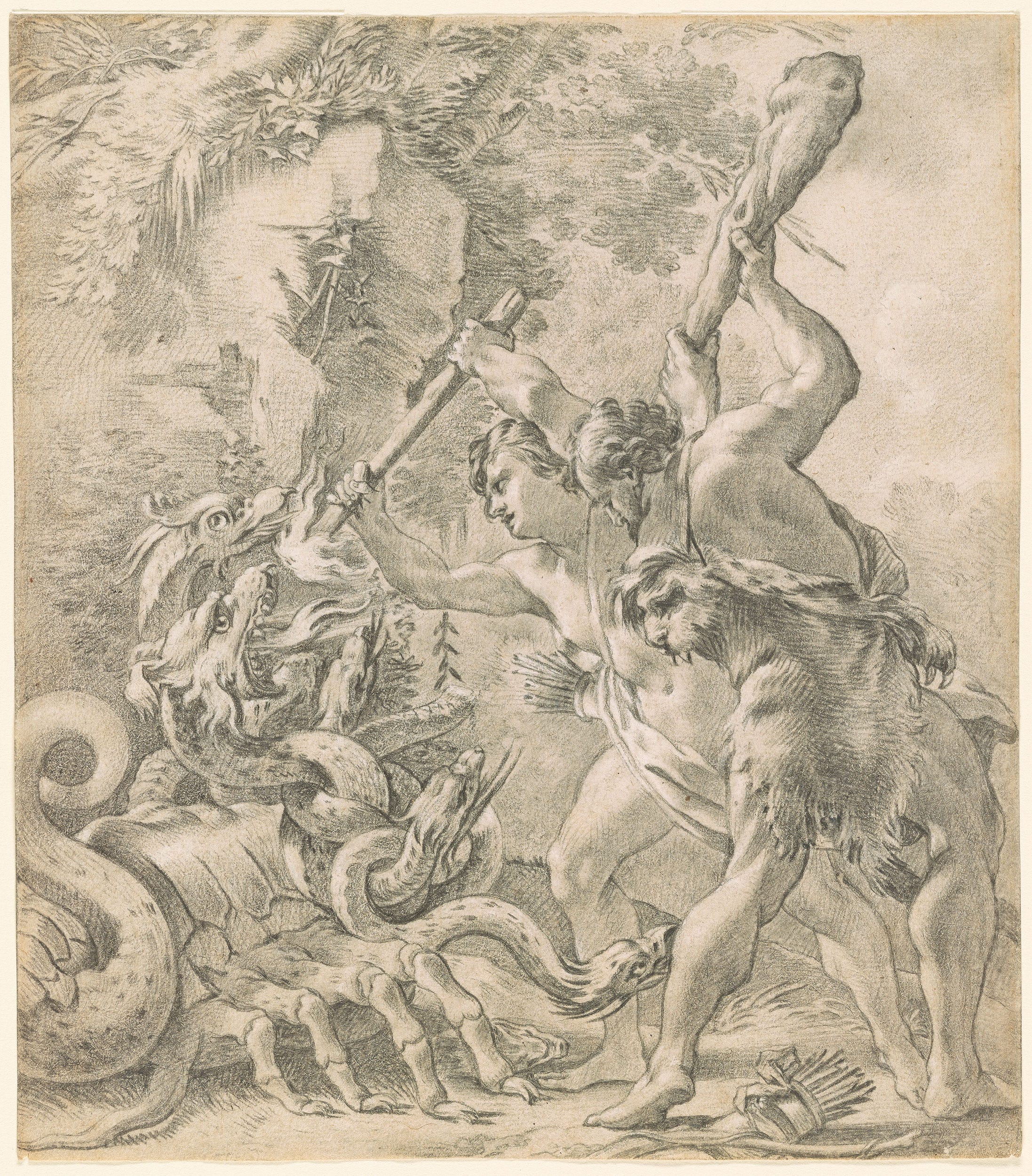
While everyday people can certainly support efforts to change the law, I think we must play a much broader role in the fight against technology’s harms. We must steadfastly pursue a totally different yet complementary approach that gets to the root of our society’s current digital distress — or else resign ourselves to continuing the battle against our hydra with a new set of “heads.” Put another way, what is the fire of Iolaus, and how can we wield it? Here is my answer:
To be crystal clear, I don’t think digital technology should be eschewed entirely, as if I believe naively that we could go back to some idyllic past — but as Peco and Ruth Gaskovski put it:
“To take the contrary position, that we should accept a life of increasing digital disembodiment and simulated or simplified digital relationships—as if other-centered love could fully flow through a screen or retinal projection—as if the deepest needs of the human heart could be filtered through Big Tech’s corporate ambitions—is to risk distorting an essential part of what makes us human.”
(excerpted from “The 3Rs of Unmachining: Guideposts for an Age of Technological Upheaval”)
While I deeply respect Tristan Harris and find his work at the Center for Humane Technology incredibly important, I would challenge him on his use of the phrase “break humanity” in the portion of “The A.I. Dilemma” that I quoted above. I think it’s nearly indisputable that social media and other digital technologies have caused or contributed to a wide variety of complex, worldwide problems, often with deathly serious consequences — and yet, I do not believe humanity has been broken. At the very least, there are still holdouts, like Ruth and Peco, who eschew what they view as the most harmful technologies, but still publish their work on Substack and use other digital tools. In fact, there is a growing movement of people who strive to use digital technology within what Cal Newport calls “a philosophy of technology use,”9 and who compellingly demonstrate that our individual efforts are vitally important contributions to the broader fight against humanity’s digital distress.
If you feel drawn to joining in this fight in earnest, but feel ill-equipped — like I still do, most days — this is for you: Your efforts to craft a life according to your values, rather than surrender to the digital status quo, are not simply inconsequential expressions of personal preference. There are no grades to strive for, no certifications to earn, and you may receive more strange looks than commendations — but you may also find, as I have, that you receive much more than you expected: the sweetness of homemade scones at the home of friends you’ve barely seen since college; a hug and a whispered “happy birthday” from your thirteen year-old niece, who you just learned shares your taste in books; raucous laughter filling your dining room the night you introduce your local friends to some friends from slightly farther away. Yes, our smartphones have taught us to seek novelty and instant gratification, rather than practice persistence and patience — but we will learn and grow in the skills we need, as we do the work we need to do.
So, what does all this have to do with the holidays? Let me explain. I’ve been thinking a lot about tradition lately, probably because my family was blessed to move into a new home earlier this year, which the previous owners’ family had called home for fifty years. Our family’s seven previous Christmas seasons have involved what has felt like more than our fair share of nasty viruses, newborn-induced (or late pregnancy) brain fog, and other such complicating factors — but truth be told, I think that whatever comes our way, we can do a better job of finding and maintaining meaningful traditions that anchor our family in the good, the true, and the beautiful. The importance of tradition deserves a much fuller exploration, to be sure, but I think it’s telling that our current age is so incredibly impoverished of any truly time-tested, widely shared tradition — and the vestiges of tradition we do have are often commodified or not treated seriously, as if holidays that were observed with joyful reverence in centuries past are “just for kids” (and perhaps some crazy Christmas parties).
Now, I understand that this time of year is incredibly busy and stressful for so many people, and the last thing I want is for this to read as yet another “to do” — but I do think this time of year is perfect for establishing our homes as havens of genuine human connection, and “refuges of authenticity,” to borrow a phrase from Hadden Turner (please do read his excellent piece here). And I have good news — you don’t have to pack all your memory-making, refuge-building Christmas activities into the first 25 days of December!10
Despite growing up in a church body that follows the Christian liturgical year,11 it wasn’t until I was an adult that I learned the Twelve Days of Christmas begin on Christmas Day. As I understand it, this is very consistent with how humans have historically treated major events (such as holidays and weddings), celebrating over the course of multiple days — and in my opinion, it makes so much more sense than placing an incredible amount of pressure on people to prepare for a month (or more) and then “pull off” the “perfect” single day (this is especially true if you have young children).
In my experience, those last few days of December are often spoken of and treated as a “limbo” period, but they are, in fact, still part of Christmas! We should treat them as such, savoring the time and prioritizing what truly binds us together — not simply treating them as “time to kill” before the new year. My plans and hopes for this year include: continuing our tradition of opening gifts over the course of all twelve days (especially gifts from a group of friends with whom we exchange gifts for this express purpose), hosting extended family for several days, enjoying mulled wine on December 27 in honor of St. John, and reading A Christmas Carol by Charles Dickens (as recommended by Ruth Gaskovski in her recent piece). (One of my favorite aspects of celebrating the full Twelve Days of Christmas is that I don’t have to plan everything in advance — and I’m looking forward to what the new Substack Signs + Seasons has in store for their upcoming issues!)
Of course, your family’s traditions should reflect your unique family members and circumstances. Families with more “readers” may want to explore the tradition of Jolabokaflod, aka “Christmas book flood” (see this episode of the Read Aloud Revival podcast for more information). Families whose members are used to significant amounts of “screen time” may want to do a one-day “experiment” in which they dramatically reduce or eliminate their screen-based activities.12 And as I’ve written before, extended family plays a critical role in shaping the expectations of the family’s younger members, so if you’re a grandparent, aunt or uncle, cool older cousin, or the like, please don’t be shy about your desire to be involved in Christmas celebrations — December 28th may be the perfect day to, say, teach your niece to ice skate.
You know what else is a great idea for late December? Visiting your local library! If you don’t already have a library card, take this opportunity to get one. If you already have a library card, consider taking your child(ren) to get their own, as tangible evidence of their growing capability to manage their own affairs (my now-six year-old got his own library card as one of his birthday presents, after having asked for one on several previous occasions).
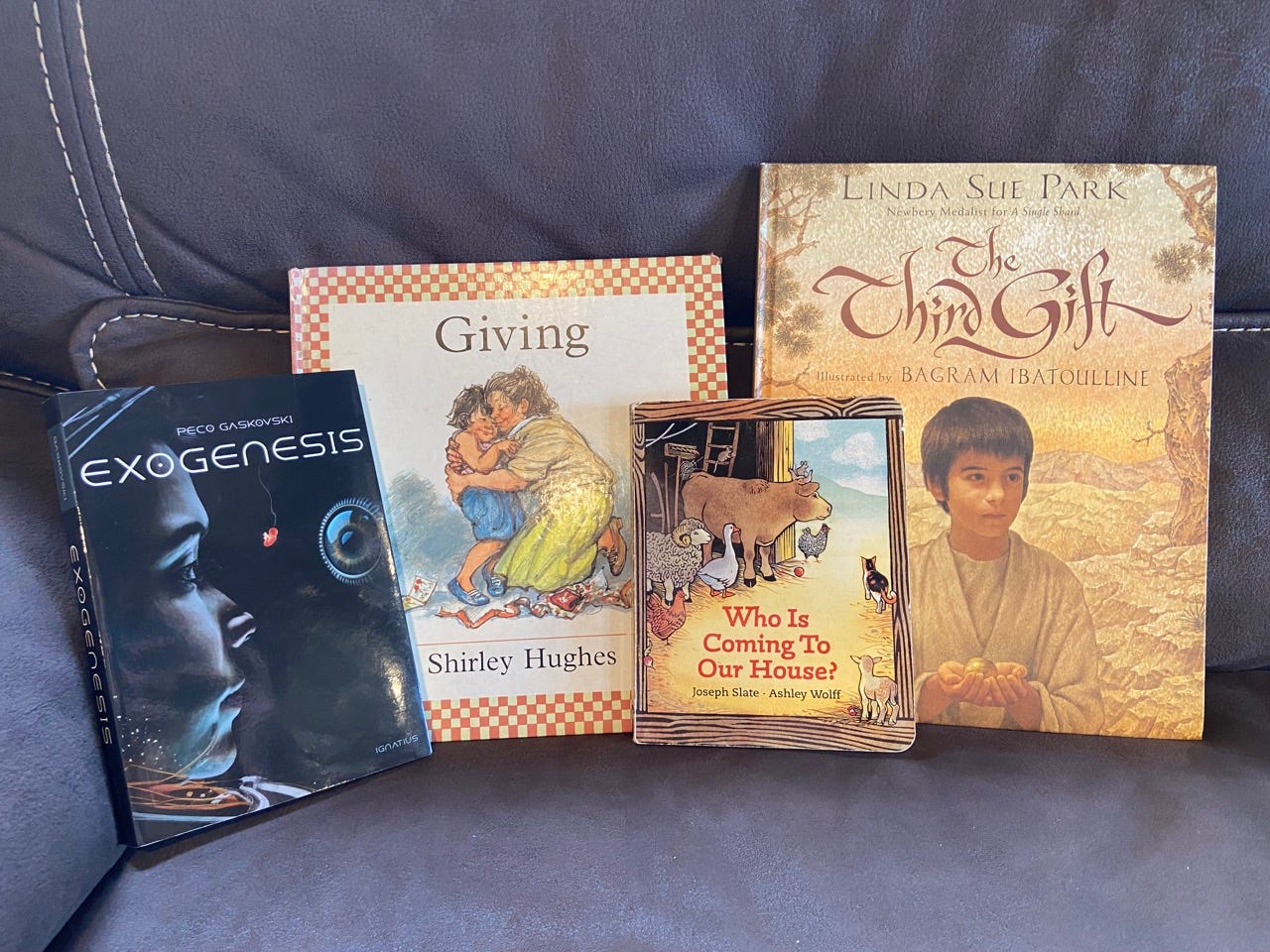
Of course, having a library card doesn’t make it easy to choose thought-provoking, nourishing books — which is why I propose moving some of the great discussion that I’ve seen happening in Substack Notes13 to a more prominent place in the “unMachining” conversation. I know that there are already many excellent booklists available, including countless titles and authors, but I think there’s a place for longer-form discussion of why certain books are worth really reflecting on and re-reading, especially in the context of pursuing a life focused on relationships rather than digital technologies. So please consider this a “teaser” for a new series here at Digital with Discernment, tentatively titled “Reading by Firelight”:
It’s also true that simply having good books in your home, from the library or elsewhere, doesn’t mean that they will be read. That’s why I highly recommend you make a clear commitment to reading every day — and for parents specifically, reading aloud as a family every day.14 I know this might sound like a big commitment in an already busy schedule, but if Kamila Bendova can read to her children for two or more hours every day while actively resisting Soviet oppression, I think you and I can manage twenty minutes a day. I’d recommend making it a multi-sensory experience — think popcorn in pajamas, or tea and cookies in the afternoon — and while it’s certainly not necessary to explicitly announce this commitment to your kids, the snacks and special time together will probably induce them to remind you of your intention, even when you don’t feel like following through. Whether or not you have kids, I’d also encourage you to increase the chances that you continue with this habit by practicing “habit stacking,” which James Clear describes here and in his incredibly helpful book Atomic Habits.
Ruth and Peco Gaskovski, whom I quoted above, have recently published another fantastic piece full of concrete advice for what I’ve called “wielding the flame of Iolaus.” I highly recommend that you print out a copy of the PDF version (which Ruth has made available at the beginning of the piece), share it with a friend or family member, and reflect on small changes you could make to, as they put it, “instigate seeds of change by unsettling the assumptions about omnipresent technology use.”
I mentioned above, almost in passing, the “epidemic of loneliness and isolation” that’s now plaguing millions of people around the world. Despite living in the most “connected” time in history, so many of us struggle with the feeling that we’re meant to live in a “village” that no longer exists, or that seems like a shadow of what we’re really looking for.15 While I cannot personally connect you with like-minded people down the street, I hope that my work can help you find the words to explain your perspective to friends and loved ones, and perhaps discover that kindred spirits aren’t as rare as you once thought. Or, if you’d like to use my words to start a conversation, please feel free to share them:
I truly believe that we all benefit when more people contribute their unique, thoughtful perspectives to this conversation, so if you would like to add yours, please do write a comment!
Finally, please consider pledging to financially support my future work. I truly love to share resources and ideas that will embolden you to act with hopeful determination, and I would deeply appreciate your help to publish more frequently. (I won’t be announcing paid subscriptions or enabling payments until Feb. 2024 or later, once all our budgets have a little more breathing room.)
I’m looking forward to sharing more reflections and suggestions inspired by the age-old practice of gathering around the fire (such as sharing physical space and embracing the sunset), and I’m very excited to start my “Reading by Firelight” series! Until then, let’s take up our torches, and get to work.
For example, the work of Peter Gray around the importance of childhood play. Haidt co-founded the organization “Let Grow” with Gray and others; the following our excerpts from their mission statement: “We believe today’s kids are smarter and stronger than our culture gives them credit for.” and “We are making it easy, normal and legal to give kids the independence they need to grow into capable, confident, and happy adults.” I encourage you to check out the organization’s full “About Us” page and peruse their broader site, especially if you are a parent like I am.
The full version of the story available through Tufts University’s Perseus Project is short and very readable; I’d encourage you to read it here.
This children’s introduction to Greek myths is titled Adventures of the Greek Heroes, by Mollie McLean and Anne Wiseman (illustrated by Witold T. Mars). It captivated my then 5 and 6 year-old boys, and I’m very grateful to my son’s godmother for gifting us with it (and many other incredible books).
For example, I think Neil Postman made an incredibly compelling case for the dangers of TV in his book Amusing Ourselves to Death, which contains a lot of prescient wisdom for the Internet age as well, despite being originally published in 1985. A growing number of people agree that we need to look at the problem more broadly, including many writers on Substack and within the broader “unMachining” movement, but that’s a discussion for another day.
Though Substack markets itself as a positive alternative to social media, in many ways it has the same dangers, especially for those of us writers who can watch our subscriber numbers rise, check our “post stats,” and experience the haunting, nagging sensation that if we don’t spend the time to read all the great content that others are producing in our area of focus, we simply can’t publish anything ourselves.
Digital Minimalism, pg. XVI
This is, of course, the case for those who celebrate Hanukkah or otherwise do not celebrate Christmas, but I believe my suggestions can be easily adapted to other contexts.
That is, a pattern of Scripture readings and remembrances that is consistent from year-to-year (more or less)
If anyone does try this, please do let me know how it goes!
Yes, even families with older children! Reading aloud has so many benefits, even once kids (or adults!) are able to read proficiently on their own. To learn more about this, read (or listen to!) The Enchanted Hour: The Miraculous Power of Reading Aloud in the Age of Distraction by Meghan Cox Gurdon.
No posts
Comments
Nothing yet. Say the first thing.
Sign in to join the conversation.