
James Plunkett has been writing some interesting stuff recently and I thought I’d try and get some debate going on.
His latest is about iteration in the public sector which is a key interest of mine too.

Iteration is a hot topic at the moment – the magic technique de jour – Test’n’Learn will cure all that ails us. Well, cool yer jets.
Iteration is about feedback loops and always working systems. So far, so good. It matters, but so does when we iterate.
Government is government, and we need to be careful describing it using private sector language.
Tech startups begin as caterpillars and metamorphose into butterflies, after dissolving themselves into mulch in the cocoon.
This transition is called finding product-market fit, described by Marc Andreessen as:
Product/market fit means being in a good market with a product that can satisfy that market.
Before it tech companies are scrappy, reactive, move fast and break things, pivoting, changing, ducking and diving.
After it they become system- and process-bound - making data-driven decisions. The focus switches to continuous improvement of existing services.
All tech origin stories are about caterpillars, but told by butterflies.
Thanks for reading Digital Policy! This post is public so feel free to share it.
Government mostly resembles post-P/MF tech companies – only rarely pre-P/MF.
In Foundations of the Digital State I used this model of the Scottish government lifecycle:
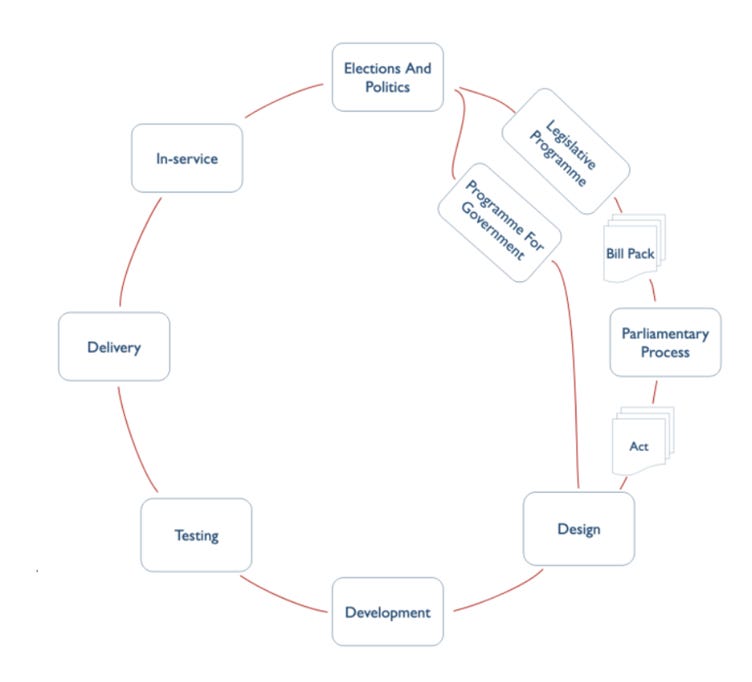
There are 3 channels for new or changed digital systems:
1 primary legislation (which goes through Parliament)
2 secondary legislation/Ministerial Orders (which touches Parliament)
3 work done under existing powers (which bypasses Parliament)
As a rule of thumb – the 1st channel corresponds to pre-P/MF tech, the 3rd to post P/MF continuous improvement and the 2nd is a mixter-maxter. Holyrood takes 22 to 25 bills a year – but only 1 or 2 are digital.
The vast majority of government digital is continuous improvement. And here we start seeing problems.
UK’s GDS created a problem of success. It transformed government by finding a solvable problem and solving it fast. The credibility of early success enabled it to build and expand a base and win the battle for thought leadership.
The problem is that the structure required to storm a beachhead is different from the structure required after victory.
Continuous improvement is operations-led and the challenge is now to move iteration from the centre to the edge – to institutionalise the practices of GDS not to copy them, to shrink the technical centre – not grow it ectopically.
It comes back to functional and non-functional (or infrastructural) requirements – the what and the how. The what of state digital is expressed in legislation – the how is smeared over service standards, blog posts, departmental guidance, what google does and what we did at my last job.
This is the central finding of Foundations of the Digital State.
Some of these hows are now systems – Gov.UK Pay and Gov.UK Notify. But the state lacks recipes to create non-functional (or cross-cutting) organisations – they are not in Common Legislative Solutions.
The debate about uptake of these services is still find internal customers and not identify and deploy central improvements.
Not all hows can become systems – some are ways of working and the challenge is to drive iteration of hows to the edge – which means giving the edge (departments, arms length bodies and local authorities) more autonomy.
This is a double institutional challenge.
Firstly the distributed hows need to be co-ordinated with technical standards – which implies a weak central co-ordinating body that can develop technical consensus across the entire landscape. Standards can be implemented without communication, without command and control.
And secondly institutions at the edge need control of money, timing, technology and procurement. This is a devolution of power.
Continuous improvement is iteration within lawful authority, but what if that is the problem? If the laws says X must sign the paper with a wet signature the process can’t be digitised. The Ontario digital programme needed 100 changes to primary legislation.
So what is the loop from edge to centre when a block is identified? And how can it be cleared without parliamentary gridlock?
The current loop is via the Scottish Law Commission – a new technical institution must rhyme with that.
The recommendation in Foundations of the Digital State is an Enabling Act – primary legislation amended by Ministerial Order on a like-for-like basis. This requires special and institutionalised parliamentary oversight.
These institutional proposals are discussed in more details in Working Paper 0 – The locus of change and Working Paper 8 – An Enabling Act.
Legislation has bedevilled digital reform since Gershon in 2004:
2.6 (…) In developing proposals the Review team was careful to avoid any which required new primary legislation or investment in large new ICT systems because of the uncertainty this would create over the delivery of the consequent savings within the 2004 Spending Review period.
Test’n’Learn dodges it too.
But passing legislation is an iterative software development process. Universal Credit had about one and a half Ministerial Orders a month for 12 years.
Scottish Social Security had 3 Acts and 76 Ministerial Orders over 6 years totalling 1,149 sections. I read and classified them all, section by section:
Functional specification 725 – 63.1%
Non-specification 419 – 36.5%
Non-functional specification 5 – o.4%
Don’t believe me? (I wouldn’t) I wrote about in in Working Paper 9.1 - Reading legislation with a non-functional eye and Appendices. All the gory detail section by grim section in the appendices there.
Legislation is accidently iterative using mechanisms to hand – it should be designed to be so - and I explored this in Working Paper 7.3 – Experimental digital legislative processes.
Getting better iterative legislation is politically tricky, lots of moving parts, but conceptually quite easy - given that the legislative process for major systems is already iterative - just not explicitly in the way we want it to be.
We have a process that works (it produces digital systems) and has the properties we seek - it stands to reason that we should focus on, and improve, it in a systematic way.
Conway’s Law tells us that the architecture of a software system recapitulates the communication structure of the team that makes it.
When you build a major IT project you have a vertical organisation at the start – to build the smallest end-to-end working system. At the end you have a horizontal operational organisation – layers and specialist services.
The starting architecture is never fit for the purpose of mature operations.
It follows that in the middle you need to take a pause and rearchitect your software – your project has a natural puberty.
It will happen whether you like it or not – you can plan for year 3 to be a year of restructuring or you can have a political crisis with the ‘troubled programme’ being ‘not fit for purpose’ and the hero being sent in to ‘save’ it.
Improving legislative iteration is constitutional – touching the format of legislation and parliamentary process.
In the report I recommended an iterative, constitutional approach – eating my own dogfood. An ad-hoc committee at Holyrood would define a new process with a temporary standing order. One of the 25 annual Bills would be diverted through it with the agreement of the government. The committee would write and introduce the necessary legislation to institutionalise the learnings of this practice run – or runs.
This approach would work in Wales which also has modernised institutions.
But it would not work at Westminster. That parliament has 2 separate weak governing bodies – and they can’t even fix the building which is crumbling.
That government controls the standing orders, the introduction of legislation and the timetabling – a proper constitutional process would need to be ginned up.
Its reviewing chamber, the Lords, has no legitimacy, seats in it are openly for sale, and most members don’t attend. During my research I tried to contact a number of peers by going to the website and following its instructions. None of my emails got an acknowledgement let alone a reply. It is a dead tooth.
On top of that Whitehall, as part of an unsystematised polity, has the problems of departmental lawful authority that I talked about in my previous response to James Plunkett.
Iteration is about course correction – improving it requires a deep understanding both of the machine we are driving and the road we are driving on and that basic administrative hygienic actions have been taken. Government is government.
No posts
Comments
Nothing yet. Say the first thing.
Sign in to join the conversation.