
April is National Volunteer Month, and this spring we have a few new faces around here! Hello to everyone who found their way to Newberry Transcribe through Chicago magazine or Lit Hub. We’re glad you’re here.
We’ve been thinking about what it means to join a project like this one: to sit down with a handwritten document from a stranger who died a century or more ago, and decide to listen carefully to what they have to say. It’s an odd, quiet, generous thing to do. We don’t take it for granted.
We found a passage in our collections that says it better than we could. It’s from an 1842 letter in the Isaac Stevens Metcalf family papers, by someone writing to a relative who had just volunteered to begin a regular correspondence:
“Your proposition of a regular confidential correspondence meets my wishes exactly. It is what I have myself thought of asking, but a fear of my inability to perform punctually (to say nothing of my indolence) has deterred me from doing so; but now that you have volunteered I must heartily acquiesce. I think it is our privilege, and in some measure our duty, freely to open our minds to each other and encourage and comfort each other in our pilgrimage.”
We think about that fear of inability to perform punctually (and the parenthetical about indolence) a lot. It’s exactly the anxiety that keeps people from starting. But the writer was wrong to worry, and so are you. There’s no commitment here, no quota, no grade. Just manuscripts waiting to be read, one page at a time.
If you’re just getting started, our tutorial will walk you through the basics. And if you’ve been here a while: thank you for continuing to show up, page after page.
Ready to join the pilgrimage? Start transcribing at Newberry Transcribe
In Jane Austen’s Emma, Miss Bates famously apologizes for Jane Fairfax writing “only two pages” — “hardly two” — when she usually “fills the whole paper and crosses half.” Her mother, she reports, always greets a newly arrived letter with the same remark: “Well, Hetty, now I think you will be put to it to make out all that checker-work.”
Miss Bates disagrees: “I am sure she would contrive to make it out herself, if she had nobody to do it for her — every word of it — I am sure she would pore over it till she had made out every word.”
We think Miss Bates is right.
Cross-writing — turning the paper sideways and writing over what you’d already written — was a common way to get more out of a single sheet of paper, which was taxed by the page in Britain until 1840. Jane Austen herself did it. So did plenty of the writers in our collections.
Like this one:
This letter is from the Alfred Barnes papers, 1834–1838, and it was transcribed by one of our volunteers — checker-work and all. Here are a few more examples; jump in wherever there’s room:
Want more Newberry x Jane Austen? Visit our interactive postcard map:
Sense and Scenery: Picturing Jane Austen’s World
What begins as handwriting on a page can open onto an entire life. In this issue, volunteer Rebecca Rector introduces us to Alexander “Zannie” Heflin, a railroad telegraph operator who wrote affectionate, funny, and sometimes wistful letters to his sweetheart Jessie in the late 1870s. Rebecca was so drawn in by the correspondence that she followed the couple’s story beyond the letters themselves, tracing their marriage and later life.
We’re delighted to share the opening of Rebecca’s article below.
My own Darling: Letters from a Railroad Telegraph Operator to his Sweetheart; Illinois and Kansas, 1878-1881
Alexander “Zannie” Heflin was born in Illinois in 1853, the son of German immigrants. In 1878, he was working on the Atchison, Topeka & Santa Fe Railroad as a telegraph operator when he began writing to his sweetheart Jessie Beathard, who was living in Kingston Mines, Illinois. These letters, preserved in the Hoefeln family collection at the Newberry, offer a lively glimpse into their courtship.
Zannie’s letters mix news of work, weather, concerts, sleigh rides, and family updates with affection and teasing. He often addresses Jessie as “Jessie Mine” or “My own darling,” and his writing is full of humor, homesickness, and longing. In one 1878 letter, he jokes about her piano playing: “Glad you will get a Piano … if you intend teaching the art so you practice on that other piano too (Washboard) ha! ha!”
As the letters continue, they reveal not only the demands of railroad life but also the couple’s hopes for a shared future. By 1880, Zannie and Jessie were married — but in these letters, we meet them in the midst of that unfolding story, one letter at a time.
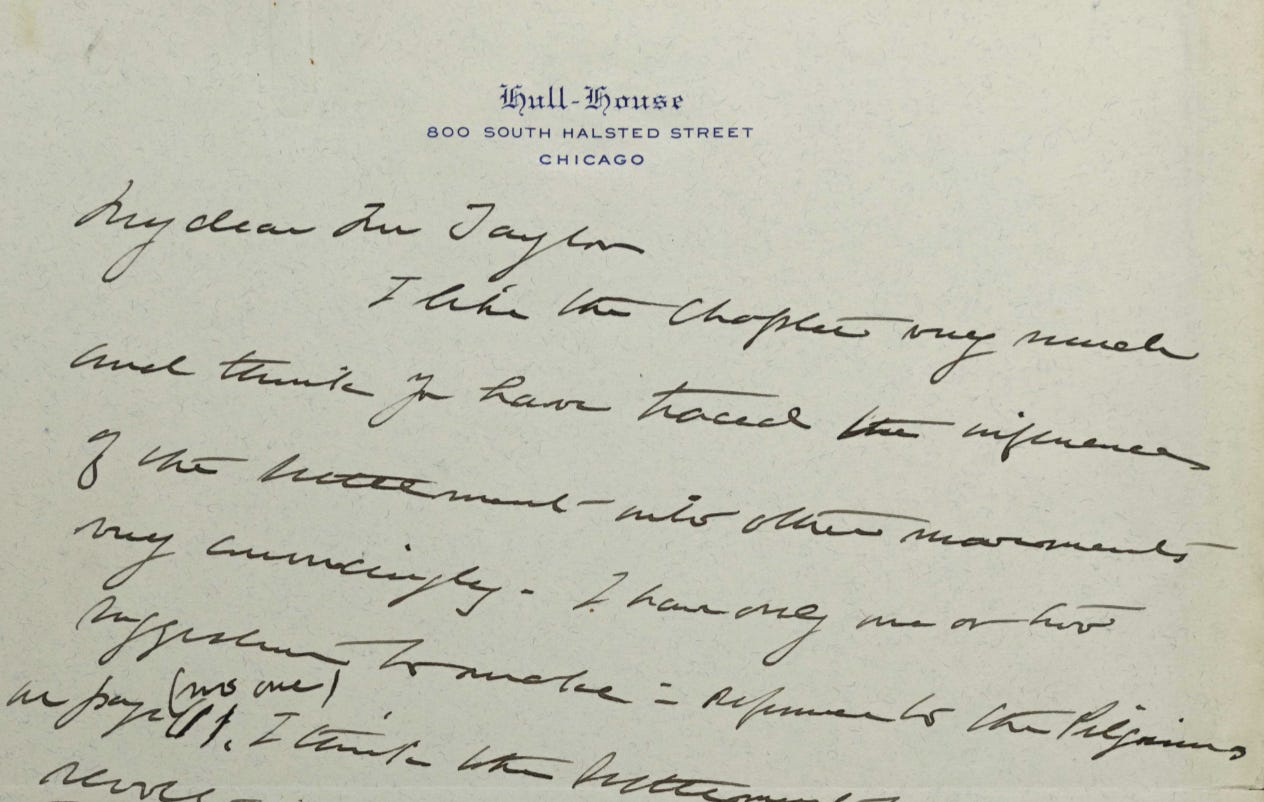
Graham Taylor letters [part 6], 1884–1938
The Newberry’s Graham Taylor correspondence runs to thousands of pages, so we work through it in chunks. The latest batch includes 30 pages of letters from Jane Addams. She and Taylor were two of Progressive Era Chicago’s most prominent social reformers, and together they helped shape the settlement house movement that transformed urban life in the late 19th and early 20th centuries. These letters capture that partnership at its most candid — in Addams’s own hand. Transcribe now →
More than 1,800 additional pages added, including:
Isaac Stevens Metcalf letters, 1850–1898 — New pages from Metcalf’s papers capture everyday family life alongside the work of railroad building in the 19th century. His letters and records span Maine, Ohio, and Illinois, tracing a life shaped by farming, business, and the expanding railroad. Transcribe now →
Erwin Watkins–Simeon Whiteley letters, 1863–1920 — These newly added letters offer glimpses of life in and around the Office of Indian Affairs in the mid- to late 19th century. The correspondence ranges from official government business to personal letters, including Whiteley’s letters home from Denver. Transcribe now →
Ben Hecht letters from daughter Jenny, 1940s–1971 — Written by Jenny Hecht to her father, these letters offer a personal window into the life of the daughter of one of Hollywood’s most celebrated screenwriters. An actress from a young age, she moved in theatrical and artistic circles, and her letters are shaped by performance, family, and creative ambition. Transcribe now →
Sherwood Anderson letters, 1915–1941 — Incoming letters to the author of Winesburg, Ohio trace his personal and professional life through correspondence with publishers, editors, scholars, admirers, and fellow writers. The newly added pages open fresh windows onto his literary world. Transcribe now →
Every page you transcribe becomes a permanent part of the public record — findable, readable, and available to anyone who goes looking. There’s always something new waiting.
No posts
Comments
Nothing yet. Say the first thing.
Sign in to join the conversation.