
When I told my drum teacher Gonzalo about doing the record store interview series, he immediately said: you have to go to Ultra Local.
Ultra-Local Records, created by Raül and his partner Carme, is an institution in Poblenou, a Barcelona neighborhood progressively taken over by tech hubs and specialty coffee.
Raül will tell us how he quit his day job and bet everything on records in 2012, when vinyl’s glorious return had barely started, and how he turned one of his favorite bands, Yo La Tengo, into returning visitors.
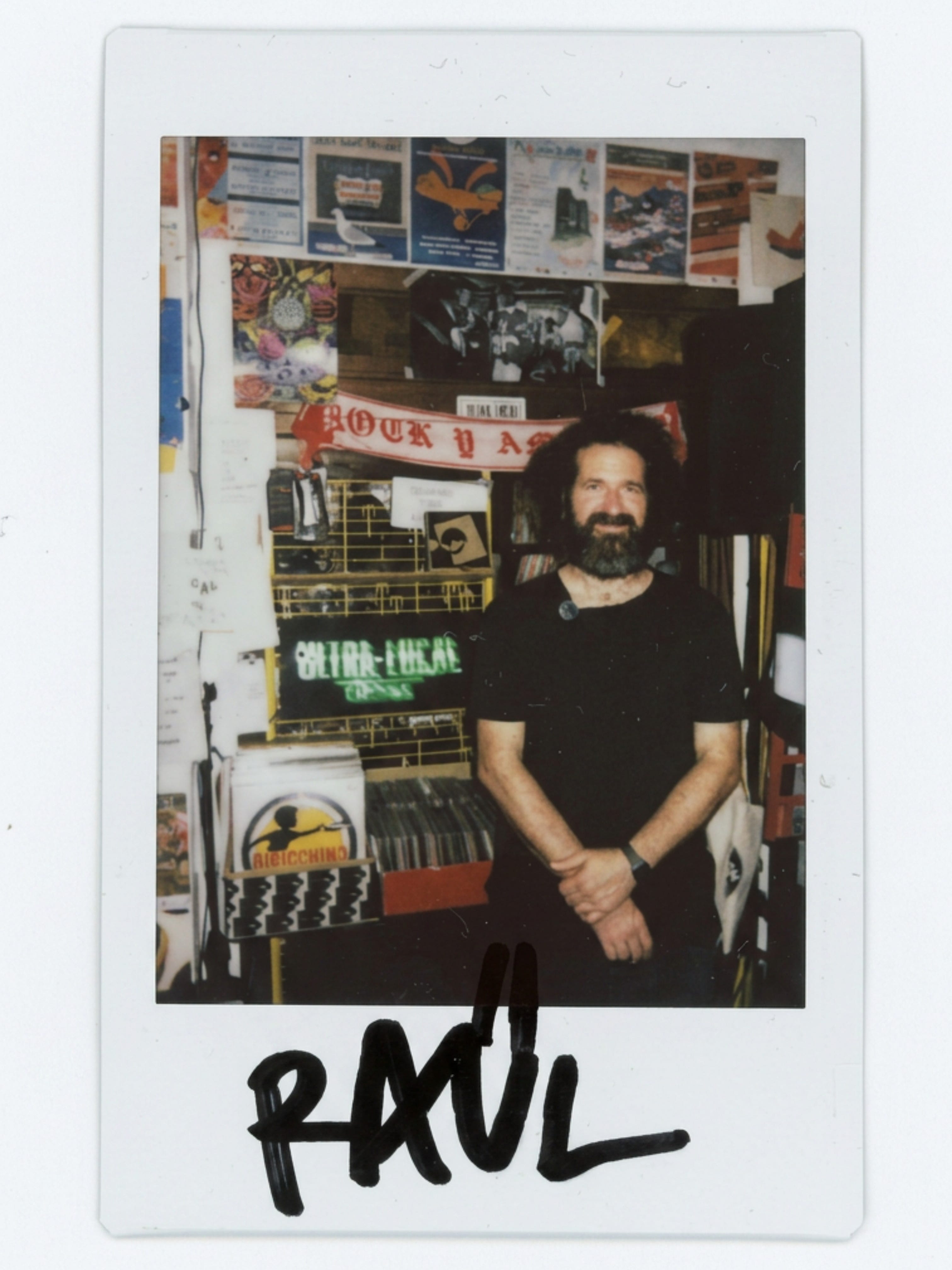
How did you get to the point of having a record store?
Raül: This year it’ll be 14 years. It all started because I was fed up with my job and wanted to leave it all behind, and Carme, my partner, who I opened the store with, told me: do something you actually want to do. And I’d respond: I don’t know anything, I only like music and records. I’d always dreamed of a record store, but I never thought I could have one. Then I decided: I’m going to do it. I’ll quit my job and try to open a record store, even if it’s suicide; I’ll close it and that’s that, on to something else, but at least I’ll have tried. And I tried, and so far, it’s worked out.
I read that one of the name ideas was Suïcidi Records.
Raül: Yeah, I liked it, it was cool, a bit punk. But the truth is we never thought the numbers could work. I had to do a sort of viability plan, because I cashed out my unemployment benefit to set up the store (in Spain you can take it as a lump sum to start a business). The plan gave you a shoe store as the example, and applying it to a record store I kept thinking: I’d have to sell a lot of records for this to be profitable. I did it to justify the lump sum, thinking the whole time: this makes no sense.
We opened the store in 2012, and it was somewhere in 2011-2012 that we decided to just go for it. There were few record stores left in Barcelona; I’d stopped buying records long before and was just getting back into it, but the main stores were closing. It was not an ideal moment, and nothing suggested buying records was about to come back.
And at the beginning, were you still working as well?
Raül: I left my job, cashed out my unemployment, and set up the store with that money; my savings kept me going. The first year was a disaster, but hey, all according to plan. Still, those first years were beautiful: you meet people, you have a door open to the street. It felt like: shit, now I have this, I don’t want to let it go. So, after going back and forth, I called my old boss and asked: can I come back? He said: sure, of course. I went back, in another part of the factory, on a compressed schedule: mornings at the factory, afternoons at the store. That morning job let me keep the store going without thinking I’d have to close it.
And when did you notice the store had become a business you could live off, without another job?
Raül: With the numbers actually working, without me worrying, it’s been about three years. The first three or four were hard on that front: Carme had her job and I had mine, so the store kept itself going, but the numbers didn’t add up anywhere. With time, you build a stock of records, people get to know you, more people come by. All of that, little by little, is like a drop filling the glass, and there’s a moment when the glass is full and you can get by on that.
The most important step was quitting my job again, just before the pandemic: in October 2019 I told my boss, again, that I was leaving, to give the store more time and see if the numbers would work. Carme had gotten a better job, we were financially calmer, and it was the moment. Then the pandemic arrived, and since I was focused only on the store, all things considered, it worked out. We already had a community of people who bought from us, and they helped us a lot. Once it passed, the store really started adding up. I have a salary now, which I’d never had. Before, I had a joint personal and store account. Now I’ve separated them, set it up like a professional, and there’s money for me and for the store, to keep buying records.
I also read that during the pandemic you were delivering records by bike.
Raül: Right, the pandemic meant closing everything. No money coming in, and the only way out was to be creative. I’d buy the records, set the house up like the store, crates everywhere, and we’d sell through live videos on Instagram. It was crazy. Now I see people doing that on TikTok, like teleshopping, but live.
Since people couldn’t leave home and I, as self-employed, had a kind of permit, I started delivering the records by bike. That saved us: people saw it was a way of helping us and brought a real will to buy, and we were delighted to do the silly thing and ride up and down the city. The best part was going to people’s homes. There’s even a book by Dimas Rodríguez, the Invisible Harvey singer, whose story is a bit like that: the protagonist’s record store floods and she delivers records to her customers’ homes. It was a special moment.
And in those 14 years, did you ever have doubts? That feeling of “this makes no sense, time to let it go”?
Raül: No, honestly. Having had a regular job before, this barely counts as working. I never want to work again. Having the store, a place where I’m surrounded by records, living off it without a boss, without anyone telling me anything, without putting up with anyone’s nonsense, without getting up in the morning for something I don’t feel like doing: that beats the thought of “what am I doing?” by a lot.
In the end you’re much more than a record store, almost a cultural institution, with your festivals, concerts, a label... And you also have a special relationship with Yo La Tengo.
Raül: One time Yo La Tengo were coming to Barcelona for a festival at Tibidabo, a couple of nights with Mogwai and Yo La Tengo headlining, 2015 or so. Back then nobody came through here; we’d spend the day sitting outside in the sun or in here, friends coming by, little improvised concerts. Edu Mató, a friend of the store from way back, suggested recording a cover of one of their songs, getting it to them, and asking them to stop by the store next time they came to Barcelona. That same afternoon, their version of You Can Have It All got covered right here, filmed, and we passed the video to Ignacio Julià, a Barcelona journalist who’s close to them.
Then, as life would have it, Yo La Tengo landed in Barcelona and were picked up at the airport by Tule, a promoter who knows us. Apparently they got off the plane and said: do you know where Ultra-Local is? When Tule called to tell me, I couldn't believe it. I was at my morning job, but he had to pick up their backline near the store anyway, so he offered to drop them off. On the way over I started calling friends to tell them Yo La Tengo were coming. By the time I arrived people were showing up, and Tule’s van appeared with James and Ira. They got out surprised, and saw 15 or 20 of us, all big fans, waiting outside. They were super nice, a bit shy at first, but then they started digging. Ira loves Spanish sixties singles; I had boxes around and he went through them. James was after experimental music tapes.
From there a beautiful relationship grew, and they've kept coming; Ira walked in one day and there I was. With the label we run on the side with Àlex, edita la servidumbre, releasing cassettes by bands that have passed through the store, we asked James, who has his own project, Dump, if he'd want to do one with us. He was coming back for another concert, we went to talk to him, and he gave us permission to do a compilation cassette of his songs. Later James even played here for Microclima Sound, the little festival we do while Primavera Sound is on; his hotel happened to be right behind the store, and he decided to come and play.
Gonzalo, my drum teacher, has very fond memories of you and the store. He told me he played in Pararrayos and that you also did a cassette of Yo La Tengo covers by local bands. Was that before or after meeting them?
Raül: After that first time, I think. We used to do a radio show here called Hip Hip Ultra, and ideas always came out of it. Since we had our own cover, we encouraged people to send us theirs, and a whole pile came in; too much for a cassette, so it’s all on Bandcamp, covers by local bands. Pararrayos did one, yes. In fact we also released their first cassette on edita la servidumbre, the label we did the Dump cassette with.
For people who don’t know Yo La Tengo: your favorite album? And a first album for someone who doesn’t know them at all?
Raül: I came to Yo La Tengo late, in the early 2000s, through a compilation called Prisoners of Love: the best of the band, and from there I went discovering the songs I liked most and which albums they were on. For me, I Can Hear the Heart Beating as One is the album where I got hooked. A lot of my friends loved them and I couldn’t quite get in: very noisy songs next to very quiet ones, and I didn’t know what it was I liked about them. Then I saw them live and I understood. They’ve kept putting records out since, but for the band’s first 15 or 20 years these two are a good start.
I didn’t know the band much before either, but I’ve been listening a bit and it seems they change style from one album to the next.
Raül: They have a beautiful thing, their essence: you hear the songs and know it’s them. They’ve kept changing, but there’s a common thread running through it all. Within their music you have the electric, noisier parts and the more ambient, pop parts; this beautiful pop song tucked between a mountain of distortion. They’re not trying to make other kinds of music: they stay in their own lane, closed inside their own sound, and very authentic.
And there’s the story of how they started late. Ira was a music journalist, a critic, I think he still is, and got into making music already older, with Georgia, his partner, just to try. It turned into a great career. They’re one of the most coherent and sincere bands in alternative rock.
I’ve also read they’re a critics’ band, always mentioned as a reference.
Raül: That’s why it was hard for me to get in at first. Whatever media like Rockdelux said, I’d take it a bit contrarily, and when they talked a band up too much, I’d put it in quarantine for a while. But once you really discover them: yes, a band critics value, but with an audience that keeps showing up and young people joining in.
I listen to more folk, country and Americana than indie, and they have one album, Fakebook, that I love because it leans toward that sound.
Raül: That album, for example, was huge for Ran Ran Ran, a band we also release records for, and they’re big Yo La Tengo fans. Fakebook is one of the records that pushed them to make music; a very important album in their path, I think.
I don’t know if it’s just my bubble, but it seems people are pushing back a bit against the world of algorithms. Do you feel local bands are growing with the younger generations, or the opposite?
Raül: Around here, Catalonia, which is what I know best, there’s a feeling that young people, unlike us, aren’t embarrassed to listen to local bands or music in Catalan. In our day that carried almost a stigma: it sounded weird, it was politicized, a lot about it wasn’t cool. The politics being there is cool, but the feeling was strange. Now the prejudices have fallen away and local bands fill big venues, bands like Oques Grasses, the local mainstream. It’s curious: around here they’re massive, but 100 kilometers out nobody shows up. I like that, bands local people are passionate about that never quite take off internationally. And that’s partly the algorithm’s fault: through the algorithms that band will never reach someone in England who maybe, hearing it, would dig it. You never know.
Oques Grasses sold out like four concerts at the Estadi Olímpic, like Bruce Springsteen.
Raül: There is some of that, but those are singular cases, worked hard at the promotion level, I suppose. The wildest is Rosalía: a local artist who, whether what she does is good or not, has a campaign behind her to make it work. It’s a strange business, because plenty of bands don’t sell records and nobody pays attention, and for local bands the language border is a real problem on top. But then look at Kneecap: a band defending exactly that, from Ireland, with their language and their way of doing things, reaching the whole world. I thought about that a lot when I opened the store, because in the early 2000s people here listened to a lot of Icelandic bands. We loved múm, Sigur Rós, and if you think about it, you don’t even know what they’re saying: a remote place, nothing like the Mediterranean, and yet they got through to you. The idea is that one day it happens here too: someone from outside hears El Petit de Cal Eril, someone with a style of their own, and says: hey, I like this. The only thing from here that ever worked globally was the music they called fusión: rumba with Latin American rhythms. Manu Chao was the great standard-bearer, and around him loads more: Ojos de Brujo, Muchachito, all that crowd. For a while they did well in Europe, toured. That doesn’t happen now.
Speaking of festivals: you’ve run Microclima Sound almost from the beginning, and you have this anti-growth philosophy, this idea of degrowing.
Raül: The idea was there from the start, because the store partly happened thanks to places like Luchador Records, in the city center, run by Pol Rodellar, one of the members of Mujeres, and Esteban. They did concerts in the store, and I always thought: if we open ours, we’ll do release shows too. Then, with Primavera Sound happening near here, came the idea of Microclima Sound. We had the name, which we loved, and said: let’s do it. There’s a Catalan saying, “el nom fa la cosa”, the name makes the thing, and that’s what happened.
We started doing concerts during Primavera. The first year nobody came: the audience was the bands. Two bands, one played while the other watched, then they swapped. But being here, completely outside something so massive happening in the city, was a very interesting feeling, and we kept at it.
Now people know it and come, and tiny as it is, that already felt like too much; Microclima, in the end, is about going against whatever is happening. Degrowth is something we believe in as a way of living, so these last years we run this gag of degrowing until we disappear: a festival that gets smaller every year. Festivals fight to get bigger; our fight is to make it smaller. It's all a joke, you can take it as funny, but behind it there's a bit of anti-system rage.
You’ve lived in Poblenou all your life, right? The neighborhood has changed a lot with the whole 22@ project. How have you seen it change, and how do you see the future?
Raül: Well, my father was born here, but I was born in la Verneda, further out. We came back: Carme and I have lived here since 2005. And musically the neighborhood has changed a lot. Poblenou was an oasis of bars, clubs, venues and, above all, rehearsal spaces. When we opened the store, part of the idea was that people heading to rehearsal would stop by for records, a wheel that made sense, and then you’d catch the concerts at the venues around. In recent years all of that has been disappearing: no rehearsal spaces left in Poblenou, venues gone or barely hanging on. Razzmatazz holding out because, for now, it’s an institution. All of it breaking apart in favor of offices.
Along with the offices came housing, and new people arrive to find a neighborhood that isn’t the Barcelona they imagined: there are people, bars, things going on, and it bothers them. It keeps smothering the musical fire this neighborhood had. Gentrification is happening everywhere; the curious thing is that here it’s been running since the Olympics, slowly, and the pandemic was a big step: they tore a lot down, and associations nearby disappeared.
How do I see the future? Getting worse, from where we stand. Nobody dares rent a space at these prices, and the city council won't let you do much either: you end up doing things clandestinely, and the neighbor who just arrived complains. Maybe other things improve, but nothing new will open for music.
And is there any neighborhood movement against all this?
Raül: The problem is that there are very few of us, and it’s hard to fight back. There’s also a bigger worry: housing. People are more focused on having an apartment than on a concert venue; what little force there is goes to fair housing and rents. We’d fight for venues if housing were solved; it’s priorities. There’s also some helplessness. A lot of places disappear because people weren’t going anyway. Somewhere closes and, people say “oh, what a shame”, but if they didn’t go, it closes. You can't mount a neighborhood fight to defend something we don't quite know how to defend.
And do you notice those changes in the store’s community? Fewer neighbors, more tourists buying records?
Raül: We’re a bit outside the touristy area. It's gone from nothing to the occasional tourist passing through. And that’s cool, because whoever comes all the way out here has a real interest, in local bands, in what’s being made here, or simply in buying a record away from the city center. It’s a very small part, but it happens. More and more people come through: neighbors, people from Barcelona... And more stores have opened, so it’s spreading out, and people build their own routes. That’s what’s changing most: the person who used to come every week now rotates, one week here, another El Genio Equivocado, another Revólver. And that’s cool too, because each store has its own thing: you walk in knowing what you can find, or discover something.
We have a question from the Substack community: is there a record people keep asking for that you completely hate and refuse to sell?
Raül: The store is made of records I like, plus a portion I know people might like. We had a slightly ugly period with Taylor Swift, who I don’t like at all, at all. For a while people kept asking and I’d stock it, but I’ve stopped: there are other places to buy her records. 99% of what I have is here because I like it, and it doesn’t hurt when someone buys one.
You’ve said that when you opened the store, you decided you couldn’t keep buying vinyl for yourself. Before the store, what kind of collector were you?
Raül: I’ve never considered myself a collector; maybe I am, a bit. I started buying records at 18, around ‘98, when I started working and having money. I came from punk, but when the urge really kicked in it was maxi singles: house, electronic music. I wanted turntables, to DJ; that little world fascinated me. Back then you could buy disco super cheap everywhere, people were offloading their records; you’d go to the fairs, buy a pile, and it became an accumulation, a room at my parents’ house full of records.
But it never felt like collecting; I always said I was accumulating, buying a lot without knowing what it was. The store, in the end, has been a bit of that: still living surrounded by records. And living with records is more than listening: it's owning them, knowing the story behind each one. I love it when people tell me the stories of their collections.
I won’t ask about growth plans, but what can we expect? What’s next for Ultra-Local Records? Any ideas?
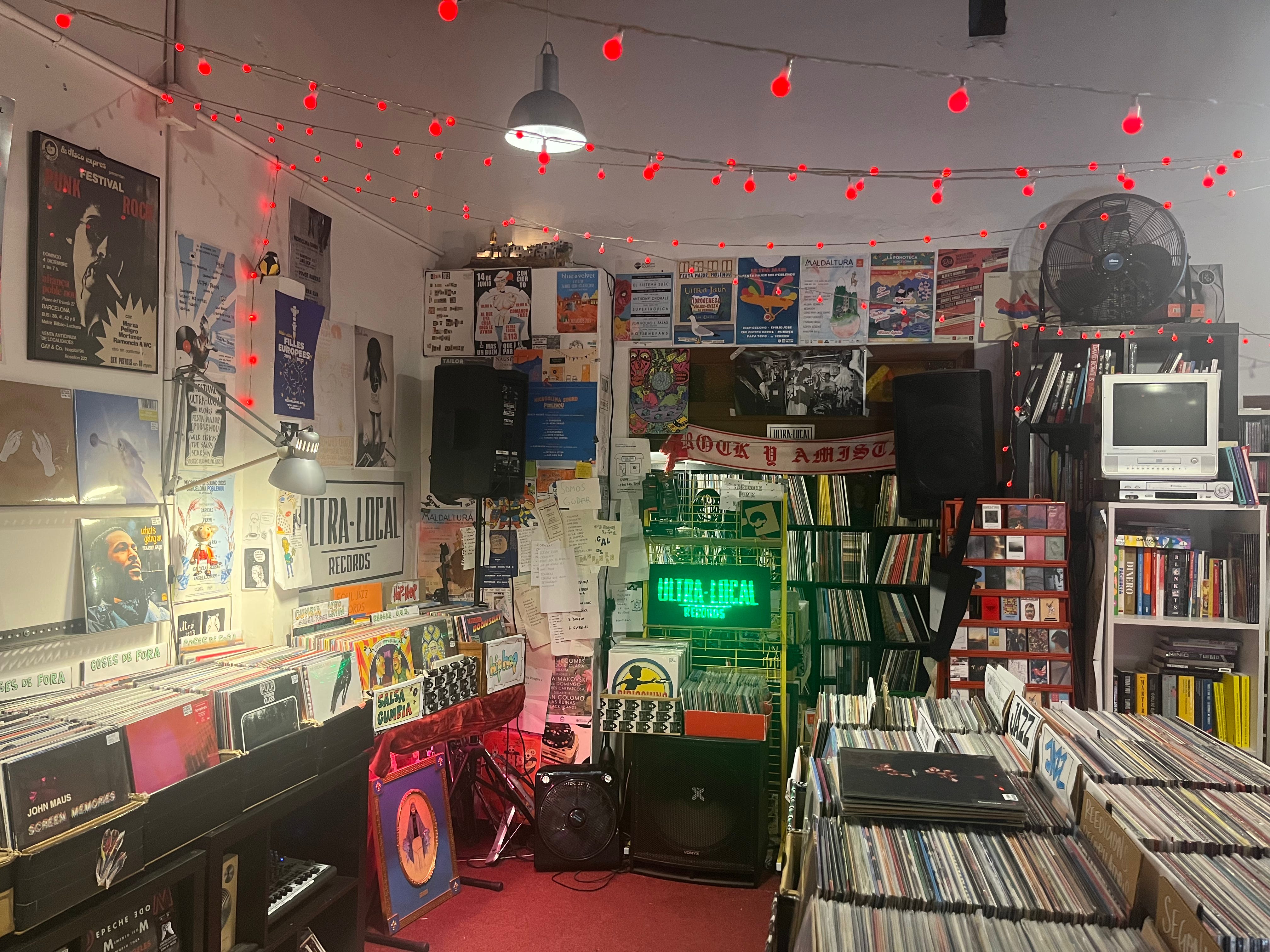
Raül: For now it’s about keeping things as they are and seeing if the numbers hold. Some things could use modernizing, a website, a proper system, the handwritten sales tickets, mostly to free me up for other things. I'll keep the labels handwritten; people tell me they like them too. The handmade side of the store is a differentiating point, and I do it because I like it: writing and drawing relax me, and that's how all the little signs get made.
As for the store itself, we’re in a moment we like. We want fewer release shows, fewer concerts, to give more weight to the records themselves. But the community side matters too: the store sits apart from everything, so if someone’s come all the way here, I want to offer them something different, a concert, a chat with the people outside. I’d like to work on that more; I don’t know how yet, but the idea is for more to happen between the people who come. That would be nice, someday.
Is there a story behind this Rock y Amistad scarf? Gonzalo mentioned it to me too.
Raül: It's a Mujeres scarf, a Barcelona band that plays rock, garage, and one we admire a lot. At one point we had some of their merch, and I wanted that scarf, so we hung it up there. I think Discos Oldies in Valencia have one hanging too. People always ask if it’s for sale, but it's something we want to keep. Mujeres is one of the local bands that supports record stores the most. They come here to buy, they go to other stores, and they know what it takes to keep it alive. All the passion they put into their music, they put into record stores too, which in the end is where their record is going to live. That relationship with the bands is a beautiful thing.
And the other way around too: if you want to support an artist, buying a record is the best way, because from Spotify they get almost nothing. It’s an important relationship in both directions.
Raül: Yes. You notice it here with the local bands: people no longer buy just to listen, to own it, because they like it; it’s also a gesture of support for the bands. It’s the only way to try to survive.
Thank you so much. And an invitation to everyone: if you’re coming to Barcelona or live here, visit Raül at Ultra-Local Records.
Raül: We’ll be here.
As a great record store owner should, Raül sold me a copy of Fakebook during our interview. If I’m lucky, maybe I’ll get it signed next time the band visits their favorite European record store.
You can’t miss Ultra-Local if you love Barcelona’s music scene. There are plenty of great international records as well, hand-picked by Raül, each with its handwritten price label. I love local independent record stores, and it doesn’t get much more local and independent than Ultra-Local Records.
Music
Yo La Tengo: Prisoners of Love (2005), I Can Hear the Heart Beating as One (1997), Fakebook (1990) and their cover of You Can Have It All (2000)
Dump, James McNew’s solo project
Mogwai
Pararrayos
Ran Ran Ran
Oques Grasses
Rosalía
Kneecap
múm
Sigur Rós
El Petit de Cal Eril
Manu Chao
Ojos de Brujo
Muchachito
Mujeres
Invisible Harvey, Dimas Rodríguez’s band
Taylor Swift
Book
Ayer estuve en Lenina, by Dimas Rodríguez
Record stores
Ultra-Local Records (Poblenou, Barcelona)
El Genio Equivocado (Barcelona)
Revólver Records (Barcelona)
Discos Oldies (Valencia)
Venues
Razzmatazz
Sala VOL (formerly BeGood)
La Nau
La Deskomunal
No posts
Comments
Nothing yet. Say the first thing.
Sign in to join the conversation.