
Welcome to Second Rough Draft, a newsletter about journalism in our time, how it (often its business) is evolving, and the challenges it faces.
It is very likely that CBS and CNN will soon be under the common ownership of Larry and David Ellison’s Paramount. Given the inept way the Ellisons (David’s management, father Larry’s money) have run CBS News since they acquired it 11 months ago, that’s probably bad news for both organizations, a subject on which many words have been written. This week, rather than add to that spillage, I want to talk about how such an association ought to be managed. I think there’s a lot that can be learned about news brands and news positioning from such a thought experiment.
I hope you didn’t recoil from the word “brands” in the previous sentence. It should be the key to managing such a combination.
When you control two established brands in the same space, their coordinated deployment is key. And it makes a big difference if the brands are products or services. If they are big-ticket products, that is, if consumers are unlikely to purchase both, the different brands can, up to a point, be left to contend with each other. The management of General Motors (Chevy, Buick, GMC and Cadillac, and formerly Olds and Pontiac) in its 20th Century heyday and more recent modest renaissance is the classic example.
But if the brands are services and can be consumed almost simultaneously and nearly interchangeably, it makes much more sense for the common owner to see that they are substantially differentiated. How should this be applied to CBS News and CNN?
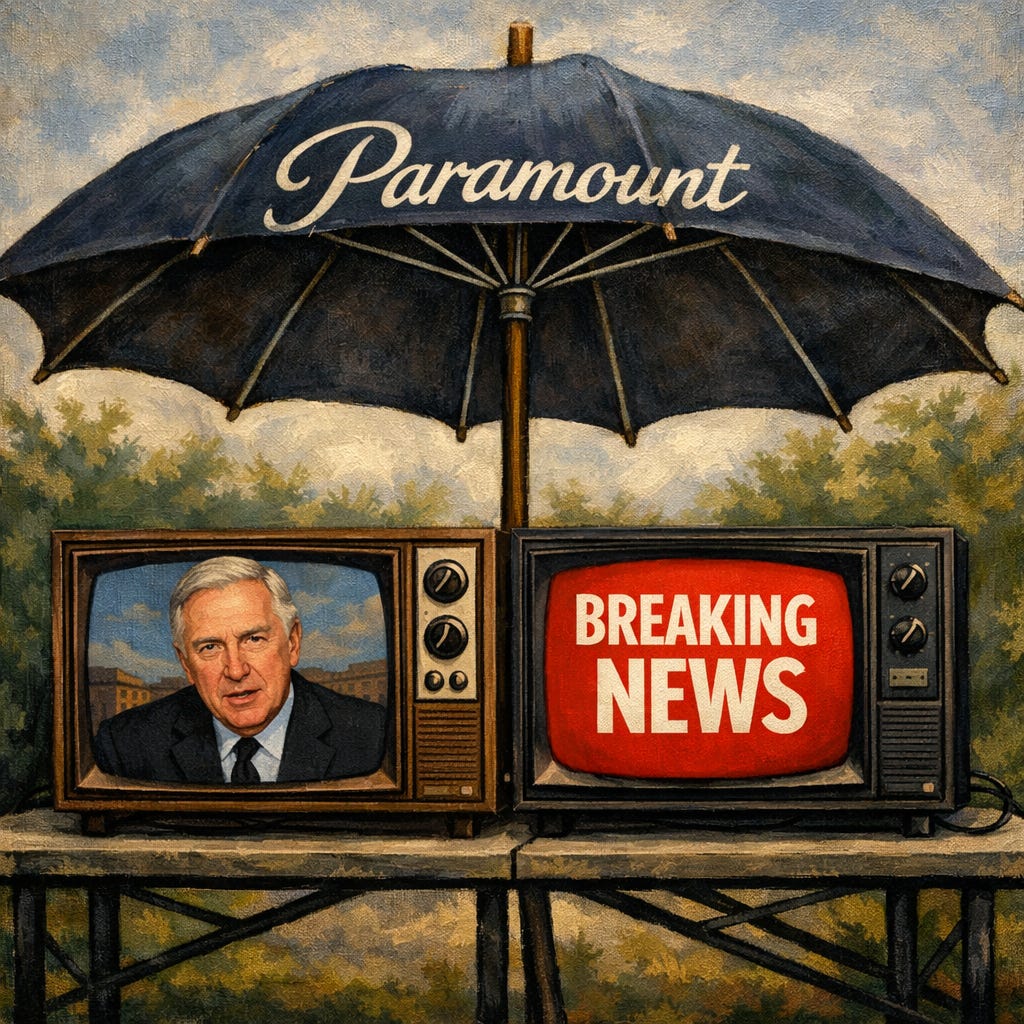
You wouldn’t know it from its management under Bari Weiss, a TV and hard news neophyte, but the heart of the CBS News brand is—or should be—accountability reporting and context and sense-making. On accountability, at least until recently, 60 Minutes included almost the only investigative reporting left on commercial television. Neither ABC, NBC nor Fox have anything serious in this realm. The failure to revive CBS News Reports from the 1960s as programming tastes shifted has long been a mistake in my view. The legacy of the CBS Evening News, under Walter Cronkite and the first two decades of Dan Rather, was of providing an authoritative aggregation of the news of the day, delivered with accuracy and fairness.
An important digression: Weiss misunderstands this, perhaps having been taken in by Roger Ailes’s clever but dishonest presentation of Fox News—a response to late Rather and more recent MSNBC and ultimately CNN—as “fair and balanced.” News is supposed to be fair, and accurate. Balance is an option for opinion journalism, the field in which Weiss does have experience.
Coming on top of accuracy and fairness, however, balance adds nothing to news reporting. In the news realm, balance that comes on top of fairness is what we have come to deride as “false equivalence.” (And—a column for another day—I think balance is a false goal for opinion journalism, where the strongest players, such as the Wall Street Journal editorial page, don’t even pretend to it. If you want a balance of opinion, consult multiple sources.)
The distillation of the CNN brand is quite different from that of CBS News. The heart of CNN remains breaking news—not the omnipresent, devaluing chyrons to that effect, but the real thing, stories with genuine salience for large audiences. Next, CNN is fundamentally more international, the most global of the video-centric US newsrooms. CNN has more than twice as many international bureaus as CBS, ABC or NBC, and more than five times as many as Fox.
CNN is also more digitally-oriented than almost all news brands. It has well more than twice as many YouTube subscribers as CBS, and substantially more than NBC or Fox, with ABC a close peer. The comparisons are largely similar on TikTok. CNN’s YouTube subscribers are more than twice those of MSNow, three times greater than those of the Wall Street Journal or New York Times, more than five times that of the Washington Post, six times larger than the Associated Press.
If you start with those strengths and characteristics, and have control of both brands, how should you manage them? Essentially, the idea would be to accentuate (invest in) their strengths, and cross-promote in a way that shores up weaknesses. On true breaking news—a natural or technological disaster, the outbreak of war, an assassination, some planned event of genuine mass interest—CBS should probably just take the CNN feed, and perhaps contribute leading analysts if it has any on staff. CBS News investigative reports, should the network continue to have the integrity and courage to produce any, should be featured heavily on CNN, as should CBS’s explanatory capabilities.
To the extent that each of the two networks has assets in each other’s core capacities, these might be realigned, for instance by shifting and increasing the regular analytical work of Dr. Sanjay Gupta, Fareed Zakaria and John King (other than on election nights) from CNN to CBS. It is some measure of how much CBS News has been weakened in recent years that I have a hard time conjuring examples of talent that could be shifted in the opposite direction.
CBS News suffered earlier in this century from not having the sort of cable outlet and capabilities of NBC, although the rise of streaming has made the advantages of pairing linear and cable much less significant. Even so, someone of vision controlling both CNN and CBS would do well to look at how ABC Sports and ESPN, long under common ownership, have been increasingly and seamlessly integrated.
All of this, of course, is happening as technology continues to shift, the linear TV audience continues to age, mobile video continues to proliferate, perhaps as AI changes news habits altogether. Managing CBS News and CNN together was an idea Ted Turner toyed with more than 40 years ago. It wouldn’t have been easy for him then, and certainly won’t be easy for the far less visionary Ellison and Weiss now. But I do hope it’s something some thoughtful people at these important newsrooms are approaching creatively today, and not just in the derivative and ideologically-driven ways they appear to be.
No posts
Comments
Nothing yet. Say the first thing.
Sign in to join the conversation.