
A few months back, people were talking about this Indie Game Reading Club post in which Paul asks where the innovation in games is right now. It’s been years since we had a new forged in the dark or pbta style wave. He talks about how some of the innovation has been in product design (see Triangle Agency) which has pros and cons.
On bluesky I kinda jokingly gave my answer on where the innovation is:
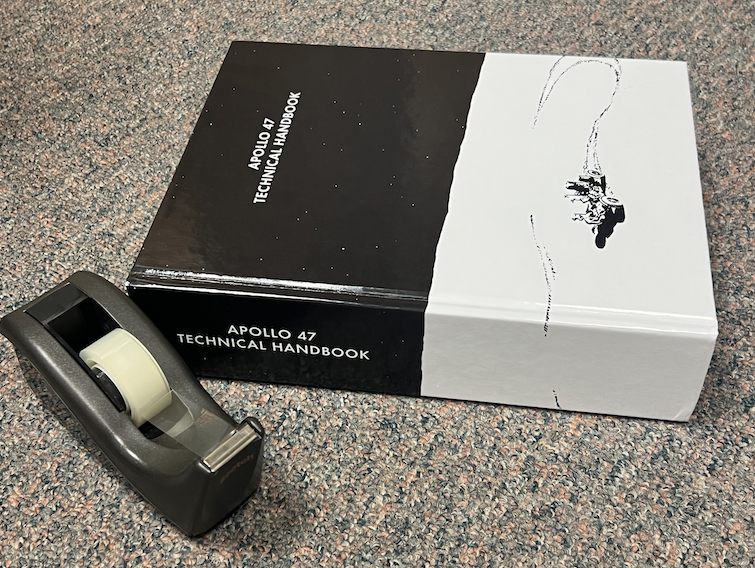
I've decided it's "Apollo 47-core": 1 page of rules + 100 pages of modular lore (see: Mythic Bastionland, Wanderhome, even Under Hollow Hills).
A few months later I put it like this:
55 Knights 55 Myths 55 Sages 55 Weapons 55 Weathers 100 Flora 100 Beasts 100 Castles 100 Rumors 100 Monuments 55 Names 55 Relationships 55 Ambitions 55 Horses 55 Examples of play 155 Swords
I’m no longer joking about this, I think this is exactly right, at least for me. But there’s more to it. I’ll explain.
We have always had a lot of games where the rules are, for me, what makes the game special. Microscope, Apocalypse World, Primetime Adventures.
We’ve also always had games where the fiction the game provides is what makes the game special: many/most parlor larps, any game that’s adventure/module-forward, etc.
And of course most games do some amount of both: Blades in the Dark has both rules that enforce its themes and a whole city built around doing the same. Dialect has tight rules aimed at a specific thematic arc but would fall apart without fictional modules to support it.
In the past few years the most exciting innovation in rpgs for me has been in the way people are presenting the fiction of their game and the tie-in procedures they give for deploying that fiction.
Mythic Bastionland is the poster child for this. It has long list of Myths and Knights that are dripping with flavor and get you wanting to play, and it’s also built for quick and easy GM reference during the game so you’re never stuck long trying to answer the question “what happens next?”
Other examples from this decade: Apollo 47, obviously. Wanderhome’s locations and NPC traits. Apocalypse World 3e’s Hard Zones. My upcoming John Wick inspired game Band-Aids & Bullet Holes contains lists like this of characters (similar to Mythic Bastionland Knights), calling cards (similar to character traits), and locations.
Older examples: Blades in the Dark’s presentation of factions. Any Monster Manual. Fiasco’s playsets. Good lord Fiasco’s playsets, both in terms of their individual fictional bits (relationships, locations, items, needs) and in terms of the playsets as a unit of modular fiction at large.
The secret sauce here, the juice, is that the deployment of these fictional elements at the table are inherently tied to these games’ rules. The games I’m listing here are tight as a drum mechanically, and part of the reason they can be so tight is that they come with a bag of 55 [whatever the appropriate unit of fictional material is] so the players don’t have to make it up. Each of those units of fiction is crafted in a specific shape so that the game’s procedures can hook onto it, like a protein folded into a specific shape that the game knows how to utilize, or like the tooth of one gear interlocking with another.
Examples
Mythic Bastionland’s Myths are cool adventure ideas in their own right, and if you ran off and plugged some of them into your Cairn campaign, they’d serve you well. But the absolute magic of the game is how the way the Myths are written and structured combines with the travel mechanics, particularly the Wilderness Roll, to gradually reveal these Myths over time. The Myths are cool pieces fiction. The game’s procedures then deploy that fiction at a gradual pace that allows the players the ability to wrap their head around them while also conveying that the world is alive, actively changing, and, y’know, mythical.
Apocalypse World’s Hard Zones are a nice treat on their own: well-written lists of flavorful locations you can use as a starting point when it’s time to barf forth some apocalyptica. But combined with The Restless playbook, they make The Restless feel like a tracker, a ranger, someone who’s out there exploring and discovering. They become something the game’s mechanics use as fuel.
Wanderhome asks you to arrive at a place and combine three different location modules (say Hamlet, University, and Tower). The game gives you all the fictional tools you need to understand this place while instilling a feeling of discovery within you by asking you to combine and collide the Hamlet and University portions of the location in unexpected ways.
In the version of Band-Aids & Bullet Holes I’m bringing to Kickstarter in May, you play out a revenge story within a community of assassins. There’s four scenarios that come with the game (will you be rival mentees, one of whom has killed your mentor? or were you left for dead by your partner after a heist so they could keep everything for themself?) as well as a dozen characters. But when you sit down to play, you cast the various roles in your scenario from among all the characters. There’s always a guy named Barf hanging around, but is he one of those mentees, the dead mentor, the bartender, or out of town this week? Like in Wanderhome, the game asks you to set things up by taking pre-existing pieces of fiction and combining them in a way unique to your table.
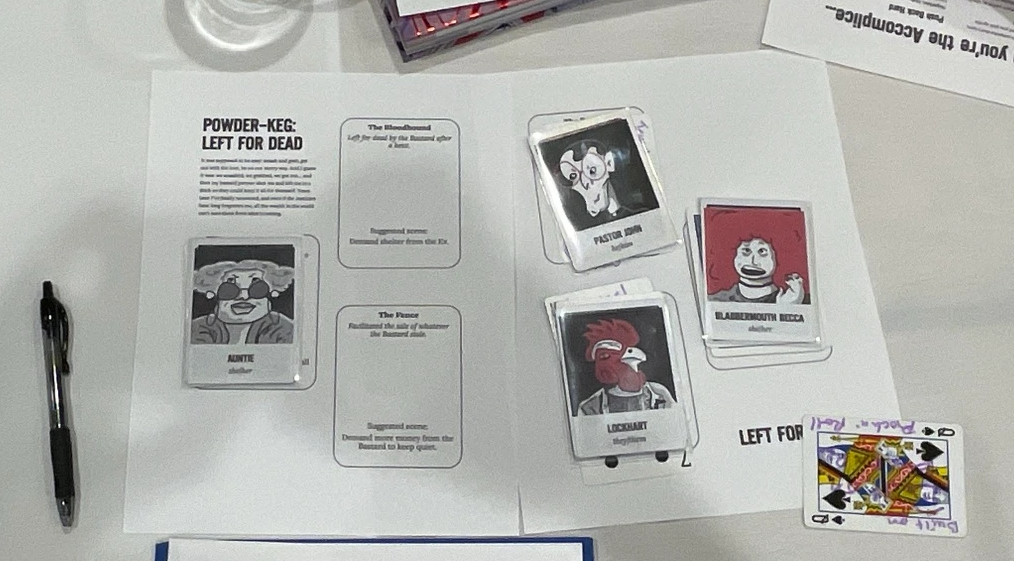
Fiasco might be the oldest and best example of all this I can think of. You have a very simple set of procedures for how to frame scenes during play, but there’s so much magic in simply attaching a location or a need to a relationship and playing to find out what blooms from the result. The game’s playsets could get you started on playing pretend without any rules. When combined with the game’s mechanics, you get a stone cold classic that fires the components of those playsets at you with surgical precision (or wanton destruction, whichever metaphor you think fits Fiasco better).
Wrap Up
I think this is cool as hell. People love this stuff. These lists clearly communicate tone, they get you imagining play, and since they come in a tight form factor meant to be used with the game, it’s easy to make your own at home. They open the game up to community contributions. When I’m GMing a game like this, I feel relieved I don’t have to prep as much (because the designer gave me so much fiction to run with) while also feeling empowered to prep productively (because the designer gave me a clear framework in which to do so).
As I’ve shown, I don’t think this trend is new. But I do think developments on it have been my favorite stuff coming out lately. See also: I think improvements in how rpgs are laid out graphically have allowed this sort of modular fiction to be more quickly and easily conveyed during play, whether that’s Fiasco going from tables to cards or Mythic Bastionland organizing information on a Myth page to be referenceable at a glance when a similar game from 20 years ago may have written everything up in big blocks of text.
None of this is what Paul was asking for in his original piece of mechanical innovation, so I don’t think this is likely to satisfy him as an answer. Nevertheless, it is my answer to “where’s the innovation right now in RPGs?
Comments
Nothing yet. Say the first thing.
Sign in to join the conversation.