
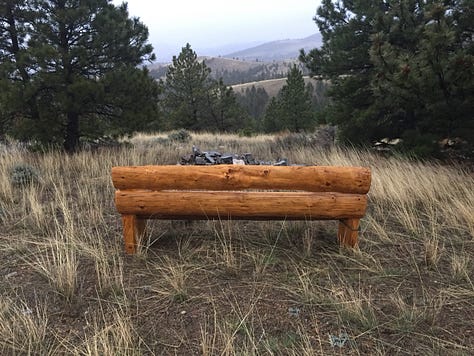
Sitting on a bench between three ponderosas, the wind blows. Calm and Cool. Budding grass still wet from morning’s dew. What a perfect way to start the morning.
In the distance, smells of wood stove, faint. Crackling kindling. Snap. Throwing sparks against glass pane.
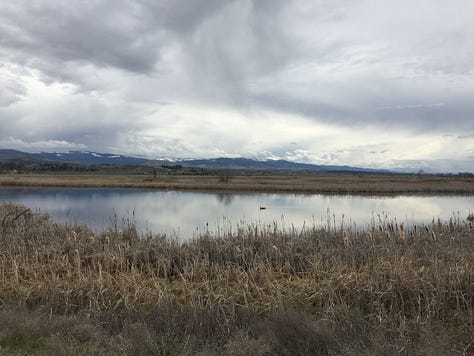
To the North, valley. And East. Rolling fields and bison. And the sound of tires over cattle guards. Distinct. Like mallets on country tone bars. Brr-rr-ap. Brr-rrr-ap.
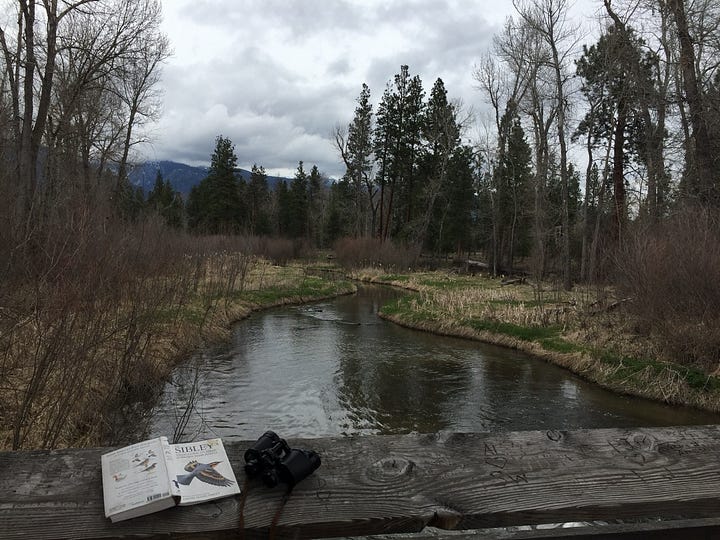
I smile. Reminded of the same sound my bike tires made over that stream crossing in Decatur, GA. Wooden and old. The one I used to pedal over religiously, in route to the bakery.
My stomach grumbles.1 Mmmm…bread. Warm and fresh from the oven. (Pan doesn’t stand a chance around me.) Especially from that bakery. Tucked away on a quiet street, against a backdrop of trees. A father-daughter duo from Mexico. Who made their bread from scratch.
I had discovered it by happy accident2 — on one of my wandering walkabouts. Enticed by the smell, entranced. Like a happier version of the Pied Piper.3
Once a month on Tuesdays they featured their triple-fermented, sourdough rye. With a yeast strain their family had been harvesting for years. And fennel seeds.
My visits became a ritual. The bakery a place of worship. Through an old deer path, I would pedal unbridled. Taking shortcuts on backroads without cars. Through Box Elders, and Maples, and Green Ash.
From my shoulder, canvas bags, flying. Like musical notes bouncing, tethered to sheets of staves.
Rolling my tire into the bikerack slot, I would flip down the kickstand. Watching it sink into soil and settle, as I threw my leg over seat to stand. Then through the screen door.
Inside, a warm glow — like sun’s rays rising from behind a mountain. “Hola. Buen dia.” Cardamom and molasses. The smell of fresh coffee, ground.
Peeling my totes from my shoulder, I wait. Bemused by the man in front of me, in limbo. Torn between tasty treats. Picking two to go and another for his coffee, here. A powdered pan dulce,4 dipped.
For me, the sourdough rye — three loaves.5 And a cocol.
Pouring a cup of hot coffee, I would linger. Enjoying my eats and visiting. One Tuesday I meet a woman who shares a story about her friend — an old robin who visits every morning. Like clockwork at her window for the last three years. Ever since her husband died.
I’m reminded of my robin — a rainbow. That first summer at the cabin after my father’s death. A double-one that broke through the misty grey of kitchen window, as I washed dishes. Somber. Forlorn that I had not yet found a place for his memorial garden. That day the sky showed me.
Brr-rr-ap. Brr-rr-ap. I’m snapped back. To rye grass and pine trees. To tires over cattle guards on Marysville Road. And that wood stove across the way. Smells of rye bread still lingering.
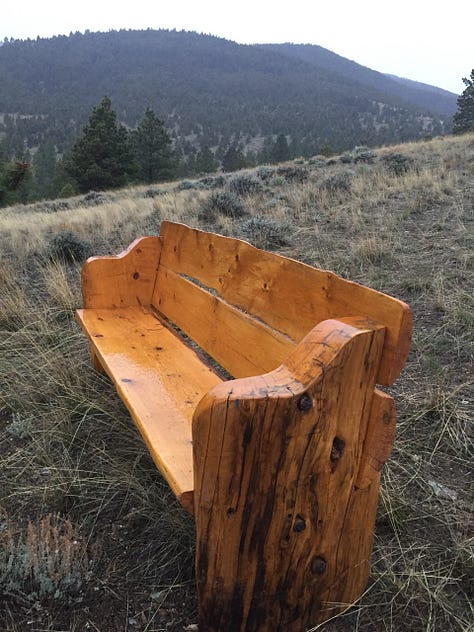
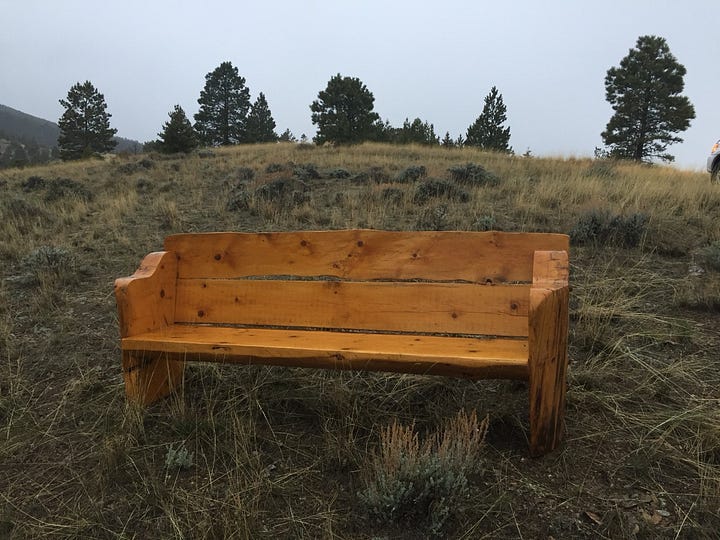
Stretching my arms out, I lean back. Draping my hands over bench’s spine. Running my fingers along the arcs of her knotted grain. I’m reminded of her story, and how she came to be here now. (Hand-crafted by a father and his son, with love).
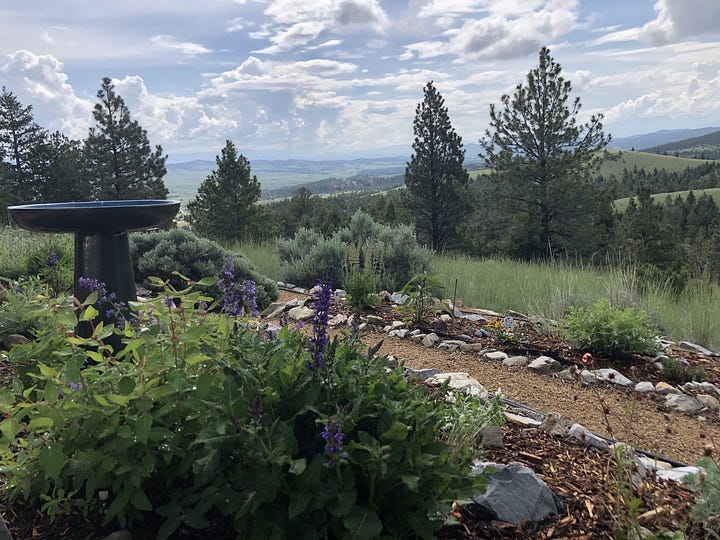
I had been searching for three years for a bench with the right character. Something funky and gnarled, with a lived in face. To place between those three ponderosas, where the double-rainbow lands every year.
By chance, I stumbled across it in the classifieds. In an ad more than 6 months old. I called, certain it would’ve been sold. But serendipitously, I was the only person who had ever called.
This morning, now, that’s where I sit. On its worn and yellowed planks. Stomach grumbling, smiling. Content. Communing and breaking bread.
Years before my father died, he made me aware of his wishes to be cremated. (No burials. No funeral. But, yes, to a party…as long as it was a good one). While I can’t be sure about the reasoning for his spurning of casket burials, I suspect we share a common ground.6
My aversion is definitely a biproduct of my constitution. I like to do things outside of the box. Literally. So the thought of being placed inside one, makes my stomach turn. Scattering seems far more appealing. Let my ashes fall where they may, to wander and take root.
Several years ago, I had a change of heart. Not a full revolution, mind you.7 But a new understanding and appreciation for burials and place. An insight that came quite unexpectedly — like a whisper from the breeze.
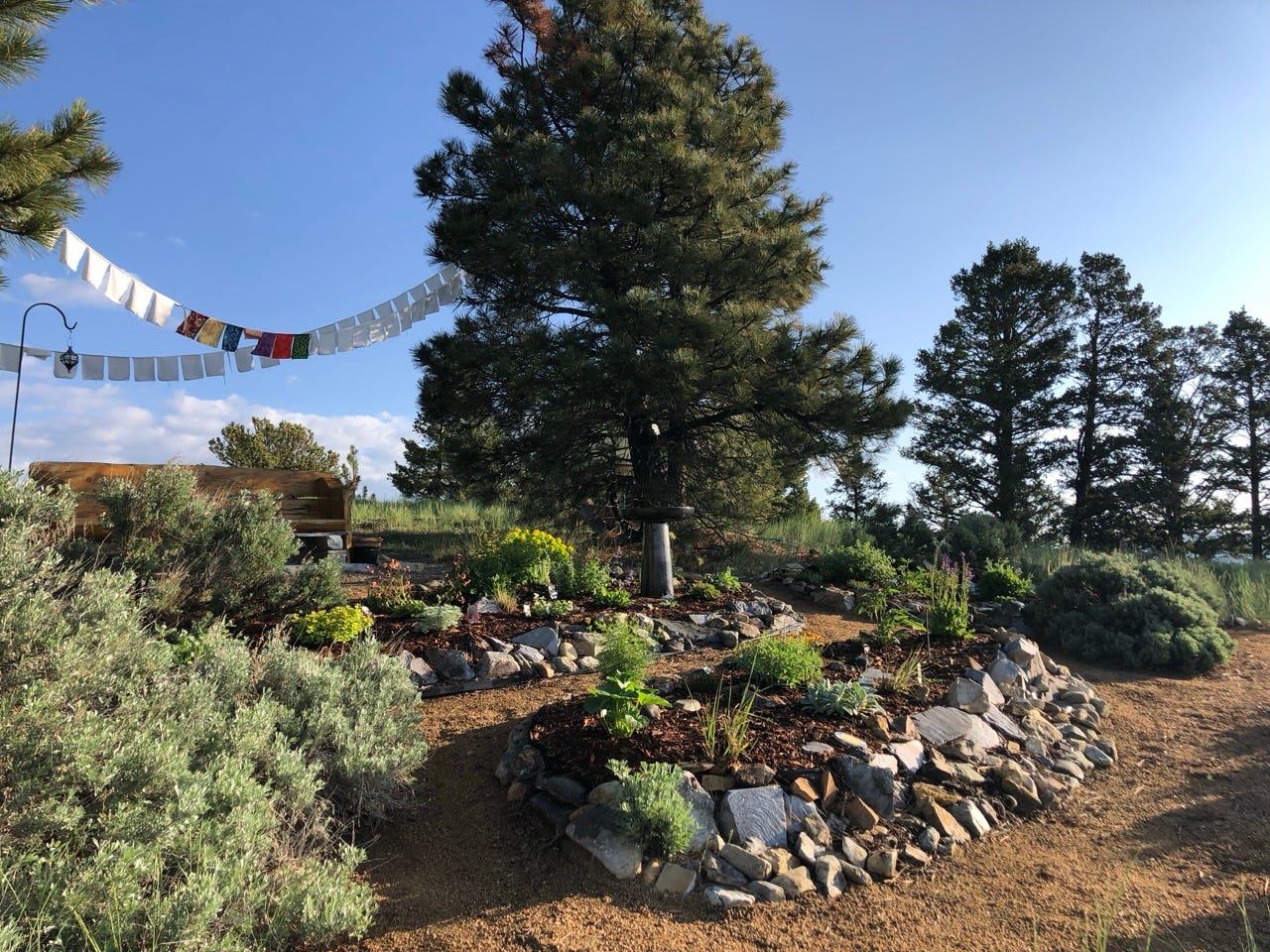
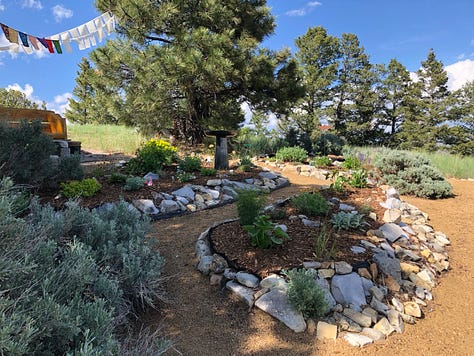
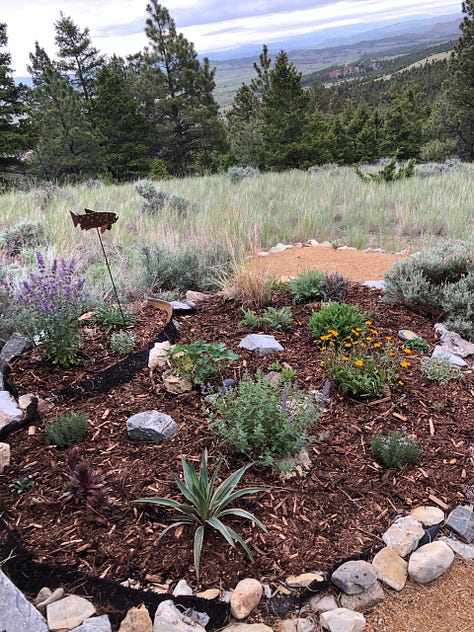
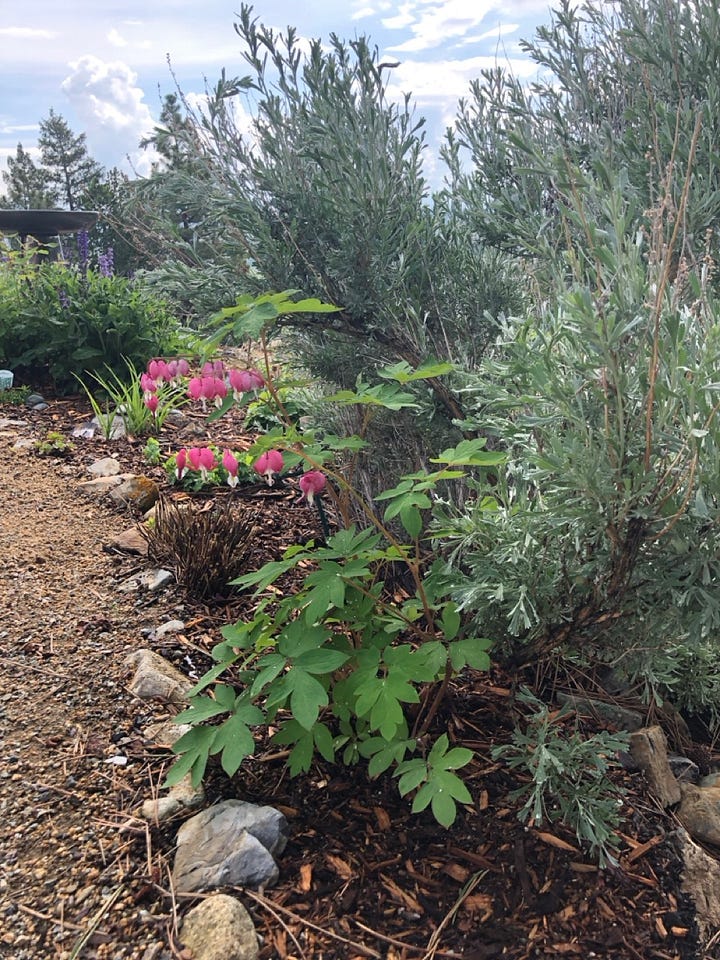
Each Spring, when it’s time to wake my dad’s garden from its slumber, I schlep my tools and paper compost bags up the hill. 900 feet from the cabin. Taking the cover off of his bench, I lay out everything I need for the day — a shovel, rake, hand broom, and some “ne’er to be worn” gloves.8 Some water and a snack, too. And bread.
First up are pine needles. I’m always amazed at how many accumulate over winter - in garden’s beds and walkways.
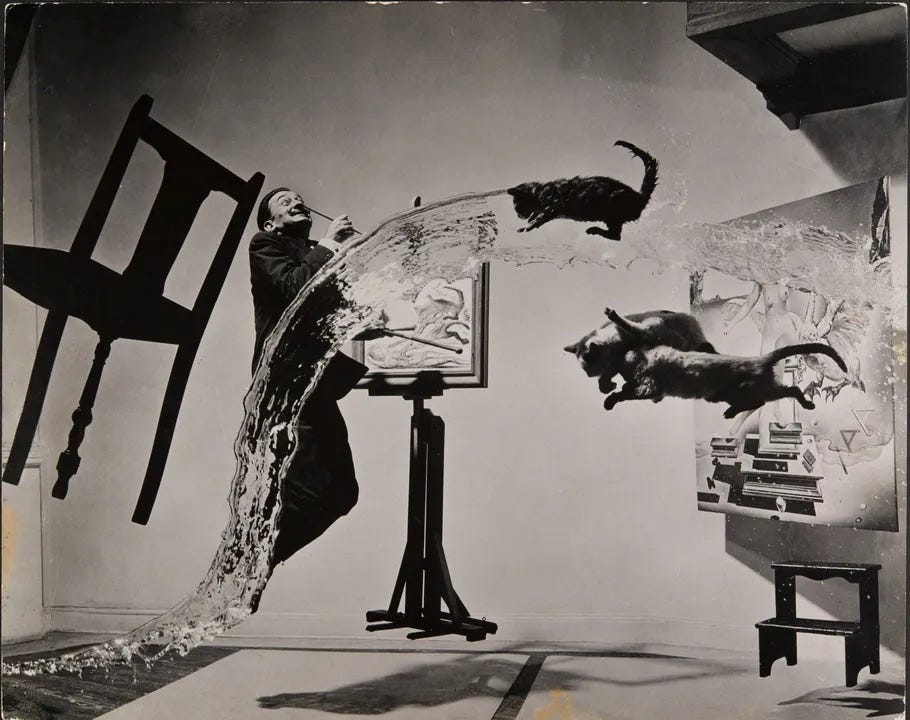
In branches of sagebrush, balancing. Like pick-up sticks, suspended. Nature’s version of Dalí Atomicus.9
I begin raking needles into piles, heavy. Damp from months of hibernation. Setting compost bags next to each mound, I begin filling them. Piles of pine’s offerings poke into my forearms. Scenting air with sweet wood, and earth, and citrus.10
Next up, garden beds. Only here, I rake with my hands. Bare. Fingerwave rows like wakes in a lake. Live and moving. Around plants in ground and roots.
And then I’m struck. Reminded of the day my poppa died and how I combed his hair, softly, after. Sweeping it back with his favorite brush. The one with a wooden handle and boar bristles, old. Tucking hair behind his ears, gently.
In his garden, I do the same — “honoring” and “attending to”. Clearing earth so it might bloom.
My Spring practice had become a ritual for me. And his garden a place of worship.
Text within this block will maintain its original spacing when published
How different is this than visiting a loved one at their grave? Text within this block will maintain its original spacing when published
Of bringing fresh cut flowers in a vase.
Text within this block will maintain its original spacing when published
Of pulling weeds from edges of a tombstone.
Text within this block will maintain its original spacing when published
Of sitting graveside to recount the day.
Just because a person is not buried, does not mean they are without place.
Text within this block will maintain its original spacing when published
For me, that was here.
Text within this block will maintain its original spacing when published
The soil an extension of him. The wildflowers a boquet. And his bench…a place to sit a while, and share.
Text within this block will maintain its original spacing when published
Communing and breaking bread.
Just the thought of bread puts my head on a swivel. Not unlike Luciano when he hears me opening a jar of his greenie treats. It’s quite remarkable, really. That cat could be in stage 3 NREM sleep and rise on a dime at the shake of a treat!
I love this phrase — “happy accident.” It comes from my friend, Dennis McCahon, who would use it when he talked about trails and streets and walkability. And the fun discoveries that meandering on crooked roads that dissolved into hillsides would bring.
“Originating as medieval folklore, the story [of the Pied Piper] inspired a Goethe verse, Der Rattenfänger; a Grimm Brothers’ legend, The Children of Hamelin; and one of Robert Browning’s best-known poems, The Pied Piper of Hamelin. And although each writer tinkered with the story, the basics remained the same: the Piper was hired by Hamelin to rid the town of its plague of rats. Trailing after the hypnotic notes of the rat-catcher’s magical flute, the rodents politely filed through the city gates to their presumed doom. They weren’t the only ones lured by his music, though. When the town refused to pay the Piper for his service, the saviour turned into a more satanic seducer and came for Hamelin’s children. Entranced by the notes of his flute, the transfixed boys and girls followed the Piper out of town and simply vanished.” While these writers may have shaped the Pied Piper legend into art, it turns out the story is likely based on an actual historical incident. Read more here: https://www.bbc.com/travel/article/20200902-the-grim-truth-behind-the-pied-piper.
This piece by Irene Arita provides a nice snapshot of the origins and history of pan dulce in Mexico: https://mysliceofmexico.ca/2021/11/13/pan-dulce-a-sweet-tradition/.
One for the freezer, one for next week…and 1/2 a loaf for the ride back!
E.g., Environmental, economic, worldviews.
Cremation and scattered, is still my preference. Or (if I’m really feeling dramatic) on a raft set afire, drifting out to sea.
My gardening gloves typically never make it in the game. Putting my bare hands in soil is just too tempting.
Dalí Atomicus is an early example of the practice Philippe Halsman used called “jumpology.” In an attempt to capture the essence or “true spirit of his subjects” he would ask them to take a jump after each photo session, explaining: “When you ask a person to jump, his attention is mostly directed toward the act of jumping and the mask falls so that the real person appears.” Read more here: https://www.artsy.net/article/artsy-editorial-story-surreal-photograph-salvador-dali-three-flying-cats.
“The fragrance of pine trees comes both from their bristly emerald crowns and from their predominantly brown trunks.” Their fragrance is calming, ephemeral, and primal…derived from a composition of essential oils that emanate from the breathing pores of its needles. See: https://www.theatlantic.com/magazine/archive/1959/09/the-fragrance-of-pines/641269/.
Comments
Nothing yet. Say the first thing.
Sign in to join the conversation.