
Hello dear ones! Just wanna give y’all a few reminders. Next Saturday, from 3-4:30pm, is our monthly DIARY CLUB meet up. The theme is CONTROL. Learn more here! Orders for next month’s CARE MAIL are now open. AND, the kickstarter for anchored: a deck for healing IS LIVE!! Kickstarter ends on August 31. Let’s do it <3

“Logic seems to demand an ‘or’ but wisdom an ‘and.’”
- Kathryn Paige Harden1
In a world of binaries, we’ve been taught that everything is either/or: good or bad, right or wrong, man or woman, sane or crazy. These binaries work to oppress us and keep us disconnected from one another by promoting an “us versus them” mentality. And they also prevent us from embodying the fullness of our being. We all contain multitudes and contradictions and complexities.
Binary thinking can show up in statements like:
You’re either with me or against me;
If they loved me then they wouldn’t have hurt me;
I can’t be angry at them and feel compassion for them at the same time;
Causing harm makes you a bad person;
I didn’t succeed at that task, and that makes me a failure;
If I have big feelings then I’m being irrational;
A normal person would do X and I did Y so that makes me abnormal.
Trauma also thinks in binaries, extremes, and black and white. Trauma doesn’t care about nuance. I’ve found myself endlessly fascinated by the ways in which, in our healing, we can swing from one end of the pendulum to another. We go from having no boundaries to rigid boundaries. We go from excusing any and all harmful behavior, because we desperately wanted to stay in connection, to disposing of those who make the slightest infraction.
I know I’m in my trauma brain when I can’t see the space of nuance in between. This happens for me a lot when I experience “splitting,” which is a symptom of living with borderline personality disorder (and, I would add, of living with trauma too, for what is BPD if not a flavor of CPTSD?). Splitting, simply defined, is moving from idealizing someone / seeing them as good to devaluing them / seeing them as bad. But it’s so much more nuanced than that.
For me, splitting looks like this: When my partner doesn’t call when they say they will, or they do something without thinking about how it will impact me, I immediately believe that they do not love me or care about me. If they loved me, they would have kept their promise to call when they said they would. Such a proclamation leaves no space for my partner to be forgetful, or caught up in the moment, or just plain human. It’s either they love me or they don’t love me. There is no both/and, no dialectic of “they love me and they lost track of time and forgot to call.”
Splitting can also be turned inwards. When I mess up, especially when I upset my partner, I go from loving who I am, to seeing myself as the worst human ever, as someone undeserving of being loved. There is no space for me to be a messy human who can make mistakes and be accountable.
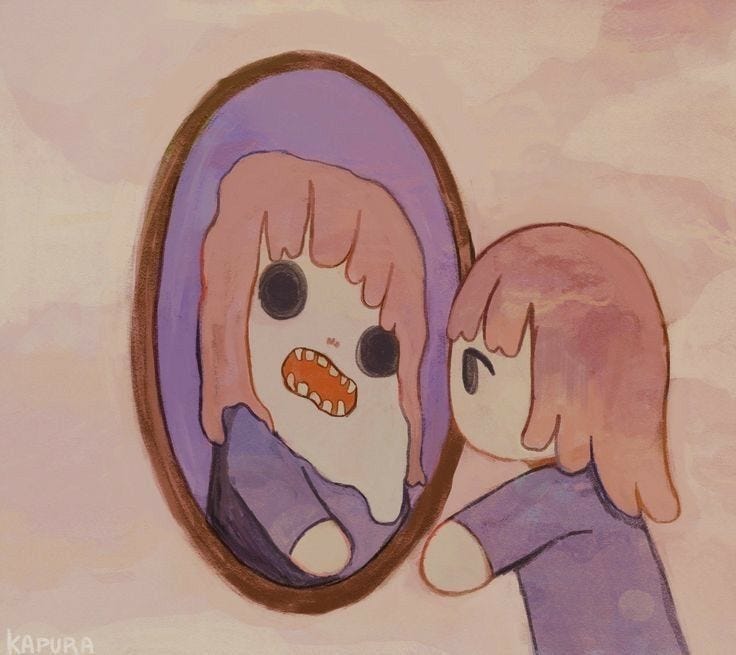
Splitting is a survival strategy, a way to escape the anxiety caused by ambiguity and uncertainty. I can see how this developed in me from a young age. After my mother’s death, my father became distant, neglectful, and emotionally abusive. I couldn’t make sense of his behavior and desperately needed to understand why I was being treated this way. Because if I could get at the “why,” then I could make the changes necessary to receive his love.
And so I turned myself into the villain. There must be something wrong with me. I must be bad, unlovable, worthless. That was the only explanation — one backed up by how often I was punished for being rebellious. But when I came home with straight A’s, I was the good kid again, and my father’s love returned.
In reality, my father was a man grieving the loss of the love of his life, now tasked with raising two children (myself age 11, and my brother 9) as he began to develop a rare, slow moving form of Lou Gehrig’s disease. He was never taught how to hold space for emotions — let alone the big emotion of grief, and was at a loss for what to do with his overly sensitive and tender-hearted child, on the brink of adolescence. He loved me, as best he could. And, his best was woefully inadequate. Both can be true.
When my adult brain is online, I know that a situation can be both/and. I want to live in a world where someone can cause upset us or even harm us and not be a bad person — this is a narrative that I struggle with inside myself. Years before I got any support for my trauma, I lashed out and hurt so many people, people who wanted to love me. I’m still learning to forgive myself. The work of transformative justice is helping, and so is dialectical behavior therapy, which teaches us that multiple truths can co-exist.
And yet I can see how we continue to rely on the binaries of good/bad, even within social justice circles that can acknowledge that binary thinking is a tenet of white supremacy culture. I continue to feel troubled by survivor politics, in which we rely on the binary of victim/survivor and abuser/perpetrator — when in reality, especially in queer community, the binary isn’t always at neat as we’d like it to be.

In defaulting to these labels, we lose all complexity, and reduce people to the worst things they’ve done. In other words, we split. Here too, I am troubled because, as Kathryn Paige Harden writes, “Equating someone’s behavior with their identity, categorizing that identity as either good or bad,” enables us to feel justified in “declaring the bad as deserving only wrath” — or punishment, exile, disposability.
I understand why we can default to binaries. They’re easy. Again and again, I return to this quote from adrienne maree brown’s book Emergent Strategy:
It’s easy to decide that a person or group is shady, evil, psychopathic […] In my mediations ‘why?’ is often the game-changing, possibility-opening question. That’s because the answers rehumanize those we feel are perpetuating against us. ‘Why?’ often leads us to grief, abuse, trauma, mental illness, difference, socialization, childhood, scarcity, loneliness. Also, ‘Why?’ makes it impossible to ignore that we must be capable of a similar transgression in similar circumstances.”
Asking why, moving from either/or to both/and, sitting in the discomfort of complexity and nuance, ambivalence and ambiguity, is no easy task. In doing so, we are asked to let go of the binaries that have brought us so much comfort because they’ve made our world so much neater — and, also, so much more violent. Both are true.
One of the signs that I’m healing is that I can recognize when I’ve slipped back into binary thinking. From that place of recognition, I can ask myself: does this way of seeing the world, of seeing others, align with my values? The answer, time and time again, is no.
I do not believe that we are inherently all good or inherently all bad. I believe that we’re human beings who’ve learned to survive in the face of trauma, and sometimes those modes of survival have led us to harm ourselves, and sometimes they have led us to harm others. Our trauma is never an excuse. But it does help us get at the “why” — and the why can open the door for transformation.
❤︎ Wanna support me / this writing or just say thanks without becoming a paid subscriber? You can send a tip via Venmo, PayPal, or through my website. Every $ truly does help sustain me.
❤︎ Looking for ways to connect offline? Join my mail club: CARE MAIL is a monthly snail mail offering to support your healing. September’s theme is AUTHENTICITY and you’ll receive a 5x7 print, a sticker, handwritten letter + postcard picture frame to color in and use for a self-portrait!
❤︎ Want some support with your writing? Check out Partial Accounts: A Guide for Writers Living With Trauma.
❤︎ My book Touch Me, I’m Sick: A Memoir in Essays is out now and you can read an excerpt in LitHub here and another in TIME Magazine.
Original Sin: The Genetics of Wrongdoing, the Problem of Blame, and the Future of Forgiveness
Comments
Nothing yet. Say the first thing.
Sign in to join the conversation.