
Relatability is a popular topic on social media nowadays. People want to feel connected to you, preferably through knowing your struggles and intimate details of your hard seasons.
And for some, that comes naturally to them — they share without skipping a beat and invite people into the most private parts of their lives.
But for others — for the ambitious, high achievers — that sounds like a threat. And it is treated as such.
I didn’t have the language to articulate this before my life unravelled (for the better) last year. I didn’t realize this was a thing, nor did I know that many others like me have been silently enduring this kind of treatment our whole lives but haven’t been able to name it.
So that’s what I’m going to do in today’s article — I’m going to talk about why high-achieving women don’t like to share our business, be vulnerable, and likely don’t want to be or care about being ‘relatable’ if it means doing any of the aforementioned.
In the last two years, I felt like I was being “hounded” by a few people in my life for not being extremely open and casually offering intimate details about my life. What caused this was my openness on my podcast about experiences I’ve had and the lessons I learned from them in an attempt to help my audience become the best version of themselves — as I’ve been doing in my personal life.
It led to many former friends taking issue with the fact that they did not know all of the details that I shared on my podcast — most of which happened either before meeting them or in my childhood. I wasn’t necessarily open just to be open; I only shared limited stories with limited details as relevant to the lesson I was sharing.
I felt “hounded,” not because there’s a problem with my friends inquiring about why I didn’t tell them otherwise irrelevant and primitive information first or in general, but rather because that’s the feeling their inquiry elicited.
So why was that the dominant feeling that came up when people wanted me to be vulnerable?
Because my vulnerability was never welcomed, supported, or handled with care like other people’s.
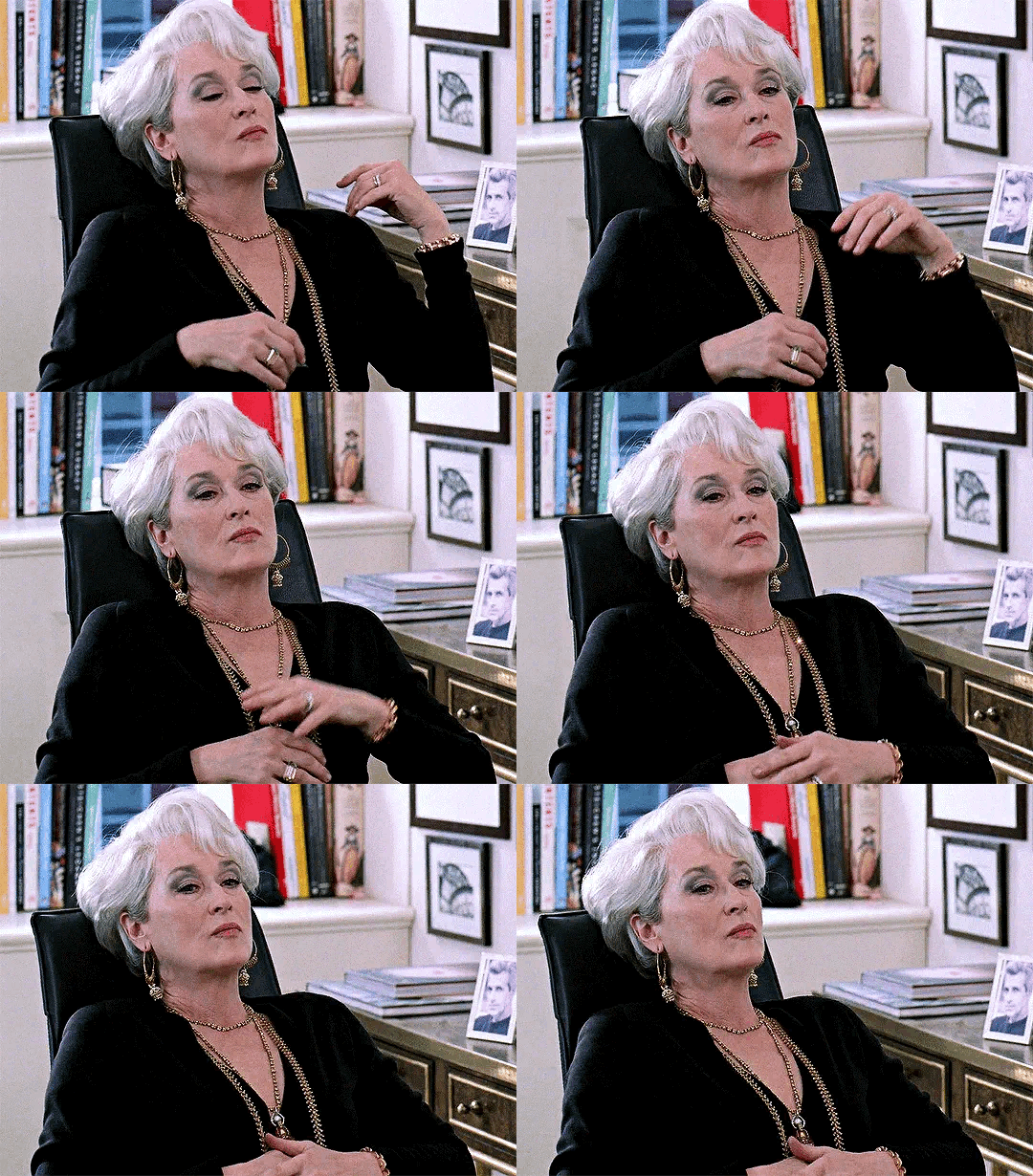
In a recent post, I shared how I discovered that I was placed on a pedestal by the people in my life, who imposed high expectations on me to perform to a certain standard because I always seemed to have my life together. The thing about that pedestal is that once you’re placed on it, your humanity is stripped immediately.
You don’t get the same kind of love, compassion, and support as other people at their low moments. You’re no longer a human being who made a mistake or is going through a hard time like everyone else — you’re little miss perfect who’s not so perfect after all.
You’re failing to be who they expected you to be.
How can you, of all people, be messing up?
You’re a machine that’s not functioning properly instead of a human being who needs support. Your access to support is revoked and replaced with complicit behavior that requires you to carry your burdens alone because you’re the strong, capable, and accomplished one.
People will tell a high achiever to open up more and share their low moments, but then turn around and ask, "Why did you, of all people, make that mistake?"
You should have known better.
I expected better from you.
Wow, you’re going through that?
The grace that’s freely given to other people is not given to you when you’re a high achiever.
It’s kind of like when people are talking to AI and it doesn’t produce what they expect, so they get frustrated and critique it like it should just perform better. High achievers get treated the same way sometimes — there’s less room to be human, less grace for mistakes, less space to struggle.
Because you’re capable and “things usually work out for you,” there’s this unspoken expectation that you should just handle things better. No mistakes, no breakdowns, no emotions. Just figure it out and do better.
Beyond being criticized and judged at our lowest moments, we’re often disregarded by the very people who once insisted on knowing us that intimately. The same people who pried into our vulnerability and asked for personal details about our lives rarely offer support when it’s needed.
They got the information — got their fix — and then dipped. All while we’re left feeling depleted and like someone just took something from us.
You wanted me to open up so you could feel better about having access to me and knowing that I’m human too. And then you leave me feeling exposed in my vulnerability because you got what you wanted — the information, the honesty, my flaws.
And after that, you go back to your life, assuming I’ll be fine. Remaining complicit in watching me struggle and be hyper-independent because you don’t think I need any support. After all, I always figure it out, right?
I’ve watched people take initiative and go out of their way to help others during the same minor inconveniences and major life events I was going through, but then turn around and lecture me because I didn’t give a 10-page dissertation asking for help — explaining what I needed, why I needed it, and why I deserved it — because it didn’t occur to them that I might not be able to handle it on my own.
After you deal with that for most of your life, you learn to keep your vulnerability to yourself. You learn to keep your low moments between you and God and quietly figure it out. You learn to handle things on your own to avoid adding the pain of being rejected and unsupported in a moment when you really need people.
High-achieving women don’t restrict access to their vulnerability for some egotistical reason that people assume. We do it to protect ourselves. Because while the average person can simply voice a struggle and have people line up at their door to help, we have to mentally prepare ourselves to be criticized, judged, disregarded, and/or encouraged to figure it out on our own after sucking up our pride and asking for help (which was our LAST resort btw).
Before the help comes (IFFF it does), the criticism comes first. The reluctance to help us because we shouldn’t have been in that position in the first place. Like our humanity is an inconvenience.
So yeah, I don’t want to be relatable if that’s what it takes for you to relate to me. Because even if we may relate to a hard situation, you’ll never relate to me in knowing what it feels like to have to protect yourself when you just need help.
You’ll never relate to me because help has always been easily available to you, while I’VE always been the one offering the help or EXPECTED to help.
So do you really want to relate to me, or do you just want to know my business?
Do you want me to be vulnerable because you intend to offer practical help and support, or do you want to just know that life isn’t going well for me, too?
Do you want to be included in the midst of my hard seasons because you plan to play an active role in helping me recover, or do you want to gather intel and ammunition to use against me?
Do you want to know the intimate and unsavory details of my journey because you plan on being someone I can trust and learn to open up to, or are you just eager for an opening to betray me?
The high-achievers will understand. And if you don’t, consider it a blessing that you think I’m overreacting. That’s yet another reason why we can’t relate.
If any of this hit a nerve... if you even felt rage reading this... I need you to know that it doesn’t have to be this way. Being the strong one — self-sufficient and hyper-independent, bracing yourself for criticism before help even arrives, hiding your low moments while pretending to be okay to avoid backlash... none of that has to keep being your story.
Because here’s the part I didn’t realize until my own life started unraveling...
The problem wasn’t just that other people expected me to perform. Somewhere along the way, I started expecting it from myself too.
I accepted hyper-independence as a personality trait instead of seeing it for what it was — a survival strategy. I wore “the strong one” label like a badge of honor while secretly resenting that nobody ever seemed to show up for me the way I showed up for them.
I convinced myself that needing support made me a burden and that vulnerability was something to be managed carefully because experience had taught me that it often came with consequences.
And because I expected myself to perform too, I kept choosing relationships, environments, and dynamics that reinforced it.
Until one day I got tired.
Tired of pretending I could do everything on my own.
Tired of acting like I preferred isolation when really I had just learned not to expect support.
Tired of confusing control with safety and strength with worthiness.
The nature of my relationships changed when I decided I wasn’t available for that version of life anymore.
I started building relationships with people who didn’t require me to earn approval through competence. People who didn’t disappear when I needed support. People who didn’t judge my vulnerability or take advantage of it. People who allowed me to exist as a person instead of a blueprint for success.
I didn’t think it was possible, sis, but it is. And it can be your reality too.
Because maybe this isn't actually about vulnerability at all.
Maybe vulnerability is just where the cracks started to show.
Maybe this is about what happens when you’ve spent your whole life learning that your value comes from what you provide, what you achieve, how useful you are to other people, and how well you perform.
Maybe this is about the subtle ways high-achieving women learn to trade their humanity for approval and call it strength.
And maybe the work isn’t becoming more vulnerable.
Maybe the work is learning that you were never supposed to earn your humanity in the first place.
If you’re tired of being the strong, capable one who is expected to have it together even when you’re struggling, this is one of the patterns we work through inside Become You 2.0. Because when you’ve spent years being praised for being dependable, competent, and easy to rely on, needing help can start to feel like you’ve failed at being the person everyone knows you to be. Inside BY2, you’ll unpack the conditioning underneath that pattern so you can acknowledge your needs, ask for support, and let people show up for you without feeling like you have to earn the right to be cared for.
Comments
Nothing yet. Say the first thing.
Sign in to join the conversation.