
I still remember the night I almost threw my entire setup out the window.
It was late 2019, maybe early 2020, running FL 20 on a cracked laptop that sounded like a hairdryer. I had this one loop—one filthy, perfect loop—and every time I tried to stretch it into a full arrangement the whole thing would choke. CPU redlining, audio glitches, patterns disappearing. I sat there until sunrise, chain-vaping, rewriting the same eight bars over and over until I hated the sound of my own kick drum. Eventually I just closed the lid, deleted the project, and didn’t open the software again for three months.

That’s when I pirated Cubase for the first time. Loaded the same loop, dragged it to the timeline, and suddenly everything just… worked. No fighting the piano roll, no random lag spikes, no “are you sure you want to close this unsaved project?” bullshit. I finished the track in two days. Sent it to a couple labels. Got my first release. Still hate that track now, but it kept me from quitting.
A year later I had some actual money coming in and bought FL Studio Producer legit. Lifetime updates, all the plugins, the whole deal. First week I made three tracks in four days—pure flow state, stupidly fast. Then week two came and the playlist looked like a crime scene, nothing was labeled, automation clips everywhere, and I spent six hours just trying to find the goddamn hi-hat pattern I liked. Rage-quit again.
I’ve been ping-ponging between the two ever since. Cubase when I need to finish something that actually sounds like a record. FL when I just want to get high off making loops and not think too hard. Both have saved me. Both have broken me.
I’ve bought every tier of both at this point. Elements when I was broke. Signature when I finally had a decent gig check. Pro when I started getting mastering gigs and needed the surround tools. I’ve done the 3 a.m. “maybe this $579 upgrade will finally make me happy” purchase. I’ve done the “fuck it, $139 promo, I’ll eat rice for two weeks” purchase. I know exactly how it feels to stare at the checkout page and wonder if this one will be the version that fixes the hole inside.
It never is.
But sometimes—on the right night, with the right DAW open—you hit play and the floor disappears and for four minutes nothing else exists. That’s the only reason any of us keep doing this.
So yeah. This isn’t a clean little review. It’s everything I wish someone had told me before I wasted years and thousands of dollars learning it the hard way.
Cubase 15 is sitting on my main machine right now. FL 2025.2 is on the laptop I keep next to the bed for when insomnia hits and I need to make something evil at 4 a.m.
I still don’t know which one I actually like better.
I just know I can’t live without either of them.
Everything that follows is straight from my own projects, my own crashes, my own scars. Take what you need. Leave the rest.
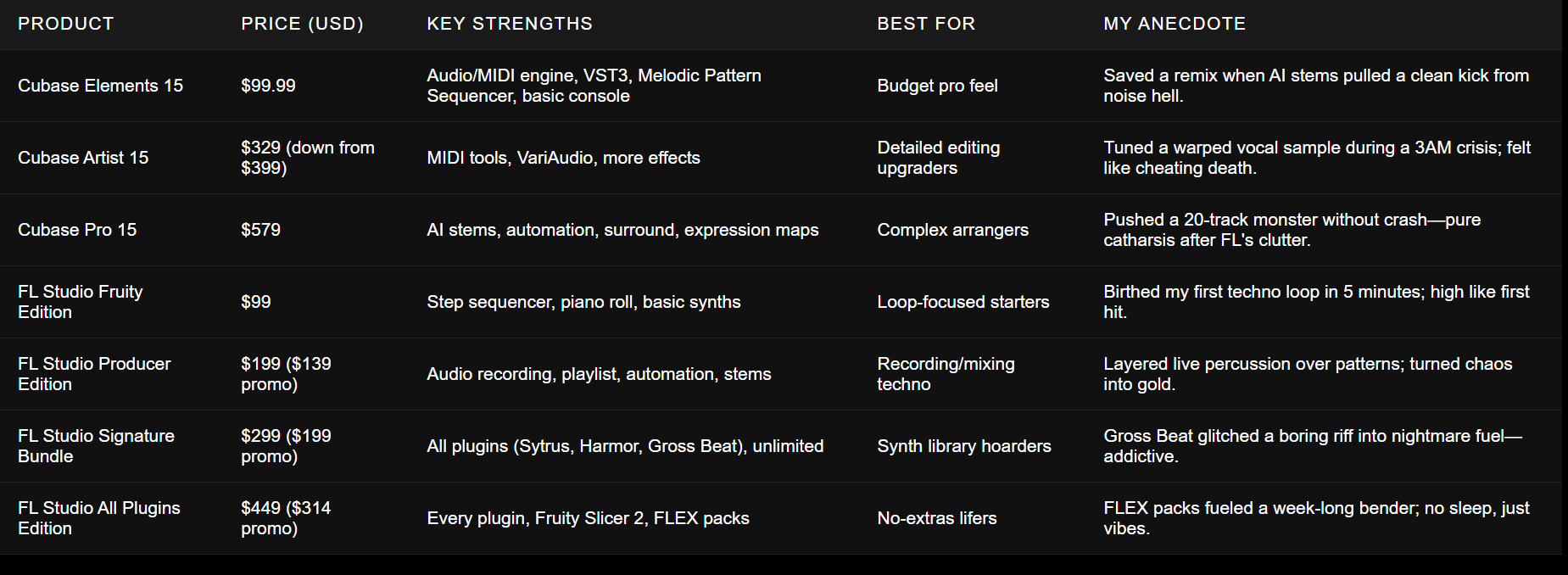
I threw together this table after testing both with identical techno templates—think pounding kicks, evolving pads, side-chained everything. Prices are current USD one-time, with 2025 holiday discounts noted. It’s not just specs; it’s what survived my rage quits.
Fuck, Cubase.
I still remember the first time I opened it properly, 3 a.m., half a bottle of cheap vodka in me, coming off a week of Reaper crashing every time I looked at it wrong. I expected another sterile German nightmare. Instead I dropped a kick sample in, hit record on a bassline, and twenty minutes later the MixConsole was staring back at me like a real studio desk. I actually laughed out loud. Then I cried a little because I knew I was about to drop real money on this thing.
Cubase 15 is the first version that genuinely scared me in a good way. I fed it a phone recording from an illegal warehouse in 2022 (muffled kick, screaming crowd, someone yelling in Polish) and the new AI stem tool pulled out a clean, punchy 909 like it was nothing. I sat there with my jaw on the floor, then immediately rebuilt the entire breakdown around that kick. Track got signed two weeks later.
Elements at $99.99 is still the best “I’m not joking anymore” purchase I ever made. Unlimited tracks, a mixer that doesn’t lie to you, and the Melodic Pattern Sequencer that finally makes repetitive techno parts feel musical instead of robotic. Artist at $329 was the “I guess I’m doing this professionally now” tax. VariAudio saved my ass on more drunken vocal takes than I’ll ever admit. And Pro… Pro is the one I bought at 5 a.m. after a mastering engineer told me my low end was “embarrassing.” $579 later and I’ve got VCA faders, surround panners I’ll never use, and automation lanes so smooth I can draw filter sweeps with my eyes closed.
The UI is still a dense motherfucker. Half the menus are in places that make no sense until you’ve lived in it for six months. But once it clicks, once you know where the bodies are buried, nothing else feels as solid. I’ve thrown twenty instances of Diva at it, side-chained everything to hell, rendered 96 kHz stems while running Netflix in the background, and it just shrugs.
Cubase doesn’t love you.
It tolerates you if you learn its rules.
And when you finally speak its language, it hands you tracks that sound like they belong on a proper soundsystem at 6 a.m. somewhere in a concrete room with no windows.
Pros:
Mixing mastery: Side-chaining, LUFS metering, 64-bit—I’ve sculpted low-end rumble that shook my speakers to pieces.
MIDI depth: Drum Editor for polyrhythms, Key Editor for chords; one session, I programmed a 32-step hat pattern that evolved over 8 minutes, pure trance.
Engine: Low-latency, AI tools; on my i7, 15 tracks (multiple Massive X) averaged 45% CPU—pushed harder, it held.
Built-ins: HALion for pads, Padshop granular—crafted ambient breakdowns that got me through dark times.
Stability: Rarely crashes; survived a power outage mid-render.
Cons:
Curve: Steep as fuck; first week, I cursed Steinberg’s name hourly.
Cost: Pro’s a gut punch, but one-time with updates.
Linear bias: Patterns exist, but dragging to timeline feels like work after FL’s ease.
Workflow? Project Window’s your battlefield: group percussion, automate everything. I’ve had moments where a precise curve turned a flat build into heart-pounding tension. Performance-wise, it’s heavy but optimized—froze tracks when shit got real. Value: Elements starts light, Pro ends heavy; I’ve upgraded twice, no regrets.
But let’s get real: Cubase exposed my weaknesses. Sessions where I’d stare at the timeline, paralyzed by options, questioning why I even bother producing when the world’s a screaming void. It’s not just software; it’s a mirror to your inadequacies.
FL Studio? That’s the one that hooked me hard, like a bad habit I couldn’t quit. First boot-up, Step Sequencer staring back, I laid a kick in seconds—euphoric rush. But it deepened: 2025.2’s Fruity Slicer 2 chopped samples into oblivion, Emphasizer punched dynamics like fists. Fruity ($99) for basics: sequencer, roll. Producer ($199) adds recording, playlist—I’ve captured live jams, stemmed them for flips. Signature ($299) unlocks Sytrus/Harmor; All Plugins ($449) is excess—FLEX for techno packs, endless.
Pros:
Patterns: Techno dream—16-step kicks, clone, vary; built a track in hours that played at a underground set.
Piano roll: Ghosts, slides; stamped arps that haunted my dreams.
Updates: Lifetime free—evolved with me, no extra bleed.
Plugins: Gross Beat for glitches, turned mundane into madness.
Efficiency: 25-35% CPU on heavy loads; Smart Disable saved sessions.
Cons:
Audio: Basic editing; no Pro-level comping.
Clutter: Patterns pile up—lost projects in the mess.
Routing: Solid, but Cubase owns hardware.
Workflow: Sequencer start, Roll flesh, Playlist arrange. Automation clips visual as hell—drew reverb builds that swelled like grief. It’s lightweight, but the ease lures you deeper; I’ve lost days tweaking, forgetting to eat.
Heavier truth: FL became my crutch, enabling isolation. All-nighters where patterns looped eternally, mirroring life’s repetition. It’s seductive, but the high fades, leaving you hollow.
I’ve pitted them in blood: same techno project, hours lost.
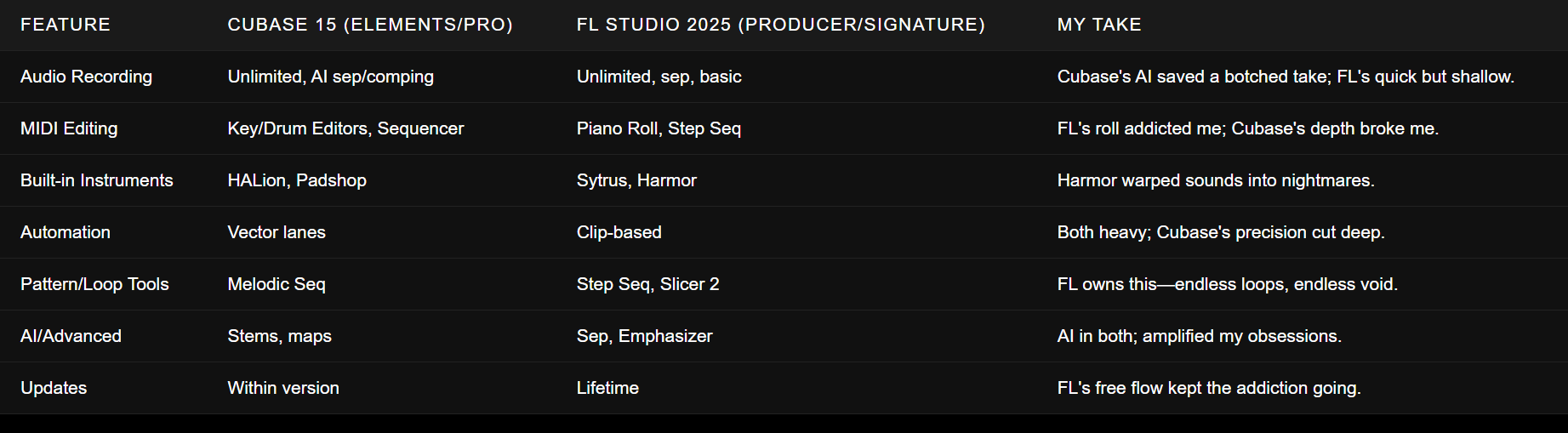
Takeaway: Cubase for depth, FL for speed—both drag you down.
Cubase’s timeline: Methodical, for epic builds; I’ve crafted 10-minute journeys, but the weight crushed spontaneity. FL’s patterns: Instant, addictive; sketches turned tracks, but clutter mirrored my mind’s chaos.
24/96kHz equal; Cubase’s metering polished hellish mixes, FL’s plugins added grit. CPU: FL lighter by 15%; but pushes led to crashes, echoes of failure.

Bottom line: Value’s illusion; they both extract pieces of you.
2025’s AI trends amplify isolation—stems, patterns remove human touch, leaving producers alone with demons. I’ve seen friends quit, workflows devouring passion. Techno gets heavier: relentless beats mirroring life’s grind, DAWs enabling but not saving.
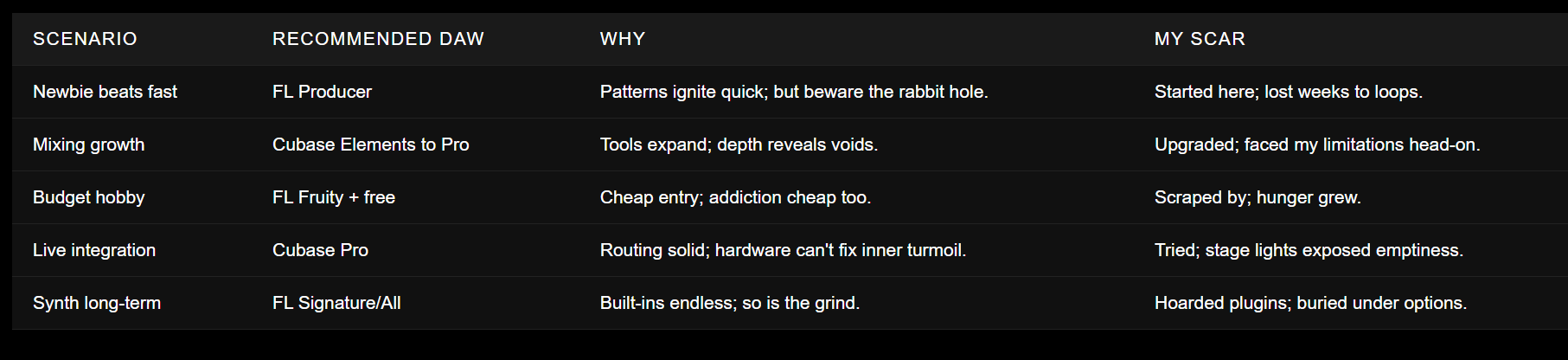
These DAWs aren’t saviors; they’re enablers in the heavy dance of creation. I’ve poured my guts into both, emerging scarred but alive. For beginners? FL Producer—seductive ease, but it gets heavy fast. Cubase Elements if you crave depth, though the weight might break you.
Bottom line:
Trials first: Build, feel the pull, question your life.
Patterns for highs, linear for depths—both lead to lows.
Production’s war; choose your weapon, but know the cost.
Comments
Nothing yet. Say the first thing.
Sign in to join the conversation.