
Now for today’s post…
The first color wheel emerging in Western culture is derived from the spectrum. Compare the sequential progression of the hues in this photo of a spectrum with those in the outer bands of the color wheel diagram below it.
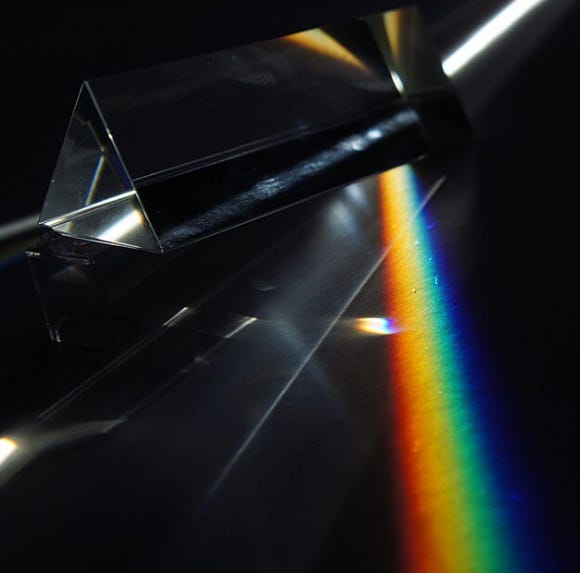
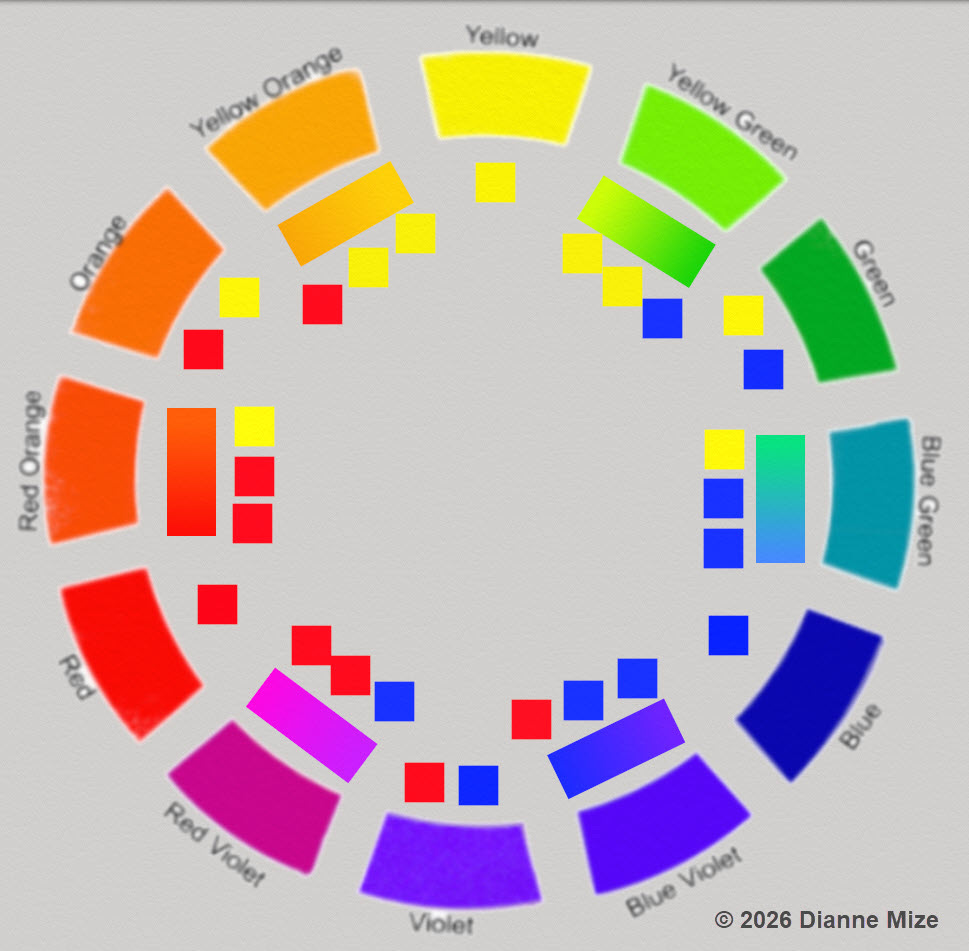
On the wheel, we can identify 12 hues in the outermost circle, each merging into the next both clockwise and counter-clockwise. Traditionally, we have collectively named those hues yellow, yellow-orange, orange, red-orange, red, red-violet, violet, blue-violet, blue, blue-green, green, and yellow-green, and we have distinguished three categories among them—primaries ( 1 hue), secondaries (1+1 hues), and tertiaries (1+2 hues)
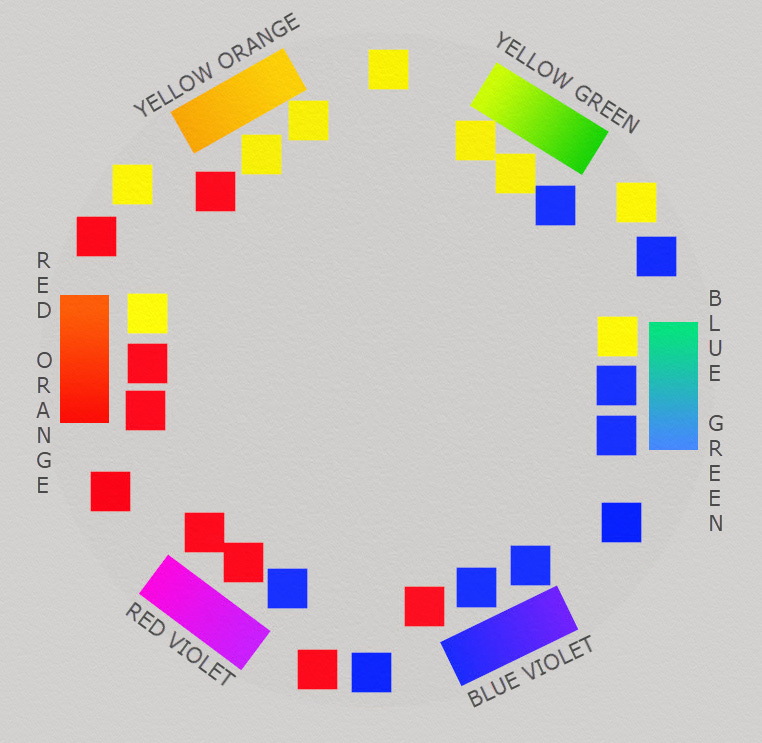
Among those 12, we can find six—the ones with double names— that are transitions between each primary and secondary hues. They are the tertiaries. On one side of each tertiary is a primary, and on the other is a secondary. Illustrated in the diagram above with the little squares of hues, we see every secondary is made of two primaries. We see the same progression in the visible spectrum. Imagine the spectrum curved into a cylinder.
The miracle of this simple arrangement is that it can guide us to find any color we see when we use it, based on what happens to these hues when we mix them across the wheel and around it.
Play with that idea for a few days.
______________________
Comments
Nothing yet. Say the first thing.
Sign in to join the conversation.