
Coaching people on pitching and writing articles is one of my specialties, since I was a magazine editor for decades who hired freelance writers. For paid subscribers, I sometimes write a newsletter where I interview editors who hire freelance writers, and I ask them to include their email for pitching.
I tried something new last month, but I’m not sure it worked. I posted an interview with Editor-in-Chief Amy Sherman, who edits four online sites: Alcohol Professor, Cheese Professor, Wine Professor and Chocolate Professor. At the end of the interview, she offered to talk with five paid subscribers about writing for her sites.
I thought paid readers would be excited about this opportunity. But to my surprise, only two writers reached out to her. Why? I can only speculate:
Pay. Perhaps my more accomplished paid readers aren’t interested.
SEO. The interview focused on understanding the impact of Search Engine Optimization on writing for websites. Maybe some people don’t want to learn that.
Topic. Maybe not everyone has something to say about alcohol, cheese, olive oil or chocolate.
Yet many readers say they want to publish a cookbook but lack the professional credentials that editors want. A way in is to write articles published by respected publications. To do that, writers must know how to pitch a story effectively. It’s part of the work that you, as a professional writer, have to do to make your name known, even when knowing that pitches have a 97-98% failure rate.
So today, I’m going to review the art of successful pitching and offer tips on where writers go wrong.
Research the publication. See if they use freelance writers (you can tell by the variety of bylines). Research topics that interest you to see if they’ve already been covered. Produce a story idea that’s similar in structure and feel to what they publish. If they don’t publish personal essays, don’t pitch one. If they like lots of lists, suggest a list. If they like a story with a short into and three recipes, follow that structure.
Write a 3-paragraph pitch letter. Start your first paragraph the way you’d start the article. Research what kind of article openings the publication likes.
In paragraph two, explain your article. How many words is it? What is the structure? Are there sidebars? Should you interview people and quote them? Do you need to supply quality photos? Find the answers to these questions by reading past published articles — because obviously, the editors liked them. Paragraph two is where most pitches fail, because the writer hasn’t imagined the story in enough detail to sell it.
Conclude with a paragraph about your qualifications to write the story. If possible, include up to three links to similar stories you have written, even if they’re just on your blog.
Follow up. If you haven’t heard back in two weeks, forward your email to the editor and ask if they have had a chance to read it. Editors are busy, and often an email gets lost. It’s not personal.
I’ve written more about pitching and freelance writing, and so have others who are successful writers. See these posts on best practices on my blog. Or read the chapter on freelance writing in my book, Will Write for Food.
If you have questions about pitching editors on stories, please ask them in the comments. I will answer! I’m here to help. If you’re a paid subscriber, attend my Office Hours (listed below) and ask me about pitching in real time by text.
And, if you are a paid subscriber who read Amy’s offer and thought…nah, not for me, I’d love to know why. Tell me in the comments.
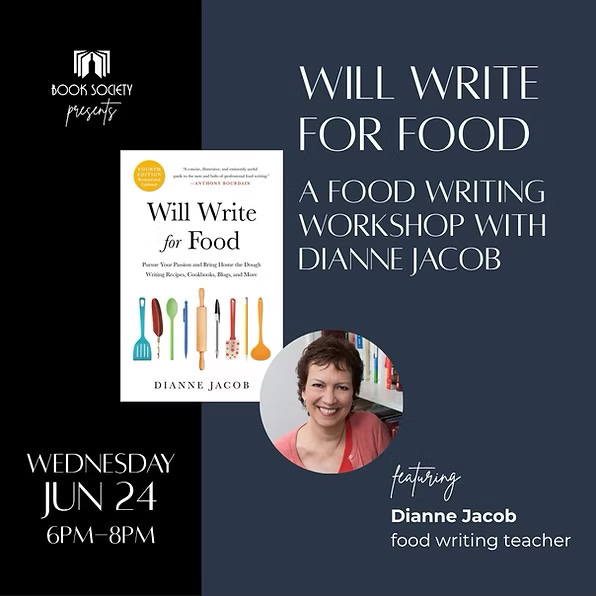
At Book Society, 2945 College Ave., Berkeley, CA, 6-8 p.m. $60-$75
Bay Area folks, I’m doing a two-hour class on how to create a stronger, more distinctive voice and what the landscape of food writing looks like today. I‘ll include writing exercises to get the creative juices flowing. The price includes a copy of my book, Will Write for Food. Sign up here.
Think of this as an hour-long group consult. You can text me about anything you want related to writing a blog, newsletter, cookbook, memoir, article and more. Join me on Substack on June 3, at 4 p.m. PDT/ 7 p.m. EDT. Paid subscribers get an email notification that the chat has begun.
Here are the 2026 James Beard Media Award nominees in advance of the 2026 James Beard Awards. The list includes nominees in Book, Broadcast Media, and journalism categories. Winners will be announced at the Art Institute of Chicago on June 13.
Summer 2026 Cookbook Preview. Jenna Helwig tried to list every one.
The Lasting Influence of Edna Lewis’s ‘Taste of Country Cooking.’ (Gift link.) Fifty years since its publication, the Virginia chef and writer’s pioneering cookbook continues to hold sway, says The New York Times.
She’s Sold 2.5 Million Cookbooks, But You May Not Know Her Name. An interview with Greta Podleski, a Canadian author whose self-published cookbooks have sold 2.5 million copies! Clarkson Potter published her latest book. Read more in this fascinating interview by Jenna Helwig.
The Impersonation List. Says the article: “An increasingly frequent fraudulent tactic…is impersonation: of reputable literary agents, major publishers, renowned movie production companies, even bookstores and organizations like the American Booksellers Association.”
I Bought a Vintage Dress With Recipes Printed on It. Then I Tried Them. What happened when the author, a registered dietician, tested the recipes printed on a dress.
The Gentle Art of Nagging. A potential author’s guide to book blurbs and why they still very much matter.
A Master Class on Becoming a Cookbook Author with Ifrah F. Ahmed. Everything Cookbooks lists what matters most to build authority and community.
Deadline is June 30 for a Flavors of the South fellowship writing residency from The Writers’ Colony at Dairy Hollow in Arkansas. Founder Crescent Dragonwagon attended my writing retreat in Sicily last year.
What Is In-House Marketing? Sally Ekus from Not So Secret Agent speaks with a publishing house marketer about what they typically do for authors during a book launch.
Should You Just Get Your Book Out There? A good discussion about self-publishing by agent Kate McKean. She also wrote 20 Things I Learned From 20 Years as an Agent.
The cliché of the nonna in the kitchen…really needs to die. Katie Parla addresses the fetishization of the self-sacrificing Italian grandmother.
Ali Slagle defines how a recipe developer is different from a food influencer or content creator, which leads to lots of disagreement from well-known food writers in the comments.
Cook Lost Her Fingers and Legs After Hospitalization. Back in the Kitchen, She Says ‘I Still Have a Place in This World.’ In People magazine, about Yewande Komolafe, a recipe developer for The New York Times.
We Need to Talk About: What is a Recipe? The Oxford Food Symposium offers a free Kitchen Table podcast on Wednesday, June 3, from Britain. Registration is free to £15.
If you want to write a cookbook or food-based non-fiction, get published or find better freelance assignments, I can help move you forward. A one-hour consult costs $250. Email me at dj@diannej.com.
I like to brag about the food writing accomplishments of clients and students. Send me yours at dj@diannej.com.
Agent Sally Ekus reveals how she sold Monti Carlo’s newest cookbook in Behind The Book Deal: Spanglish. (I coached Monti on her cookbook proposal.)
Julie Dove’s essay, A Pie Conversation Across Time, appeared in Baking Nation Issue 12, along with her Graham Cracker Pie Crust recipe. (I coached her on freelance writing.)
Student Matthew Kline wrote a self-published memoir-cookbook about five decades of cooking, titled Kline & Dine. It’s a huge hardcover, full-color book!
Everything Cookbooks interviewed Domenica Marchetti about her latest book and her career in Domenica Marchetti on Writing her 9th Italian Cookbook. (I coached her on her first book proposal.)
Yvette Marquez-Sharpnack will appear on 100 Cooks, a new television show from the Food Network. It premieres Sunday, June 7 at 9 p.m. EDT. Also streaming on Max and Discovery+. (I coached her on a cookbook proposal.)
Paula Shoyer’s agent Sally Ekus got her an excellent book deal from Union Square publishing. The tentative title is Maven: Mastering Jewish Cooking with 250 Recipes, out in 2028. (I coached Paula on the book proposal.)
Martin Sorge, winner of The Great American Baking Show, has written his first cookbook, Great Bakes: Modern Classic Recipes from the Midwest, available for preorder. (I coached him on the book proposal.)
Student Kate Ryan’s book, Blood, Guts & Black Pudding-Ireland’s Dying Art of Blood as Food, releases on September 10.

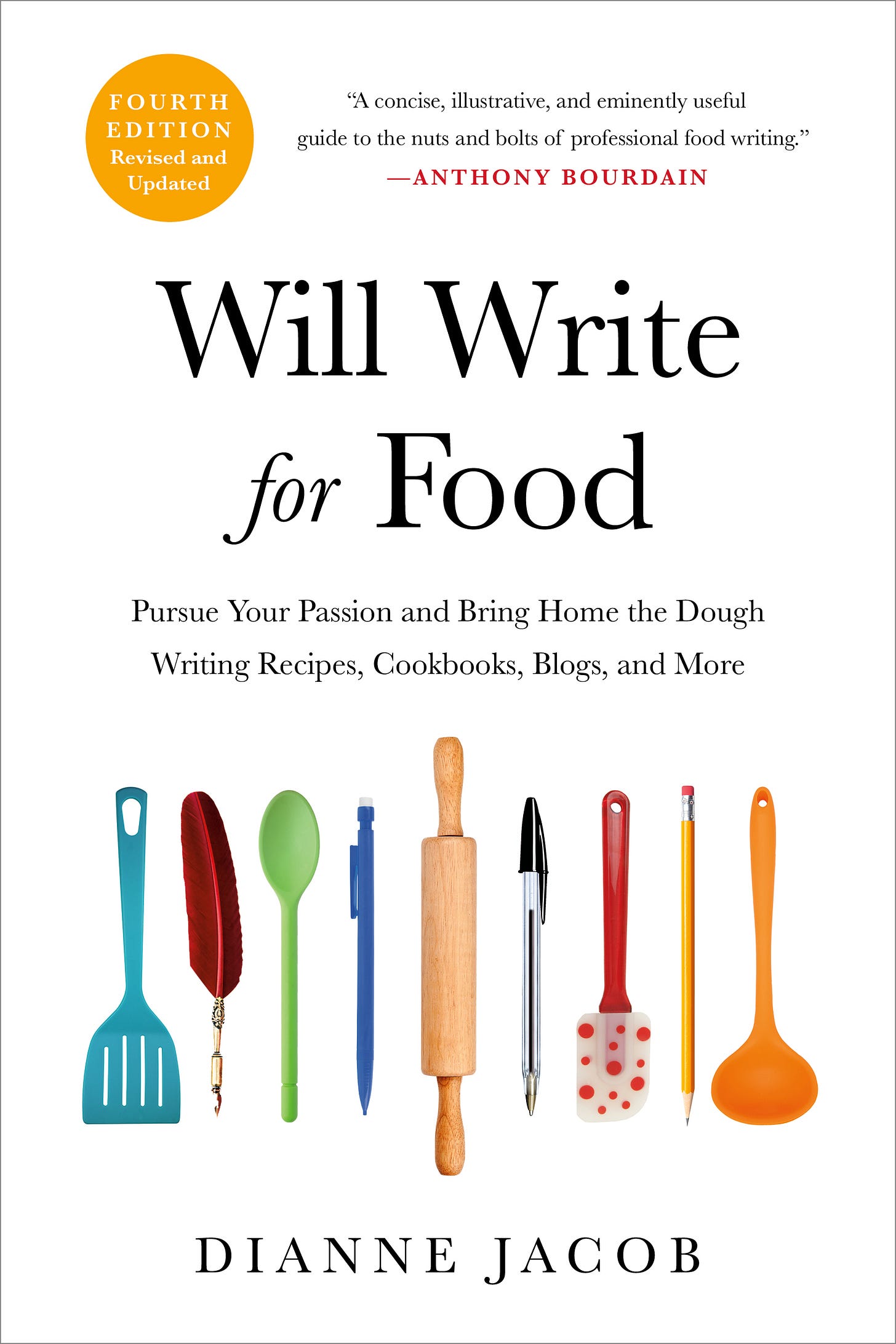
The newest edition of my multiple award-winning book, Will Write for Food: 2021: Pursue Your Passion and Bring Home the Dough Writing Recipes, Cookbooks, Blogs, and More.
Disclosures: I am an affiliate of Food Blogger Pro, Amazon and Bookshop.org. Right now I’m mad at Bookshop.org, because they keep my book on backorder, so no one can order it.
Like this newsletter? Please forward it to a few people or share it on social media. I would really appreciate that. New subscribers can sign up here. Thank you.
If you enjoyed this post, please click on the little ❤️ below ⬇️.
Dianne Jacob
Editor, Writer and Coach
Email: dj@diannej.com
Website: http://diannej.com
X: https://twitter.com/diannej
Facebook: https://www.facebook.com/foodwriting
Instagram: https://www.instagram.com/diannemjacob
No posts
Comments
Nothing yet. Say the first thing.
Sign in to join the conversation.