
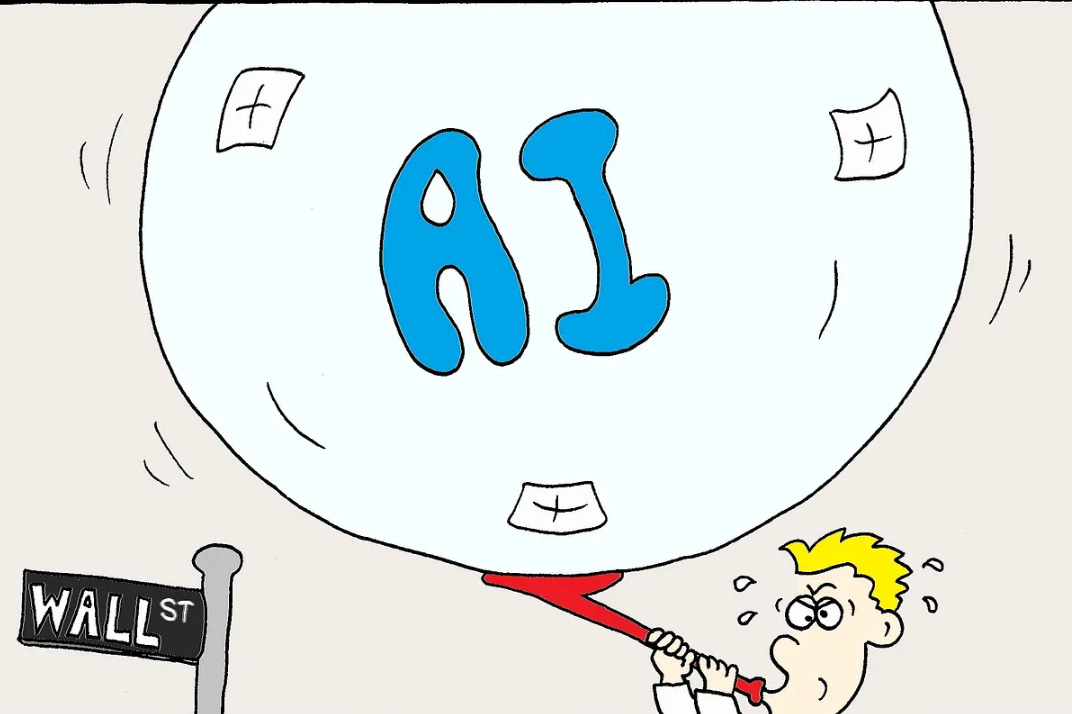
AI-related companies have added a staggering $27 trillion, or 36%, to the value of all US stocks since November 2022, transforming some into global titans. America’s AI tech giants lead the world, make the country an economic superpower, and build infrastructure that is changing existence, just as the pioneering robber barons did with building railroads and electrifying the world. Naturally, America’s investors have benefitted, continue to feed them capital, and markets soar. Still, concerns have arisen that a financial bubble may be forming and that too much is in the hands of too few. Fortunately, this AI-driven market is not like the speculative dot-com collapse that happened in 2000, according to experts. Unlike then, today’s tech companies are not startups but are experienced and generate more cash flows than most nation-states. Even “Dr. Doom” economist Nouriel Roubini, who predicted the dot-com bust, said recently when asked, “AI bubble? Nonsense.”
The dot-com crash in 2000 involved early-stage outfits without revenues, track records, profits, or successful business plans, said Roubini. By contrast, today’s AI favorites are highly profitable companies which can finance a massive structural change that, in the long run, will dramatically expand the economy. The negative, he added, is that AI and robotics will cause long-term, permanent technological unemployment over the next 20 to 25 years, making a universal basic income or “some form of socialism” inevitable. But, on the positive side, he believes tech will be robust enough to offset the negative impacts of displacement or of Donald Trump’s geopolitical moves.
The stock market guru Warren Buffett of Berkshire Hathaway never bought a tech stock until 2016. He acquired Apple that year, and added more in 2025. Then, in 2026, his successor Greg Abel announced Berkshire was acquiring a great deal of Alphabet (formerly Google) stock, but also emphasized, “We’re not going to do AI for the sake of AI”.
Stock market guru Jim Cramer of CNBC agrees there is no “AI bubble” but cautioned investors to be wary of promoters who apply the label inaccurately to their stocks in order to attract buyers. A company that uses AI services is not an “AI company,” but some are exploiting the connection. There is also plenty of confusion around when it comes to tech investing because of Wall Street nicknames and acronyms. So here’s a basic guide:
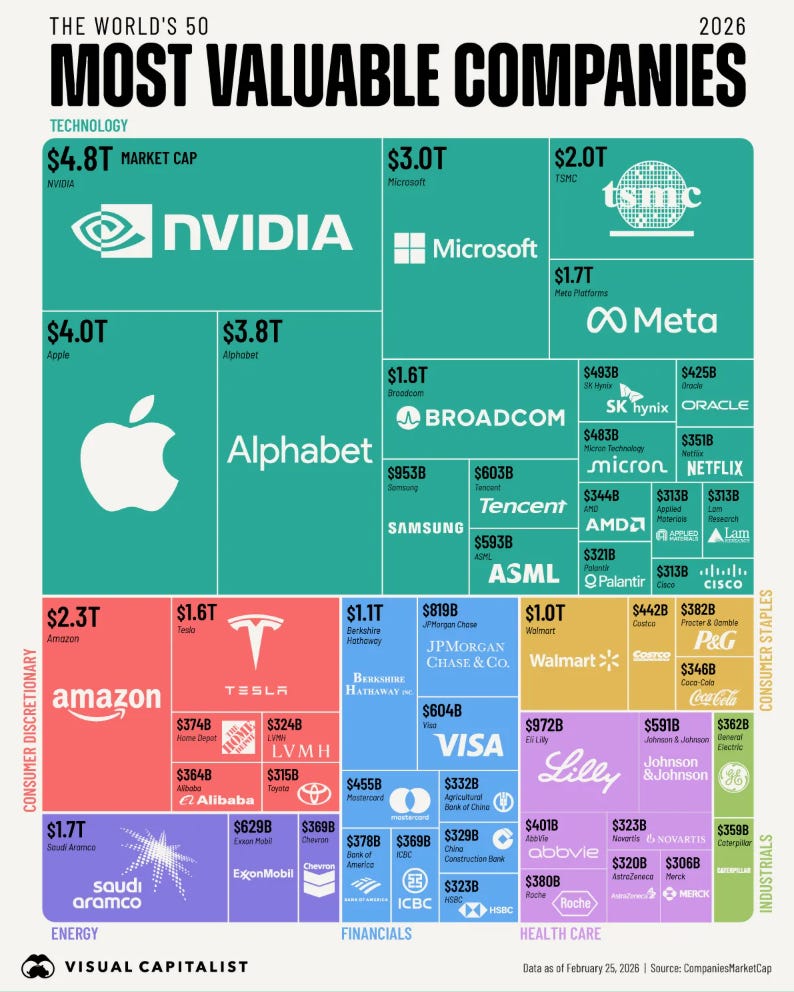
1. The “Magnificent Seven” include Alphabet, Amazon, Apple, Tesla, Meta Platforms, Microsoft, and NVIDIA and are the world’s seven largest and most influential publicly listed tech companies.
2. The five “FAANG” stocks overlap and collectively have the highest market value in tech: Meta, Amazon, Apple, Netflix, and Alphabet. (The Companies in the FAANG acronym are F for Facebook (rebranded Meta); A for Amazon; A for Apple; N for Netflix; and G for Google (rebranded as Alphabet.)
3. “Hyperscalers” are massive corporations that are the “utilities” providing cloud computing and data management services to organizations that require infrastructure for large-scale data processing and storage. The largest two, Amazon and Microsoft, each invest more in AI per year than is being spent by Washington to wage the Iran War. The five hyperscalers are Amazon Web Services, Google Cloud, Microsoft Azure, IBM Cloud, and Alibaba Cloud.
Tech giants, based on market value, dominate the world’s 50 most valuable companies:
The biggest risk in the future is greed and human nature. Previous bubbles have afflicted industries, commodities, companies, or economies and brought many of them down completely. In 1637, the Dutch Tulipmania for rare flowers crashed suddenly and was followed by others throughout history. Most recently, it was the 2000 Dot-com Bubble and then in 2006 the US housing bubble, driven by easy credit that led to unsustainable prices. That triggered a banking crisis and recession. Now the AI casino roars along, a worrisome development to some because it is becoming too narrow, too volatile, and too dependent on a small group of companies.
Tech prices climb, based on expected future profits, but is this sustainable? There are also concerns that concentration and overleveraging by companies and investors alike artificially propel higher prices. Another issue is “circularity”. Reuters calculated that nearly half of a $280-billion increase in second-quarter S&P 500 earnings came from unrealized gains recorded by just two companies — Alphabet and Amazon — because of their investments in SpaceX and Anthropic, companies that remain unprofitable. Others worry about interdependent deals between major hardware suppliers and AI model developers, and that this creates double-counting and localized bubbles.
What’s also new this time is that President Donald Trump promotes the AI Casino by publicly promoting stocks and approving favorable policies and statements designed to move markets. He recently suggested that the US government should take equity stakes in leading AI companies, which pushed their stocks higher. His administration has also backed off regulations that would prevent US tech giants from competing successfully against China, or that would hurt their stock values. Last month, he disclosed that his family invested heavily in AI companies such as Apple, Nvidia, Oracle, Alphabet, and Meta Platforms and has encouraged the public to buy these tech stocks on his Truth Social platform.
But the most sensible attitude toward investing in new technology is Berkshire Hathaway’s: You cannot assume that a miraculous technology will automatically create a profitable, publicly listed company with a solid future and good management. Even so, there are plenty of analysts and investment advisors who still promise to forecast and pick “the best tech stocks to buy”.
Instead, and just for fun, I asked AI itself about investing in AI. First, I asked ChatGPT (the non-profit chatbot owned by unlisted giant OpenAI) whether I should put all my savings into the “Magnificent Seven”. Then I asked Grok (another chatbot owned by Elon Musk’s unlisted xAI) whether to put my savings into the “hyperscalers”.
Here were their replies:
ChatGPT
“No—putting all your savings into the Magnificent Seven would be dangerously concentrated. These are exceptionally profitable companies, but they share several risks: high valuations, enormous AI spending, regulatory pressure and sensitivity to technology-sector sentiment. In June and July 2026, the group fell more than 8% while many other stocks rose—showing why yesterday’s leaders need not remain tomorrow’s.”
GROK
“No. Putting all your money into the hyperscalers (primarily Amazon/AWS, Microsoft/Azure, Google/Alphabet/GCP, and sometimes Nvidia or others tightly linked to the AI/cloud stack) is a high-concentration bet that violates basic risk management.”
Finally, I asked ChatGPT if the current tech market was a bubble, and it replied: “I would call it a selective bubble inside an overvalued market, not proof that every technology stock is irrationally priced. A correction of 20-30% in expensive AI shares would be entirely plausible.”
No posts
Comments
Nothing yet. Say the first thing.
Sign in to join the conversation.