
Zero. That’s how many customer conversations it takes to decide what to build next.
Not six. Not a pattern across a rapid design sprint. Just transcripts, retrieved by an AI system, matched to a keyword. That’s the basis for the next sprint.
On a coaching call, a design leader at a B2B data company described this to me. He’s smart and deeply skilled. Someone who bridges design, research, and technology in ways most can’t. He wasn’t burned out. He was something harder to fix. He cared about the customer and his team. He could see exactly what was happening, and the organization was moving in the opposite direction.
Energized by AI tools and under pressure to ship, product managers bypassed research entirely. Pull transcripts. Surface problems. Build. No designer in the loop. No broader pattern sought.
“We are literally doing the same thing, in a different skin.”
That sentence has stayed with me because it’s not just his company.
We’re reverting back to feature teams. Demanding a product manager rapidly build a feature based on a few random customer transcripts.
The only change is that they’re using AI and have the ability to create more undesired features.
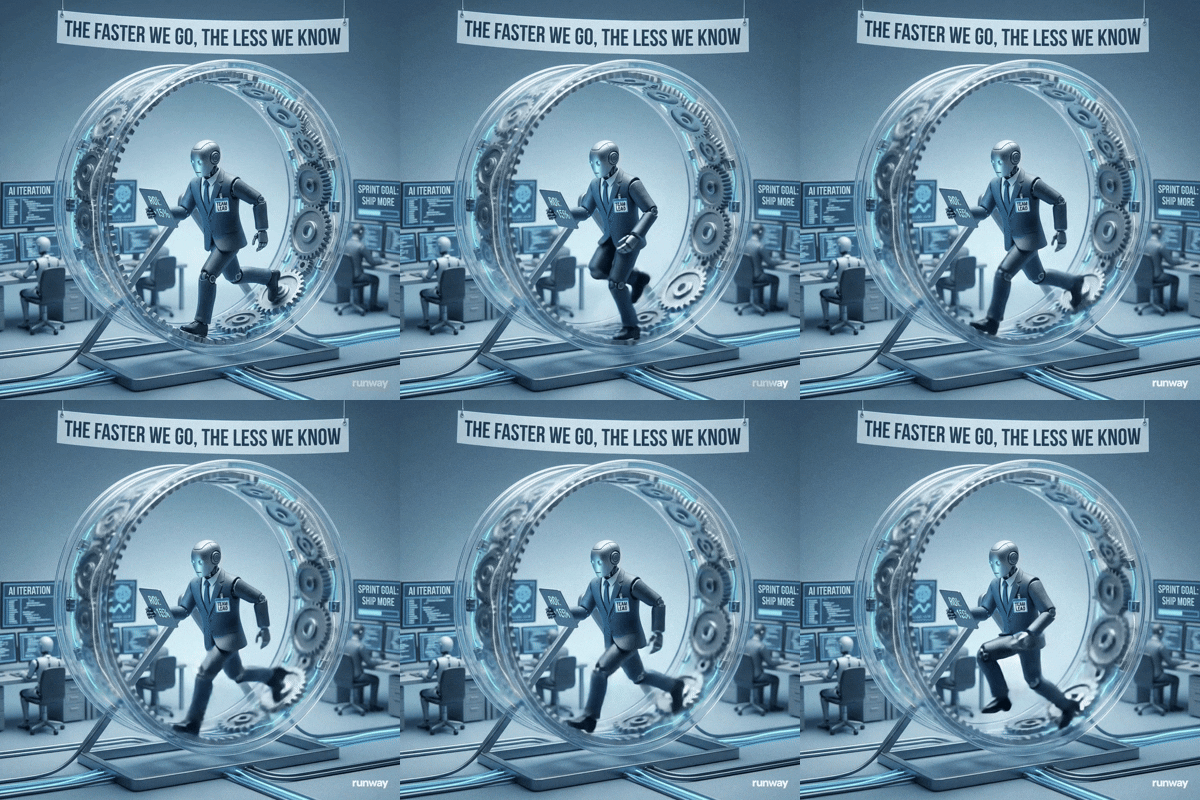
Post-layoff teams are eager to prove ROI. AI tools make iteration feel free. Sprint culture has been validated for a decade. Together, they’ve created a robotic hamster wheel: go faster, ask fewer questions, measure success by shipping instead of outcomes.
The result? More sprints. Faster cycles. Shorter discovery windows. The to-do list doesn’t get shorter. It just moves faster.
And the inputs feeding that speed? Thin. A handful of call transcripts captures frustrations in a moment. A customer who couldn’t do one specific thing. Useful signal, yes. But signal ≠ pattern.
When you take a sliver of signal, hand it to an AI, and generate a direction without a designer, synthesis, or exploring new possibilities, you’re not building for your customer. You’re building for the noise in random calls.
When every team at every company runs the same tools on the same thin inputs through the same two-week cycles, you end up with products that look alike.
That’s the math of short-term thinking.
The differentiation disappears.
The insight that set you apart was in the research that never happened. The ideas that mattered are dismissed due to taking more than a sprint.
My client had a backlog item his team had built real momentum around. The CPO was supportive. Engineers were excited. Internal users said their work got harder without it. Everything indicated this was worth pursuing.
Then they de-scoped it. It was not a bad idea, but two-week sprint culture makes anything needing more runway feel like overkill.
Cory Ondrejka, co-creator of Second Life, recently wrote that the traditional backlog is dead. He envisions “Outcome Engineering,” where cross-functional teams use AI to test and prove ideas in real time.
That’s a beautiful vision. It assumes curiosity is valued, designers stay informed, and teams have the space to explore.
None of that is true from my client calls or the tech news. We’re moving further from Ondrejka’s vision, not closer.
The backlog is being replaced with DELIVER <feature> NOW.
Backlogs should be seen as records of curiosity. Home to ideas that aren’t ready yet, problems not fully understood, and questions we’re saving until the right moment. They’re where differentiation lives.
Kill the backlog, and you don’t free your team. You give them amnesia. Teams stop generating ideas, not because they’ve run out of curiosity, but because curiosity stops feeling valued. The design leader I mentioned? He’s still there, seeing the gaps. But he’s learned it’s safer to explore them in his side hustle.
Now here’s the number that surprised me: the design leader shared that 90% of an engineering colleague’s work isn’t used?!?!
Yet the same organization constantly talks about engineers (and everyone) needing to do more. That’s the issue with short-term thinking.
Fast sprints on the wrong things cost more in time, morale, and customer trust than one slightly slower initiative that addresses the right problem.
The speed is an illusion. The waste is real.
They experience your product. If they can’t get from step A to C due to a missing critical step, they give up and try a competitor. The short-term win becomes a long-term problem.
If you’re feeling this pressure, here are some items to defend:
One customer conversation per sprint.
One assumption/hypothesis tested before building.
One curiosity log
Why? Because today’s impossible ideas often become the breakthroughs six months from now, if you haven’t forgotten them. If your team hasn’t learned to stop thinking about “what if.”
Speed without direction isn’t progress. It’s just movement.
The question isn’t whether AI can help us build faster. It can.
We should wonder if we’re building the right things and creating space to discover what “right” means for the humans we’re building for.
The design leader I mentioned at the start still cares and sees what’s missing. But he’s learned long-term thinking won’t win him supporters. That’s not efficiency. That’s wasted talent.
Don’t let that be your team.
The backlog isn’t dead. It’s waiting for someone to advocate for it.
I hope that’s you.
What’s on your curiosity log right now that deserves more attention? What idea have you set aside because it didn’t fit a sprint?

P.S. If you found this helpful, share it with a product friend. If you’re not subscribed, join us! Here are a few other ways to connect.
Reach out over LinkedIn: Diana Stepner
Curious about coaching? Let’s talk.
Explore my product leadership collection on Wizly.
Comments
Nothing yet. Say the first thing.
Sign in to join the conversation.