
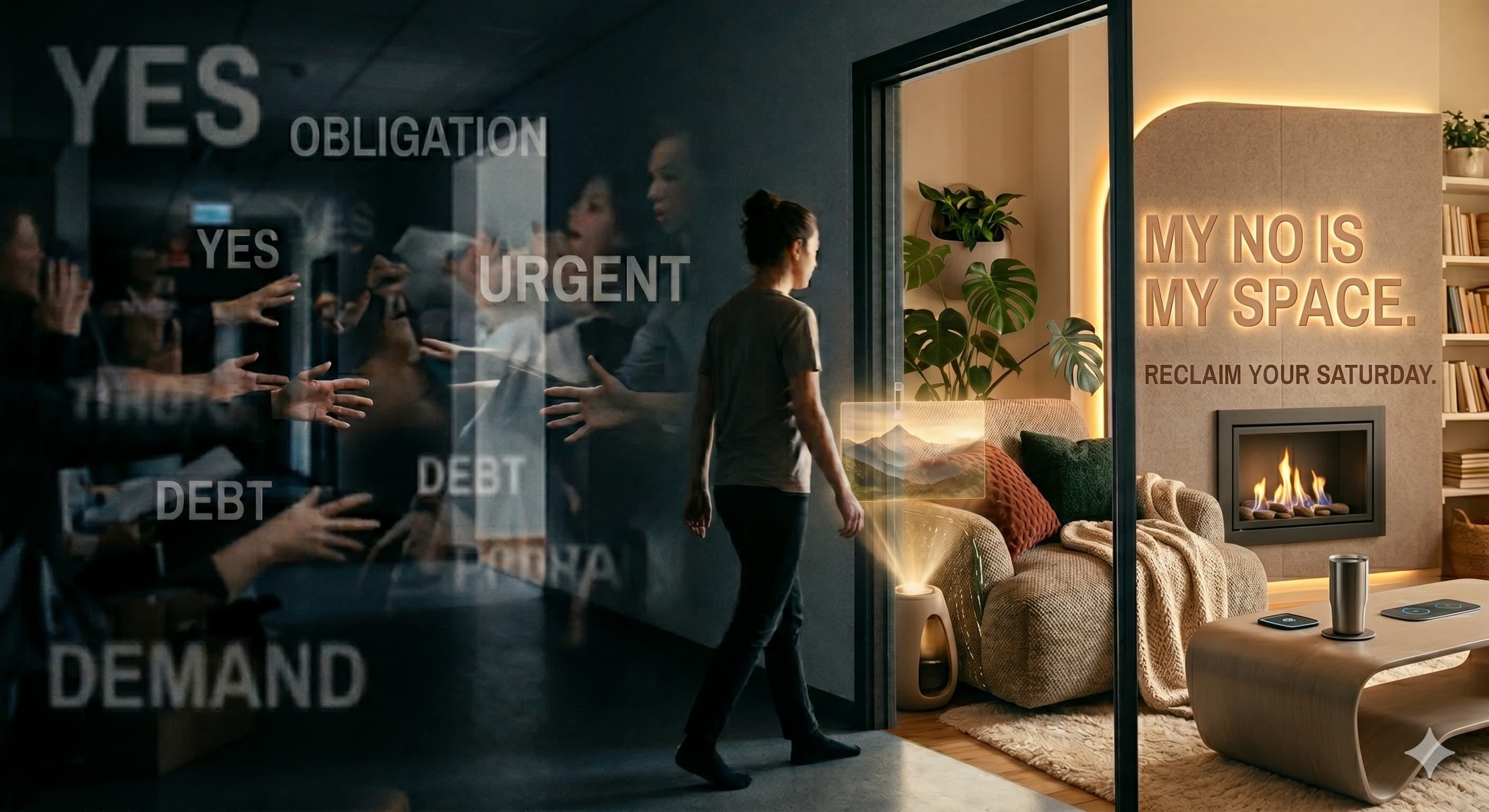
If you’ve spent your morning googling “how to say no without feeling guilty,” we have a diagnostic problem. You aren’t looking for politeness tips. You’re looking for a permission slip that no one is ever going to give you.
Your problem isn’t a character flaw. It’s a design flaw in the very architecture of your life.
Imagine it’s Saturday morning. You wake up with a blank calendar. For the first time all week, you can actually hear yourself breathe. Coffee. Silence.
How long does that silence usually last?
By noon, who do you think has shown up? A friend who “needs to vent.” A relative who “knows they can count on you for a small favor.” A colleague who knows it’s the weekend but “just has one quick question.” Maybe it’s just the weight of an unanswered request sitting in your inbox, staring you down.
And you answer. To all of them. Or most of them. Because you’re a “good person.” Because it was “only a small thing.” Because it “didn’t take that long.”
By 7:00 PM, your free Saturday is gone. You look back and can’t find a single trace of what you wanted to do. You might not even remember what that was anymore. Your day filled itself up, the way a vacuum always finds dust.
This isn’t a willpower issue. It’s the physics of relationships: if your space is always available, someone else will occupy it. Not out of malice, but out of necessity. And because you left the door wide open.
Why do you say “yes” when everything inside you is screaming “no”?
Guilt isn’t a moral compass; it’s a control mechanism. You feel it because, on a level you’ve never quite articulated, you’ve started equating availability with value. You’ve convinced yourself that if you aren’t useful, you aren’t enough.
This doesn’t mean you aren’t a good person. You are. But kindness without structure is just a system without filters. You’ve become an exploitable resource that forgot to write its own owner’s manual.
At the office or at home, with friends or family, you are “present” for everyone. And somewhere in the middle of all that availability, you disappeared. If your space is always occupied by other people’s priorities, there is no room left for the architecture of your own vision.
Know someone you could benefit from this? Send it their way.
A timely “no” is an act of hygiene, not an act of aggression. It doesn’t destroy relationships; it calibrates expectations.
Before you say yes, try this simple test: “If I do this for them now, am I undermining their ability to solve their own problem?” Often, your “help” isn’t help at all. It’s a short circuit. You are robbing them of the chance to grow, and robbing yourself of the time to live.
Let’s look at the mechanics. How do you say “no” in a way that isn’t an invitation for a debate?
The “Nice Person” Version: “I’m so sorry, I really can’t right now...”
The Message Received: “Keep pushing, I’m negotiable.”
The Strategic Version: “I’m currently focused on X and Y. If I take this on, one of those will have to drop. Which one should we sacrifice?”
This moves the responsibility of the choice back to the person making the request. It’s mathematics, not an emotional negotiation. The difference isn’t about being polite; it’s about being clear. The first response leaves the door ajar. The second closes it with respect.
There is a trade you make every day without even realizing it: Your time in exchange for external validation.
Time is a finite resource. The need for validation is a bottomless pit. It will never be full, no matter how much you pour into it.
If your social system wobbles when you set a boundary, it means the system was already broken. Boundaries don’t destroy healthy relationships; they simply expose the ones that were built on your self-sacrifice.
When you start drawing lines, some people will leave. Those used to “feeding” off your availability will call your new clarity “arrogant” or “heartless.” Let them. Those people weren’t benefiting from you—they were benefiting from your lack of boundaries.
What remains are real relationships, where both people are actually present.
Your life is currently perfectly designed to produce the results you are getting right now. That’s not an accusation; it’s an observation.
If you want a different result, you have to change the system. Not your kindness—that’s real. But the structure you put it in.
If you’re ready to see exactly where your system is breaking down, book a free 60-minutes conversation. It won’t be comfortable. We’ll go straight into the “convenient stories” you tell yourself to avoid setting boundaries. But it will be the first honest conversation you’ve ever had about your actual freedom.
Tell me: What is the “yes” you give most often, and regret the fastest?
This article was originally published in Romanian on www.dianasoare.com.
Comments
Nothing yet. Say the first thing.
Sign in to join the conversation.