

Ask Phil Klint whether he’s ever entered the Minnesota State Fair vegetable competition and the answer comes fast and furious.
No. He grows hostas.
Phil is the superintendent of vegetables and potatoes at the fair and has spent 39 years running that room.
His father was brought in from the Extension Service to launch the whole operation about 40 years ago (”we had no idea what we were doing,” Phil says of those early days), and the job has passed down through the family ever since. Two years ago his granddaughter started working the room. That makes four generations. And the guy at the center of it goes home to South Minneapolis and tends his hostas.
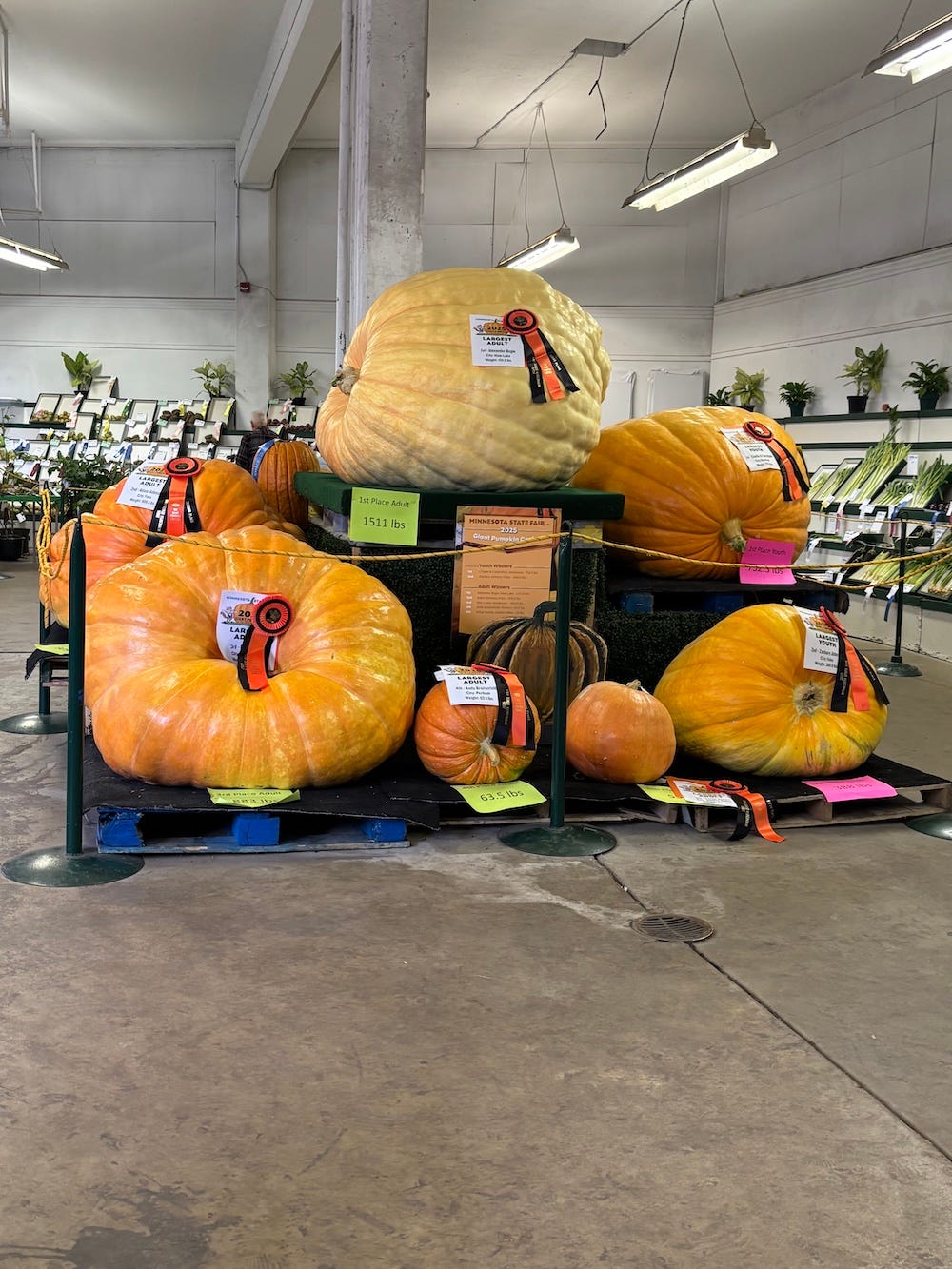
I sat down with Phil to learn how the competition actually works, and more to the point, how you might win. If you’ve ever walked through the Ag-Hort building and wondered whether your tomatoes could hang with those, this one is for you. For those who haven’t visited you might notice this part of the building feels like you are in a barn, minus a dirt or hay floor. Everything in the room is set up around that big pumpkin display.
If you didn’t grow up here, it’s hard to explain what the State Fair means to a Minnesotan. It’s a pilgrimage. Twelve days at the end of every summer when what feels like the whole state files through the gates. See above photo. People who visit or drive in from elsewhere usually don’t understand the pull of it until they’ve stood in the crowd themselves. It’s called the Great Minnesota Get-Together for a reason.
Here’s something else to think about when you consider putting your prized vegetable specimen on a judging table. Minnesota weather can give you a short season. Throw in blazing heat, hail that can flatten a yard in ten minutes or less, and like this spring too much rain and then not enough. Coaxing a first place specimen out of all that, exactly on the week the fair opens, is no easy accomplishment. That’s why a ribbon here carries bragging rights.
Phil hears this the most, and he wants it gone. You do not have to qualify anywhere first. The State Fair is an open competition. Anybody can enter.
In fact, he says most serious growers skip the county level entirely, because county fairs land too early in the season. Think about when your tomatoes and peppers actually come ripe. Late summer. Early fall. That’s exactly when the State Fair happens and your garden peaks right on cue.
Growing one perfect tomato might seem easy. Growing twelve that are all ripe and perfect looking on the same day for the fair? That’s the real test. That’s what the judge looks for.
Every class stipulates exactly how many specimens you bring. It might be 6. It might be 12. It might be 25, depending on the category. So the rule book is not optional reading. Phil says the books used to be printed, but printing got expensive, so everything lives online now. You’ll find the rules under Competition, then the Ag-Hort building, then the Vegetable and Potato division.
Registration is open now, and it closes Aug.13.
Phil says most growers judge their own entries on looks alone, and that’s where they go wrong. This is what the judges weigh:
Is it true to its class? A Roma tomato entered as a Roma; a round entered as round. Do all your specimens match each other in size and shape? (Heirlooms get some grace here, since their lumpy shape is considered part of their charm.) Are they free from defects? And how is their maturity? Consistency is what wins. Uniformity in a set of veggies beats a single showstopper sitting next to five that don’t belong.
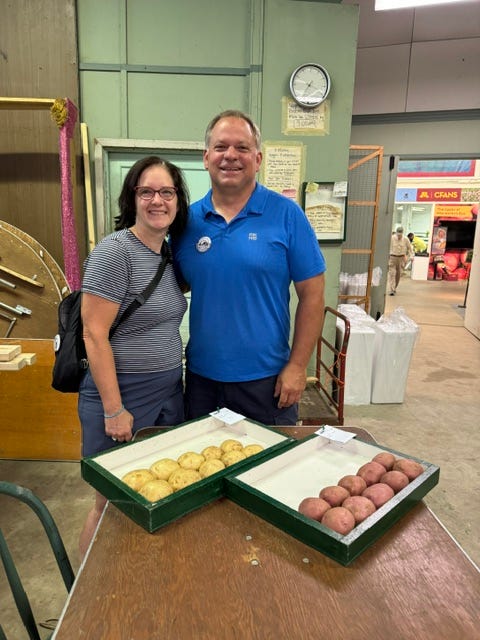
You may remember Joe and Pam Axberg from June. Those blue-ribbon potatoes are what a matched set looks like.
One detail that surprised me and should reassure any nervous first-timer: out of every 100 people who register, only about 40 actually show up with produce. That’s not abnormal. Phil says that’s what he sees. You register in spring for everything you hope to grow, then Mother Nature decides who makes it. Over-registering is normal. Nobody expects you to bring it all.
And Mother Nature really does run the show. Phil says the biggest villain is hail, which can shred a season’s fruit, leaves and blooms overnight.
Diana Note: I know one Dahlia grower, a fair regular, who runs out and opens patio umbrellas over his blooms every time a hail threat blows through.
Other weather curve balls come too: Heat at the wrong time, rain at the wrong time, humidity that invites mildew. As he puts it, Mother Nature controls everything that comes into that judging room.
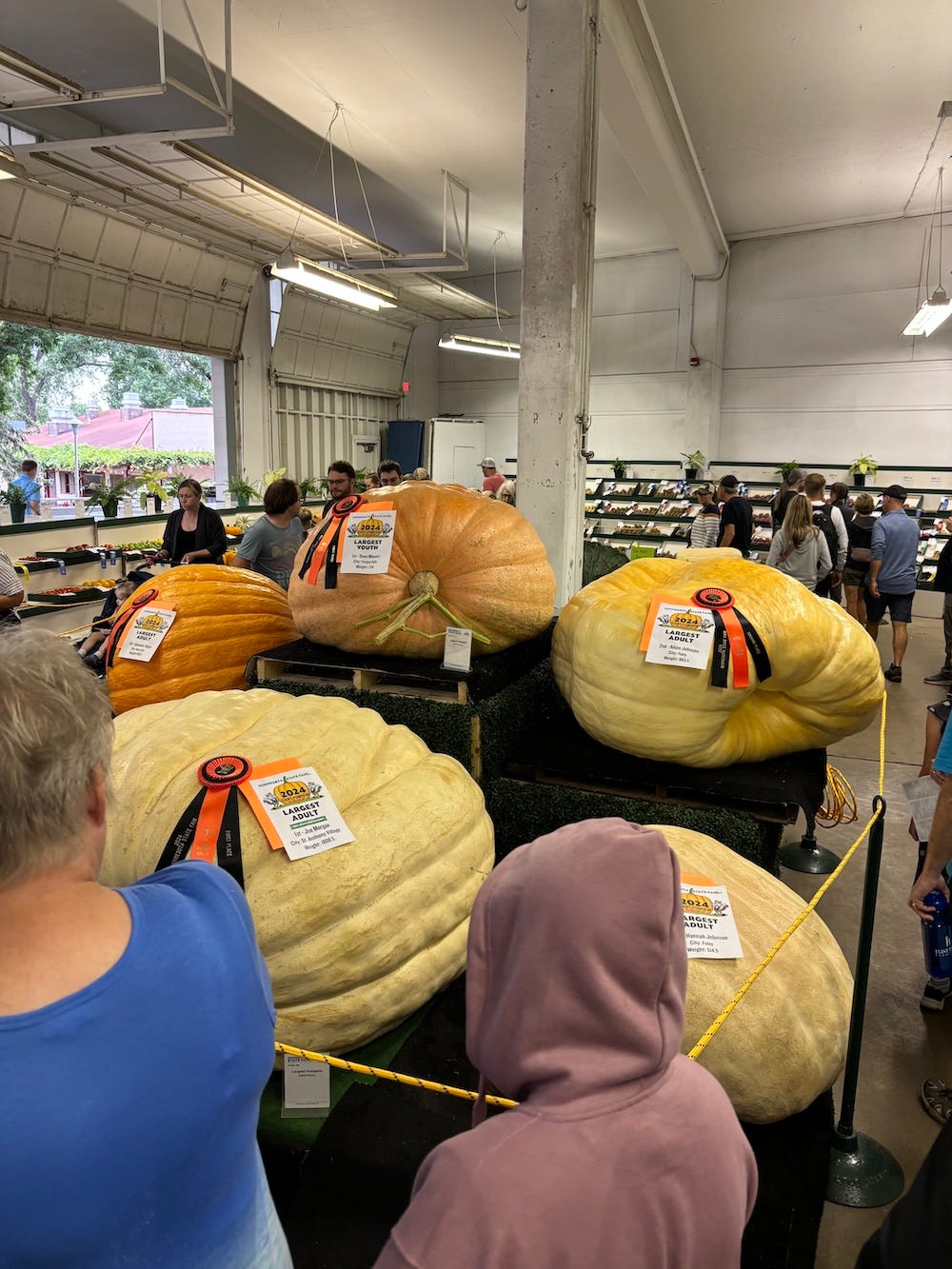
Giant pumpkins are judged on one thing only: weight. Heaviest wins. Having stood in line to see them plenty of times, trust me, it’s not a beauty contest. They come in on the Wednesday before the fair for a forklift-and-sling weigh-in, and Phil says if you want a good time, come watch.
The current fair record is a stunner. In 2024, Joe Morgan of St. Anthony brought in a pumpkin that weighed 1,808.5 pounds, breaking the old fair record of 1,676.5 set in 2022. These things can gain 20 to 40 pounds in a single day at their peak. It is, in Phil’s words, a real art.
Most of us assume the superintendent rolls in a few days before the gates open. Not close. Planning for the 2026 competition began before the 2025 fair had even ended. On the Saturday of Labor Day weekend, Phil meets with the exhibitors still hanging around, and they talk through what worked, what needs fixing, what should be added, and what has run out of interest. Those notes become the following year’s rules, which he then sits down and rewrites with the competition division come spring. The rules for 2027 will be hashed out on the Saturday before Labor Day this year.
Which means the competition is shaped by the people who compete in it. If you enter this year and find something you’d change, there’s a room where that gets discussed.
After all those years, I asked Phil what still pulls him back to that building every summer. I expected something about a perfect specimen, a record broken, the thrill of the competition.
He said the people.
His crew is family, some by blood and some just by years. His kids work the room. His granddaughter now too.

The Monday before the fair he takes them all out for beer and wings, and again on Labor Day when it’s over, and he picks up the tab. “It’s like a family reunion that lasts for two weeks every year.”
He paused, then added:
“The produce are just secondary.”
Registration is open now and closes Thursday, Aug. 13, at 4:30 p.m. You’ll need to create an account first at users.mnstatefair.org, so give yourself a few extra minutes. The fair runs Aug. 27 through Labor Day, Sept. 7.
If entering has ever crossed your mind, this is your year and this is your window.
As a former TV news broadcaster, part of my job was to be at the fair, reporting live from the fairgrounds. I’ve walked past more prize tomatoes and giant pumpkins than I can count. And yet, like every other Minnesotan, I feel the pull of our Great Get-Together every year, and I still can’t wait for it.
See you at the fair.
Diana
#bloomwithme
Comments
Nothing yet. Say the first thing.
Sign in to join the conversation.